Government publishes report on Mid-term Update of Manpower Projection
The Labour and Welfare Bureau (LWB) today (September 22) published the report on the Mid-term Update of Manpower Projection. The report indicates that the overall manpower shortage in Hong Kong has been alleviated, benefiting from the various talent admission and labour importation measures implemented by the Government over the past three years. The overall manpower shortage is projected to narrow from the previous projection of approximately 180 000 to some 130 000 by 2028, while the manpower situation across most key industries remains tight, particularly for innovation and technology, aviation, construction, city operation and healthcare services.
Click to Gallery
The Labour and Welfare Bureau, Photo source: reference image
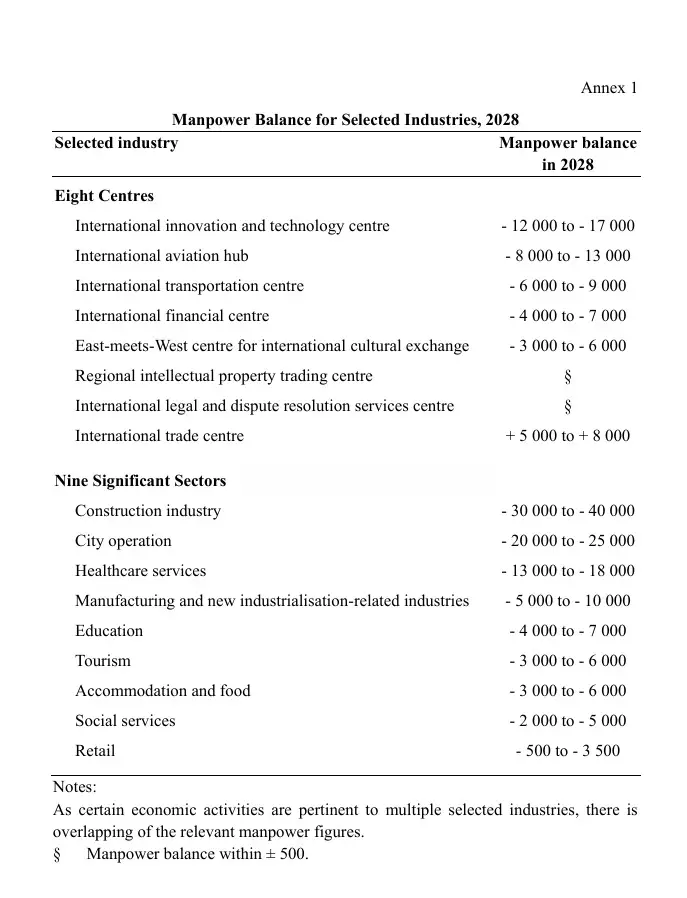
Photo source: HKSAR Government Press Releases
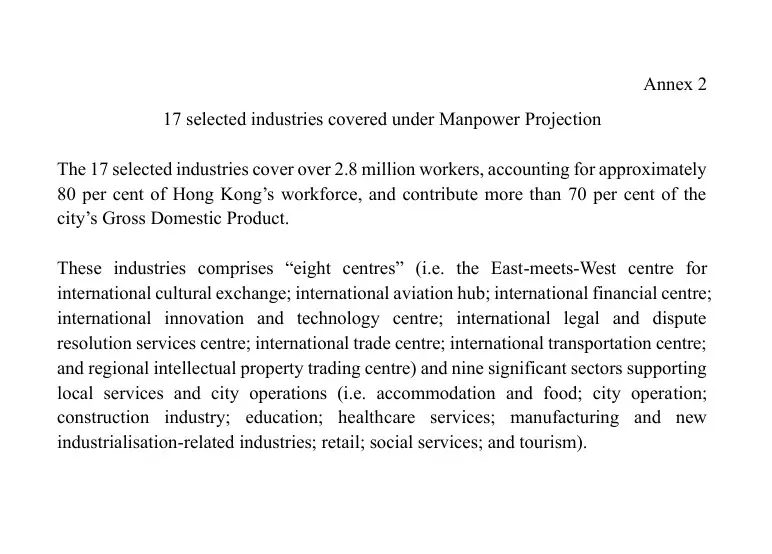
Photo source: HKSAR Government Press Releases
Photo source: reference image
Photo source: reference image
The Labour and Welfare Bureau, Photo source: reference image
The Secretary for Labour and Welfare, Mr Chris Sun, said, "This mid-term update reflects that talent admission and labour importation policies have effectively stabilised the labour force and alleviated the overall manpower shortage. However, manpower demand in certain industries remains acute. In response to the job reshaping driven by artificial intelligence (AI), the Government will continue to collaborate with all parties to formulate targeted measures. In addition to strengthening retraining mechanisms and providing flexible skill-conversion programmes for elderly and middle-aged employees, we will enhance the employment support for young graduates and explore incentives for employers and employees to engage in on-the-job retraining. The Government will adopt a multipronged approach to assist workers at all levels in equipping themselves to step into the new era of AI."
Manpower shortage alleviated, manpower in key industries remains tight
Looking to 2028, the overall manpower shortage is projected to narrow from approximately 180 000 in the previous projection to some 130 000. Economic restructuring and AI adoption have moderated the growth in manpower demand, alongside the admission of talent and workers effectively supplementing part of the labour force. Nevertheless, the manpower situation across most key industries (particularly for innovation and technology, aviation, construction, city operation, and healthcare services) remains tight. The projected manpower situation across selected industries by 2028 is at Annex 1.
Photo source: HKSAR Government Press Releases
Photo source: HKSAR Government Press Releases
In terms of occupation group, the manpower shortage over the next three years is projected to be concentrated in "skilled technical workers" and "services and sales workers", accounting for about 60per cent of the overall shortage. While these roles, which rely on interpersonal interaction and complex craftsmanship, are harder for AI to replace, manpower shortage persists due to workforce ageing, coupled with difficulties in attracting youth entrants. In contrast, as companies expand AI adoption for routine administrative tasks, "clerical support workers" are projected to record a manpower surplus of approximately 25,000 to 30,000 by 2028.
External workforce alleviating the impact of population ageing
Hong Kong's overall labour force (excluding foreign domestic helpers) recorded a slight decrease from 3.50 million in 2023 to 3.47 million in 2025. Driven by structural factors such as the ageing of the population, the local labour force registered a notable decline even after factoring in the entry of One-way Permit holders and fresh graduates into the labour market. Nevertheless, various talent admission and labour importation measures introduced during the same period have provided timely replenishment to effectively offset part of this decline. Without this external workforce, the overall labour force in 2025 would be estimated at only 3.35 million.
Looking ahead to 2028, driven by the continuing trend of population ageing, the overall labour force is projected to decrease gradually to approximately 3.40 million even after accounting for various sources of new entrants. In the absence of the supplementary impact from various admission measures, the labour force will drop further to around 3.21 million, with the overall manpower shortage widening significantly to about 300,000.
Photo source: reference image
Proactively addressing AI-driven job reshaping and transformation
The report further analyses the profound impact of AI on the labour market. Research indicates that adoption of AI in applicable roles will boost individual productivity by 20per cent to 30per cent. Companies are currently managing the transition through natural attrition and the risk of large-scale layoffs in the short term remains relatively low. However, approximately 20per cent to 30per cent of positions, primarily clerical roles, will face restructuring. This wave of AI will primarily affect two major groups. First, the displacement of entry-level positions has reduced the number of job vacancies suitable for fresh graduates sharply by approximately 60 per cent compared to 2022. Second, approximately 70 000 middle-aged clerical support workers aged 45 to 54 without post-secondary education are facing transition pressure. At the same time, the demand for emerging AI experts continues to grow, particularly for "composite talent" who possess both AI application skills and sector-specific knowledge.
In the face of this technological wave, the labour force must actively up-skill and transform. Proficiency in "human-machine collaboration" will become a basic competency, while soft skills that AI cannot replace, such as interpersonal communication, critical thinking, and problem-solving, will remain the core of competitiveness. The Government will continue to promote "AI for All" and support lifelong learning, ensuring that the skills of the labour force remain aligned with Hong Kong's future economy.
The Government has been conducting periodic manpower projection exercises to assess future manpower supply and requirement trends at a macro level. The previous round of projection was published in 2024, which examined Hong Kong's overall manpower trends at that time and provided a detailed analysis of the manpower situation in 17 selected industries (Annex 2) for 2023 and 2028. In view of the rapid adoption of AI and the swiftly changing economic environment, the LWB commenced the mid-term update of manpower projection in 2025 to stay abreast of market dynamics and respond promptly with policy measures.
The Mid-term Update of Manpower Projection report has been uploaded to the website of the LWB (www.lwb.gov.hk/en/highlights/manpower_projection/index.html).
Photo source: reference image