At Duke Kunshan University, a Sino-American joint venture in east China, different perspectives meet and creativity follows, as the campus serves as a bridge for people-to-people exchanges between Chinese and U.S. youth.
Located in Kunshan City of east China's Jiangsu Province, the institution now hosts students from 75 countries and faculty members from about 40.
John A. Quelch, executive vice chancellor of Duke Kunshan University, said although the university was jointly operated by China and the U.S., it also opens its doors to youth from all around the world.
"We are Sino-American joint venture university based in China, but we are for the world. The creativity really bubbles up when there are people with different perspectives coming together and sharing ideas on how to solve a particular problem," said Quelch.
A champion of liberal arts education, the university encourages students and faculty alike to look beyond a single discipline, letting different fields of knowledge meet and collide in dialogue.
"I think that field work is so extremely important. Whether students are doing research projects, or they are just part of a class. They need to go out and see what's happening in the world," said Kenneth S. Rogerson, professor of the practice at Duke University's Sanford School of Public Policy.
In November 2023, China put forward a major initiative to invite 50,000 American young people to China for exchange and study over the next five years.
Duke Kunshan is part of that effort in action, each year, it brings some 70 students from Duke University's home campus in the United States to China.
"As a China-U.S. joint-venture university, beyond our essential function of cultivating talent, I think it's also very important to serve as a key window for China-U.S. cultural exchange," said Liu Yaolin, chancellor of Duke Kunshan University.
The "50,000 in five years" initiative has already met its target two and a half years ahead of schedule, but the exchange between Chinese and American youth is far from over.
"Sharing what we love, understanding different perspectives, is really what I really hope to share and learn," said Caleb Leonard, a student at Duke Kunshan University.

Sino-American university campus bridges youth exchanges between China, U.S.
Global economic growth is projected to stand at 2.9 percent in 2026 and 3.0 percent in 2027, according to the Economic Outlook Interim Report released by the Organization for Economic Cooperation and Development (OECD) on Wednesday.
Growth in the advanced G20 economies, as well as in the G20 emerging-market economies, is projected to remain broadly stable, the report said.
The report also forecasted inflation levels for the two years, predicting that some major economies will see price rises that outstrip global growth levels. G20 headline inflation is expected to rise from 3.4 percent in 2025 to 4.1 percent in 2026, before easing to 3.6 percent in 2027.
In the advanced G20 economies, headline inflation is projected to rise from 2.5 percent in 2025 to 3.2 percent in 2026, before falling to 2.6 percent in 2027, while in emerging-market G20 economies it is expected to increase from 4.1 percent to 4.8 percent before easing to 4.3 percent.
The OECD noted that the projections are based on a technical assumption that Brent crude prices and TTF gas prices will peak in the fourth quarter of 2026 and then decline steadily through the end of 2027.
The assumed Brent crude price path is broadly consistent with the "short disruption" scenario in the OECD's June 2026 Economic Outlook, while the assumed gas price path is about 60 percent higher.
Persistent uncertainty over the evolution of the conflict in the Middle East remains a key risk to the baseline projections, the OECD warned, adding that constraints on exports through the Strait of Hormuz, additional disruptions to alternative export routes such as the Bab al-Mandeb Strait, or further significant damage to energy production facilities in the region could prompt a further sustained rise in energy prices and potentially lead to shortages of key commodities, particularly in net importing countries.
Low European gas reserves and uncertain scope for sustained further reductions in oil inventories in some countries could exacerbate supply disruption risks.
Further monetary policy rate adjustments may be needed, the OECD said, noting that faced with renewed energy price shocks, stronger-than-expected demand pressures, and above-target inflation in many economies, central banks need to ensure that underlying inflation pressures are durably contained.
The OECD also called for further structural policy reforms to help economies cope with future supply shocks, including diversifying energy supply, improving energy efficiency, enhancing product and labor market adjustment, and ensuring workers have adaptable skills.
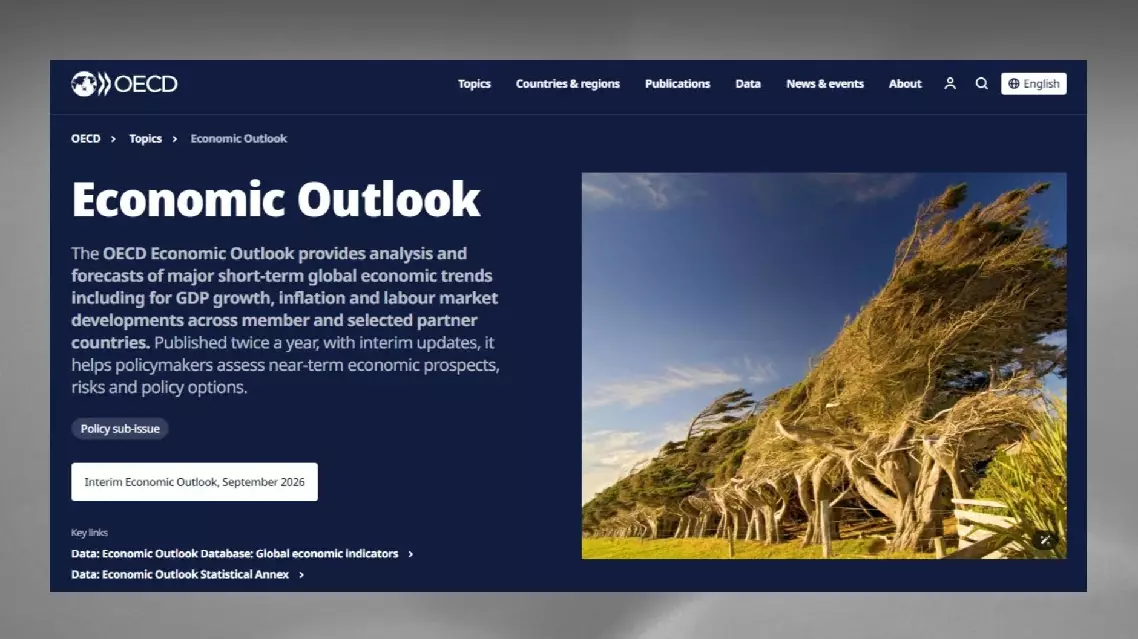
Global economic growth projected at 2.9 pct in 2026: OECD