SINGAPORE, Sept. 24, 2026 /PRNewswire/ -- Light Origins this week launched Light-O1, its first general-purpose embodied foundation model, as part of its work to build foundation models for Physical AI. Light-O1 learns a reusable human action prior from structured human actions recovered from internet videos, then adapts that prior to different robot embodiments and tasks. In scaling experiments, larger pretraining budgets consistently reduced post-adaptation prediction errors on egocentric human data and held-out data from two humanoid platforms.
Starting from the same 4B base model, Light Origins trained independent models at six pretraining budgets ranging from 3.75 billion to 120 billion multimodal tokens, with the largest corresponding to approximately 100,000 hours of human action. The pretrained models were then separately adapted to public egocentric human data, public Unitree G1 robot data, and Light Origins' in-house LightBot loco-manipulation data. Across all three target domains, held-out next-action-token prediction loss and whole-body pose prediction error declined as pretraining scale increased, with both trends following power-law fits.
For the reported robot results, Light-O1 is adapted with target-domain data. The scaling result shows that larger-scale human-action pretraining provides a stronger starting point for downstream adaptation.
Scaling Action Knowledge Beyond Dedicated Robot Data Collection
Robot interaction data is valuable because it directly reflects a specific machine's observations and actions. But collecting it at scale requires hardware, operators, environments and dedicated data pipelines, making it difficult to capture the diversity and long tail of everyday physical activity.
Light Origins takes a complementary approach. It recovers structured 3D human actions from existing internet video, aligns those actions with visual observations and language, and trains an autoregressive model on the resulting multimodal sequences. The goal is to learn a reusable human action prior from recurring patterns of physical behavior, then adapt that prior to target robots and tasks.
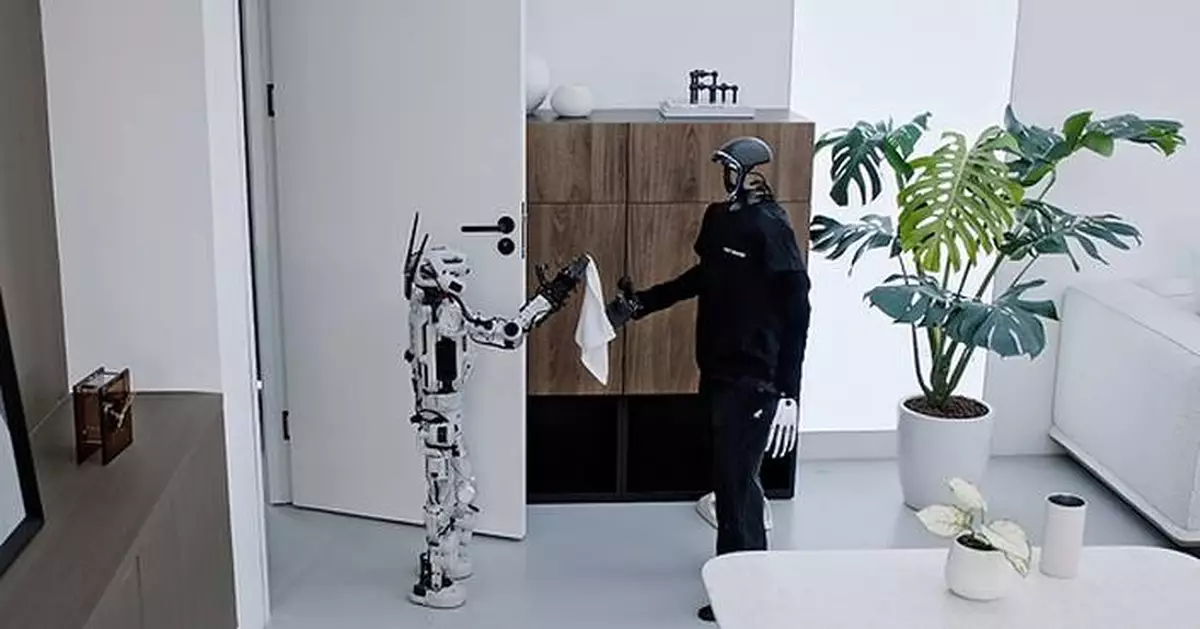
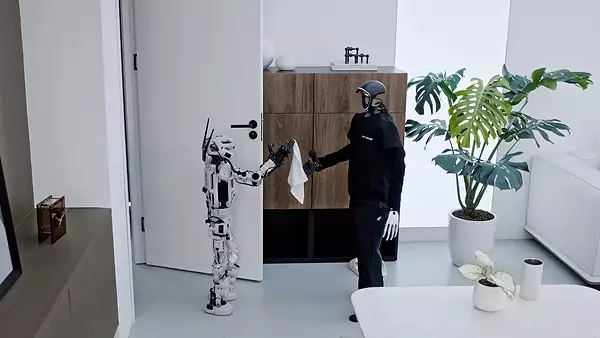
Light-O1 combines language reasoning and visual-spatial understanding with coordinated whole-body action. In real-world demonstrations, LightBot performs multi-step household tasks including opening a shoe cabinet and putting slippers inside, picking up different types of trash even when items are moved mid-task, and handing over a towel. On Unitree G1, the model wipes a table and receives the towel handoff within the same demonstration.
These demonstrations are separate from the transfer-scaling analysis, which uses held-out prediction metrics — including open-loop whole-body pose evaluation — rather than a scaling curve of real-robot task success.
Light Origins is also releasing Light-O1-Preview, a reasoning text-to-action model that takes a natural-language instruction, describes in language what the instruction requires of the body, and then generates the corresponding whole-body action sequence. Model weights, code and a public playground are available as part of the Light-O1 release.
From Pretraining to Deployment: Three Scaling Paradigms Toward Physical AGI
Light Origins' roadmap toward Physical AGI is organized around three scaling paradigms: Scalable Pre-Training, Scalable Alignment and Scalable Deployment. Light-O1 represents the company's work in Scalable Pre-Training, using large-scale human-action pretraining to build a transferable action prior before adapting it to specific robots and tasks.
Earlier this month, Light Origins introduced LightNav-0 as its first step toward Scalable Alignment. Its Real2Sim2Real data engine turns more than 2,000 internet-sourced real-world scenes into reusable simulated worlds, yielding more than 4,000 hours of navigation experience for post-training. The resulting model generalizes zero-shot across humanoid, quadruped, aerial and wheeled robots.
For Scalable Deployment, Light REACT uses recent physical interactions as context to infer the effects of external forces, hardware impairments and environmental constraints, then responds with adaptive whole-body skills.
Together, the three paradigms are intended to connect pretraining, alignment and real-world deployment in a shared learning loop.
Light Origins is also building the data and compute infrastructure to pursue that roadmap at larger scale. Its data infrastructure now operates at the thousand-GPU scale, with weekly video-processing throughput reaching approximately 200,000 hours — up from 12,500 hours six months earlier.
"For Physical AI, the key question is whether there is a pretraining signal whose value continues to grow with scale," said Roger Jiang, founder and CEO of Light Origins. "Light-O1 provides evidence that human action pretraining can serve as such a signal: as pretraining scale increases, post-adaptation prediction error decreases across different robot embodiments. We will continue scaling data and model capacity, then build alignment and real-world deployment on that foundation to make physical intelligence more generalizable and reliable."
Light Origins closed a Pre-A round of several hundred million yuan in August 2026 to support large-scale model training, multimodal data infrastructure, and full-stack software and hardware R&D.
About Light Origins
Light Origins builds foundation models for Physical AI, extending foundation model intelligence from the digital world into the physical world. Founded in late 2024 by Roger Jiang, a former OpenAI researcher and core contributor to ChatGPT, the company is advancing toward Physical AGI through three scaling paradigms: Scalable Pre-Training, Scalable Alignment, and Scalable Deployment. Models, compute, data, hardware, and deployment all feed the same learning loop.
CONTACT:
Light Origins PR team
pr@lightorigins.com
** This press release is distributed by PR Newswire through automated distribution system, for which the client assumes full responsibility. **
Light Origins Launches Light-O1: Cross-Embodiment Transfer Improves as Human-Action Pretraining Scales