Skip to Content Facebook Feature Image

Venezuela's acting leader, at UN for first address, promises elections at the 'right moment'

News

Venezuela's acting leader, at UN for first address, promises elections at the 'right moment'
News

News

Venezuela's acting leader, at UN for first address, promises elections at the 'right moment'

2026-09-24 08:35 Last Updated At:08:40

Venezuela’s acting president, delivering her first address to the U.N. General Assembly since coming to power, promised elections Wednesday and said the nation’s people will determine the “right moment.”

“I wish to state this very clearly before this General Assembly: Elections will be held in Venezuela,” Delcy Rodriguez said, adding that her government has started a “political dialogue with opposition sectors” to secure a “process based on equal conditions for all.”

Rodríguez said the Venezuelan people will determine the best time to get elections moving and assured the United Nations that, when the time comes, the country’s institutions “will be prepared to guarantee an inclusive and transparent process.”

Rodríguez took over in Venezuela after a surprise U.S. military raid in January that captured then-leader Nicolás Maduro and brought him to the United States to face drug trafficking charges.

This is the first trip to the United States by a Venezuelan head of state since 2018, when Maduro traveled to New York to participate in the U.N. General Assembly himself. He is currently being held only a few miles from the organization’s headquarters as he awaits trial.

Rodríguez’s participation in the international forum also marks a milestone in Venezuela’s reintegration into global diplomacy. Addressing global leaders, she said that “the last time that two presidents of Venezuela and the United States met was in 2009.”

She added that her country is coming back strong after “setbacks” suffered this year and thanked President Donald Trump for being willing to resume relations after the U.S. military spirited her predecessor out of the country.

The other setback to which she referred: On June 24, two powerful earthquakes, magnitudes 7.2 and 7.5, struck north-central Venezuela and killed more than 6,500 people, leaving an untold number of missing and causing widespread devastation.

“I come to talk about a Venezuela whose national life has been affected by a crisis of political coexistence that disrupted the life of the nation and our interaction with the world," Rodriguez she said. “Interests alien to the common good of Venezuelans were imposed.”

Rodriguez faced a delicate balance in her speech, which needed to be addressed to both her people and the U.S. government that holds her predecessor. She thanked Trump for his willingness to resume the course of diplomatic relations and cooperation with Venezuela.

“We are working earnestly to resolve existing differences through dialogue, but above all to pave the way for cooperation in the energy sector, the promotion of security, the joint fight against transnational crime, and economic cooperation for the benefit of both peoples and our continent," she said. “Today, Venezuela is being reborn.”

Since rising to power, Rodríguez has forged a close working relationship with Trump. U.S. influence in Venezuela has grown following the lifting of sanctions against Rodríguez in April, one of several recent moves by Washington to recognize her as a legitimate authority ever since the U.S. military captured her predecessor.

Addressing some words to her people, Rodríguez said that she could not promise an “easy path,” noting that “the country’s recovery will take time.”

“Rebuilding the national soul will be our priority," she said. “We will walk united as a single nation that, after the pain, chose hope.”

Before her speech at the U.N. Wednesday night, Trump and Rodríguez, who had been Maduro’s vice president, met at a pull-aside meeting late Tuesday during a reception the U.S. president hosted at a New York hotel.

It was the first time the two had met in person since the operation that captured the nation’s former leader and effectively put Rodríguez in charge.

“We discussed strengthening the bilateral relationship between our countries and advancing a cooperation agenda in strategic areas such as energy, mining, security, and other matters of mutual interest,” Rodríguez said on X after the encounter.

The meeting came after the two countries announced an agreement last month to give the United States a stake in Venezuela’s vast oil reserves. She described the deal as a step toward economic recovery that will modernize the country’s oil industry.

Rodríguez vowed to shoulder the “historic responsibility” of leading Venezuela “from a period of uncertainty and conflict toward a stage of full democracy, recognized by its own people and by the world.”

“Venezuela wants to breathe freely and exercise its rights as a sovereign nation without any kind of interference,” she said.
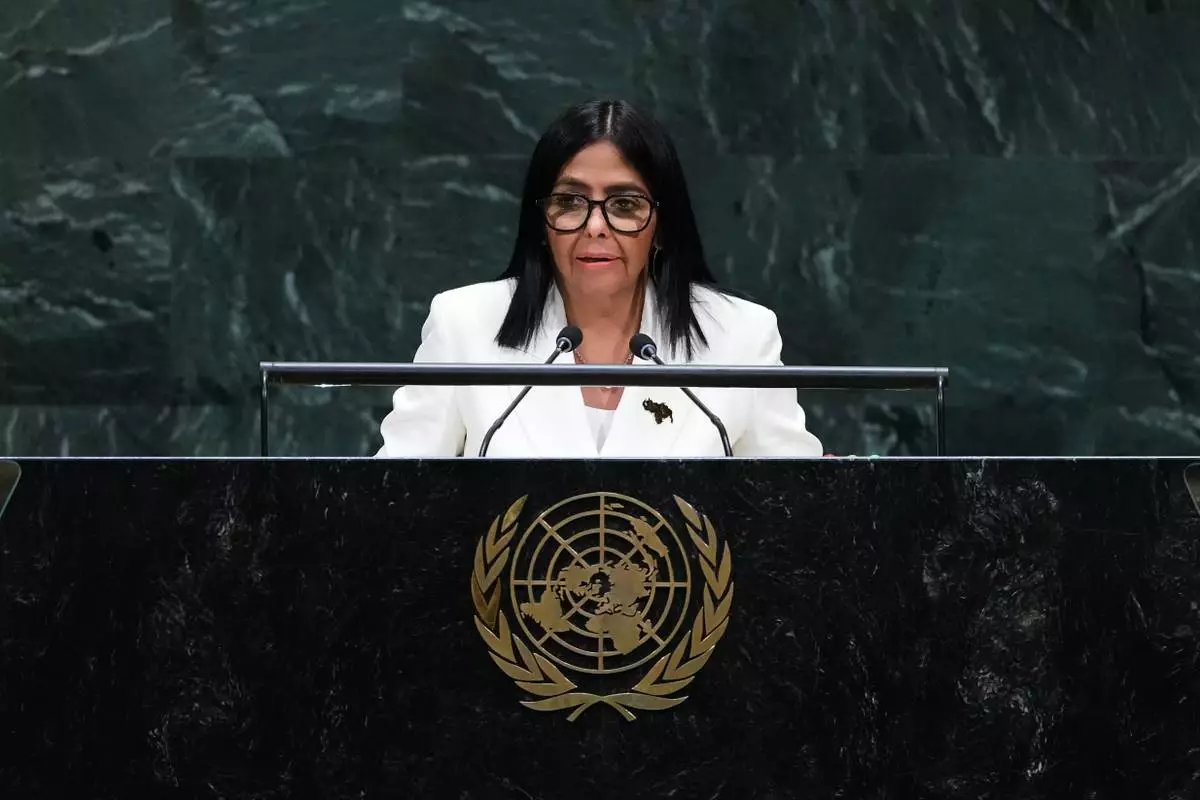
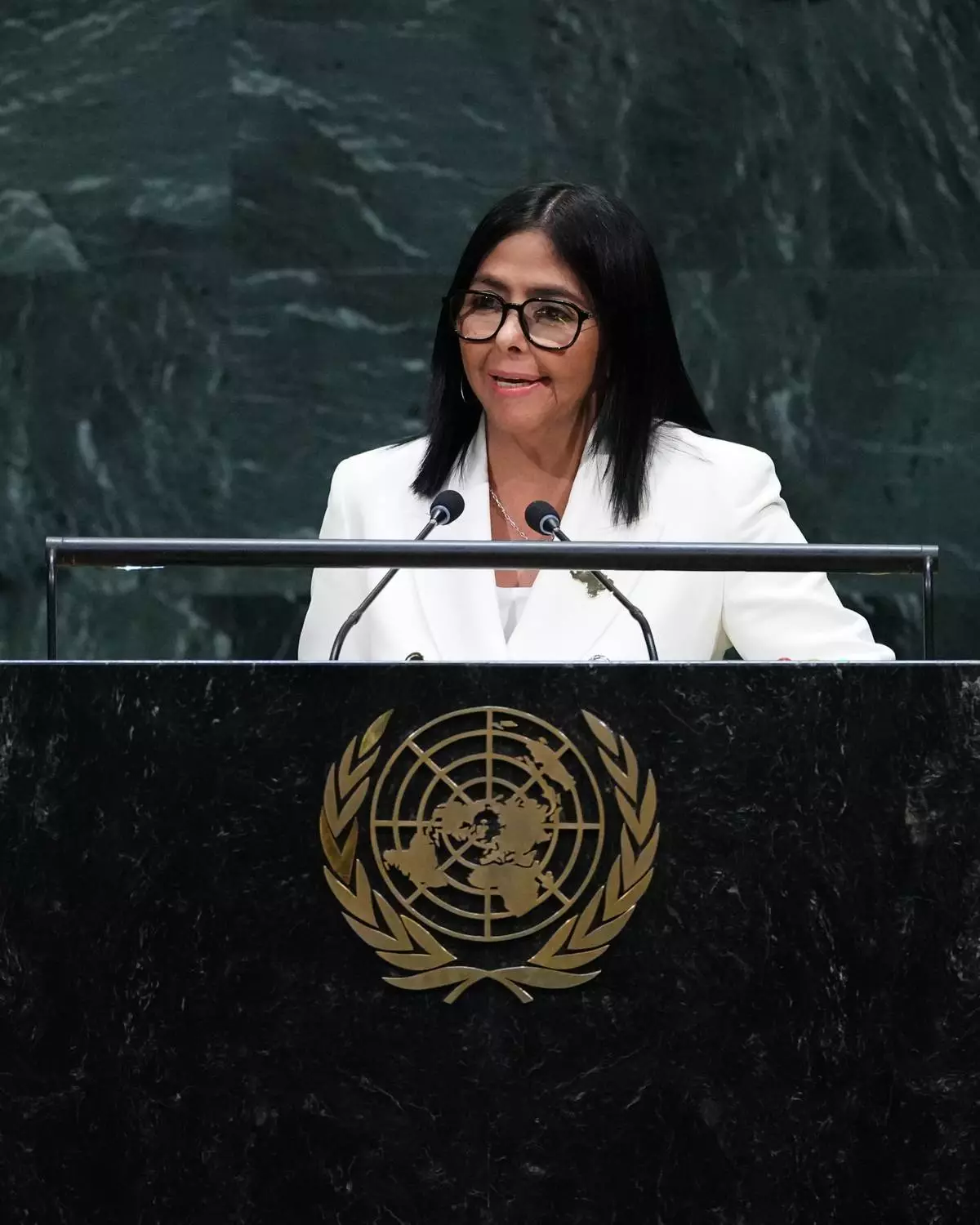
Delcy Rodríguez, acting president of Venezuela, addresses the 81st session of the United Nations General Assembly at U.N. headquarters Wednesday, Sept. 23, 2026. (AP Photo/Frank Franklin II)
Delcy Rodríguez, acting president of Venezuela, addresses the 81st session of the United Nations General Assembly at U.N. headquarters Wednesday, Sept. 23, 2026. (AP Photo/Frank Franklin II)
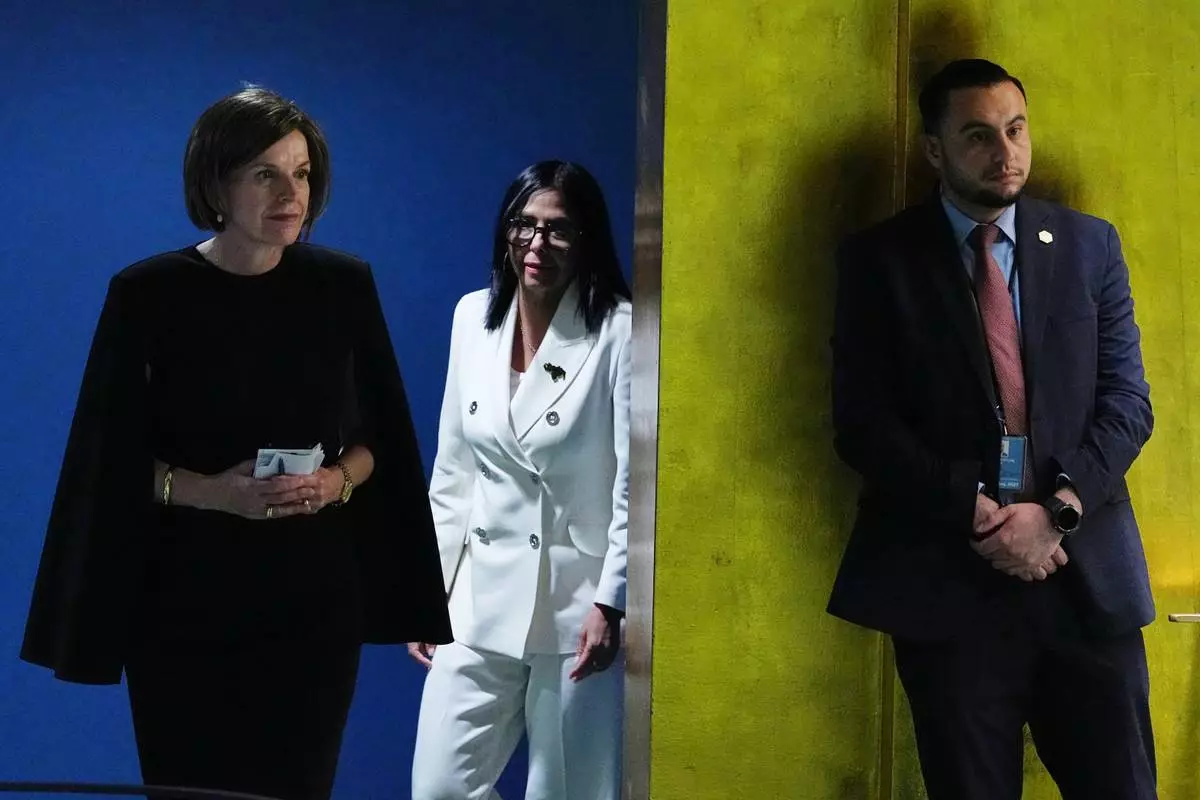
Delcy Rodríguez, acting president of Venezuela, is escorted to the podium to address the 81st session of the United Nations General Assembly at U.N. headquarters Wednesday, Sept. 23, 2026. (AP Photo/Frank Franklin II)

Delcy Rodríguez, acting president of Venezuela, is escorted to the podium to address the 81st session of the United Nations General Assembly at U.N. headquarters Wednesday, Sept. 23, 2026. (AP Photo/Frank Franklin II)
Delcy Rodríguez, acting president of Venezuela, addresses the 81st session of the United Nations General Assembly at U.N. headquarters Wednesday, Sept. 23, 2026. (AP Photo/Frank Franklin II)
Delcy Rodríguez, acting president of Venezuela, addresses the 81st session of the United Nations General Assembly at U.N. headquarters Wednesday, Sept. 23, 2026. (AP Photo/Frank Franklin II)
MEXICO CITY (AP) — Southwestern Mexico braced for heavy rain and mudslides Wednesday after Polo, a powerful Pacific cyclone, became a major hurricane. Forecasters also warned another system headed for Hawaii could cause catastrophic flooding later in the week.

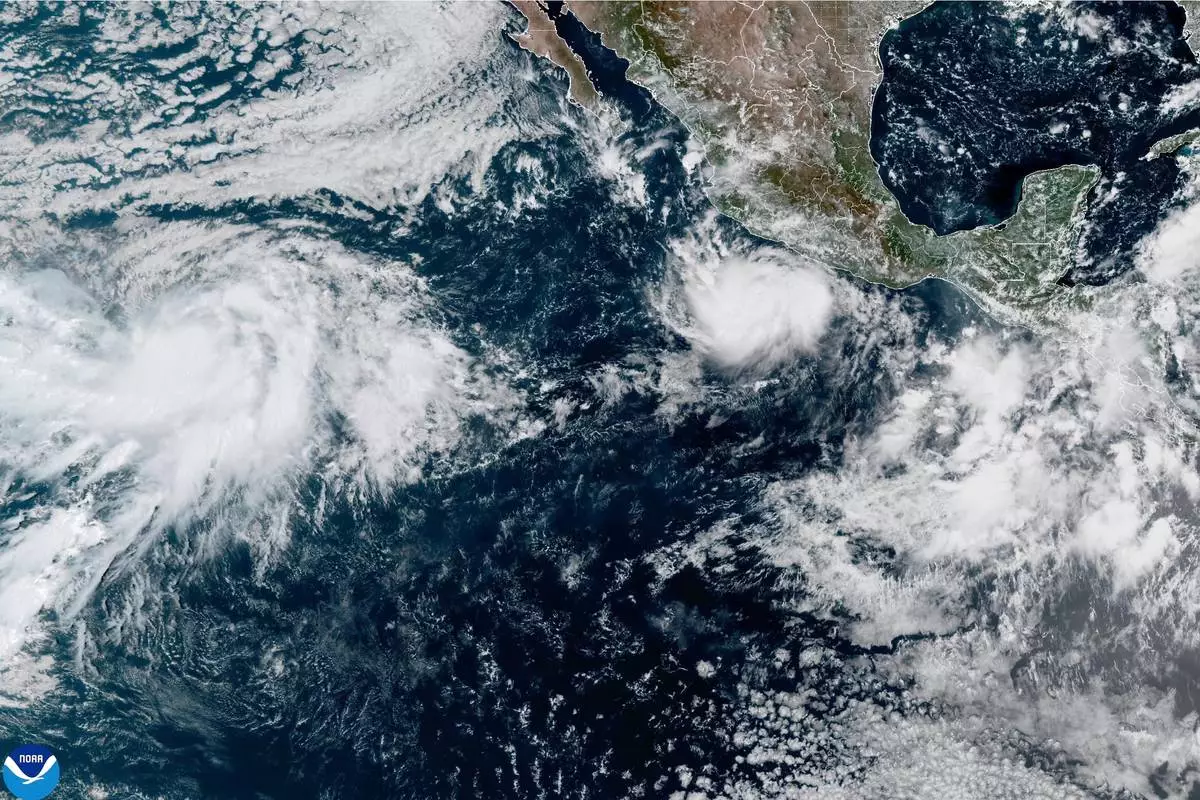
Hurricane Polo, an “extremely dangerous” storm, is expected to skirt Mexico’s Guerrero state, submerging coastal areas with 4 to 6 inches (10 to 15 centimeters) of rain through Thursday, according to the National Hurricane Center in Miami. Guerrero has been repeatedly pummeled by hurricanes in recent years.

Farther out in the Pacific, Tropical Storm Nolo was churning about 305 miles (491 kilometers) south of South Point, Hawaii. The storm is expected to approach the Big Island as early as Friday and could drop up to 20 inches (51 centimeters) of rain, raising the possibility of flooding and mudslides.

Concepción López Villegas was busily bolstering her seaside restaurant in Lázaro Cárdenas, Michoacán, against the expected onslaught of rain. Strong waves were already hitting some beaches and López Villegas said she feared the storm could destroy the small business she worked decades to build.

“We’re worried and trying to protect our businesses,” López Villegas said. “And of course, we’re sad because it’s our heritage, our legacy that from one moment to another could be destroyed.”

Guerrero state was particularly at risk of life-threatening flooding and mudslides, the hurricane center said.

Polo, which was swirling about 145 miles (233 kilometers) south-southwest of Zihuatanejo Wednesday, was not expected to make landfall, meteorologists and Mexican President Claudia Sheinbaum said. Rain and strong winds had already started to pummel the coast, with waves crashing onto the normally pristine beaches.

The hurricane center warned that Polo’s deluge could cause life-threatening flooding and mudslides, in particular in Guerrero.

The region most under threat from the hurricane is rural and mountainous, scattered with a few small tourist towns and ports. Much of the area is marked by poverty and residents routinely complain authorities abandon them to fend for themselves during natural disasters.

Mexico’s government has called for evacuations in some areas and set up shelters for those affected. Thousands of military and Red Cross personnel have been deployed to the region as a preventive measure.

The National Weather Service said Tropical Storm Nolo would likely strengthen before closing in on the Big Island on Friday or Saturday.

The storm has the potential to be a major hurricane, John Bravender, a weather service warning coordination meteorologist, said during a news conference Wednesday afternoon.

While high winds are expected, Bravender said the main concern is the possibility of flash flooding. He said 20 to 30 inches (50 to 76 centimeters) of rain could fall through Saturday on southeastern parts of the Big Island, the same region hit hard in August by Hurricane Lala.

“That by itself could cause catastrophic flooding, but when you put that on top of grounds that we’ve been raining off and on for the last couple of months … that rain could cause even more damage," Bravender said.

He urged preparation across all Hawaii islands in case the storm’s trajectory shifts.

“You need to take action now,” said Bravender. “Today is really the last dry day you have to get ready.”

Hawaii County Mayor Kimo Alameda told residents in a video message on social media that they should start preparing now for the storm. He urged people to put together an emergency kit with food, water and medications, trim vegetation and clear drains.

Kauai’s electric cooperative urged residents to prepare for “the possibility of prolonged power outages,” and to store nonperishable food and potable water.

Over 100 Kauai households remain without power from Hurricane Lowell, which passed west of the island on Sept. 7.

Hawaiian Electric, the state’s primary utility, said crews would return to at-risk areas in preparation for the coming storm.

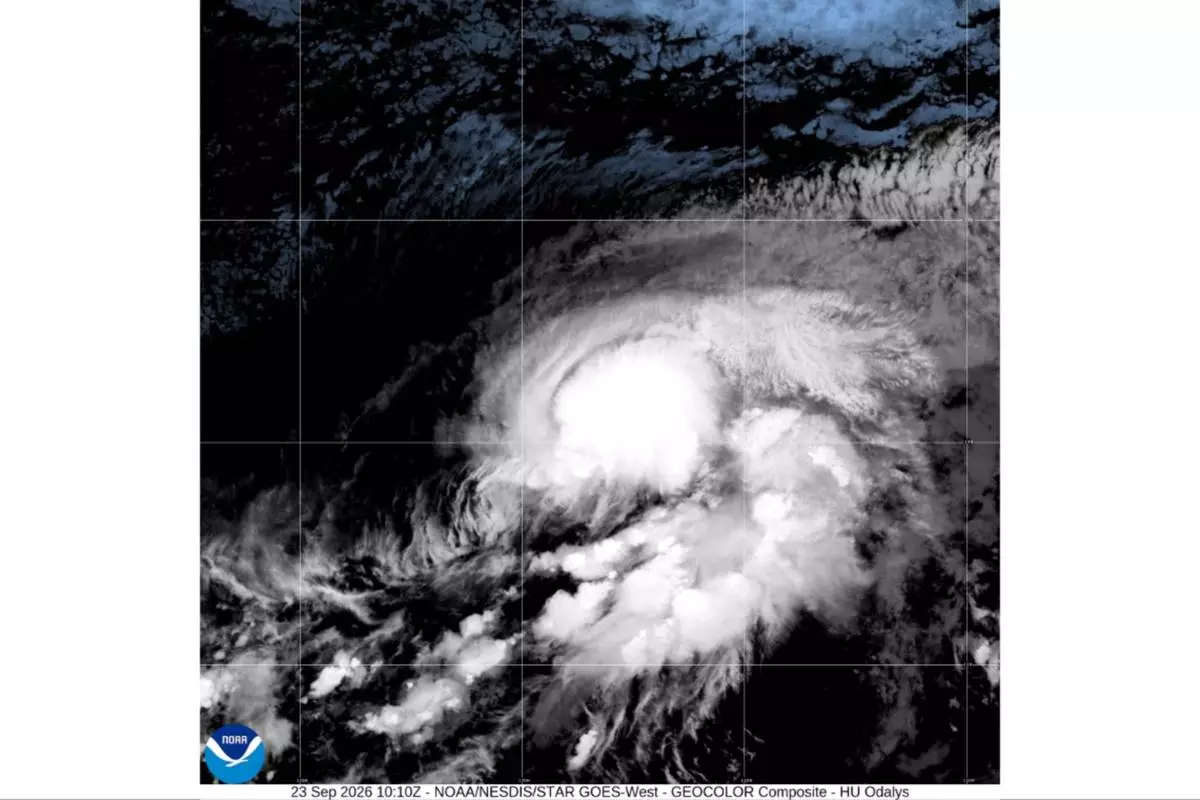
Hurricane Odalys, also in the Pacific, strengthened on Wednesday, carrying maximum sustained winds of 75 mph (120 kph). It churned about 1,265 miles (2,040 kilometers) west-southwest of the southern tip of Mexico’s Baja California peninsula and was not at risk of making landfall, according to the hurricane center.

An advisory said Odalys could increase in strength over the next couple of days but would likely weaken by the end of the week.

Aoun reported from San Diego. Associated Press reporter Desiree Brooks in Atlanta contributed.

This satellite image from the National Oceanic and Atmospheric Administration shows Hurricane Odalys in the Pacific Ocean, Wednesday, Sept. 23, 2026. (NOAA via AP)

This satellite image from the National Oceanic and Atmospheric Administration shows Hurricane Odalys in the Pacific Ocean, Wednesday, Sept. 23, 2026. (NOAA via AP)

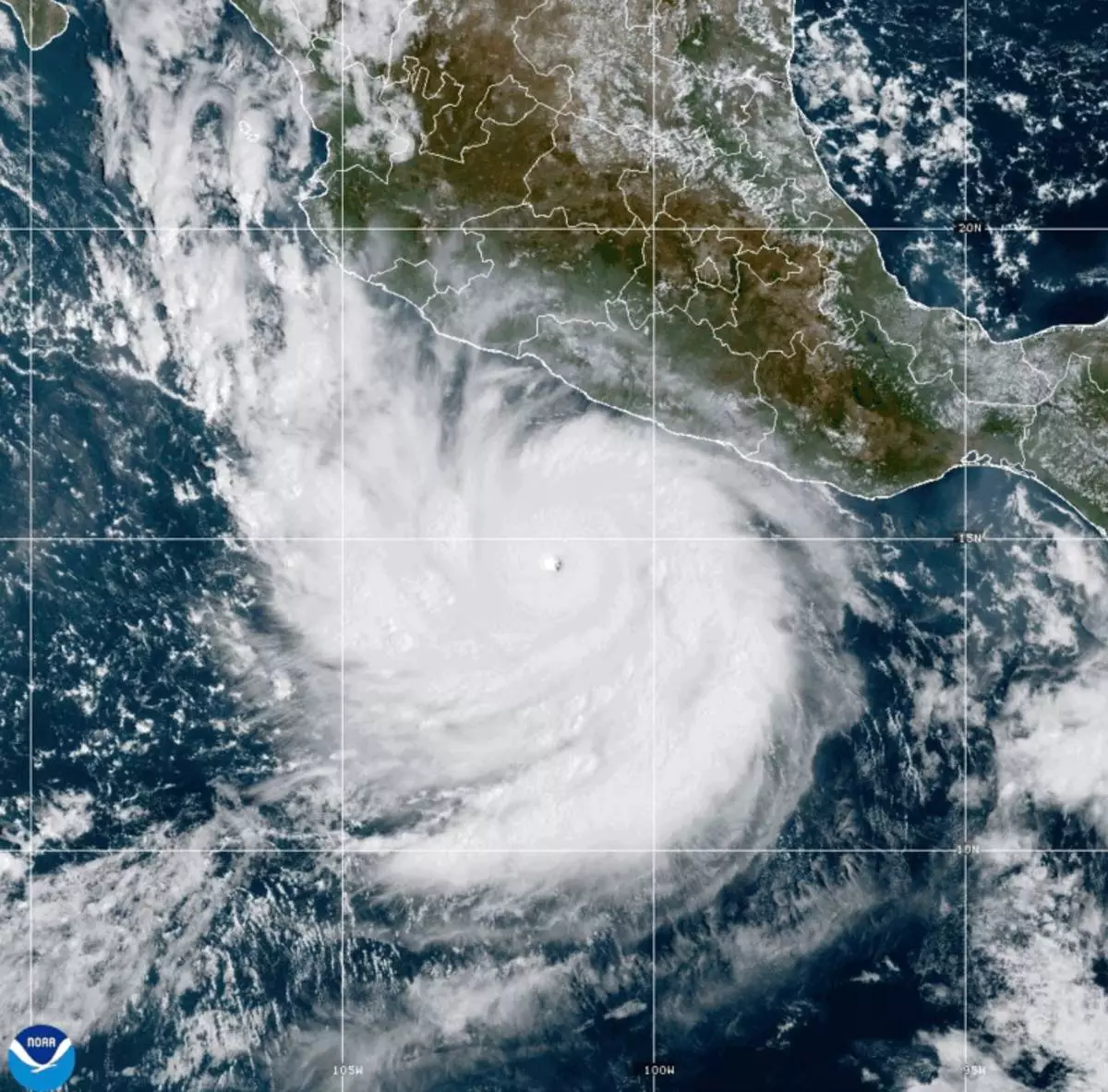
This photo provided by NOAA shows Hurricane Polo strengthening in the Pacific Ocean off the coast of Mexico on Tuesday, Sept. 22, 2026. (NOAA via AP)

This photo provided by NOAA shows Hurricane Polo strengthening in the Pacific Ocean off the coast of Mexico on Tuesday, Sept. 22, 2026. (NOAA via AP)

This photo provided by NOAA shows Hurricane Polo intensifying in the Pacific Ocean off the coast of Mexico on Monday, Sept. 21, 2026. (NOAA via AP)

This photo provided by NOAA shows Hurricane Polo intensifying in the Pacific Ocean off the coast of Mexico on Monday, Sept. 21, 2026. (NOAA via AP)

Recommended Articles