BEIJING, Sept. 24, 2026 /PRNewswire/ -- Meizhou Island, located in Putian City in southeast China's Fujian Province, is renowned as the hometown of the Chinese sea goddess Mazu.
In recent years, the island has been tapping its tourism resources and developing distinctive Mazu culture-themed tourism activities, offering visitors a wider range of experiences and giving them more reasons to stay longer on the island rather than leave after half-day temple visit.
Born as Lin Mo on the island in 960, Mazu is believed to be a legendary woman who was deified as a protector of seafarers. Mazu has more than 300 million followers worldwide. In 2009, "Mazu belief and customs" was inscribed on the UNESCO representative list of the intangible cultural heritage of humanity.
"In previous years, visitors mainly came to Meizhou Island to worship Mazu. Many would arrive in the morning and leave in the afternoon," said a staff member of the island's administrative committee. "Now, more visitors are treating the island as a vacation destination, with a notable increase in family travelers, self-driving tourists and young visitors."
Meizhou Island received about 3.23 million tourist visits in 2025, surpassing the 3-million mark for the first time. With the popularity of slow tourism, more visitors are no longer simply coming to "pay their respects" before leaving, but are choosing to stay for several days, taking leisurely walks, enjoying the sea views and embracing the relaxed pace of island life.
Popular experiences on the island include dressing in traditional attire and taking photos in front of distinctive local architecture. Visitors can also experience "a day in the life of Mazu" at her former residence in the Mazu Heritage Park, and visit the Mazu cultural museum, and the Ping'an Pagoda.
Moreover, large Mazu-themed live performances and fireworks after sunset can definitely light up visitors' night life on the island.
From "paying respects and leaving" to lingering for the scenery, and from a half-day trip to "living a day in Mazu's world," Meizhou Island is transforming the appeal of a single temple into the allure of an island where visitors want to stay.
Original link: https://en.imsilkroad.com/p/352337.html
** This press release is distributed by PR Newswire through automated distribution system, for which the client assumes full responsibility. **

Xinhua Silk Road: From temple visit to island getaway: Fujian's Meizhou Island expands tourism appeal
PHNOM PENH, Cambodia, Nov. 15, 2026 /PRNewswire/ -- Cambodia is taking its national digital payment system, Bakong, onto the global stage, unveiling initiatives spanning international card payments, stablecoin and bond tokenisation pilots with Japan, and a remittance corridor with Rwanda.
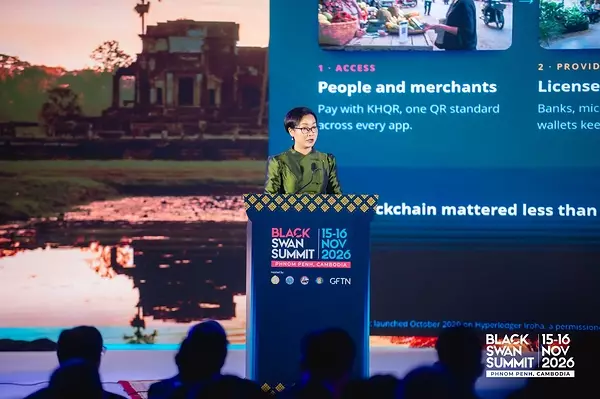
The announcements were made at the inaugural Black Swan Summit Cambodia, co-hosted by the National Bank of Cambodia (NBC) and the Singapore-headquartered Global Finance & Technology Network (GFTN), in collaboration with three Cambodian ministries: the Ministry of Post and Telecommunications, the Ministry of Commerce, and the Ministry of Industry, Science, Technology and Innovation.
Held alongside the Sommet de la Francophonie, the two-day summit has attracted over 5,000 registered participants from 60 countries, including policymakers, central bankers, investors and technology leaders, to advance financial connectivity between ASEAN, Africa and other international markets.
From National Payment System to Global Network
Cambodia has built a digital payments infrastructure that has transformed domestic financial access. It is now extending that infrastructure internationally through three initiatives:
Bakong to the World: Bakong users will be able to create Visa or Mastercard virtual cards through the app, enabling contactless payments overseas.
Japan–Cambodia stablecoin remittances: NBC and SBI Group will explore stablecoin-based cross-border transfers, with funds received through Bakong wallets.
Government bond tokenisation: NBC and SBI Bank will pilot the tokenisation of Cambodian government bonds on the Canton Network, exploring new approaches to trading and settlement.
Bakong has also contributed to the growing use of Cambodia's national currency. The riel's share of transactions on the platform increased from 17% in 2020 to 58% in 2025.
A Model for Emerging Economies
Cambodia's financial transformation is rooted in an extraordinary history. Following the destruction of its banking system and the abolition of its currency between 1975 and 1979, the riel was reintroduced on 20 March 1980.
Rather than replicate conventional financial infrastructure, Cambodia has built a digital-first payments ecosystem. Today, Bakong connects approximately 38 million accounts in a country of 17 million people. In 2025, it processed 1.3 billion transactions worth US$241.84 billion, equivalent to approximately 4.5 times Cambodia's GDP.
For emerging economies seeking to expand financial inclusion, strengthen domestic currencies and connect to global markets, Cambodia offers an example of how public digital infrastructure can accelerate financial development.
Bridging ASEAN and the Francophone World
The summit also marks a step towards connecting Southeast Asia with Francophone economies, particularly in Africa.
Two initiatives signal this ambition:
Cambodia–Rwanda remittance corridor: The National Bank of Cambodia and the National Bank of Rwanda are working to connect Bakong with Rwanda's RSwitch payment infrastructure, initially facilitating remittances from Cambodia to Rwanda.
Francophone Africa payment connectivity: H.E. Dr. Chea Serey, Governor of the National Bank of Cambodia, underscored the shared vision of exploring cross-border payment connectivity with Francophone African payment systems, with potential initial use cases focusing on remittances and small-value trade.
These initiatives advance South–South cooperation, demonstrating how emerging economies can collaborate directly on interoperable financial infrastructure without relying exclusively on traditional international payment networks.
The summit continues on 16 November, with discussions on economic corridors, payment interoperability, financial resilience and regulatory cooperation.
Leadership Perspectives
H.E. Dr. Chea Serey, Governor of the National Bank of Cambodia, said: "Cambodia knows what it means to lose a financial system and rebuild trust in money. Bakong has expanded access and the use of the riel. Now we are connecting it to the world. Sovereignty and openness are not opposites. Inclusion must be measured not just by whether people can pay, but by whether they can withstand shocks."
Sopnendu Mohanty, Group CEO, Global Finance & Technology Network (GFTN), said: "Cambodia shows that emerging economies can build financial infrastructure around their own needs rather than inherit systems designed elsewhere. The next challenge is connecting these platforms internationally. From African payment links to Japanese fintech pilots, Black Swan Summit Cambodia demonstrates how emerging markets can open new channels for trade, investment and financial inclusion."
For more information: www.cambodia.blackswansummit.com
** This press release is distributed by PR Newswire through automated distribution system, for which the client assumes full responsibility. **
Cambodia Takes Bakong Global, Connecting ASEAN with Japan and Africa