ANKARA, Turkey (AP) — Turkey has agreed to gradually withdraw forces from a strategic military base in northern Iraq and hand over its control to the Iraqi government, following a meeting between the two countries’ leaders on the sidelines of the U.N. General Assembly in New York.
Iraq, meanwhile, pledged to remove armed groups that Turkey considers security threats from the region of Sinjar, in northwestern Iraq, according to a joint statement issued after the meeting late Wednesday between Turkish President Recep Tayyip Erdogan and Iraqi Prime Minister Ali al-Zaidi.
“In light of the progress Iraq has achieved through security measures, Turkish forces will gradually hand over the Bashiqa-Zelikan camp to the Iraqi federal government, in accordance with the agreed-upon mechanism and timeline,” according to the joint statement released by Erdogan and al-Zaidi’s offices.
Turkey and Iraq also agreed to “fully extend the authority of the Iraqi state in Sinjar and to end the presence of banned foreign armed elements,” the statement read.
The strategically-located Bashiqa base has long been an issue of contention between Turkey and Iraq, with Turkey failing to fully withdraw forces, despite previous discussions for their removal. Turkey established a military presence there in 2015 to support operations against the Islamic State group and help secure the region.
Although Turkey maintains several bases in northern Iraq for operations against the militant Kurdistan Workers’ Party, or PKK, the Bashiqa camp is Turkey's furthest base from its border.
Turkey, for its part, has long been pressing Iraq to curb groups with links to the PKK and other non-state armed groups from operating in Sinjar.
The Iraqi government announced earlier this month that the Sinjar Resistance Units, a Yazidi militia affiliated with the PKK, had agreed to disarm and eligible fighters would be integrated into the Iraqi security forces. The group played a significant role in the fight against IS, but was seen by Turkey as a threat because of its PKK affiliation.
The agreement came as the U.S. is ending its decades-long military presence in Iraq, with officials saying the hundreds of troops remaining in northern Iraq will be out by a Sept. 30 deadline.
Turkey, meanwhile, is engaged in peace efforts with the PKK aimed at ending a decades-long conflict. The group, whose fighters have launched attacks on Turkish targets from bases in northern Iraq, has agreed to disband and lay down arms as part of the effort.

Iraqi Prime Minister Ali al-Zaidi attends a press conference in Berlin, Germany, Tuesday, Sept. 15, 2026. (AP Photo/Markus Schreiber)

Turkey's President Recep Tayyip Erdogan listens during a meeting with President Donald Trump at a multilateral meeting with the Gulf Cooperation Council during the United Nations General Assembly, Tuesday, Sept. 22, 2026, at the UN headquarters. (AP Photo/Julia Demaree Nikhinson)
MEXICO CITY (AP) — Powerful Hurricane Polo sent bands of heavy rain across Mexico's Pacific coast early Thursday as a growing Tropical Storm Nolo approached Hawaii with the potential for catastrophic flooding.
Polo was forecast to maintain Category 5 strength as it skirts Mexico's coast over the next few days. Rain and strong winds had already started to pummel the coast, with waves crashing onto the normally pristine beaches.
While the eye and the strongest winds were expected to remain at sea, the heavy rains could cause life-threatening flooding and landslides, according to the U.S. National Hurricane Center in Miami.
Farther west in the Pacific, Tropical Storm Nolo was churning about 295 miles (475 kilometers) south of South Point, Hawaii. It was forecast to become a hurricane by Thursday night and was expected to approach the Big Island as early as Friday. A hurricane watch was issued for Hawaii County.
Gov. Josh Green's office said public schools and state and county offices on the Big Island will close Thursday and Friday, while Maui County will shutter them on Friday ahead of the threat of heavy rain, winds and flooding. Forecasters said the storm could drop up to 20 inches (51 centimeters) of rain.
Concepción López Villegas was busily bolstering her seaside restaurant in Lázaro Cárdenas, Michoacán state, against the expected onslaught of rain. Strong waves were already hitting some beaches and López Villegas said she feared the storm could destroy the small business she worked decades to build.
“We’re worried and trying to protect our businesses,” López Villegas said. “And of course, we’re sad because it’s our heritage, our legacy that from one moment to another could be destroyed.”
Guerrero state was particularly at risk of life-threatening flooding and mudslides, the hurricane center said.
Polo was swirling about 130 miles (209 kilometers) south-southwest of Zihuatanejo early Thursday and was moving northwest at 7 mph (11 kph). A turn west-northwest was forecast for later in the day, taking it further out to sea, before turning northwest Saturday.
The storm had maximum sustained winds of 160 mph (257 kph), and was expected to remain a major hurricane for the next few days. Hurricane-force winds extended up to 40 miles (65 km) from the eye and tropical-storm-force winds extended up to 115 miles (185 km).
The region most under threat from Polo is rural and mountainous, scattered with a few small tourist towns and ports. Much of the area is marked by poverty and residents routinely complain authorities abandon them to fend for themselves during natural disasters.
Mexico’s government has called for evacuations in some areas and set up shelters for those affected. Thousands of military and Red Cross personnel have been deployed to the region as a preventive measure.
The National Weather Service said Tropical Storm Nolo would likely strengthen before closing in on the Big Island on Friday or Saturday.
The storm has the potential to be a major hurricane, John Bravender, a weather service warning coordination meteorologist, said during a news conference Wednesday afternoon.
While high winds are expected, Bravender said the main concern is the possibility of flash flooding. He said 20 to 30 inches (50 to 76 centimeters) of rain could fall through Saturday on southeastern parts of the Big Island, the same region hit hard in August by Hurricane Lala.
“That by itself could cause catastrophic flooding, but when you put that on top of grounds that we’ve been raining off and on for the last couple of months … that rain could cause even more damage," Bravender said.
He urged preparation across all Hawaii islands in case the storm’s trajectory shifts.
“You need to take action now,” said Bravender. “Today is really the last dry day you have to get ready.”
Hawaii County Mayor Kimo Alameda told residents in a video message on social media that they should start preparing now for the storm. He urged people to put together an emergency kit with food, water and medications, trim vegetation and clear drains.
“This is a very serious situation," he said. "We do believe that the rain is going to come. It's coming already.”
The governor issued an emergency proclamation Tuesday and more than 230 Hawaii National Guard members have been activated, said Maj. Gen. Stephen Logan, adjutant general of the state’s Department of Defense.
Kauai’s electric cooperative urged residents to prepare for “the possibility of prolonged power outages,” and to store nonperishable food and potable water.
Over 100 Kauai households remain without power from Hurricane Lowell, which passed west of the island on Sept. 7.
Hawaiian Electric, the state’s primary utility, said crews would return to at-risk areas in preparation for the coming storm.
Tropical Storm Fay re-formed early Thursday in the northern Atlantic Ocean with maximum sustained winds near 40 mph (65 km/h), the U.S. hurricane center said. It was 935 miles (1,505 kilometers) west-southwest of the Azores, moving west-southwest at 9 mph (15 kph).
In the Pacific, Hurricane Odalys had winds of 85 mph (137 kph) and was centered about 1,200 miles (1,940 kilometers) west-southwest of the southern tip of Mexico’s Baja California peninsula.
Aoun reported from San Diego. Associated Press reporters Desiree Brooks in Atlanta and Hallie Golden in Seattle contributed to this report.
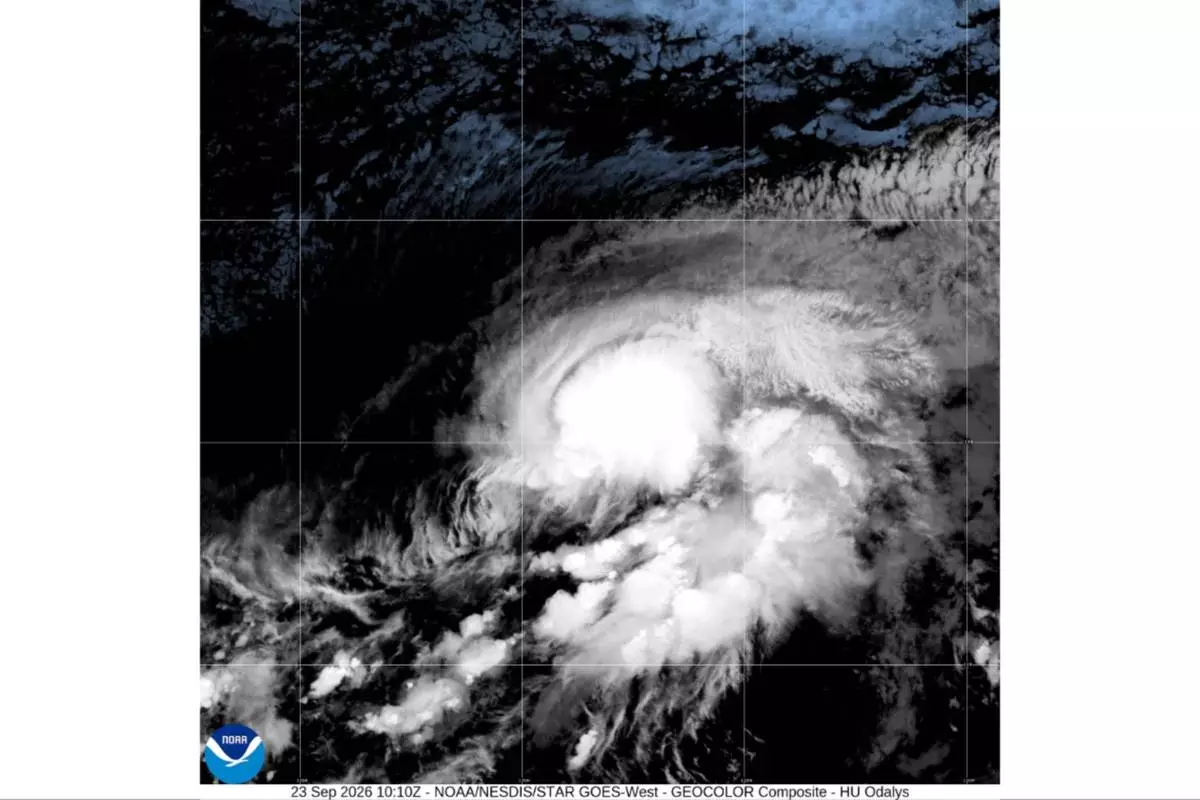
This satellite image from the National Oceanic and Atmospheric Administration shows Hurricane Odalys in the Pacific Ocean, Wednesday, Sept. 23, 2026. (NOAA via AP)
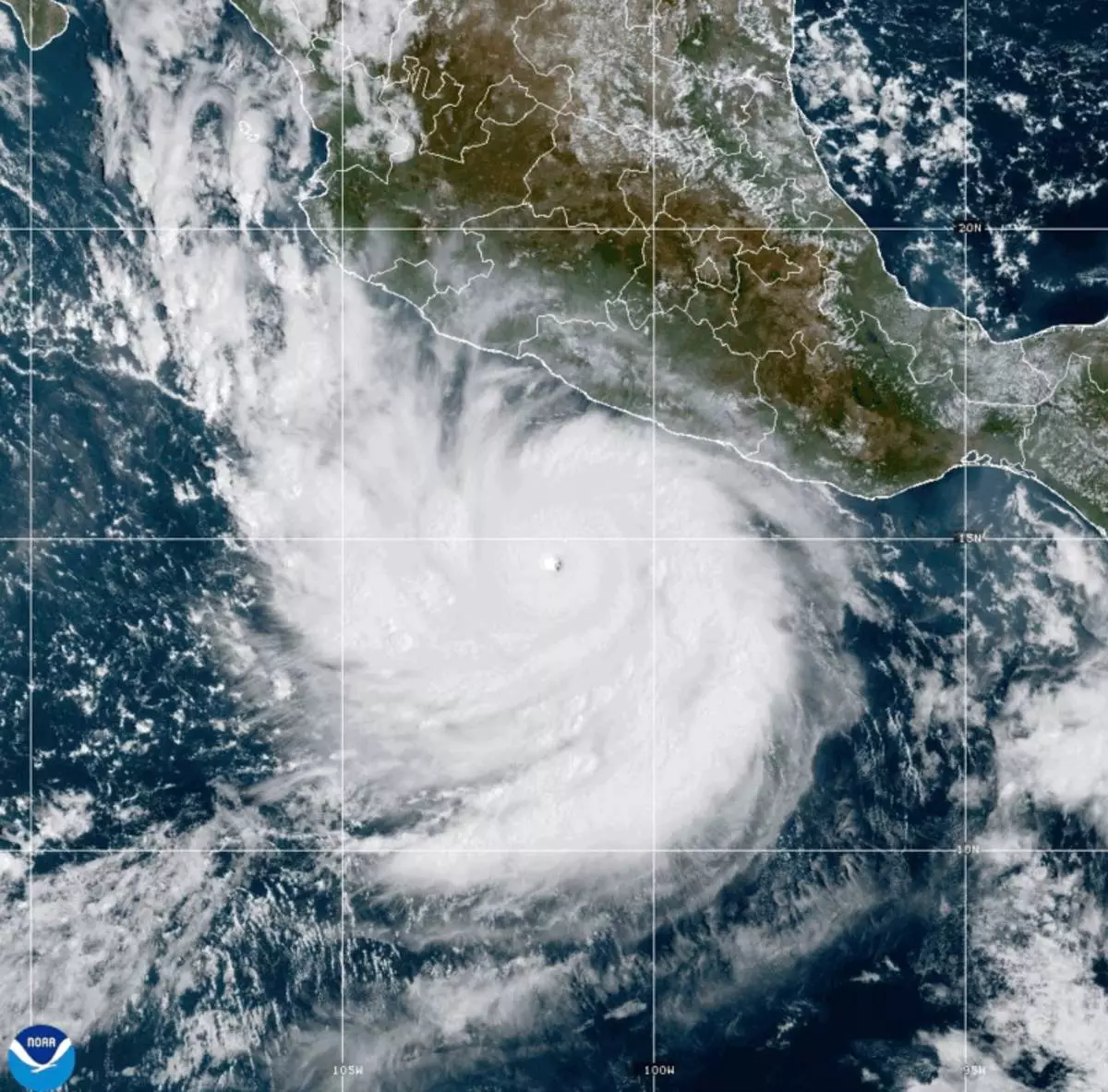
This photo provided by NOAA shows Hurricane Polo strengthening in the Pacific Ocean off the coast of Mexico on Tuesday, Sept. 22, 2026. (NOAA via AP)