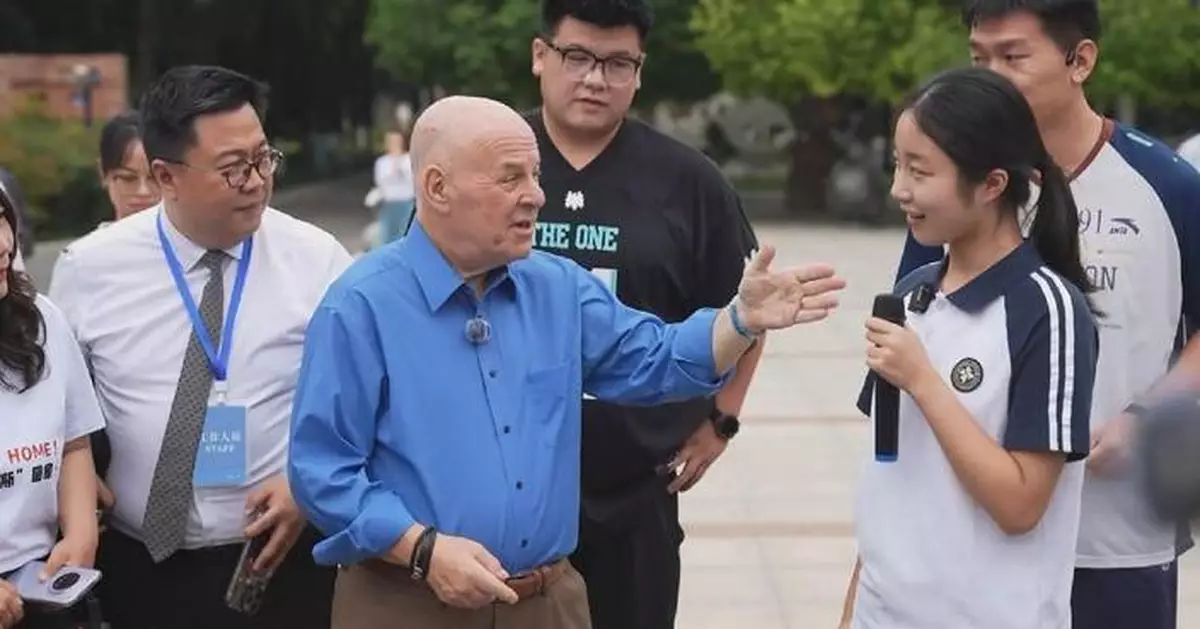
Decades after American educator Ronald Sakolsky first taught students and helped fight desertification in China, his story of cross-cultural connection took center stage at the White House.
Speaking at a welcome banquet hosted by U.S. President Donald Trump on Thursday, Chinese President Xi Jinping pointed to Sakolsky’s decades-long journey as proof that the foundation of China-U.S. relations lies with its people.
More than two decades ago, Sakolsky supported a Chinese woman, Yin Yuzhen, in planting trees to combat desertification. When he returned to China earlier this year, he found that the trees he planted had flourished, as had the friendships he forged with the students he taught.
For Sakolsky, teaching was never just a job. It was a lifelong commitment to memory, devotion, and bridging cultures across oceans.
"A good teacher consumes him or herself to light the way for others. The love of students and the giving to others comes from the heart. And the reward comes years later when they still call you coach, when they remember your quotes, when they tell you it was because of you they are the person they are today," he said.
Inside the classroom at Luoyang Foreign Language School, where Sakolsky used to teach, the years apart dissolved. They cracked inside jokes, laughing over old memories and the days when they’d run to the basketball court after class.
In those fleeting moments, middle-aged adults became kids again, gathered around the man who expanded their horizons.
"When I come back 27 years later, and I see all of you, I know that I have done my job. I planted the seed with each and every one of you, and you have grown into trees. Once you are my student, you are my child forever," said Sakolsky.
Sakolsky was not the only teacher who crossed the Pacific that year, or the years after. Since the late 1990s, hundreds of teachers have travelled eastward and westward, bearing a message no textbook could deliver.
"These teachers planted the seeds of hope for China-US friendship in the hearts of their students. As President Xi Jinping has said, the story of China-US relations is written by the people," said Shen Xuesong, Minister Counselor of Chinese embassy in United States.
These teachers planted a simple, tenacious hope that two cultures oceans apart could still, somehow, call each other family.
"The formal exchange may have ended but the connection certainly did not, and I think that is the real power of international education, because you never know where the impact of one relationship, one teacher, or one student might lead," said Chris Fray, a former U.S. exchange teacher who served the fall semester during 1998 to 1999.
"People like us who experienced both cultures can have deeper understanding and sometimes I will also explain and help the people around me to understand this kind of situation better," said Xue Jianru, a former Chinese exchange teacher.
That simple urge to reach out rather than pull back has expanded today.
In November 2023, China proposed inviting 50,000 young Americans to visit and study in the country over the next five years.
By May 2026, more than 50,000 students across the 50 U.S. states had arrived, reaching the goal two and a half years ahead of schedule.
"At a time when the global and domestic U.S. situation can seem very bleak, it is key to remember that people-to-people exchange is important and can, bit by bit, individual by individual, change the world around us," said Margot Landman, deputy vice president of programs of the National Committee on US-China Relations.
"America and China can work together if you want to. Start to listen to the other side. I'm not saying believe the other side, I'm saying listen to the other side. Then combine the two and make your own decisions," said Sakolsky.
In today’s digital age, Sakolsky’s story with China and its people has rippled far beyond offline encounters. Shared across social media, it gave millions of Americans another window into the warmth of ordinary Chinese people.
In 1999, Sakolsky helped plant trees in the desert, and nurtured young minds in the classroom. But little did he know that in every conversation and gesture, he was sowing a different kind of seed.
"My part in the story is very small. But the message is very big. If a Chinese woman living in the desert, can share a story with an American teacher from the suburbs of Pittsburgh, Pennsylvania, then the countries can share. And that's the message I will take back, that China is ready to rebuild the bridge. Is America ready? I believe so. Then let's start," said Sakolsky.
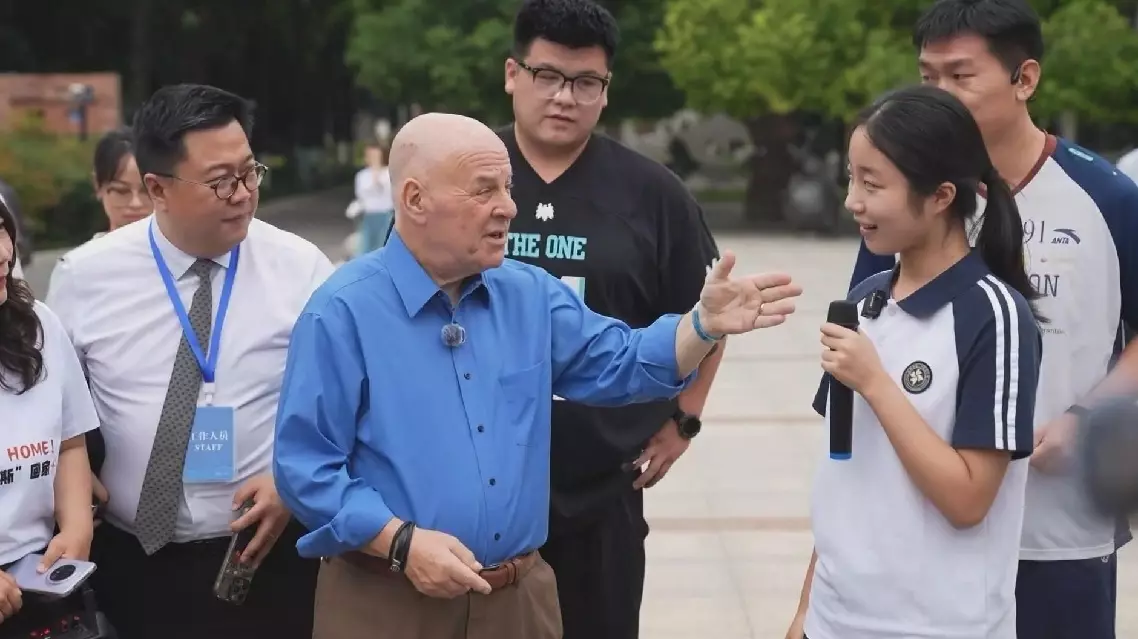
American educator Ronald Sakolsky reflects on decades of grassroots US-China ties