Skip to Content Facebook Feature Image

EBANX and NetEase Games Club bring local payment methods to Latin America’s booming video game market

Asia Pacific

EBANX and NetEase Games Club bring local payment methods to Latin America’s booming video game market
Asia Pacific

Asia Pacific

EBANX and NetEase Games Club bring local payment methods to Latin America’s booming video game market

2026-09-28 08:00 Last Updated At:08:02

Partnership unlocks card and local payment options for players in Brazil, Mexico, Argentina, Chile, and Peru as the region's gaming revenues outpace mature markets

SINGAPORE / GUANGZHOU, CHINA – Media OutReach Newswire – 28 September 2026 — Latin America is one of the fastest-growing video game markets in the world, yet millions of its players have long faced barriers to purchasing content because of how they pay. EBANX, a global technology company specializing in cross-border payments for emerging markets, and NetEase Games Club, the official top-up destination for NetEase Games titles, today announced a partnership to expand payment access for players across the region.
Local payment methods close Latin America's credit card gap

Local payment methods close Latin America's credit card gap

Through this collaboration, NetEase Games Club will, in its initial rollout, offer players across Brazil, Mexico, Argentina, Chile, and Peru access to the region's widely used local payment methods alongside credit and debit cards. Supported methods include Pix in Brazil, SPEI in Mexico, PagoEfectivo in Peru, and the digital wallet Mercado Pago across the region.

In Latin America, only one in four adults has a credit card, while more than half of the population aged 15 and older has already made a digital payment, according to World Bank data. For those without access to credit cards, this payment gap is increasingly being filled by local payment methods, including those now available to NetEase Games Club through EBANX.

Reaching players where cards don't

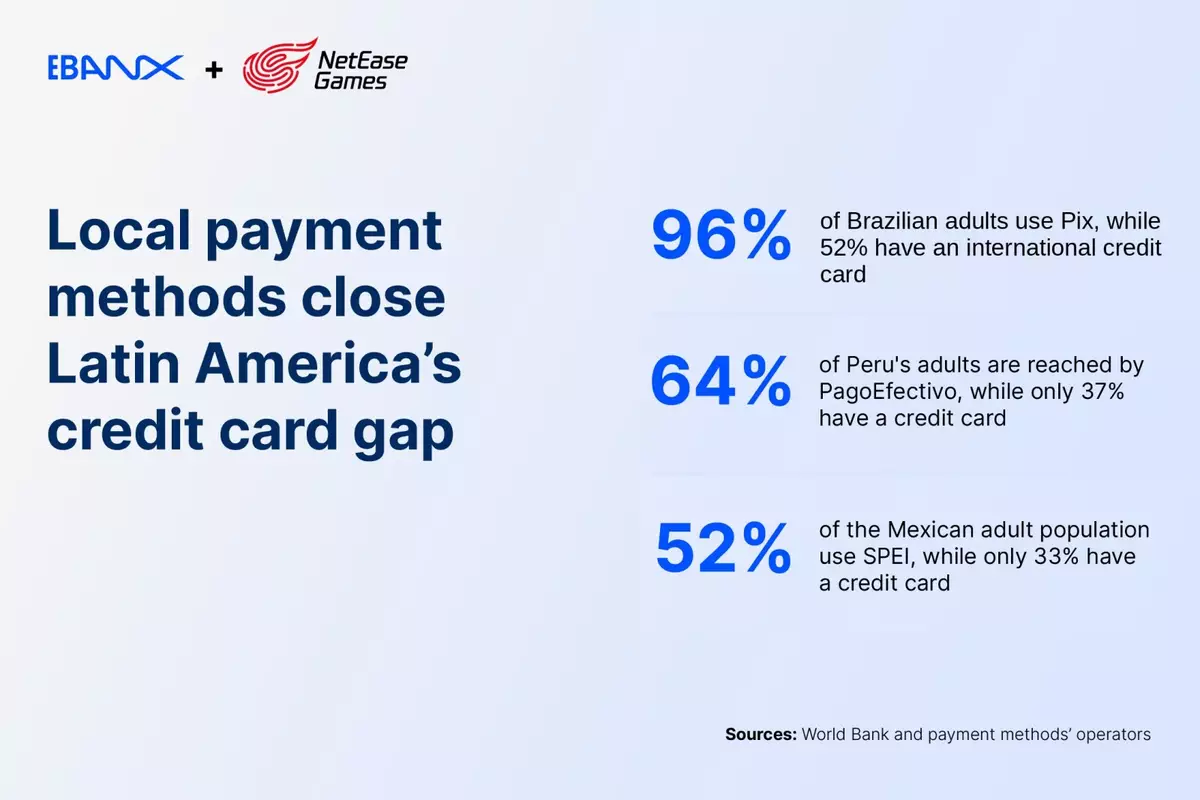
In Brazil, the instant payment system Pix is used by around 170 million people, equivalent to 96% of the adult population, while around 60 million Brazilians do not have a credit card. In Mexico, only 33% have access to one, in a country where more than half of adults use the account-to-account payment system SPEI. In Peru, 37% of adults have a credit card, yet the cash-based PagoEfectivo reaches 64% of the adult population.

The commercial impact of closing that gap is well established. For EBANX merchants, integrating Pix has driven revenue uplifts of up to 37% within six months. Adding SPEI in Mexico has produced increases of up to 46% within three months and PagoEfectivo in Peru up to 19% within one month.

"The next wave of video game growth is coming from emerging markets, and Latin America is leading it," said Sean Yu, VP of Commercial for APAC at EBANX. "By combining cards with the local payment methods players actually use, NetEase Games Club is building a truly localized checkout experience, and unlocking access to a much larger share of the region's revenue potential."

A market outpacing mature regions

The five markets covered by the partnership between NetEase Games Club and EBANX are expected to generate USD 8.4 billion in video game revenues in 2026, according to Payment and Commerce Market Intelligence (PCMI) data analyzed by EBANX. Brazil, the region's largest market, is projected to reach USD 3.8 billion this year.

The Latin American video game market grew 6.4% in 2025, according to Newzoo's latest report, outpacing North America (+4.2%) and Europe (+3.6%). The region is home to 372.3 million gamers, with 69% of its online population playing games on at least one platform.

The infrastructure connecting APAC to Latin America

The partnership reflects an accelerating movement of APAC companies expanding into Latin America, driven by market saturation at home and the search for new growth corridors. EBANX has operated at the center of this dynamic for years, with an APAC headquarters in Singapore, an office in Shanghai, and a track record serving global video game leaders across more than 20 markets in Latin America, Africa, and Asia.

The company recorded 48% growth in total payment volume (TPV) in 2025, a record in its history, with APAC merchants contributing to that expansion as they increased their presence in Latin American markets. EBANX holds a Major Payment Institution (MPI) licence in Singapore and provides Chinese and broader APAC companies a single, compliant entry point into those markets.

Hashtag: #EBANX #NetEase #Fintech #Payments #Gaming #LatinAmerica

The issuer is solely responsible for the content of this announcement.

ABOUT EBANX

EBANX is the leading technology platform connecting global businesses to the world's fastest-growing digital markets. Founded in 2012 in Brazil, EBANX was built with a mission to expand access to international digital commerce. Leveraging proprietary technology, deep market expertise, and robust infrastructure, the platform enables global businesses to offer hundreds of local payment methods and streamline cross-border payments across Latin America, Africa, and Asia. With a global footprint, it established a technology and regulatory headquarters in Singapore in 2026. More than just payments, EBANX drives growth, enhances sales, and delivers seamless purchase experiences for businesses and end users alike.

For further information, please visit:
Website: LinkedIn:

ABOUT NETEASE GAMES

NetEase Games, the online games division of NetEase, Inc. (NASDAQ: NTES and HKEX: 9999), is a leading global developer and publisher of video game IP across a variety of genres and platforms. NetEase Games' development and publishing slate includes titles such as Marvel Rivals, Where Winds Meet, Knives Out and Naraka: Bladepoint, and partnerships with major entertainment brands such as Warner Bros and Mojang AB (a Microsoft subsidiary).

For more information, please visit:

ABOUT NETEASE GAMES CLUB

NetEase Games Club is the official top-up destination for players worldwide, offering recharges and in-game items for Marvel Rivals, Where Winds Meet, Once Human, Knives Out, Identity V, and more — delivered directly to your account. Pay by credit card, local wallet, bank transfer, or NetEase Pay gift card through a secure checkout. Members earn points on every purchase and unlock exclusive rewards through GamesClub Membership.

For more information, please visit:

** This press release is distributed by Media OutReach Newswire through automated distribution system, for which the client assumes full responsibility. **


The launch programme includes a one-day trade exhibition, Master of Wine masterclass and Michelin-starred pairing dinner, highlighting Xinjiang terroir.

SINGAPORE - Media OutReach Newswire - 14 November 2026 - Eleven boutique wineries from China's Xinjiang Uygur Autonomous Region will make their collective Singapore debut on Nov. 19 & 20. This campaign, titled "Xinjiang Wine: A World of Chinese Terroir", will introduce Southeast Asian sommeliers, importers and fine wine collectors to 68 labels spanning four distinct Xinjiang viticultural subregions.

11 Boutique Xinjiang Wineries to Debut in Singapore

11 Boutique Xinjiang Wineries to Debut in Singapore

Organized by the Forestry and Grassland Administration of Xinjiang Uygur Autonomous Region alongside campaign lead Up-Chinese Wine (UCW) and strategic partners Vinexpo Asia and Jin Ting Wan Chinese Restaurant, the tripartite initiative aims to establish an international trade platform bridging production with distribution, expand on-trade dining channels and elevate the regional identity of Xinjiang wine across Southeast Asia.

The showcase features 68 core labels—including 60 domestic and international award winners—presented across three invitation-only trade and gastronomic sessions:

  • Nov. 19 — Gala Pairing Dinner: Hosted at Singapore's Michelin-starred Jin Ting Wan Chinese Restaurant overlooking Marina Bay, the opening dinner pairs one flagship vintage from each of the 11 participating wineries with bespoke Cantonese fine dining. Jin Ting Wan head sommelier Joe Yang, recipient of the 2026 Michelin Guide Singapore Sommelier Award, will spearhead an ongoing initiative to integrate Xinjiang vintages into the restaurant's wine program.
  • Nov. 20 — Regional Masterclass: Master of Wine Xing Wei, who curated the lineup for both the gala dinner and educational programming, will lead an analytical masterclass examining the viticultural evolution, macroclimates, soil compositions and varietal profiles of Xinjiang's four primary wine-producing subregions.
  • Nov. 20 — Trade Exhibition and Walk-Around Tasting: Open by invitation to certified sommeliers, wine importers, distributors, high-end restaurateurs, trade media and collectors, the exhibition enables side-by-side comparative tastings across all 68 labels and 60 award winning wines.

Government Backing and Market Expansion The Singapore debut follows seven policy measures issued by the General Office of the People's Government of Xinjiang Uygur Autonomous Region to modernize the regional wine sector. The directives focus on upgrading vineyard grape bases, expanding corporate vinification and processing infrastructure, strengthening regional brand equity, advancing wine tourism and industry integration, reinforcing viticultural research and expanding financial guarantees for overseas market entry.

Concurrently, an official delegation from the Forestry and Grassland Administration of Xinjiang Uygur Autonomous Region will conduct market research in Singapore—evaluating local consumption patterns, import regulations and distribution networks—while meeting with major importers, restaurant groups and trade associations to build long-term commercial partnerships.

Four Distinct Terroirs of the Tianshan Mountains Fed by glacial snowmelt from the Tianshan Mountains, Xinjiang's vineyards span vast geographic distances north and south of the range, producing contrasting mesoclimates and varietal expressions:

  • Turpan-Hami (Tu-Ha) Basin: Characterized by an arid, high-heat continental climate suited to ripe, concentrated styles.
  • Yanqi Basin: Naturally moderated by surrounding mountains and nearby lake systems that temper seasonal extremes.
  • Northern Slopes of the Tianshan Mountains: Home to Xinjiang's largest wine-producing cluster and a center for modern, large-scale experimental viticulture.
  • Ili Valley: Uniquely tempered by warm, humid Atlantic airflows that create a markedly distinct growing environment.

Participating Wineries The 11 exhibiting producers representing all four subregions are:

Turpan-Hami Basin

  • Puchang Vineyard

Yanqi Basin

  • Château Aroma
  • Tiansai Vineyards
  • Bainian Manor
  • Château Zhong Fei

Northern Foothills of Tianshan Mountains

  • Château Xianghai
  • Château Lixuan
  • Yaochixiye Winery
  • Tangting Xialu Winery

Ili River Valley

  • Silk Road Vineyards
  • Château Crescent

Notes to Editors: Two Millennia of Silk Road Viticulture
Modern Xinjiang producers combine contemporary vineyard management, clonal selection, terroir mapping and international winemaking technology with a viticultural history spanning more than 2,000 years. Historically known as the Western Regions (Xiyu), Xinjiang served as a primary conduit for the east-west exchange of Vitis vinifera and winemaking craft along the overland Silk Road.

Between the third and second centuries B.C., winemaking techniques crossed the Pamir Plateau into oasis kingdoms north and south of the Tianshan Mountains, including Niya, Kucha (Qiuci), Karasahr (Yanqi) and Gaochang. Archaeological discoveries—such as a 2,300-year-old grapevine unearthed at the Yanghai Tombs in Shanshan County, Turpan, and painted pottery bearing grape motifs in Hejing County—date local viticulture prior to imperial envoy Zhang Qian's 138 B.C. diplomatic expedition, which introduced Vitis vinifera varieties from Dayuan to the Han court. Subsequent artifacts, including Loulan and Astana tomb murals depicting vineyard cultivation and wine pressing, Gaochang tax ledgers recording vineyard acreage and wine levies, and Tang dynasty records of Gaochang tribute wines sent to Chang'an, document an unbroken regional winemaking lineage.

Hashtag: #XinjiangWine

The issuer is solely responsible for the content of this announcement.

** This press release is distributed by Media OutReach Newswire through automated distribution system, for which the client assumes full responsibility. **

Recommended Articles