Chinese researchers on Saturday unveiled new findings from their 2026 study of the Qiantang River's world-famous tidal bores in Haining City, east China's Zhejiang Province, announcing breakthroughs in landscape evolution, engineered bore shaping and acoustic analysis.
During field surveys, the research team observed an exceptionally rare "triple-bore butterfly" spectacle.
"Three intersecting tide currents first formed a triangular bore, which then evolved into a butterfly-shaped one," Mu Jinbin, deputy head of the Zhejiang Institute of Hydraulics and Estuary, told reporters.
In Haining's Yancang section of the Qiantang River, the original trapezoidal spur dikes produced a relatively uniform tidal view, as the water simply glided past the structures. Local authorities reshaped three spur dikes by adjusting their shapes to create more varied tidal-bore formations.
"After partial modification of the spur dikes, soaring bores and reflected bores have taken shape. The successful practice of tidal bore reshaping marks a key step forward from passive tide avoidance to active tidal regulation," said Mu.
People in the region have a centuries-old tradition of "listening to the tide." To study the acoustic landscape of tidal bores scientifically, researchers used digital artificial-head recording equipment to capture the sounds of the tides and quantitatively analyze their acoustic characteristics.
The research team said it will next develop a model linking tidal bore sounds with tide height and propagation speed and expand its research to other large estuaries.

Qiantang River tidal bore survey yields breakthroughs in landscape evolution, bore shaping, acoustics research
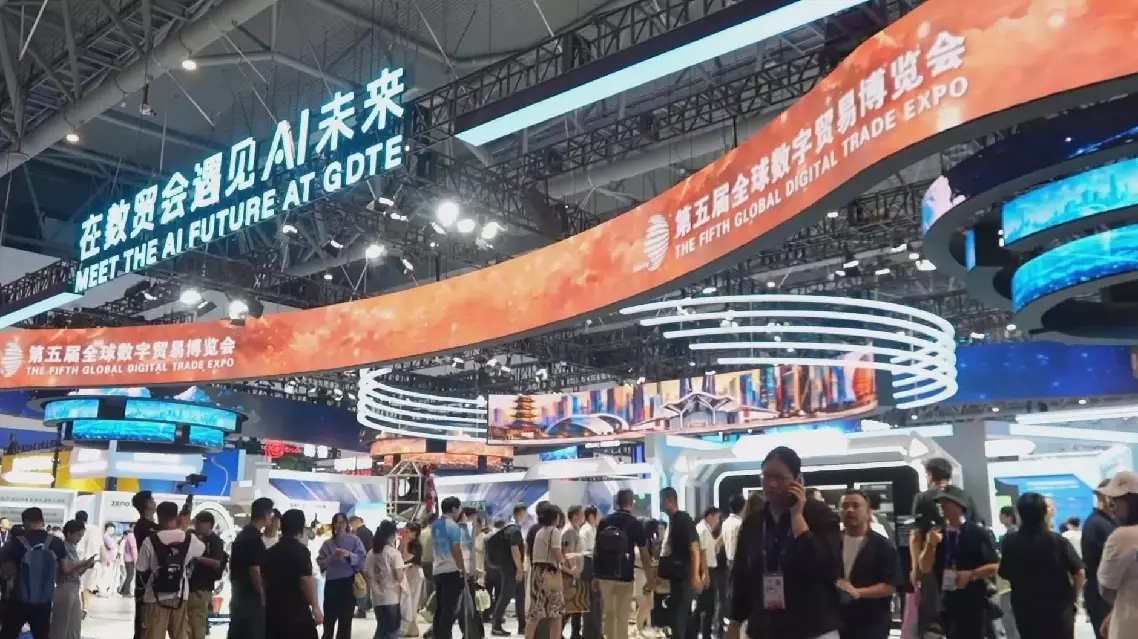
An expo highlighting China's efforts to deepen global digital trade cooperation concluded in Hangzhou, a tech hub in east China's Zhejiang Province, on Sunday with a series of new product launches and announcements.
Running from Sept. 23 to 27, the fifth Global Digital Trade Expo (GDTE) featured 226 debuts, including product launches, premieres and exhibitions, and attracted more than 50,000 participants from 163 countries and regions. The event highlighted the growing role of artificial intelligence in reshaping trade and China's push to expand global digital trade cooperation.
A total of 996 AI companies, nearly three times the number at the previous expo, attended the event and showcased more than 100 AI application scenarios.
"Through this expo, we have realized that China's AI sector is garnering more attention and recognition around the world, and Chinese solutions are empowering the development of digital trade worldwide. We are shifting from merely showcasing products and technologies toward fostering chains for product and technology cooperation, ultimately creating a growing digital trade ecosystem," said Li Yang, secretary-general of the GDTE organizing committee's secretariat.
The expo serves as a crucial bridge for international dialogue and mechanism building.
The China-Arab AI International Cooperation and AFDE First China-Arab Digital Dialogue, held during this year's expo, brought together more than 200 participants from China and abroad. Seven cooperation projects worth 255 million U.S. dollars were signed, covering areas including robotics and smart manufacturing.
This year's exhibition also featured a dialogue on BRICS special economic zones, focusing on practical cooperation. In 2025. The number of Chinese enterprises engaged in trade with other BRICS members exceeded 300,000 for the first time, up 8.8 percent year on year. The China Center for Cooperation on Special Economic Zones in BRICS Countries was also launched in Hangzhou last year.
In addition, the "Global Digital Trade Development Report 2026" was unveiled at the event, outlining the scale and structure of global digital trade, technological transformation and innovative practices, while also exploring future industry trends.
The global digital trade sector has demonstrated resilience amid multiple external pressures, with export value reaching 7.75 trillion U.S. dollars in 2025, a 7.1 percent year-on-year increase, according to the report.
Fifth Global Digital Trade Expo concludes in Hangzhou