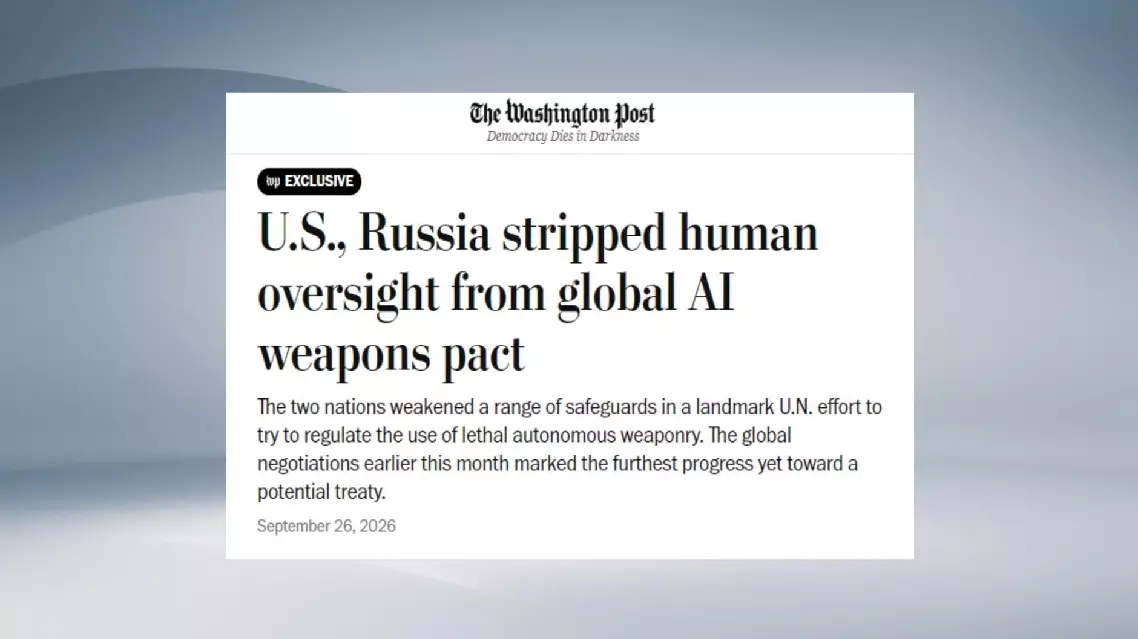
U.S. and Russian diplomats pushed to strip multiple critical safety provisions aimed at ensuring the safe use of AI weapons during the final stages of United Nations negotiations on lethal autonomous weapons earlier this month, the Washington Post reported on Saturday.
The negotiations, held in Geneva, Switzerland, from August 31 to September 4, aimed to advance a framework regulating the use of lethal autonomous weapons.
Citing three people familiar with the matter and documents reviewed by the newspaper, the Washington Post report noted that on the final day of the talks, diplomats from the United States and Russia heavily edited the text to remove provisions intended to guarantee the safe use of AI weapons.
The deleted provisions included requirements for the systems to operate in a "predictable" and "reliable" manner, mandates for ethical considerations during their deployment, and a strict rule requiring humans to review AI-identified military targets before launching strikes. The report said the U.S. and Russia each deployed about 10 lawyers to participate in the revisions, nearly twice the number of diplomats from other delegations. The speed of the changes left smaller delegations struggling to keep up. While the current UN negotiations are not legally binding, an agreement among member states could pave the way for a future binding treaty. Participating countries are scheduled to meet again in Geneva in November to discuss whether to further advance the development of such a treaty. The report also cited experts to warn that if rules on lethal AI weapons are too weak, it could mean machines are able to make life-and-death decisions without human control. The practical impact could include more civilian casualties, less accountability, and a faster slide toward riskier automated warfare, it cautioned.
US, Russia weaken AI weapons safety clauses in UN negotiations: report