
Wage and payroll statistics for June 2026
Overall Wage and Payroll Statistics
Click to Gallery

The Census and Statistics Department, Photo source: reference image

Photo source: reference image
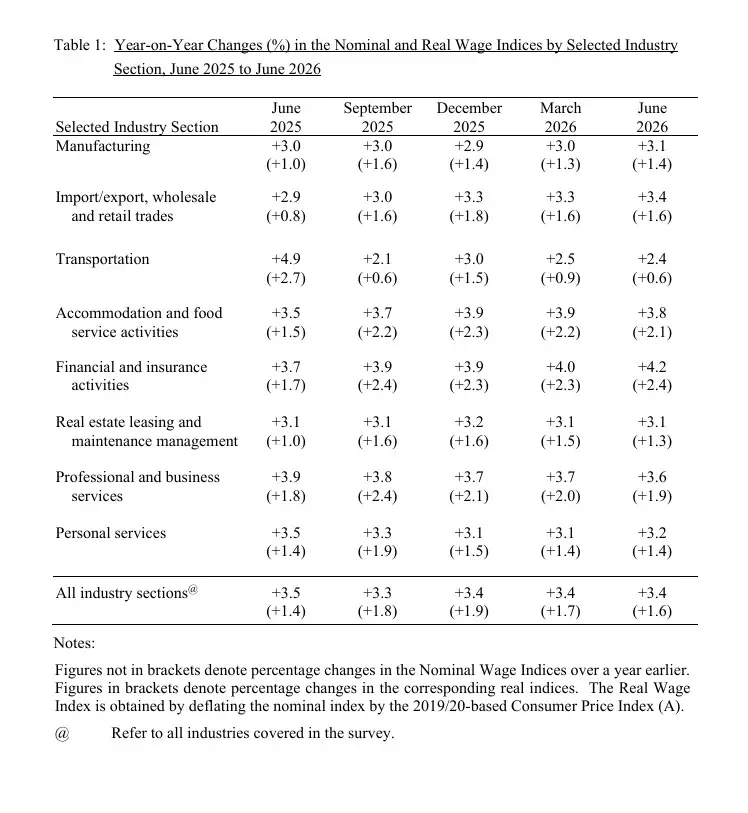
Photo source: HKSAR Government Press Releases
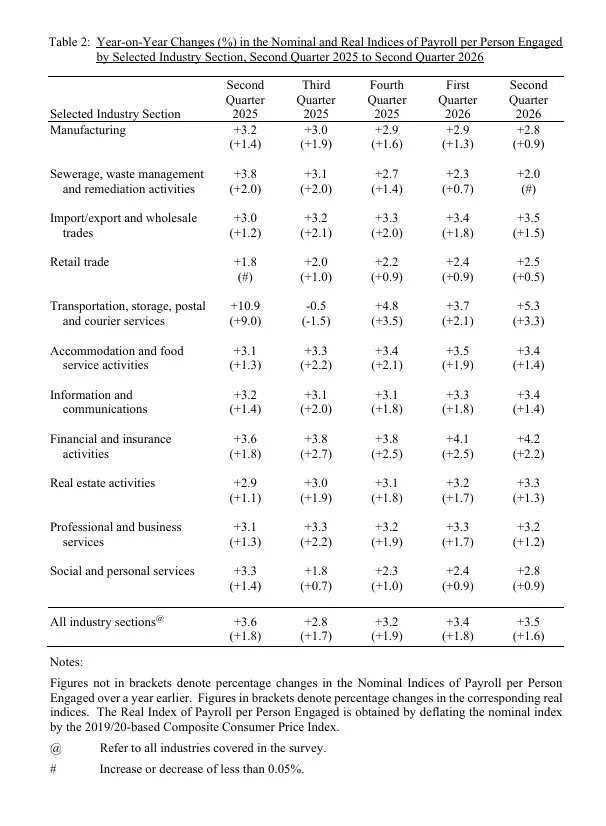
Photo source: HKSAR Government Press Releases
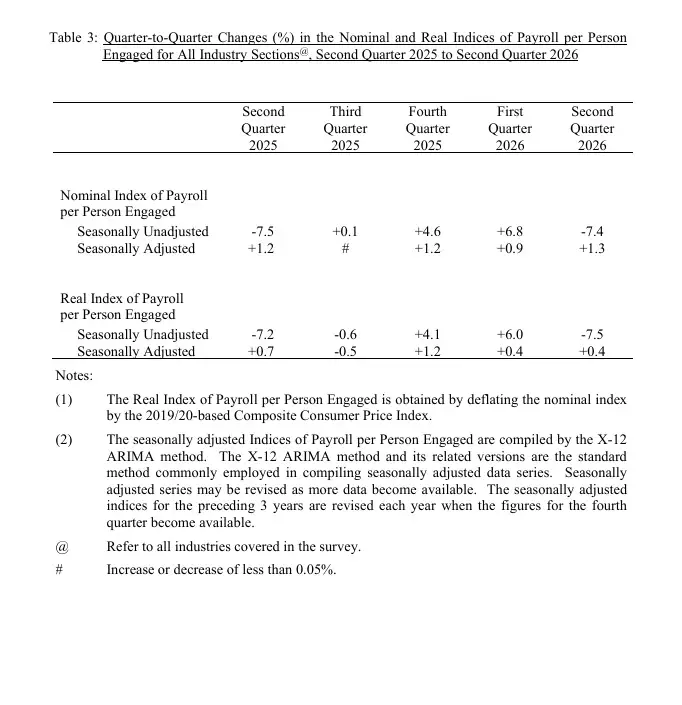
Photo source: HKSAR Government Press Releases

Photo source: reference image
According to the figures released today (September 28) by the Census and Statistics Department (C&SD), the average wage rate for all the selected industry sections surveyed, as measured by the wage index, increased by 3.4% in nominal terms in June 2026 over a year earlier.
The Census and Statistics Department, Photo source: reference image
About 62% of the companies reported increase in average wage rates in June 2026 compared with a year ago. A total of 33% of the companies recorded decrease in average wage rates over the same period. The remaining 5% reported virtually no change in average wage rates.
After discounting the changes in consumer prices as measured by the Consumer Price Index (A), the overall average wage rate for all the selected industry sections surveyed increased by 1.6% in real terms in June 2026 over a year earlier.
As for payroll, the index of payroll per person engaged for all the industry sections surveyed increased by 3.5% in nominal terms in the second quarter of 2026 over a year earlier.
After discounting the changes in consumer prices as measured by the Composite Consumer Price Index, the average payroll per person engaged increased by 1.6% in real terms in the second quarter of 2026 compared with a year earlier.
The wage rate includes basic wages and other regular and guaranteed allowances and bonuses. Payroll includes elements covered by wage rate as well as other irregular payments to workers such as discretionary bonuses and overtime allowances. The payroll statistics therefore tend to show relatively larger quarter-to-quarter changes, affected by the number of hours actually worked and the timing of payment of bonuses and back-pay.
Photo source: reference image
Sectoral Changes
For the nominal wage indices, year-on-year increases were recorded in all selected industry sections in June 2026, ranging from 2.4% to 4.2%.
For the real wage indices, year-on-year increases were also recorded in all selected industry sections in June 2026, ranging from 0.6% to 2.4%.
The year-on-year changes in the nominal and real wage indices for the selected industry sections from June 2025 to June 2026 are shown in Table 1.
Photo source: HKSAR Government Press Releases
As for the nominal indices of payroll per person engaged, year-on-year increases were recorded in all selected industry sections in the second quarter of 2026, ranging from 2.0% to 5.3%.
For the real payroll indices, year-on-year increases were recorded in all selected industry sections surveyed in the second quarter of 2026, ranging from 0.5% to 3.3%, except the sewerage, waste management and remediation activities section which remained virtually unchanged.
Photo source: HKSAR Government Press Releases
The year-on-year changes in the nominal and real indices of payroll per person engaged for selected industry sections from the second quarter of 2025 to the second quarter of 2026 are shown in Table 2. The quarterly changes in the seasonally adjusted nominal and real indices of payroll per person engaged in the same period are shown in Table 3.
Photo source: HKSAR Government Press Releases
Commentary
A Government spokesman said that wages and labour earnings continued to increase solidly in the second quarter of 2026, with the rise broad-based across industries.
Looking ahead, wage growth is expected to remain positive, supported by the continued expansion of the local economy, which should sustain labour demand and contribute to further increases in wages and labour earnings. The Government will continue to closely monitor the evolution of external uncertainties and their potential impacts on the Hong Kong economy.
Other Information
Both wage indices and payroll indices are compiled quarterly based on the results of the Labour Earnings Survey (LES) conducted by C&SD. Wage index only covers employees up to the supervisory level (i.e. not including managerial and professional employees), whereas payroll index covers employees at all levels and proprietors actively engaged in the work of the establishment.
Apart from the differences in employee coverage, wage statistics are conceptually different from the payroll statistics. Firstly, wage rate for an employee refers to the sum earned for his normal hours of work. It covers basic wages and other regular and guaranteed allowances and bonuses, but excludes earnings from overtime work and discretionary bonuses, which are however included in payroll per person engaged. Secondly, the payroll index of an industry is an indicator of the simple average payroll received per person engaged in the industry. Its movement is therefore affected by changes in wage rates, number of hours of work and occupational composition in the industry. In contrast, the wage index of an industry is devised to reflect the pure changes in wage rate, with the occupational composition between two successive statistical periods being kept unchanged. In other words, the wage index reflects the change in the price of labour. Because of these conceptual and enumeration differences between payroll and wage statistics, the movements in payroll indices and in wage indices do not necessarily match closely with each other.
It should also be noted that different consumer price indices are used for compiling the real indices of wage and payroll to take into account the differences in their respective occupation coverage. Specifically, the Composite Consumer Price Index, being an indicator of overall consumer prices, is taken as the price deflator for payroll of workers at all levels of the occupational hierarchy. The Consumer Price Index (A), being an indicator of consumer prices for the relatively low expenditure group, is taken as the price deflator for wages in respect of employees engaged in occupations up to the supervisory level.
Photo source: reference image
Detailed breakdowns of the payroll and wage statistics are published in the "Quarterly Report of Wage and Payroll Statistics, June 2026". Users can browse and download the publication at the website of C&SD (www.censtatd.gov.hk/en/EIndexbySubject.html?pcode=B1050009&scode=210).
For enquiries on wage and payroll statistics, please contact the Wages and Labour Costs Statistics Section (1) of C&SD (Tel.: 2887 5550 or email: wage@censtatd.gov.hk).