China's Mengxiang (Dream) ocean drilling vessel has set a national record for deep-sea drilling capacity, reaching 5,000 meters after obtaining basalt samples from the South China Sea basin, the Ministry of Natural Resources said on Monday.
This marks China's entry into the international ranks of advanced deep-sea drilling operators, according to the ministry.
A 4.27-meter basalt sample was extracted during a 30-day voyage using a self-developed drill, making China the third country after the United States and Japan to obtain hard rock samples from a deep ocean basin using drilling vessels.
"From our current position, we drilled down 4,929.17 meters, extracting 109 meters of core with a 61.7 percent recovery rate. Meanwhile, we retrieved about 4.3 meters of basalt core samples at a depth of around 4,300 meters. This validates the superiority of the light-tonnage, modular, and multi-functional design philosophy of the Mengxiang vessel, proving its versatile capability to handle both oil and gas exploration and core sampling," said Wang Mingxin, an engineer with the Guangzhou Marine Geological Survey and also team leader of the drilling department at the Mengxiang vessel.
The research team conducted a long-term and high-intensity operation of shipborne remotely operated vehicles (ROVs), deploying two ROVs to operate for over 358 hours in total at a depth of 4,000 meters, with a single continuous operation lasting up to 103 hours, reaching internationally advanced levels.
Following the International Ocean Discovery Program standards for the first time, researchers also completed on-site multi-parameter processing and analysis of the samples, including cataloging, cutting, scanning, testing, and storage, thereby mastering full-process operational capabilities for ultra-deep-water ocean scientific drilling.
The samples and data obtained during the voyage provide crucial empirical evidence for addressing core scientific issues such as the expansion of the South China Sea. They are also significant for studying the evolution of the ancient marine environment and for exploring and developing ultra-deep-water energy resources, researchers noted.
"The sediment was initially black and rich in organic matter, indicating a sudden die-off of marine organisms and the subsequent dissolution of their calcareous shells. It later turned green, signaling a partial recovery of oxygen levels despite remaining hypoxic, and eventually turned red, indicating an oxygen-rich environment. This is highly significant for helping us understand the scale and duration of extinction events triggered by massive magma eruptions," said Sun Zhen, a researcher at the Guangzhou Marine Geological Survey and chief scientist of the voyage.
A total of 170 researchers from nine institutions participated in the voyage, which was organized by the China Geological Survey and implemented by the Guangzhou Marine Geological Survey.
China's first domestically built ocean drilling vessel, Mengxiang, was officially commissioned in 2024.
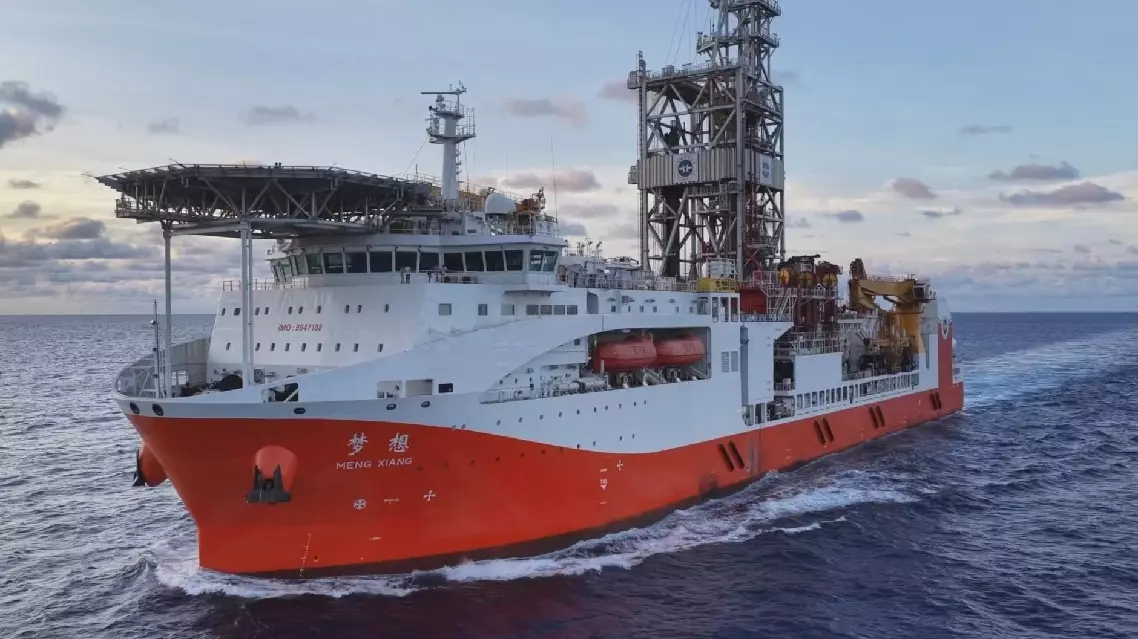
China's deep-sea drilling capacity reaches 5,000 meters after mission in South China Sea