Hong Kong Customs detects money laundering case involving about $3.6 million following infringement investigation
Hong Kong Customs today (September 29) detected a suspected money laundering case involving about $3.6 million in criminal proceeds, subsequent to a follow-up investigation of an infringement case identified earlier this year. One local man suspected to be connected with the case was arrested.
In May this year, Customs detected an online shop offering counterfeit perfumes and skincare products for sale and arrested a 37-year-old local man. A subsequent financial investigation and fund-flow analysis revealed that the arrested person operated an infringing business and utilised bank accounts of another person to receive about $3.6 million in suspected criminal proceeds between February 2024 and May 2026.
Customs today arrested the local man for "dealing with property known or reasonably believed to represent proceeds of an indictable offence" (commonly known as money laundering) under the Organized and Serious Crimes Ordinance (OSCO) and searched his residential premises. During the operation, a batch of items suspected to be connected with the case was seized.
The arrested person has been released on bail pending further investigation. An investigation is ongoing, and the likelihood of further arrests is not ruled out.
Under OSCO, a person commits an offence if he or she deals with any property knowing or having reasonable grounds to believe that such property, in whole or in part, directly or indirectly represents any person's proceeds of an indictable offence. The maximum penalty upon conviction is a fine of $5 million and imprisonment for 14 years, while the crime proceeds are also subject to confiscation.
Members of the public may report any suspected money laundering activities to Customs' 24-hour hotline 182 8080 or its dedicated crime reporting email account (crimereport@customs.gov.hk) or online form (eform.cefs.gov.hk/form/ced002).
Source: AI-found images
FEHD releases third batch of gravidtrap indexes for Aedes albopictus in September
The Food and Environmental Hygiene Department (FEHD) today (September 29) released the third batch of gravidtrap indexes and density indexes for Aedes albopictus in September, covering 12 survey areas, as follows:
District
Survey Area
First Phase Gravidtrap Index
First Phase Density Index
Islands
Tung Chung
4.0%
1.0
Kowloon City
Ho Man Tin
1.8%
1.0
Sham Shui Po
Lai Chi Kok
5.5%
1.0
Sai Kung
Tseung Kwan O East
1.8%
1.0
Tseung Kwan O West
0.0%
N/A
District
Survey Area
Area Gravidtrap Index
Area Density Index
Sham Shui Po
Sham Shui Po and Shek Kip Mei
3.4%
1.5
North
Fanling South
2.3%
1.0
Sai Kung
Sai Kung Town
5.7%
1.0
Kwai Tsing
Kwai Chung West
3.3%
1.0
Lai King
5.7%
1.2
Yuen Long
Hung Shui Kiu and Ping Shan
2.1%
1.0
Yuen Long Town
7.4%
1.0
The FEHD continues to carry out a series of mosquito prevention and elimination measures, including:
- interdepartmental collaboration: convening special meetings of the interdepartmental task forces on anti-mosquito work to co-ordinate relevant departments and stakeholders (such as construction site contractors, schools and property management companies) in strengthening mosquito control work at venues;
- precise risk assessments: carrying out intensive and targeted mosquito control work at locations with more serious mosquito infestations, including stepping up inspections, eliminating mosquito breeding and potential breeding grounds, applying larvicides, conducting fogging operations to eradicate adult mosquitoes, and placing mosquito trapping devices at appropriate locations;
- promotion and education: organising exhibitions with relevant departments and stakeholders, and distributing leaflets and posters to enhance public awareness of mosquito control and prevention; and
- rapid alert mechanism: notifying residential estates that have subscribed to the gravidtrap Rapid Alert System, and advising property management companies and residents to stay vigilant and work together in taking mosquito prevention and elimination measures.
Public participation is crucial to the effective control of mosquito problems. The FEHD appeals to members of the public to continue to work together in strengthening personal mosquito control measures, including:
- tidying up their premises and checking for any accumulation of water inside the premises;
- removing all unnecessary water collections and eliminating the sources;
- checking household items (those placed in outdoor and open areas in particular), such as refuse containers, vases, air conditioner drip trays, and laundry racks to prevent stagnant water;
- changing water in flower vases and scrubbing their inner surfaces thoroughly, and removing water in saucers under potted plants at least once a week;
- properly covering all containers that hold water to prevent mosquitoes from accessing the water;
- properly disposing of articles that can contain water, such as disposable meal boxes and empty cans; and
- scrubbing drains and surface sewers with alkaline detergent at least once a week to remove any mosquito eggs.
Starting in August 2025, following the completion of the surveillance of individual survey areas, and once the latest gravidtrap index and the density index are available, the FEHD has been disseminating relevant information through press releases, its website and social media. It aims to allow members of the public to quickly grasp the mosquito infestation situation and strengthen mosquito control efforts, thereby reducing the risk of chikungunya fever (CF) transmission.
Following recommendations from the World Health Organization and taking into account the local situation in Hong Kong, the FEHD sets up gravidtraps in districts where mosquito-borne diseases have been recorded in the past, as well as in densely populated places such as housing estates, hospitals and schools to monitor the breeding and distribution of Aedes albopictus mosquitoes, which can transmit CF and dengue fever. At present, the FEHD has set up gravidtraps in 62 survey areas of the community, with a surveillance period of two weeks. During the surveillance period, the FEHD will collect the gravidtraps once a week. After the first week of surveillance, the FEHD will immediately examine the glue boards inside the retrieved gravidtraps for the presence of adult Aedine mosquitoes to compile the Gravidtrap Index (First Phase) and Density Index (First Phase). At the end of the second week of surveillance, the FEHD will instantly check the glue boards for the presence of adult Aedine mosquitoes. Data from the two weeks of surveillance will be combined to obtain the Area Gravidtrap Index and the Area Density Index. The Gravidtrap and Density indexes for Aedes albopictus in different survey areas, as well as information on mosquito prevention and control measures, are available on the department's webpage (www.fehd.gov.hk/english/pestcontrol/dengue_fever/Dengue_Fever_Gravidtrap_Index_Update.html#).
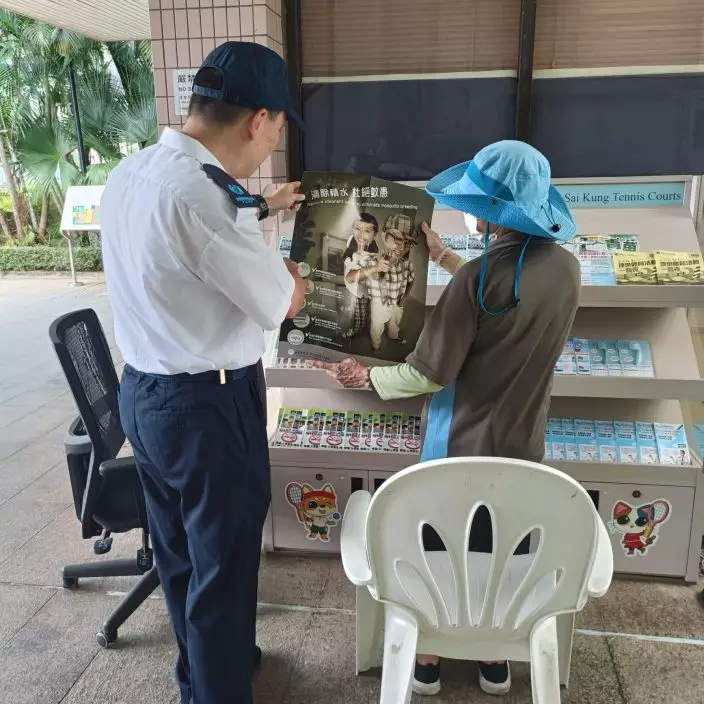
The Food and Environmental Hygiene Department (FEHD) today (September 29) released the third batch of gravidtrap indexes and density indexes for Aedes albopictus in September, covering 12 survey areas. Photo shows an FEHD staff member inspecting a park in Sai Kung Town, Sai Kung District, and providing a venue management staff member with advice and technical support on mosquito prevention and control. Source: HKSAR Government Press Releases
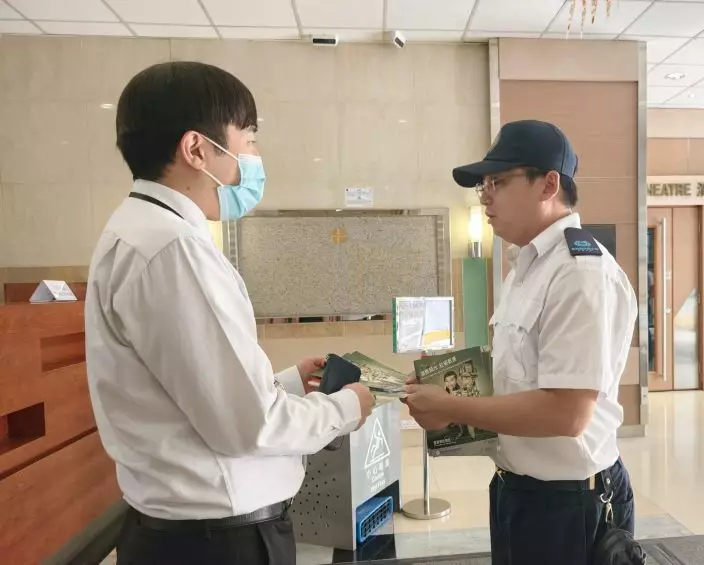
The Food and Environmental Hygiene Department (FEHD) today (September 29) released the third batch of gravidtrap indexes and density indexes for Aedes albopictus in September, covering 12 survey areas. Photo shows an FEHD staff member inspecting a hospital in Lai Chi Kok, Sham Shui Po District, and providing a hospital management staff member with advice and technical support on mosquito prevention and control. Source: HKSAR Government Press Releases
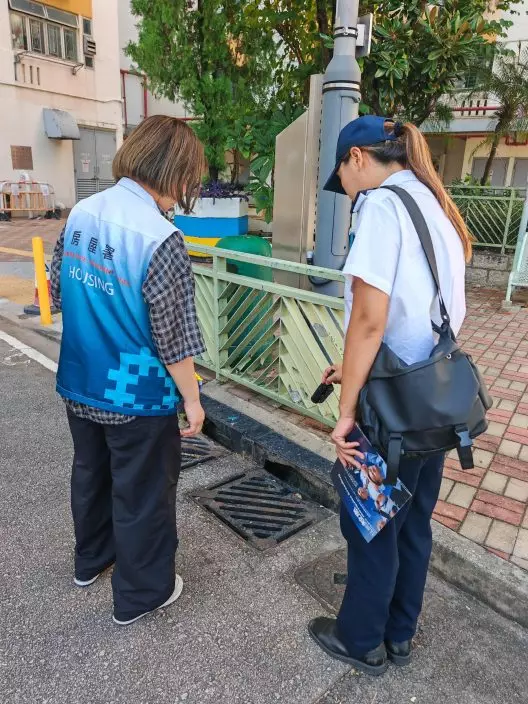
The Food and Environmental Hygiene Department (FEHD) today (September 29) released the third batch of gravidtrap indexes and density indexes for Aedes albopictus in September, covering 12 survey areas. Photo shows an FEHD staff member inspecting a public housing estate in Lai King, Kwan Tsing District, and providing an estate management staff member with advice and technical support on mosquito prevention and control. Source: HKSAR Government Press Releases
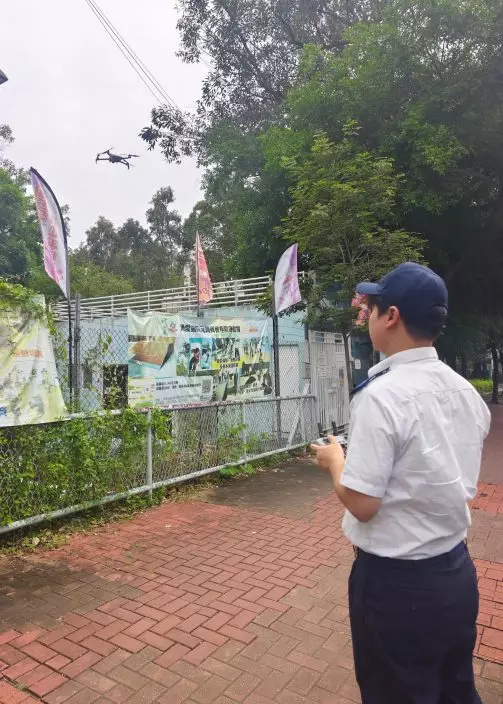
The Food and Environmental Hygiene Department (FEHD) today (September 29) released the third batch of gravidtrap indexes and density indexes for Aedes albopictus in September, covering 12 survey areas. Photo shows an FEHD staff member deploying a drone for aerial surveillance at Yuen Long Town, Yuen Long District, to identify potential mosquito breeding grounds for follow-up action. Source: HKSAR Government Press Releases