China's external debt rose in the second quarter of 2026 amid active cross-border trade, while the latest available debt-risk indicators were within internationally recognized safety thresholds.
Outstanding external debt stood at 2.4982 trillion U.S. dollars at the end of June, up 86.1 billion dollars, or 4 percent, from the end of March, data from the State Administration of Foreign Exchange (SAFE) showed on Tuesday.
The increase was mainly driven by relatively active cross-border trade, with both corporate trade credit and intercompany lending rising, said Li Bin, deputy head and spokesperson of SAFE.
Li said China's external debt remained generally stable in the second quarter.
China's goods imports and exports reached 13.61 trillion yuan (about 2.02 trillion U.S. dollars) in the second quarter, up 18.4 percent year on year, the fastest year-on-year growth for any quarter since the third quarter of 2021, according to data from the General Administration of Customs. Trade value in June alone rose 24.2 percent year on year, marking 17 consecutive months of growth.
Yuan-denominated external debt accounted for 56 percent of the total at the end of June, up 1 percentage point from the end of March, while medium- and long-term debt held steady at 41 percent.
SAFE said in July that the share of yuan-denominated external debt had risen while medium- and long-term debt had remained broadly stable at over 40 percent in recent years, with currency and maturity mismatch risks seeing significant declines.
Moderate external borrowing allows Chinese companies and banks to tap both domestic and international markets, diversify financing channels and improve operational efficiency, while risks stemming from excessive debt levels require continued monitoring, SAFE said.
At the end of 2025, China's outstanding external debt was equivalent to 11.9 percent of gross domestic product, below the 20-percent international safety threshold cited by SAFE.
Separate data released on Tuesday showed that China's external financial assets continued to exceed its external liabilities. External financial assets stood at 12.1804 trillion U.S. dollars at the end of June, against liabilities of 8.3555 trillion dollars, leaving net external financial assets of 3.8249 trillion dollars.

China's external debt rises in Q2 amid active cross-border trade
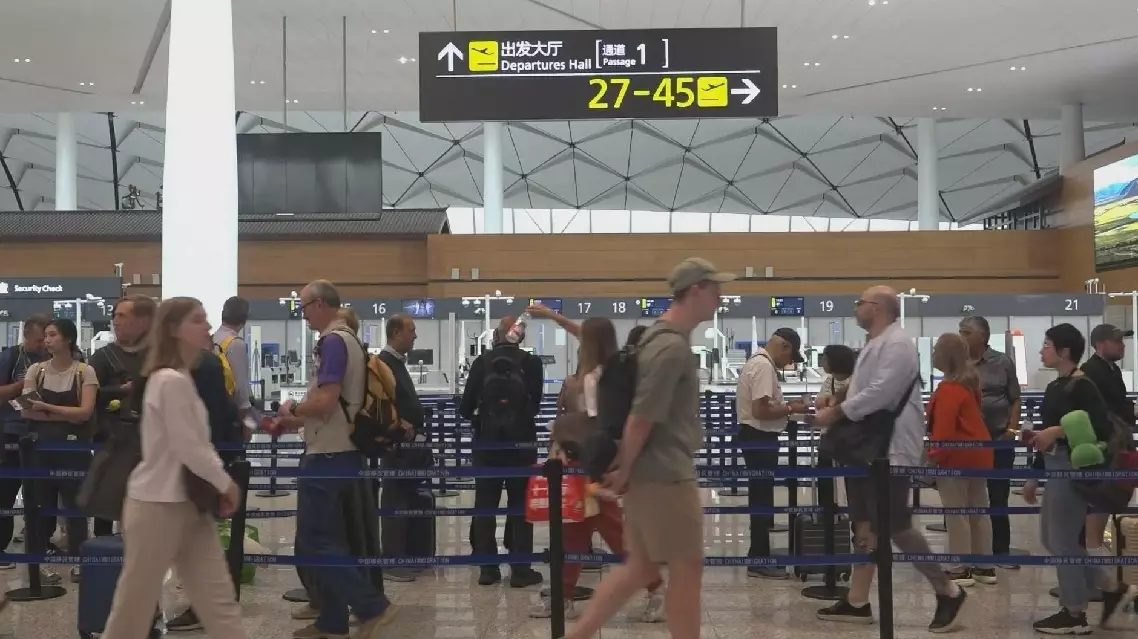
China's tourism sector is gearing up for a booming influx of international visitors as the National Day holiday kicks off on Thursday, driven by relaxed visa policies and soaring overseas interest.
In the southwestern province of Sichuan, curated boutique travel routes are offering international tourists immersive experiences, highlighting local attractions ranging from snow-capped mountains and giant pandas to intangible cultural heritage and local cuisine.
According to forecasts by the Sichuan General Station of Exit and Entry Frontier Inspection, the total volume of inbound and outbound travelers at Chengdu’s two major airports -- Tianfu and Shuangliu -- is expected to exceed 150,000 during this year's National Day holiday. The daily average throughput is projected at 21,000 travelers, with a peak daily volume of 22,000 expected on the first day of the holiday.
"This is my first time in China. I always wanted to visit China. I want to make a big trip in China. I'm in Chengdu right now and I want to see the pandas, and I also want to try Sichuan cuisine," said a tourist from Russia.
Meanwhile, eastern China's coastal hubs are experiencing a parallel boom. According to the Shandong General Station of Exit and Entry Frontier Inspection, ports across Shandong Province are expected to handle 142,000 inbound and outbound travelers during the holiday, marking a 27.3 percent increase year on year. Driven by the continuous policy dividends of China's expanding visa-free transit policies, cities including Jinan, Qingdao and Yantai are seeing peak travel flows. In Weihai, located at the eastern tip of the Shandong Peninsula, tourism momentum has carried over from the summer season, marked by a noticeable rise in travelers opting for ferry routes between China and South Korea. The dozen-hour maritime passage has emerged as a popular choice for tourists commuting between the two countries. "It is very convenient, the customs clearance process is smooth, and the staff are very enthusiastic. Weihai is very clean," said a tourist from South Korea.
China's border authorities are ramping up operational capacity to manage the heavy foot traffic.
"During the holiday, we have increased the number of inspection lanes, optimized duty arrangements, and deployed staff in advance to direct passenger flows. Meanwhile, we continue to implement measures to facilitate convenient customs clearance, ensuring efficient and smooth operations at the port," said Guo Xu, head of the first inspection team at the Weihai border inspection station.
China braces for inbound travel surge during National Day Holiday