A woman from north China's Inner Mongolia Autonomous Region who has been hailed as a heroine for her determined decades-long fight against desertification has shared her tale following a recent reunion with an old American acquaintance which once again thrust her story into the spotlight.
Local villager Yin Yuzhen has been nationally honored for her pioneering efforts in environmental protection and tree-planting along the Mu Us Desert, also known as the Maowusu Desert, in Ordos of Inner Mongolia.
Yin's remarkable story, and her unexpected encounter and enduring friendship with American teacher Ronald Sakolsky, is featured in an China Global Television Network (CGTN) production titled "One Earth, One Promise," which follows Sakolsky as he returns to China to reunite with Yin after nearly three decades.
In 1985, at the age of 19, Yin left her home in the neighboring Shaanxi Province and settled in the Wushen Banner of Ordos. What she found was a stark and unforgiving landscape — an endless stretch of barren desert and a house half-buried in sand.
She spent years battling desertification that severely threatened her livelihood, but a pivotal moment in her fight came from the most unlikeliest of sources.
In 1999, Ronald Sakolsky, a history teacher from Pittsburgh, came to China to teach English at the Luoyang Foreign Language School in Henan Province.
After watching a television news report featuring Yin's tireless work, he was deeply moved and raised 5,000 U.S. dollars to help Yin in her afforestation efforts against desertification. He later traveled to meet Yin and learn more about the conditions of the area, striking up a friendship.
"In my heart, I felt that his money had not come easily either. He donated money for us to plant trees, and it came from across the ocean. I cherished it deeply. To think that a foreigner would donate money to a tree planter in China - what a surge of hope it ignited in my heart. I said 'I will definitely give you a forest in return'," Yin recalled.
The saplings bought and planted with that donation have since grown into a forest of more than 50,000 towering trees, standing as a testament to Yin's mammoth work on the frontlines of the desert.
Walking through the now blossoming woodland with a CGTN reporter, Yin pointed to the trees with quiet pride.
"They were planted in 2000. These saplings were bought with the money he (Sakolsky) donated. You can see them over there. These trees are very tough. These trees were all planted during the same period. These trees need to absorb a lot of water. But they can't stabilize the sand in just one year. Some of them died, and then we replanted some later. They were not all planted in a single year," she said.
Her relationship with the desert has undergone a profound transformation, but Yin looks back fondly on the experiences which have shaped her, saying she always had the confidence that her efforts would lead to change.
"In the past, I felt hatred toward the Mu Us Desert; now I feel love for it. I say: You made me, and I made you. So now we're even good friends," she said.
In August this year, Yin and Sakolsky finally met once more when the now retired U.S. teacher embarked on a ten-day trip to China, which came after a social media campaign to track him down and an ensuing online clamor for the pair to have a long-overdue reunion.
Together they returned to the forest and saw how a promise made almost three decades earlier had taken root and flourished.
Today, including the trees funded by Sakolsky's donation, Yin and her family have planted trees across nearly 4,600 hectares of land, an area roughly the size of 6,500 standard soccer pitches.
Poplars, oriental arborvitaes, spruce and Mongolian Scots pines now rustle in the wind as birds chirp, transforming this once barren and desolate land into a green oasis.
The remarkable bond between Yin and Sakolsky was even mentioned by Chinese President Xi Jinping during his toast at a welcome dinner held at the White House as part of his three-day state visit to the United States at the invitation of U.S. President Donald Trump earlier this month.
Xi said that the story touches the hearts of many Chinese people and stands as a shining example of the friendly exchanges between the two peoples.
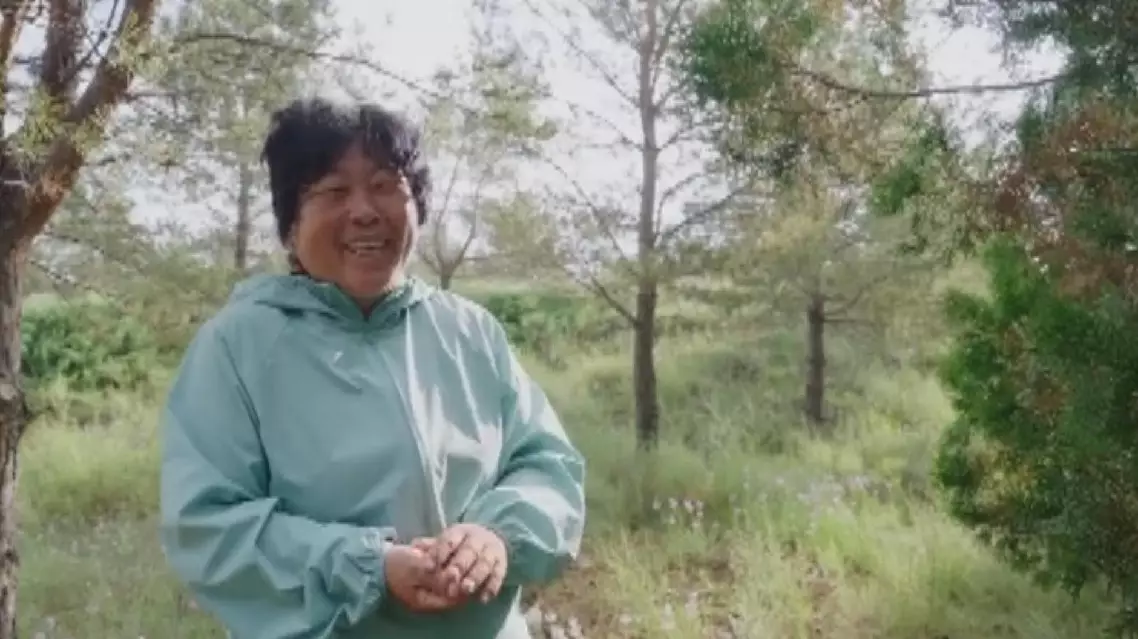
Villager hailed as heroine for turning desert into green oasis shares remarkable story