Skip to Content Facebook Feature Image

34% of Global Consumers Say They Are Worse Off Financially Than a Year Ago as Households Adapt to a New Era of Permanent Uncertainty, NIQ Finds

Business

34% of Global Consumers Say They Are Worse Off Financially Than a Year Ago as Households Adapt to a New Era of Permanent Uncertainty, NIQ Finds
Business

Business

34% of Global Consumers Say They Are Worse Off Financially Than a Year Ago as Households Adapt to a New Era of Permanent Uncertainty, NIQ Finds

2026-09-30 18:45 Last Updated At:18:50

CHICAGO--(BUSINESS WIRE)--Sep 30, 2026--

With over a third (34%) of global consumers saying they are financially worse off than they were a year ago, and another third (30%) saying they are financially better off, consumers are no longer waiting for economic conditions to improve. Around the world, households are adapting to a future where volatility remains a persistent reality, creating increasingly different financial outcomes, spending priorities, and pathways to growth.

This press release features multimedia. View the full release here: https://www.businesswire.com/news/home/20260930542911/en/

These findings come from NielsenIQ’s (NYSE: NIQ) latest global Consumer Outlook survey of more than 21,000 respondents across 31 countries, combined with NIQ's measurement of real-world purchasing behavior. The research reveals that economic uncertainty is no longer a temporary disruption, but a defining feature of how consumers make decisions.

Findings include:

The research reveals a growing consumer divide; as households navigate rising costs, shifting priorities, and uneven financial circumstances, they are becoming more deliberate about what they purchase, where they shop, and which brands they choose. But this is not simply a story of consumers trading down: NIQ’s measured data shows spending shifting away from the mainstream middle toward both value and premium alternatives, as consumers seek products that clearly justify either the savings they offer or the premium they command.

“The most important story is not that consumers are under pressure, it's that they’re responding to that pressure in fundamentally different ways,” said Lauren Fernandes, Vice President, Global Content at NIQ. “The next phase of consumer growth will be shaped less by the average consumer and more by increasingly different spending realities. Across many markets, we are seeing consumers gravitate toward either meaningful savings or meaningful upgrades, creating pressure on the middle of the market and forcing brands to be much clearer about where they compete and why they matter.”

The findings suggest that economic polarization is no longer simply an economic phenomenon. It is increasingly visible within measured consumer behavior, spending intentions, and market structure itself. As growth concentrates across value and premium segments, organizations will need a more nuanced understanding of where demand is emerging, which consumers are driving it, and how those dynamics differ from market to market. To learn more, visit niq.com/consumer-outlook-2027.

FAQs

Q: What is Consumer Outlook: Guide to 2027?
A: Consumer Outlook: Guide to 2027 is NIQ's latest global thought leadership report exploring how consumers are adapting to ongoing economic uncertainty, shifting spending priorities, and changing purchasing behaviors. The report combines NIQ's global consumer survey data with observed retail purchasing behavior to identify emerging trends shaping consumer markets worldwide.

Q: How was the research conducted?
A: The findings are based on NIQ's global Consumer Outlook survey of more than 21,000 consumers across 31 countries, combined with NIQ's measurement of real-world purchasing behavior across global retail markets.

Q: What does the $23 billion shift away from mainstream-priced products mean?
A: NIQ's analysis found that consumers are increasingly moving spending away from traditionally mainstream-priced consumer packaged goods and toward either value-oriented options that help stretch budgets or premium products that offer perceived quality, performance, or other benefits that justify a higher price.

Q: Are consumers simply trading down because of inflation?
A: No. The research suggests a more nuanced trend. While some consumers are seeking savings and value, others continue to spend on premium products that they believe are worth the additional cost. This has created increasing polarization in spending patterns across many categories.

Q: What is driving the growing consumer divide?
A: Consumers are experiencing economic conditions differently. Rising living costs, income differences, varying levels of financial resilience, and changing personal priorities are contributing to different spending behaviors and financial outcomes.

Q: What does this mean for brands and retailers?
A: Brands and retailers may need to move beyond a one-size-fits-all strategy. Understanding which consumer segments are driving growth, how spending priorities differ, and where consumers perceive value can help organizations better position products and marketing investments.

About NIQ

NielsenIQ (NYSE: NIQ) is a leading consumer intelligence company, delivering the most complete and trusted understanding of consumer buying behavior and revealing new pathways to growth. By combining an unmatched global data footprint and granular consumer and retail measurement with decades of AI modeling expertise, NIQ builds decision systems that help companies turn complex data into confident action.

With operations in more than 90 countries, NIQ covers approximately 82% of the world’s population and more than $7.4 trillion in global consumer spend. Through cloud-based platforms, advanced analytics and AI-driven insights, NIQ delivers The Full View™—helping brands and retailers understand what consumers buy, why they buy it, and what to do next.

For more information, please visit www.niq.com.

© 2026 Nielsen Consumer LLC. All Rights Reserved.

Forward Looking Statement

This press release regarding Consumer Outlook: Guide to 2027 may contain forward-looking statements regarding anticipated consumer behaviors, market trends, and industry developments. These statements reflect current expectations and projections based on available data, historical patterns, and various assumptions. Words such as “expects,” “anticipates,” “projects,” “believes,” “forecasts,” and similar expressions are intended to identify such forward-looking statements.

These statements are not guarantees of future outcomes and are subject to inherent uncertainties, including changes in consumer preferences, economic conditions, technological advancements, and competitive dynamics. Actual results may differ materially from those expressed or implied in these statements. While we strive to base our insights on reliable data and sound methodologies, we undertake no obligation to update any forward-looking statements to reflect future events or circumstances, except to the extent required by applicable law.

NIQ-General
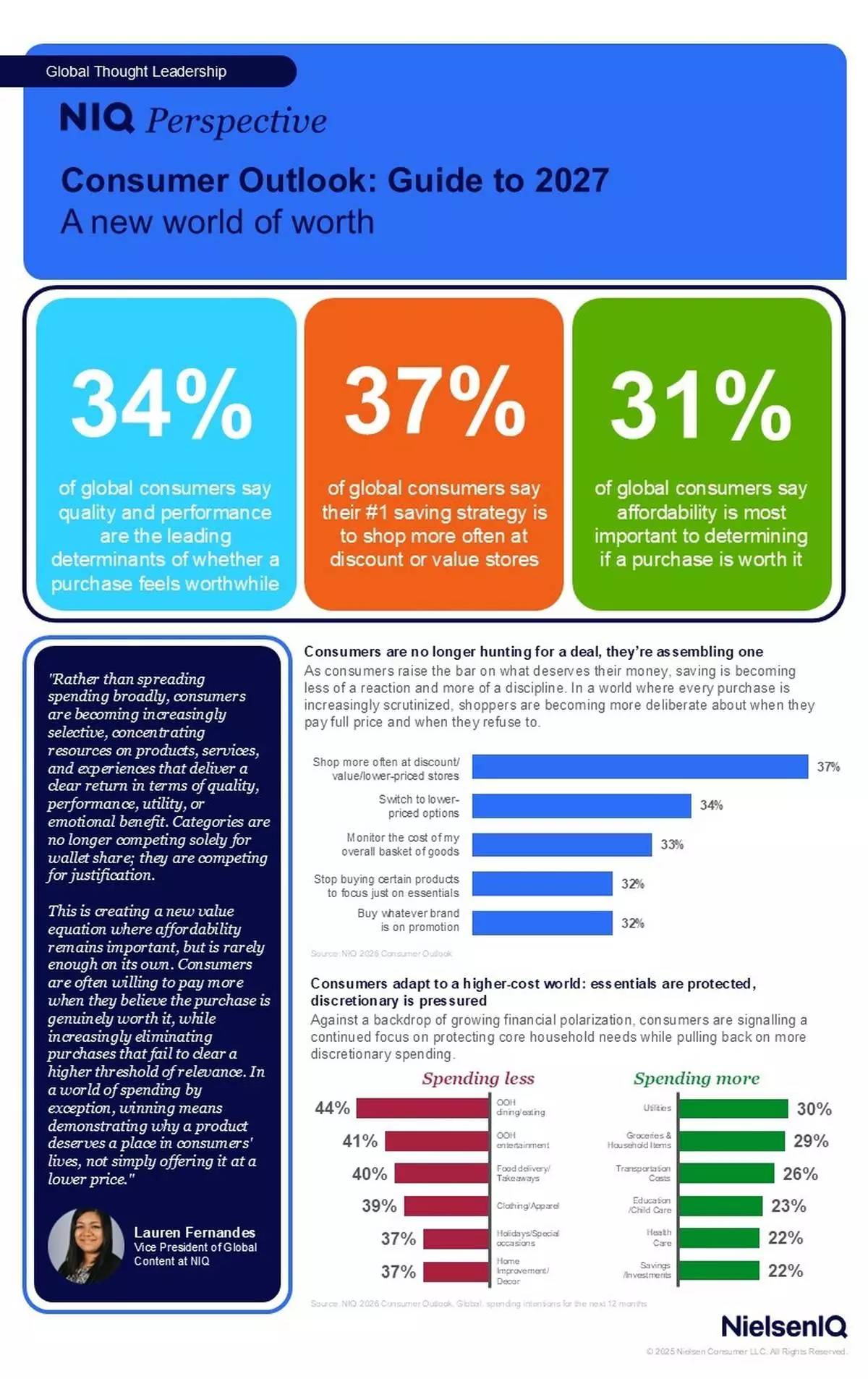
NIQ's Consumer Outlook: Guide to 2027

NIQ's Consumer Outlook: Guide to 2027
BAGHDAD (AP) — The U.S. military announced on Wednesday that it has completed the withdrawal of all American troops from Iraq, ending a 12-year mission to fight the Islamic State group. The last U.S. troops left an air base in northern Iraq under a deal between Baghdad and Washington.

The withdrawal, agreed on two years ago, comes against the backdrop of the ongoing war between the United States and Iran that has also sometimes spilled over into Iraq, with Iran-backed militias firing on U.S. troops and the U.S. striking the groups' strongholds.

Baghdad touted the end of the U.S. mission as a sign of the country's increasing strength and sovereignty.

The withdrawal was also celebrated by Iran-backed groups but raised concerns among some other Iraqis, particularly in the Kurdish region. Meanwhile, questions loom around the future of the Iraqi militias, which the Baghdad government has sought — with little success so far — to disarm.

Pentagon spokesperson Sean Parnell said in a statement that U.S. troops and equipment had completed an “orderly departure” from the air base in Irbil, in northern Iraq's semi-autonomous Kurdish region.

“This milestone reflects the success of a 12-year campaign that defeated ISIS as an organized military threat in Iraq and across the region,” he said. “It also marks a transition from a wartime coalition mission to an Iraqi-led security effort supported by a more normal bilateral security relationship.”

Iraqi Prime Minister Ali al-Zaidi presided over the handover ceremony and described the U.S. withdrawal as the beginning of a “new phase, one defined by Iraq’s sovereignty, the strength of its institutions, the readiness of its forces, the unity of its decision-making, and balanced partnerships with its friends.”

He said Iraqi security forces will continue the fight against IS and the government will ensure that non-state groups no longer hold weapons.

U.S. troops invaded Iraq in 2003 to topple Saddam Hussein. They departed in 2011, but three years later, Iraqi authorities invited a smaller U.S.-led mission to fight the Islamic State group, which had rampaged across Iraq, seizing large swaths of territory.

With the extremist group reduced to scattered sleeper cells, Washington and Baghdad agreed in 2024 to wind the mission down.

U.S. troops pulled out of bases in most areas of Iraq last year but maintained a small presence of hundreds of troops in the semiautonomous northern Kurdish region. Bases there have regularly come under attack since the U.S. and Israel launched their war against Iran on Feb. 28. Iran-backed Iraqi militias also have coordinated with Yemen’s Houthi rebels to attack Saudi Arabia.

The Iraqi government initially linked the Sept. 30 deadline for U.S. withdrawal to the disarmament of non-state armed groups by that date.

While a handful of less-influential militias have agreed to turn over their weapons, powerful groups close to Iran rejected the prospect or set conditions for disarming that the government would be unlikely to meet.

Al-Zaidi has since walked back the deadline. He told The New York Times earlier this month that the deadline for militia disarmament has been pushed to June 2027.

The effects of the U.S. withdrawal may not be immediately visible, particularly since the U.S. military presence had already been scaled down. But officials in Iraq's Kurdish region have expressed anxiety about the departure and particularly about the removal of U.S. air defense systems.

The Kurdish regional government's Peshmerga Ministry said the Kurdish region had faced more than 1,000 drone and ballistic-missile attacks during the recent U.S.-Iran conflict.

“The departure of the United States from the Kurdistan Region under these complex regional circumstances, without the provision of a defense system, is a matter of concern,” the statement said.

Iran-allied groups in Iraq, meanwhile, have celebrated the U.S. withdrawal.

“The expulsion of the occupation forces, defeated, from the land of Iraq is the beginning of full sovereignty,” Abu Mujahid al-Assaf, a security official with the powerful Kataib Hezbollah militia, said in a statement.

He added a warning to al-Zaidi and his government not to carry out American plans, threatening that “any government that does not work for the benefit of the people will be overthrown by all means.”

Associated Press writer Abby Sewell in Istanbul contributed to this report.

Iraqi police officers stand beside security vehicles decorated with national flags and ribbons during a convoy celebrating the complete withdrawal of U.S. troops from Iraq, in Baghdad, Iraq, Wednesday, Sept. 30, 2026. (AP Photo/Hadi Mizban)

Iraqi police officers stand beside security vehicles decorated with national flags and ribbons during a convoy celebrating the complete withdrawal of U.S. troops from Iraq, in Baghdad, Iraq, Wednesday, Sept. 30, 2026. (AP Photo/Hadi Mizban)

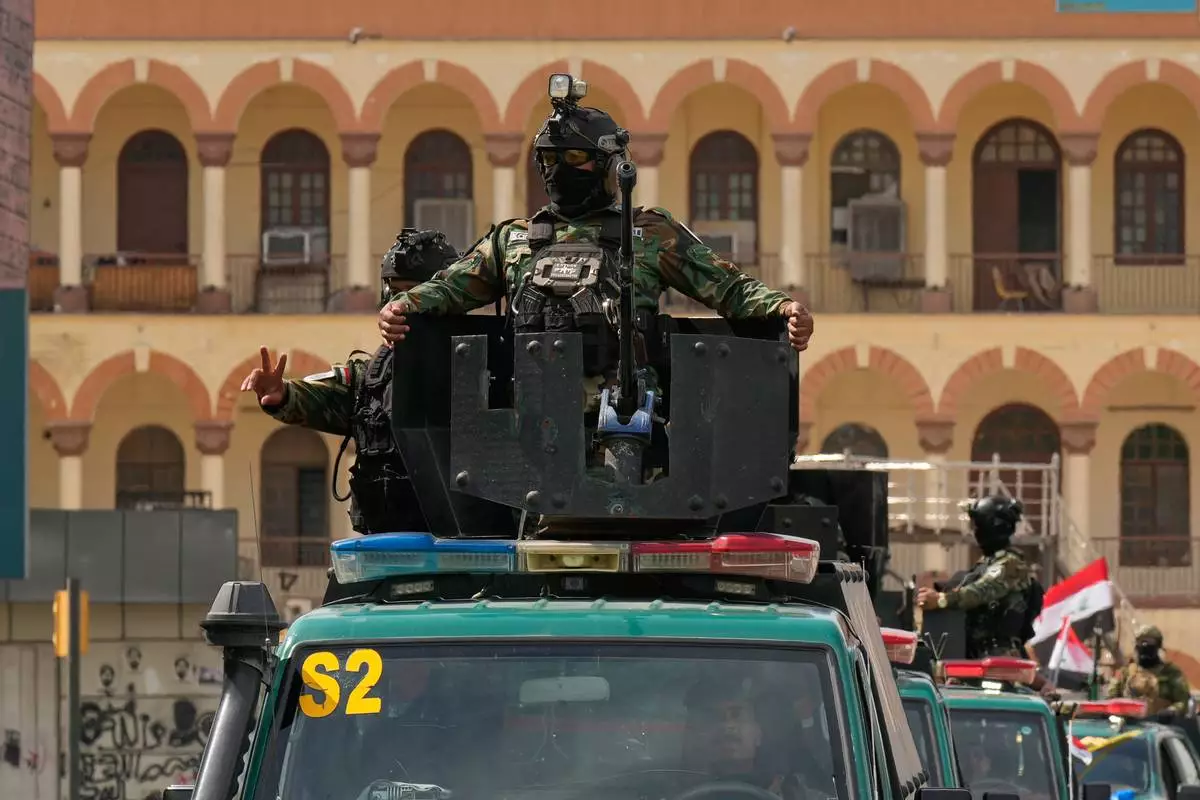
Iraqi security vehicles decorated with national flags and ribbons drive in a convoy past a billboard depicting slain Iranian commander Qassem Soleimani, slain Hezbollah leader Hassan Nasrallah and slain Iraqi militia commander Abu Mahdi al-Muhandis seated with religious figures around a fire, as they celebrate the complete withdrawal of U.S. troops from Iraq, in Baghdad, Iraq, Wednesday, Sept. 30, 2026. (AP Photo/Hadi Mizban)

Iraqi security vehicles decorated with national flags and ribbons drive in a convoy past a billboard depicting slain Iranian commander Qassem Soleimani, slain Hezbollah leader Hassan Nasrallah and slain Iraqi militia commander Abu Mahdi al-Muhandis seated with religious figures around a fire, as they celebrate the complete withdrawal of U.S. troops from Iraq, in Baghdad, Iraq, Wednesday, Sept. 30, 2026. (AP Photo/Hadi Mizban)

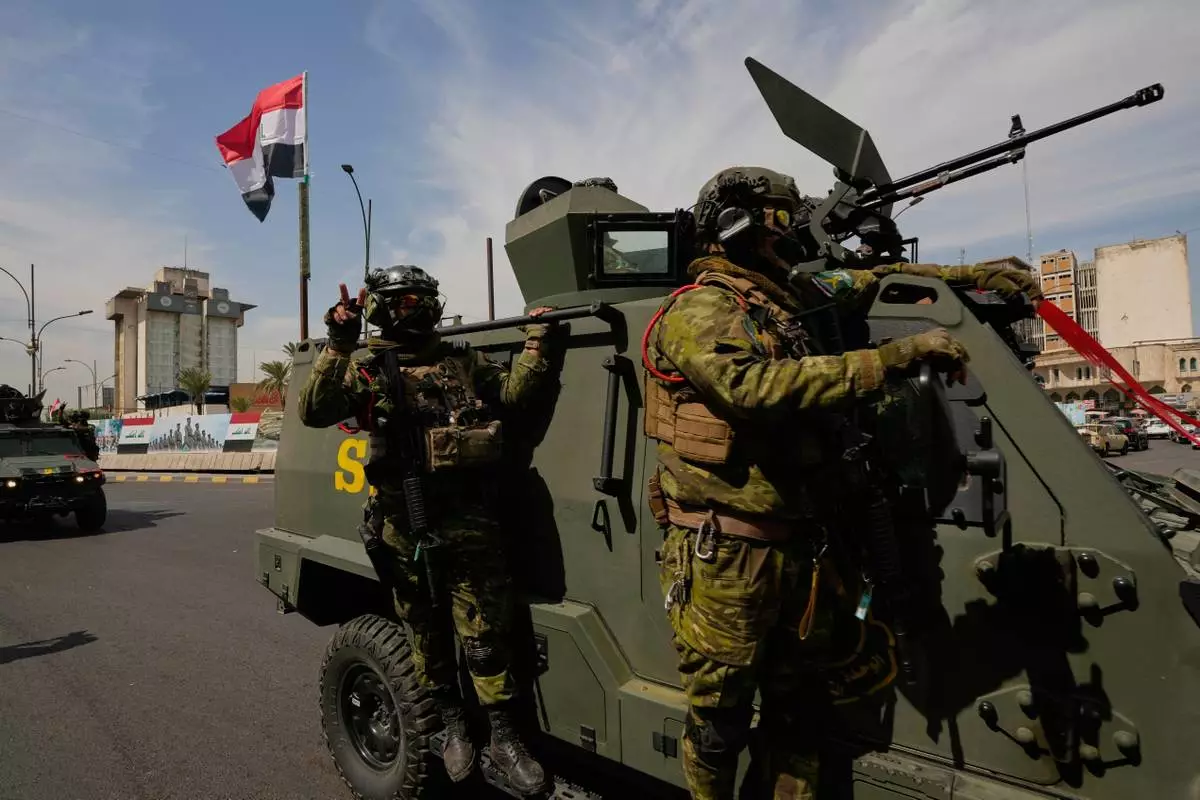
Iraqi security officers ride atop vehicles during a convoy celebrating the complete withdrawal of U.S. troops from Iraq, in Baghdad, Iraq, Wednesday, Sept. 30, 2026. (AP Photo/Hadi Mizban)

Iraqi security officers ride atop vehicles during a convoy celebrating the complete withdrawal of U.S. troops from Iraq, in Baghdad, Iraq, Wednesday, Sept. 30, 2026. (AP Photo/Hadi Mizban)

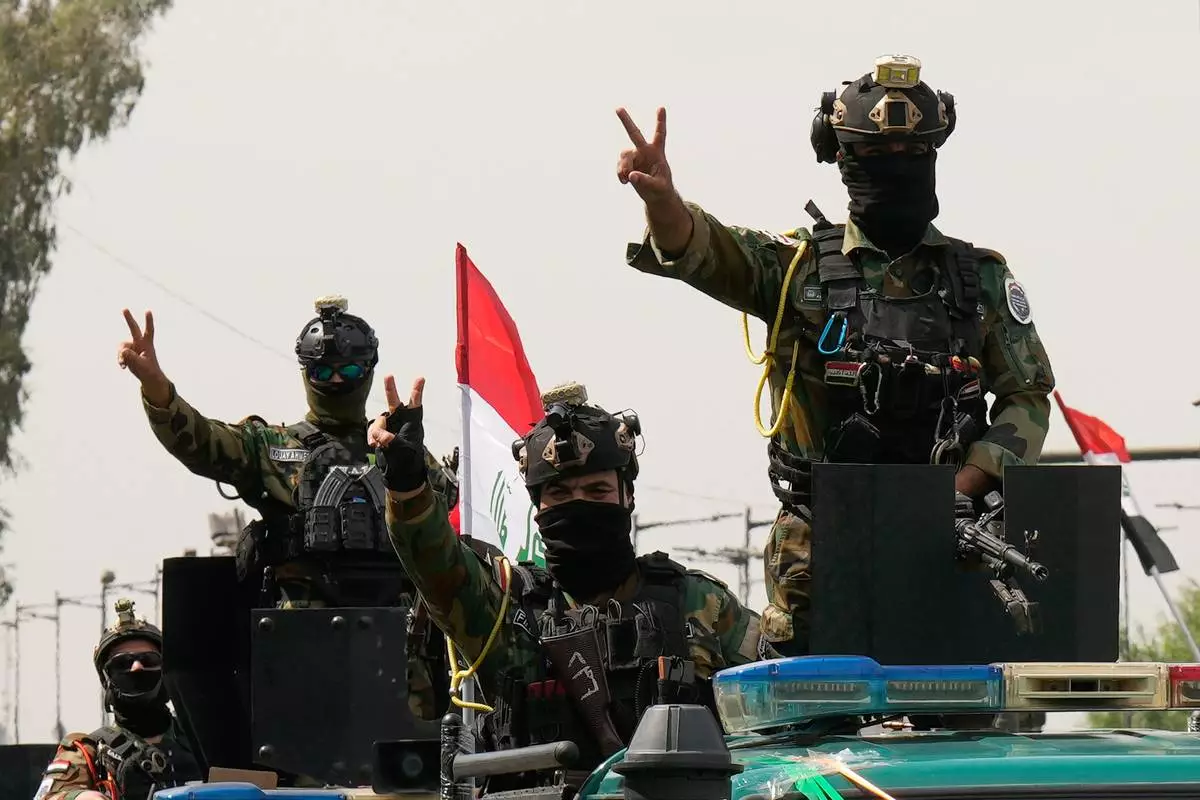
Iraqi security officers flash victory signs while riding in vehicles decorated with national flags during a convoy celebrating the complete withdrawal of U.S. troops from Iraq, in Baghdad, Iraq, Wednesday, Sept. 30, 2026. (AP Photo/Hadi Mizban)

Iraqi security officers flash victory signs while riding in vehicles decorated with national flags during a convoy celebrating the complete withdrawal of U.S. troops from Iraq, in Baghdad, Iraq, Wednesday, Sept. 30, 2026. (AP Photo/Hadi Mizban)

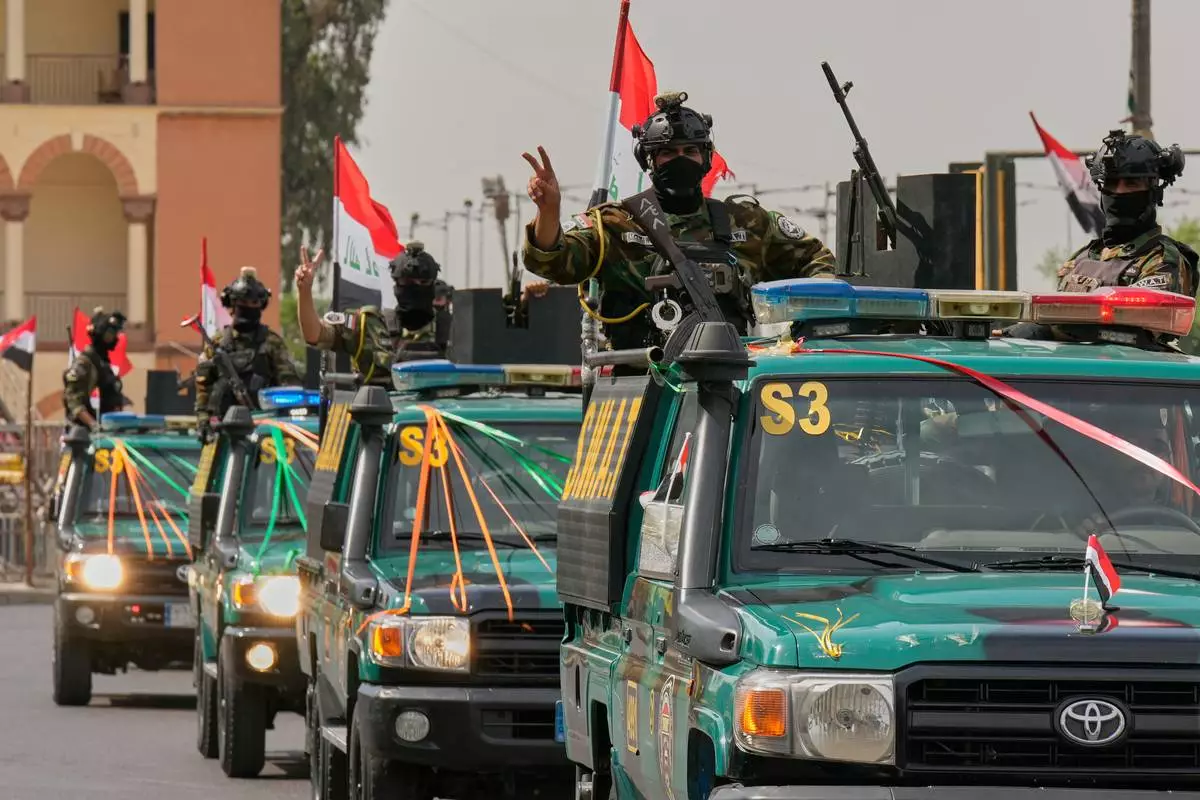
Iraqi security officers flash victory signs as they ride on vehicles decorated with national flags and ribbons during a convoy celebrating the complete withdrawal of U.S. troops from Iraq, in Baghdad, Iraq, Wednesday, Sept. 30, 2026. (AP Photo/Hadi Mizban)

Iraqi security officers flash victory signs as they ride on vehicles decorated with national flags and ribbons during a convoy celebrating the complete withdrawal of U.S. troops from Iraq, in Baghdad, Iraq, Wednesday, Sept. 30, 2026. (AP Photo/Hadi Mizban)

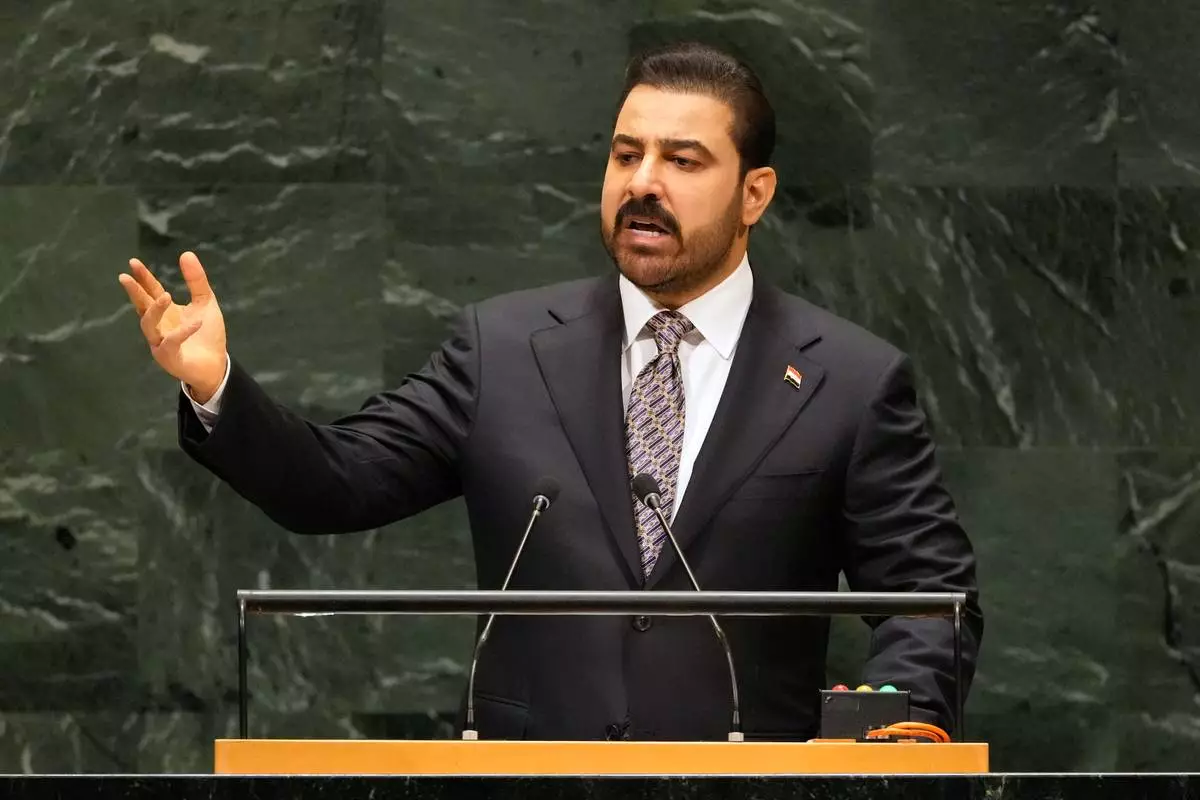
Iraq's Prime Minister Ali al-Zaidi speaks during the 81st session of the United Nations General Assembly at United Nations headquarters, Friday, Sept. 25, 2026. (AP Photo/Seth Wenig)

Iraq's Prime Minister Ali al-Zaidi speaks during the 81st session of the United Nations General Assembly at United Nations headquarters, Friday, Sept. 25, 2026. (AP Photo/Seth Wenig)

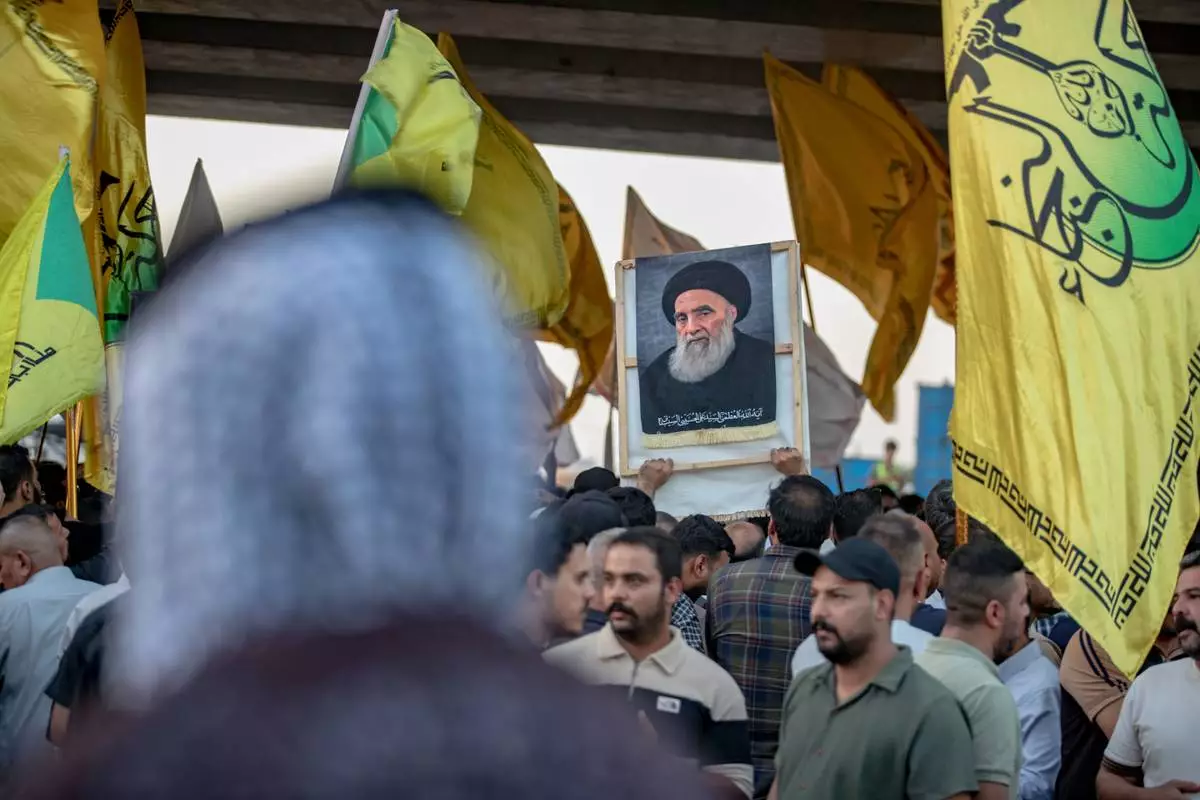
A demonstrator holds a portrait of Iraq's top Shiite cleric, Grand Ayatollah Ali al-Sistani, during a protest against the suspension of flights between Iraq and Iran outside Najaf International Airport in Najaf, Iraq, Monday, Sept. 28, 2026. (AP Photo/Anmar Khalil)

A demonstrator holds a portrait of Iraq's top Shiite cleric, Grand Ayatollah Ali al-Sistani, during a protest against the suspension of flights between Iraq and Iran outside Najaf International Airport in Najaf, Iraq, Monday, Sept. 28, 2026. (AP Photo/Anmar Khalil)

Recommended Articles