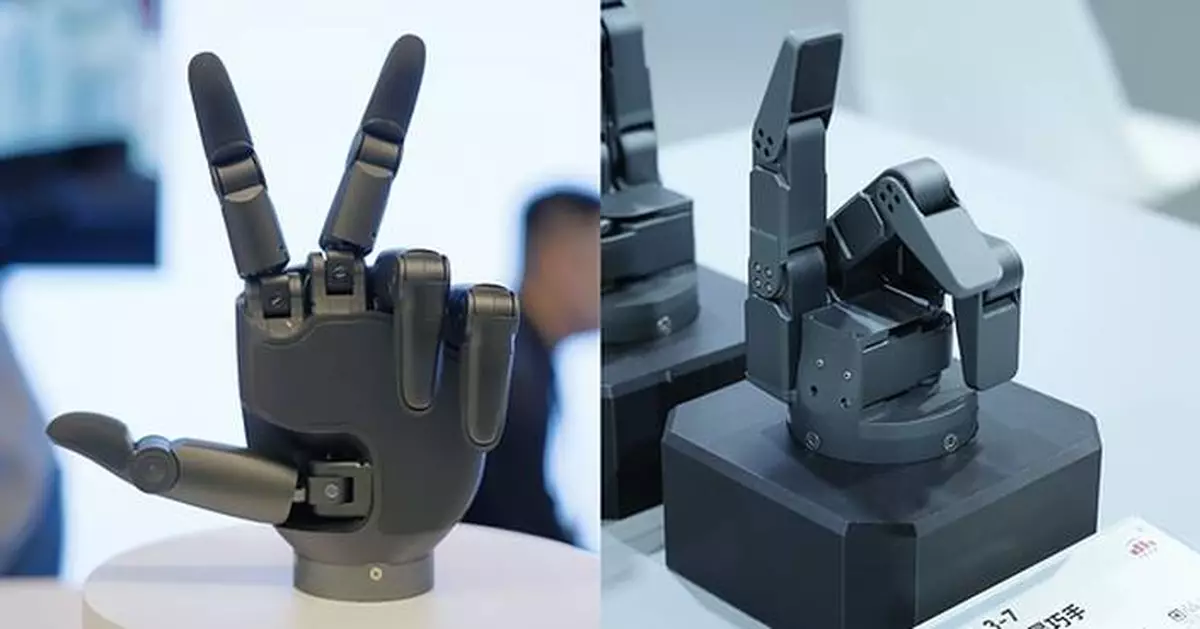
ADH-5-13 joins the deployment-focused UDH-3-7 and a portfolio of two-, three- and five-finger robotic end effectors
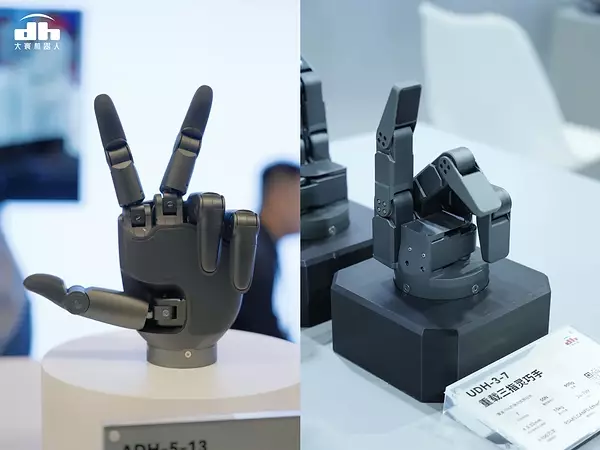
PITTSBURGH, Sept. 30, 2026 /PRNewswire/ -- DH-Robotics today debuted the ADH-5-13, a five-finger dexterous hand with 13 independently controllable active degrees of freedom (DOF), at IROS 2026 in Pittsburgh. The company also demonstrated the UDH-3-7, its three-finger direct-drive dexterous hand, alongside a portfolio of two-, three- and five-finger end effectors for a range of gripping and manipulation tasks.
The debut reflects DH-Robotics' "Dexterity as Productivity" approach: matching hand architecture, sensing and control to the manipulation requirements of embodied AI research, teleoperation and robotic systems.
ADH-5-13: a five-finger platform for multi-finger manipulation
The ADH-5-13 uses an anthropomorphic five-finger configuration with 13 active DOF. The thumb, index finger and middle finger each have three DOF; the ring and little fingers each have two. The index and middle fingers also provide ±15° of lateral motion for a broader range of multi-finger poses.
At 735 g, the hand is designed to balance dexterity with system weight. DH-Robotics specifies a maximum lifting payload of up to 20 kg once an object is grasped.
The ADH-5-13 integrates fingertip tactile sensing and can accommodate additional sensing options, including electronic skin, six-axis force/torque sensors and vision-based tactile sensors. Sensors and individual modules can be replaced without dismantling the entire hand or a full finger, simplifying service and maintenance. According to DH-Robotics, this serviceable design improves maintenance efficiency by 300%, helping reduce downtime and operating and maintenance costs.
The hand's fully direct-drive, backdrivable architecture provides independent control of all 13 active DOF. Dual magnetic encoders at each joint provide position feedback, and DH-Robotics specifies fingertip positioning repeatability of ±0.2 mm. The company says the architecture supports hybrid force/position control and compliant contact behavior in manipulation tasks.
UDH-3-7: strength, flexibility and a compact three-finger form factor
The UDH-3-7 is built around a streamlined three-finger configuration with seven active DOF. DH-Robotics specifies a maximum payload of 15 kg, maximum fingertip force of 50 N, positioning repeatability of ±0.02 mm and a design life of one million cycles.
The hand also uses a direct-drive, backdrivable design. Its thumb supports a 180° range of rotation and opposition, enabling different grasp configurations for objects with varied shapes and materials.
UDH-3-7 supports CAN FD, RS-485 and EtherCAT. Development tools support C++ and Python, while ROS 2 integration and workflows using Isaac and MuJoCo can help teams evaluate and integrate the hand in embodied AI systems.
A portfolio organized around the task
DH-Robotics positions its two-, three- and five-finger end effectors around distinct manipulation needs:
- Two-finger end effectors: general-purpose gripping and grasping.
- Three-finger dexterous hands: a balance of strength, dexterity and working space for manipulation.
- Five-finger dexterous hands: coordinated multi-finger manipulation and more complex dexterous tasks.
IROS attendees can see the portfolio at Booth #1008 through Sept. 30. The IROS 2026 conference runs Sept. 27–Oct. 1 in Pittsburgh.
About DH-Robotics
DH-Robotics develops robotic end effectors and precision motion-control components for industrial automation and embodied AI. Its portfolio includes electric grippers, dexterous hands, linear coil actuators, rotary grippers and servo electric cylinders. Learn more: https://en.dh-robotics.com/.
** This press release is distributed by PR Newswire through automated distribution system, for which the client assumes full responsibility. **
DH-Robotics Debuts 13-DOF Direct-Drive Dexterous Hand at IROS 2026
- Most CFOs report their role has expanded into enterprise technology or AI strategy leadership
- By 2030, more than half of surveyed CFOs expect to help design financial and ethical guardrails for AI
ARMONK, N.Y., Sept. 30, 2026 /PRNewswire/ -- A new global study from the IBM (NYSE: IBM) Institute for Business Value finds that as AI becomes more integrated into enterprise operations and decision-making, CFOs are taking on a larger role in shaping enterprise priorities around AI, helping turn strategy into execution, and determining how investments and capital allocation support them.
The study* of 1,500 CFOs found that 62% of respondents say their role has expanded into enterprise technology or AI strategy leadership, 56% report greater portfolio-management and capital reallocation authority, and 54% have taken on more responsibility for business model or growth strategy design. Yet only 6% of surveyed CFOs say finance has reached a transformation-ready state, with AI consistently embedded into finance workflows and decision-making at scale.
More than half of surveyed CFOs report that by 2030 they expect to have greater responsibility for designing financial and ethical guardrails for AI (56%), shaping operating models, workforce strategies and organizational structure (55%), and driving enterprise value creation and portfolio strategy (52%).
James Kavanaugh, IBM Chief Financial Officer, writes in the study's foreword: "Historically, the CFO was viewed as the guardian of stability, responsible for financial discipline and controllership of risk. Those responsibilities remain essential. But today, it's not enough for CFOs and their teams to simply evaluate decisions. They need to shape them from the start – connecting strategy to execution, insight to action, and technology to value creation."
The study also identifies a group of AI-first CFOs whose organizations demonstrate advanced capabilities across enterprise strategy, AI governance, integrated intelligence, capital allocation, and long-term planning. These CFOs are twice as likely as their peers to help design enterprise-wide business-model experiments or lead initiatives that could shape their industries.
Other key findings include:
Data-driven insights are changing how CFOs approach capital allocation
- 48% of CFOs say their organizations frequently update capital allocation for AI and growth investments using real-time, data-driven insights, while 38% say their approach is informed by data but slow to adjust.
- 48% of CFOs say finance actively tracks AI-driven value creation and reallocates capital accordingly, but just 8% say finance leads enterprise-wide AI value goals and has automated investment triggers tied to those results.
- Only 6% of respondents allow AI to recommend or execute reallocations within defined guardrails.
Finance is developing AI skills faster than it is redesigning work around AI
- Nearly half (48%) of CFOs describe finance as being in the developing stage, where targeted AI skills remain concentrated in specific roles, teams or use cases rather than scaled across the function.
- 42% of CFOs say finance has reached a high stage of AI readiness, with AI-fluent teams capable of scaling AI.
- Only 6% of respondents describe finance as transformation-ready with AI consistently embedded into workflows and decision-making at scale.
Organizations led by AI-first CFOs report stronger execution and better outcomes
- Organizations led by AI-first CFOs achieved revenue growth rates 23% higher relative to peer organizations from 2022 to 2024.
- AI-first CFOs are 18% more likely to report that their organization executes its enterprise strategy effectively.
- Organizations led by AI-first CFOs approve funding for new AI initiatives 15% faster than peer organizations.
The study includes a playbook for CFOs on connecting enterprise strategy, AI governance, decision-making, capital allocation and long-term flexibility to create value. To view the full report, visit: https://www.ibm.com/thought-leadership/institute-business-value/en-us/c-suite-study/cfo
The study also features perspectives from CFOs across industries on how finance leaders are turning AI ambition into disciplined execution. A selection of these quotes is available in the addendum below.
*Study Methodology
The IBM Institute for Business Value, in cooperation with Oxford Economics, conducted a survey of 1,500 CFOs and equivalent senior finance leaders across 33 geographies and 26 industries from February to April 2026. A composite performance measure was developed using respondents' assessments of organizational growth, efficiency and productivity, agility and adaptability, and risk preparedness relative to competitors. Additional analysis was conducted to measure which organizational capabilities, leadership practices, and investment approaches are closely tied to stronger business outcomes.
The IBM Institute for Business Value, IBM's thought leadership think tank, combines global research and performance data with expertise from industry thinkers and leading academics to deliver insights that make business leaders smarter. For more world-class thought leadership, visit: www.ibm.com/ibv. To receive more insights, subscribe to the IdeaWatch newsletter: https://ibm.co/ibv-ideawatch.
About IBM
IBM is a leading provider of global hybrid cloud and AI, and consulting expertise. We help clients in more than 175 countries capitalize on insights from their data, streamline business processes, reduce costs and gain the competitive edge in their industries. Thousands of government and corporate entities in critical infrastructure areas such as financial services, telecommunications and healthcare rely on IBM's hybrid cloud platform and Red Hat OpenShift to affect their digital transformations quickly, efficiently and securely. IBM's breakthrough innovations in AI, quantum computing, industry-specific cloud solutions and consulting deliver open and flexible options to our clients. All of this is backed by IBM's long-standing commitment to trust, transparency, responsibility, inclusivity, and service. Visit www.ibm.com for more information.
Media Contact
Marisa Conway
IBM Corporate Communications
conwaym@us.ibm.com
Executive Perspectives:
"Going forward, we want to delegate generating forecasts to AI and shift human effort toward higher-level decision-making." – Koichi Takahashi, Member of the Board and Senior Executive Officer, CFO, Daikin Industries
"If relevant data can be generated quickly and provide some indication of what lies ahead, we can make decisions proactively rather than reactively." – Mitsuru Hashimoto, Executive Officer, Chief General Manager, Corporate Planning & Finance Center, Yamaha Motor Co., Ltd.
"Capital allocation should operate dynamically and be reviewed continuously as opportunities and conditions change." – Hisako Takada, Senior Executive Officer and CFO, Advantest
"Given today's pace of change, you have to stay alive to new opportunities. So rather than commit all investments through the budget process, keep an element of funds ready to allocate to new initiatives as they take flight." – Lindsey Crossland, Group CFO, KPMG UK
"Finance needs to bring analytics and insights together to enable the business to make better decisions. And then we need to get out of the way and let the business do what it needs to do." – Erika Taurel, CFO, Lummus Technology
** This press release is distributed by PR Newswire through automated distribution system, for which the client assumes full responsibility. **

IBM Study: As AI Scales Enterprise-Wide, CFOs Play an Expanded Role in Transformation