SAN FRANCISCO--(BUSINESS WIRE)--Oct 1, 2026--
Hims & Hers Health, Inc. (NYSE: HIMS), the leading global health and wellness platform, today announced two new clinical experts will join its global medical leadership team, led by Global Chief Medical Officer Pat Carroll, MD. Kultar Garcha, MD, will serve as Chief Medical Officer of the UK and EMEA, and Matt Vickers, FRACGP, MBBS, BMedSci, AICGG, will serve as Chief Medical Officer of Hims Australia. The appointments mark the company’s latest step in strengthening the local clinical leadership that underpins its international growth and pursuit to deliver access to personalized care.
This press release features multimedia. View the full release here: https://www.businesswire.com/news/home/20261001442387/en/
"We believe the only way to grow internationally is to invest in leaders who have a deep understanding and expertise in these markets," said Dr. Pat Carroll, Global Chief Medical Officer at Hims & Hers. "Dr. Garcha and Dr. Vickers bring nearly 30 years of combined experience in public healthcare systems, seeing patients regularly. They know the regulatory landscape, but just as important, they know what it's actually like for a patient trying to get care in each of these systems. That's the kind of leadership we're proud to bring into Hims & Hers as we scale."
Dr. Garcha has over two decades of experience across public and private UK and international health systems, including clinical leadership roles at Flow Neuroscience and Babylon Health, and almost 15 years as a practicing NHS GP. His clinical focus has included expanding perinatal mental health care, as well as examining functional and behavioral health outcomes in perimenopause and menopause. He sits on the National Institute for Health and Care Excellence's (NICE) Quality Standards Advisory Committee, where he helps develop quality standards that set out priorities for improving care in England. Dr. Garcha will oversee clinical quality, patient safety, and prescribing standards across the UK and EMEA.
“As a GP, my job has always been to look at the whole person, not just the problem in front of me,” said Dr. Garcha, Chief Medical Officer of the UK and EMEA at Hims & Hers. “Hims & Hers takes that same instinct and gives it a deeper impact, bringing comprehensive care to patients broadly. I’m looking forward to making sure that care reaches more people, regardless of where someone lives or how well they can navigate the traditional healthcare system."
Dr. Vickers is a practicing GP and supervisor with more than a decade of experience in family medical practice. Since 2019, he has led health-tech efforts at Eucalyptus, helping build its model of care, clinical governance, and research capabilities. He is a vocal advocate for improving clinical governance and safety in health-tech organizations, with a focus on prevention and using digital health to scale access to high-quality care. As Chief Medical Officer, he will lead clinical strategy in Australia as Hims & Hers deepens its presence in the region.
“Practicing family medicine, I saw how much access to care depends on where you live — rural communities carry some of the highest rates of chronic disease, and some of the lowest access to care,” said Dr. Vickers, Chief Medical Officer of Hims Australia. “Hims Australia has the ability to get care to patients the same day, wherever they live, without lowering the bar on how that care is delivered. Few things in medicine can change outcomes at this scale, and it's why I’m so passionate about this work.”
Dr. Garcha and Dr. Vickers join the company’s international medical leadership bench, which includes Sandy Van, MD, CCFP, ABOM Dipl, who has served as Chief Medical Officer of Hims & Hers Canada since December 2025.
About Hims & Hers Health, Inc.
Hims & Hers is the leading global health and wellness platform on a mission to help the world feel great through the power of better health. We believe how you feel in your body and mind transforms how you show up in life. That’s why we’re building a future where nothing stands in the way of harnessing this power. Hims & Hers normalizes health & wellness challenges—and innovates on their solutions—to make feeling happy and healthy easy to achieve. No two people are the same, so the Company provides access to personalized care designed for results. For more information, please visit www.hims.com and www.forhers.com.

Kultar Garcha, MD, joins as Chief Medical Officer of the UK and EMEA, and Matt Vickers, FRACGP, MBBS, BMedSci, AICGG, is named Chief Medical Officer of Hims Australia, guiding clinical strategy as Hims & Hers continues to expand internationally
Political power in legislatures and governors' offices is at stake in the November elections in more than one-third of the states, creating down-ballot drama in the midterms that could have significant implications for President Donald Trump’s agenda.
Outside groups aligned with the two major parties have pledged heavy spending in a battle for control of closely divided legislatures in at least a half-dozen states. But that's just the tip of the spear in their political jousting.
In numerous other states, the parties are striving to make or break a legislative supermajority — an important threshold that allows them to enact laws with little regard to dissent. And in several states, competitive gubernatorial races could determine whether one party achieves a political trifecta, grasping hold of both legislative chambers and the top executive spot.
Party control of state governments can shape policies on contentious issues including abortion, school choice, data centers and the use of law-enforcement surveillance cameras. In a few states, the electoral outcomes this cycle could also have congressional redistricting implications for 2028.
The state races also carry significant implications for Trump's agenda, because the elected officials can either aid or resist his immigration enforcement actions, social safety net limitations and efforts to alter voting procedures.
All told, voters in 46 states will choose more than 6,100 lawmakers in November, accounting for about 83% of all legislative seats nationwide, according to the National Conference of State Legislatures. Thirty-six states will hold gubernatorial elections.
Historically, the party of the president typically loses U.S. House seats in midterm elections. That also is true of state legislative seats.
In midterm elections over the past 50 years, the president's party has lost an average of 7.9% of its house and assembly seats up for reelection in states, according to research by Steven Rogers, a political science professor at Saint Louis University. In Trump's first midterm, in 2018, Republicans lost 8.7%, Rogers said.
A similar showing this year could spell the end of Republican control of legislative chambers in Arizona, Michigan, New Hampshire, Pennsylvania and Wisconsin. Minnesota currently has the nation's tightest margins, with an even split between Democrats and Republicans in the House and a one-seat Democratic edge in the Senate.
Trump's poor public approval ratings could play a role in those states. For voters choosing state house and assembly candidates, presidential approval typically has three times the impact of state legislative approval, Rogers said.
Edith Jorge-Tuñón, president of the Republican State Leadership Committee, conceded that her party is in a defensive position.
“I think we knew going into this cycle, Democrats have an advantage,” said Jorge-Tuñón, whose group works to elect Republicans to legislative seats and statewide offices. But she argued that voter frustration with Democratic leadership in states like Minnesota or Oregon could provide a buffer against that advantage.
Wisconsin provides an example of how political power could swing. Democrats haven't fully controlled Wisconsin's government since 2010. But new legislative districts, ordered by the liberal-controlled Wisconsin Supreme Court, give Democrats a shot at flipping both Republican-led chambers.
Democrats’ hopes run through downtown Racine. Located along the shores of Lake Michigan north of Chicago and south of Milwaukee, Racine is a Democratic stronghold known both for its rich manufacturing past and as the kringle capital of Wisconsin. Danish immigrants brought the buttery, oval-shaped pastry to the area in the 1800s, and bakeries in downtown Racine continue to make the sweet treats and ship them around the country.
Under Republican-drawn maps enacted in 2011, most of Racine was removed from the 21st Senate District to make the seat safe for Republicans. But the new map added back the city’s north side and more Democratic-favorable areas in Milwaukee County and removed conservative rural areas.
The Republican incumbent decided to retire rather than seek reelection under the more competitive lines, further bolstering Democratic hopes.
Democrats are optimistic they will pick up the two seats needed to flip control of the Senate in November. They need to flip five seats to gain control of the Assembly. An open governor's office, also on the ballot, gives them a shot at full control.
“In a year like this with the president and his war jacking up the prices of gas, Democrats are in a really strong position,” said Will Karcz, spokesperson for Wisconsin Senate Democrats.
In North Carolina, Republicans need to gain just one state House seat — without losing any Senate seats — to reestablish a three-fifths supermajority. That threshold is important because it gives Republicans the ability to override vetoes by Democratic Gov. Josh Stein without needing any Democratic votes.
Iowa Republicans face a similar math equation to regain a two-thirds legislative supermajority, which could matter even more if Democrats win the race to replace Republican Gov. Kim Reynolds, who chose not to seek reelection.
A loss of just one state Senate seat could cost Republicans a supermajority in Florida. Meanwhile, a pickup of one seat could result in a new Democratic supermajority in New York.
Among other battlegrounds, a swing of just a few seats could break a Republican supermajority in Missouri and gain Democratic supermajorities in Colorado and Nevada.
If Democrats are able to win full control in Minnesota, Pennsylvania or Wisconsin, they could use their new trifectas to redraw U.S. House districts ahead of the 2028 elections. They would be copying tactics employed by Republicans ahead of this year's elections in states such as Texas and Florida and by Democrats in California.
Republicans currently hold 20 of the 33 total congressional seats in those three northern states. So Democrats could make notable gains if they redraw districts to their advantage.
In Arizona and Michigan, where Republicans also hold an edge in congressional seats, redistricting would be more difficult because the task is assigned to an independent commission. California was in a similar situation. But Democratic lawmakers there placed an amendment on the statewide ballot last year allowing them to sidestep a commission to enact a new congressional map.
Both major parties are openly fundraising off the partisan redistricting stakes.
“Every election in this moment … potentially is about redistricting,” said Heather Williams, president of the Democratic Legislative Campaign Committee.
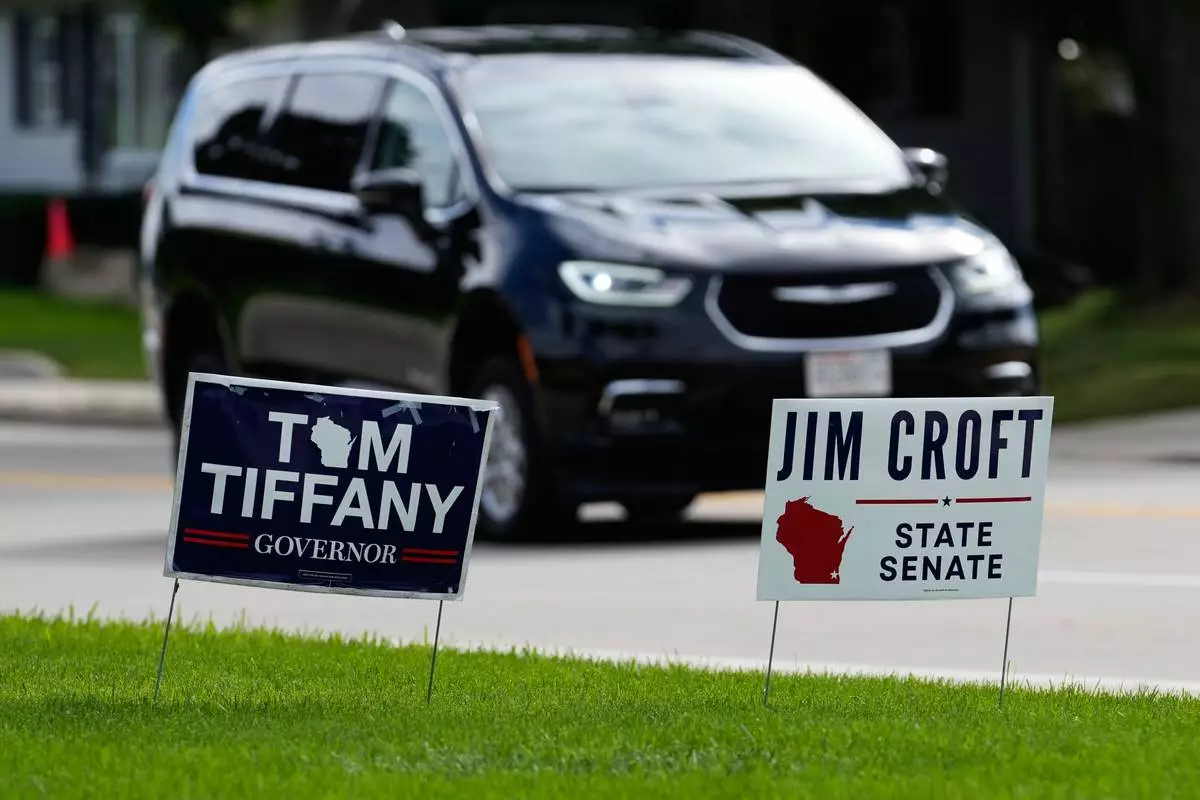
Signs for Republican candidates in the 2026 midterm election are seen outside of a home in Racine, Wis., Tuesday, Sept. 22, 2026. (AP Photo/Nam Y. Huh)

People walk past a sign directing voters on the first day of early voting in Minnesota at the Elections & Voter Services building in Minneapolis, Friday, Sept. 18, 2026. (AP Photo/Ellen Schmidt)