THE ATACAMA DESERT, Chile (AP) — Spring has finally arrived in the Southern Hemisphere and, in Chile, even the desert is blossoming.
Known as the driest nonpolar desert on Earth, a massive portion of the Atacama Desert has been covered in flowers after the El Niño weather pattern brought heavy rains to the region earlier this year. The unusually large amount of water allowed millions of seeds and bulbs to sprout and bloom, many of them after remaining dormant for decades.
Click to Gallery
Dew droplets cling to a flower among a carpet of blooms covering the Atacama Desert near Copiapo, Chile, Friday, Sept. 25, 2026. (AP Photo/Esteban Felix)
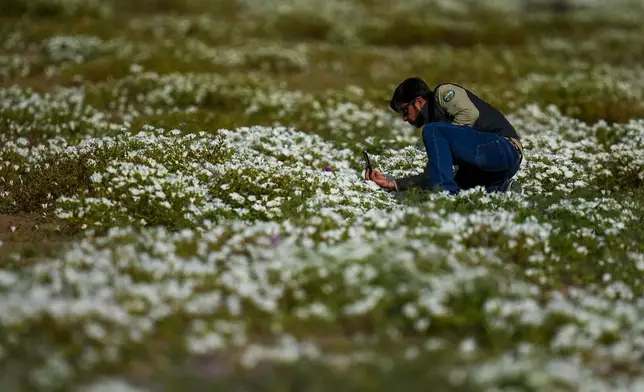
César Pizarro, head of conservation for the National Forestry Corporation (CONAF), takes photos of flowers in a carpet of blooms covering the Atacama Desert after rains near Copiapó, Chile, Thursday, Sept. 24, 2026. (AP Photo/Esteban Felix)
Dew droplets cling to a flower among a carpet of blooms covering the Atacama Desert near Copiapo, Chile, Friday, Sept. 25, 2026. (AP Photo/Esteban Felix)
The sun sets behind flowers in a carpet of blooms covering the Atacama Desert after rains near Copiapó, Chile, Thursday, Sept. 24, 2026. (AP Photo/Esteban Felix)
A carpet of flowers covers the Atacama Desert after rains near Copiapo, Chile, Thursday, Sept. 24, 2026. (AP Photo/Esteban Felix)
“It is a unique phenomenon; there are more than 200 plant species,” Jorge Carabantes, head of the Protected Areas Department at the National Forest Corporation (CONAF), told The Associated Press. “This is a flowering event that is obviously extraordinary and unusual, very different from other blooms that occur elsewhere on the globe.”
The Atacama lies between the Pacific Ocean and the Andes Mountains, stretching some 1,600 kilometers (1,000 miles) all the way down the northern coast of Chile.
Although flowering is common during the transition from winter to spring, this year the rocky, brownish dunes that make up the desert’s traditional landscape have turned into a vibrant, colorful carpet of wildflowers during a historic Desierto Florido, or “flowering desert.”
“I always thought it was just going to be brown. That’s my image of a desert, just brown,” said Felix Banda, 51, who was born in Chile but has lived his whole life in Australia. “I knew that it had rained a lot, so I was expecting to see some beautiful greenery, but this is an incredible landscape,” he added about his first visit to the Atacama.
Between July and August, Chile recorded record rainfall in several regions, with some levels never seen since measurements began in the 1950s. The heavy precipitation was driven by a super El Niño, a climate phenomenon that causes sharp rises in global temperatures and is becoming increasingly strong.
“Since rainfall records began, these are the most significant figures in terms of volume: 160, 180, 190 millimeters (6 to 7 inches) in some locations,” explained biologist César Pizarro, head of the Biodiversity Conservation Section at CONAF Atacama. “What has happened now has an origin, and it is called ‘super El Niño.’”
The storms have caused flooding, havoc and devastation in several parts of Chile. In the north, they have also enabled the historic desert bloom, with an estimated coverage of some 17,000 square kilometers (6,560 square miles) this year. This area is similar in size to the Santiago Metropolitan Region, the country’s largest and most populous area.
According to CONAF projections, this is expected to be the most intense and extensive Desierto Florido since 1997.
That's because, Pizarro said, the heavy rainfall activated the desert’s biological material, known as germplasm. This includes seeds, bulbs, and tubers but also the eggs of various invertebrates and reptiles.
The result is a true visual spectacle featuring more than 200 species of plants and flowers in a variety of colors, shapes and forms. Red and yellow ñañucas, purple rock purslane, white suspiros, orange terciopelos and the native garra de león, one of the desert’s most iconic species, have transformed the hills, plains and ravines of the Atacama.
“There are hills and mountain ranges where no greenery or flowers had been seen for more than 30 or 40 years,” Pizarro added. “This desert germplasm can remain (dormant) for many years, even decades. The hills this year are the best example of that.”
Whether arriving from within Chile or overseas, tourists are venturing into the remote, inhospitable areas of the Atacama to admire the millions of flowers adorning vast areas of the desert, stretching from the coast to the horizon.
According to data provided to the AP by the National Tourism Secretariat, the Atacama region is expected to see nearly 300,000 overnight trips by the time the natural phenomenon ends in November, positioning Desierto Florido as one of the region’s main tourist attractions this season.
Chef Franco Moya, 37, and his girlfriend traveled nearly 1,000 kilometers (about 620 miles) from Santa Cruz, a town in central Chile’s Colchagua Valley, to several parts of the desert to celebrate his birthday.
“It was striking to see how the flowers grow in such a dry place,” he said. “It’s my first time here ... and it was a truly surprising moment.”

Dew droplets cling to a flower among a carpet of blooms covering the Atacama Desert near Copiapo, Chile, Friday, Sept. 25, 2026. (AP Photo/Esteban Felix)
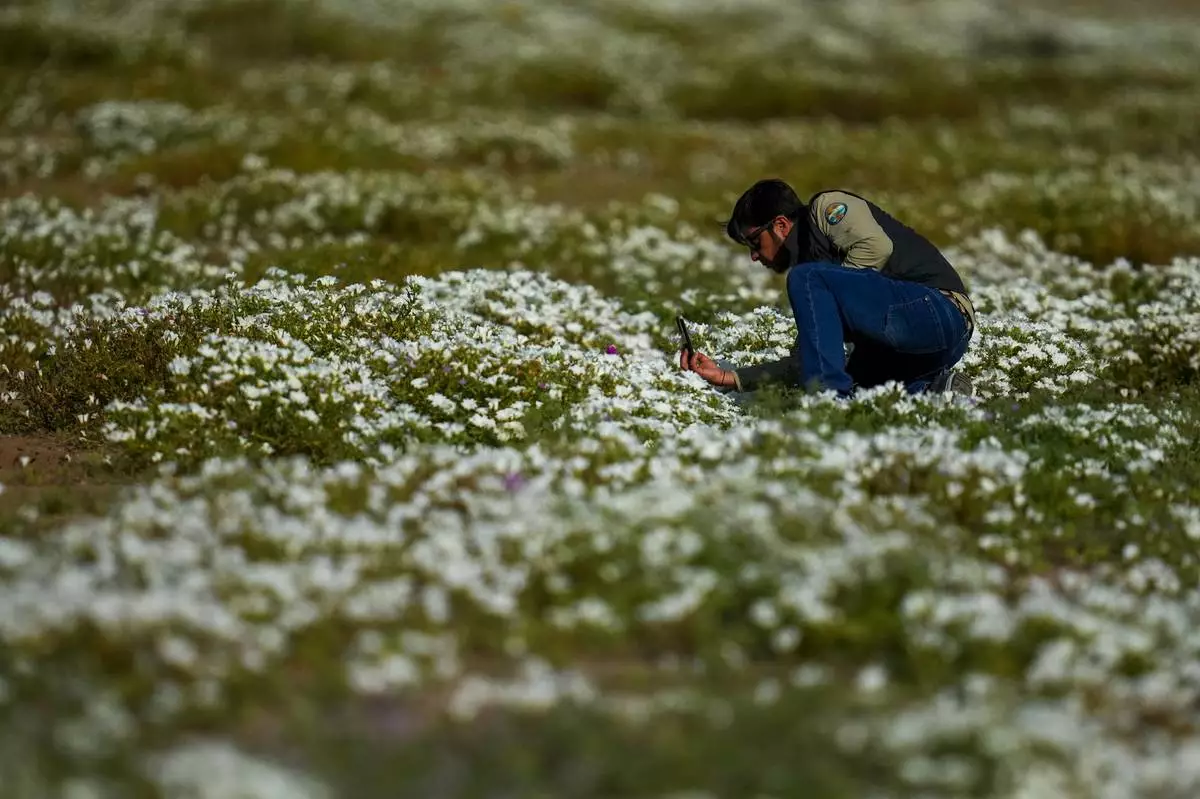
César Pizarro, head of conservation for the National Forestry Corporation (CONAF), takes photos of flowers in a carpet of blooms covering the Atacama Desert after rains near Copiapó, Chile, Thursday, Sept. 24, 2026. (AP Photo/Esteban Felix)

Dew droplets cling to a flower among a carpet of blooms covering the Atacama Desert near Copiapo, Chile, Friday, Sept. 25, 2026. (AP Photo/Esteban Felix)

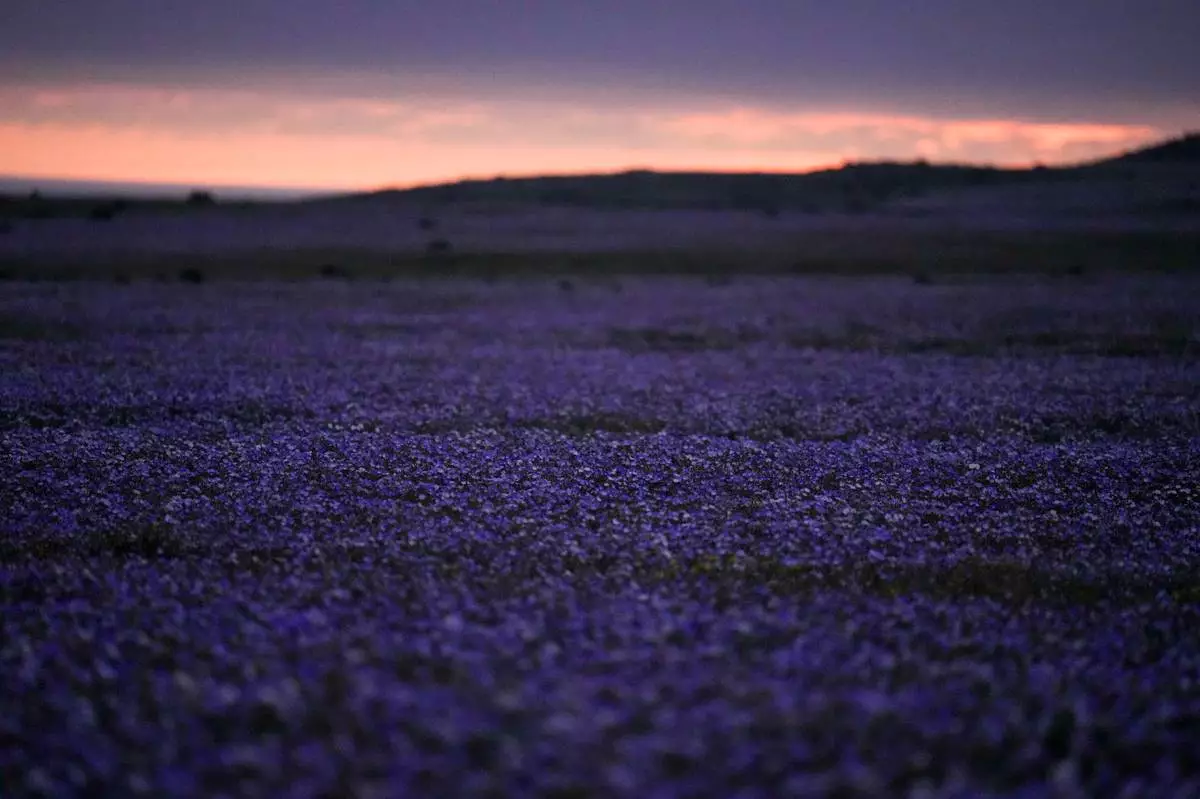
The sun sets behind flowers in a carpet of blooms covering the Atacama Desert after rains near Copiapó, Chile, Thursday, Sept. 24, 2026. (AP Photo/Esteban Felix)
A carpet of flowers covers the Atacama Desert after rains near Copiapo, Chile, Thursday, Sept. 24, 2026. (AP Photo/Esteban Felix)
KYIV, Ukraine (AP) — A Russian drone struck a school in Kyiv on Thursday, city officials said, as the Ukrainian capital endured another day of relentless aerial attacks.
Children and staff at the school were in shelters when the drone hit, Mayor Vitalii Klitschko said, and its warhead didn’t explode. No casualties were reported, but the building’s brick facade showed a large hole, revealing a staircase, and burn marks alongside smashed windows.
Kyiv has felt like a city under siege in recent weeks, with repeated air raid alerts, punctuated by loud explosions from drone and missile strikes. The onslaught aims to terrorize civilians, officials and analysts say, and break their will to resist 4½ years after Russia’s full-scale invasion.
The strain is showing. Maryna Lystopad, 35, said her hair has started falling out due to the stress from escalating attacks and never knowing where the next attack will hit.
"It’s really horrible. I can’t take it anymore. I think, I think that soon we’re all going to leave. I’m really not doing well,” she told The Associated Press. “I’m constantly anxious. I can’t relax. I keep thinking that if something happens, if something hits, one of my relatives could be killed.”
Lystopad said she recently had to travel to another part of Kyiv and had been “genuinely stressed" the whole way there.
“I kept checking, like, whether anything was flying in, where it was going, where am I supposed to go? Where am I supposed to run?” she said.
The front line in eastern and southern Ukraine hasn’t seen major shifts since last year, but the country is struggling to fend off Russia’s intensified aerial attacks on cities that include ballistic missiles and high-flying jet-powered drones.
Reflecting the urgency of Ukraine’s plight, President Volodymyr Zelenskyy said he held a conference call Thursday with senior military and government officials in charge of protecting infrastructure, as some areas fall behind on implementing previously agreed measures.
He said the Foreign Ministry and Defense Ministry will review agreements Ukraine has made with partner countries on supplying ammunition for air defenses and F-16 fighter jets, with an updated schedule of deliveries to be presented within 24 hours.
“It is important that we have additional missiles in October,” Zelenskyy said on social media.
In response to Russia's attacks, Ukraine has fired its long-range drones at manufacturing plants deep inside Russia and has targeted Russia’s drone launch sites. Zelenskyy said Thursday that Kyiv’s forces struck a site in Russia’s southwestern Oryol region that is used to store and launch attack drones.
Ukraine also has repeatedly attacked Russia's oil refineries from Moscow to Siberia, sparking a widespread fuel crisis. President Vladimir Putin said in a rare admission Thursday that because of these strikes, “according to our estimates, we lost around 1%" of gross domestic product.
“They started attacking oil refineries and openly declared the goal of damaging our economy. Did they achieve their goal? Partially,” Putin said at a meeting of the Valdai Club forum of international foreign policy experts.
Separately, Zelenskyy said Ukraine had deployed its domestically developed short-range FP-7 ballistic missile in combat for the first time, without elaborating on when or where the mission took place. Accompanying the post was an image of a missile being launched, and he said the next stage would be to scale up production. The Associated Press was not able to verify the claim independently.
To turn the tide, Ukraine needs U.S.-made Patriot missiles that can effectively defend against ballistic missiles, but they are in short supply since the Iran war began. A plan to produce them inside Ukraine could take years to bear fruit.
Kyiv is racing to produce interceptors that can bring down fast-moving jet-propelled drones as the swift cycle of military innovation during the war continues.
Ukraine wants tougher sanctions imposed on Russia to prevent it from getting key high-tech components for its arsenal.
Britain on Thursday imposed sanctions on 31 Russian individuals, entities and ships it says are linked to disinformation, attempts to avoid energy sanctions and the mistreatment of Ukrainian civilians in areas seized in the war by Russia.
Moscow, meanwhile, is pressing its advantage before Ukraine comes up with an answer to the latest challenges.
Two Russian drones hit an important bridge across the Dnipro River in Kyiv on Thursday, Klitschko said, with traffic suspended until a safety inspection could be done.
Also, the Parkovyi data center in Kyiv, which provides cloud services and server hosting, was critically damaged and has stopped operating following repeated Russian strikes, the company said. Client data has been moved to backup sites in the European Union, it said on Facebook.
Ukrainian officials didn’t report any energy infrastructure being hit Thursday, a day after what officials said was the biggest Russian attack on the power grid since spring.
Wednesday's barrage marked “the beginning of Russia’s strike campaign aimed at degrading Ukraine’s energy security ahead of winter … and forcing Ukraine to capitulate,” said the Institute for the Study of War, a Washington-based think tank.
Russia is expected to step up attacks on the electricity supply as the weather gets colder. It was 19 degrees Celsius (66 F) in Kyiv on Thursday, and mild temperatures were set to continue.
In a surprise development, Russia for the first time on Wednesday used a jet-powered drone fitted with a warhead designed to sever high-voltage pylons, said Serhii Beskrestnov, an adviser to Zelenskyy on defense technology.
AP reporter Volodymr Yurchuk in Kyiv contributed.
Follow the AP’s coverage of the war in Ukraine at https://apnews.com/hub/russia-ukraine
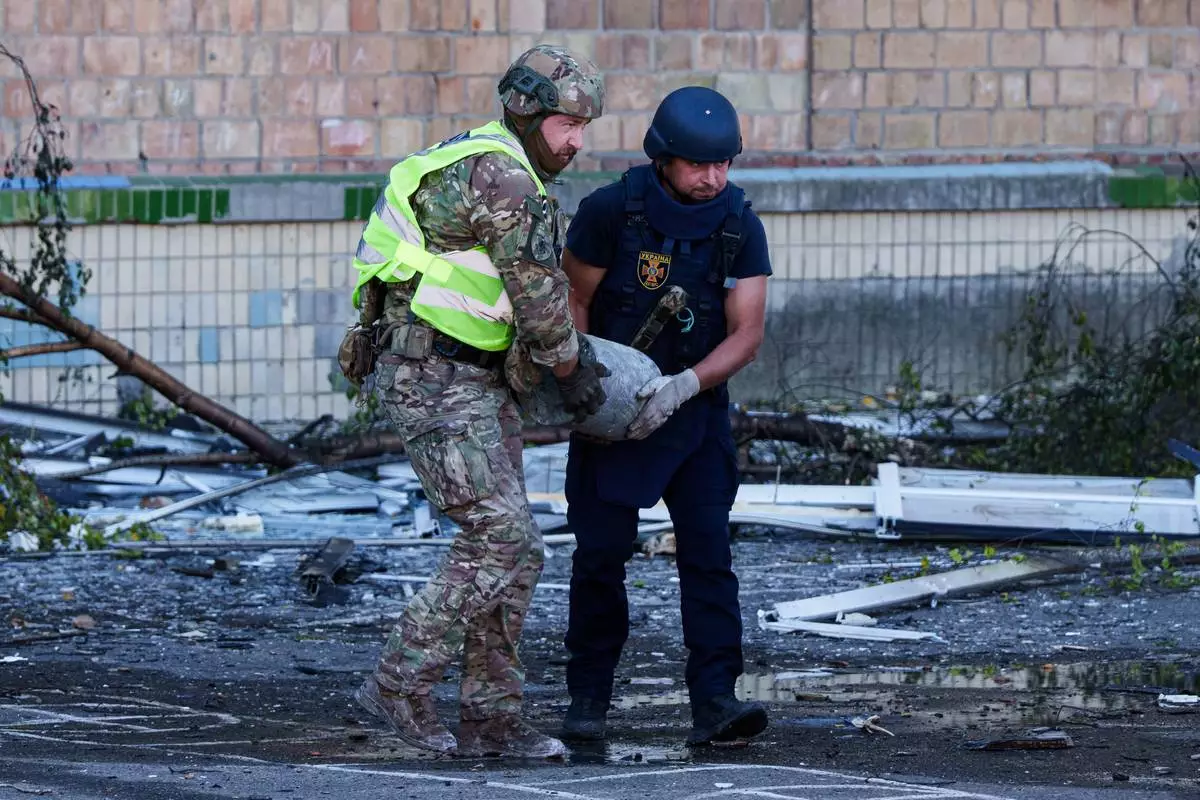
A police officer and a rescue worker carry an unexploded warhead from a Shahed drone out of a school damaged by a Russian strike on Kyiv, Ukraine, Thursday, Oct. 1, 2026. (AP Photo/Evgeniy Maloletka)
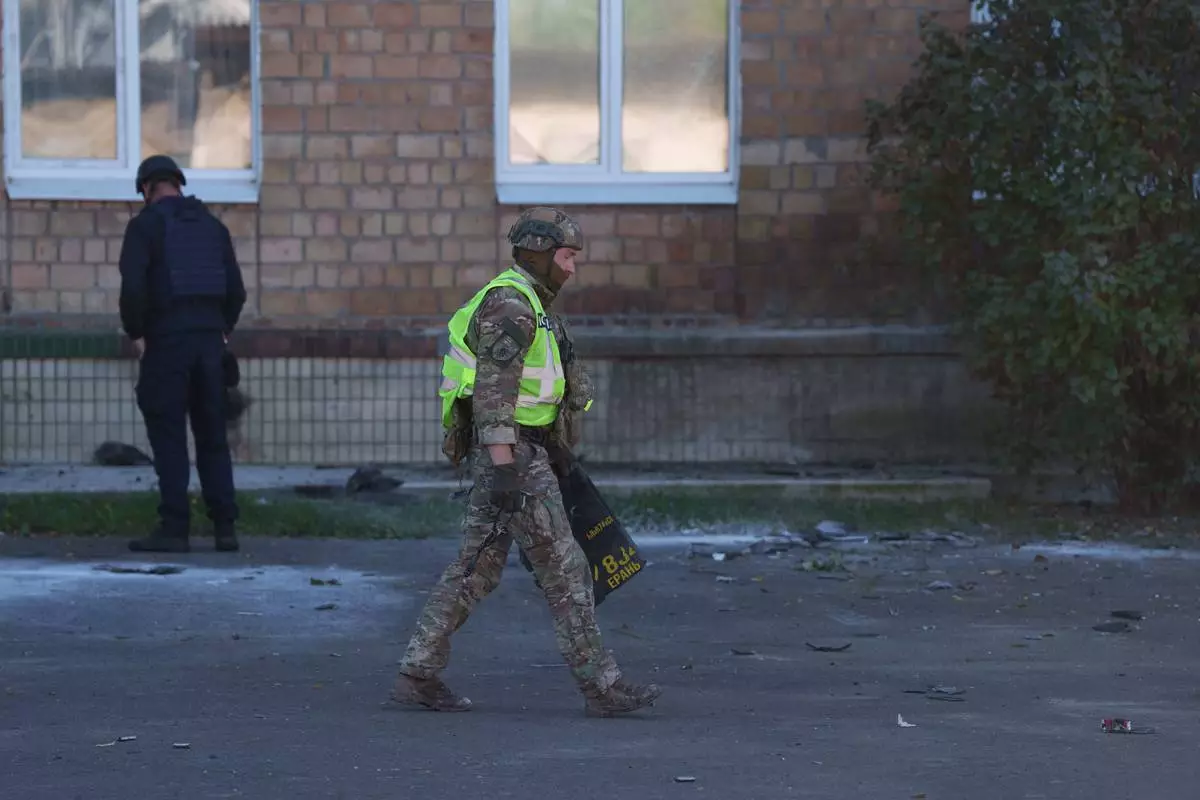
A police officer carries fragments of a Shahed drone in front of a school damaged by a Russian strike in Kyiv, Ukraine, Thursday, Oct. 1, 2026. (AP Photo/Evgeniy Maloletka)
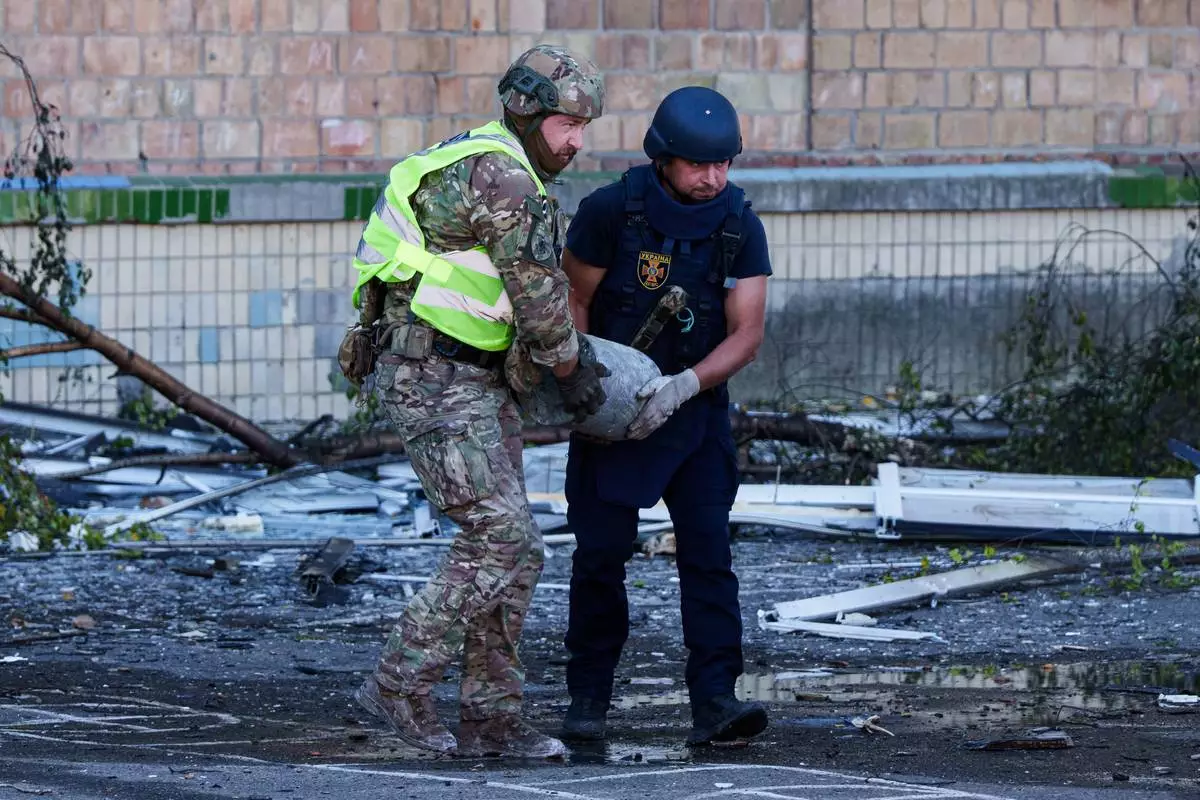
A police officer and a rescue worker carry an unexploded warhead from a Shahed drone out of a school damaged by a Russian strike on Kyiv, Ukraine, Thursday, Oct. 1, 2026. (AP Photo/Evgeniy Maloletka)
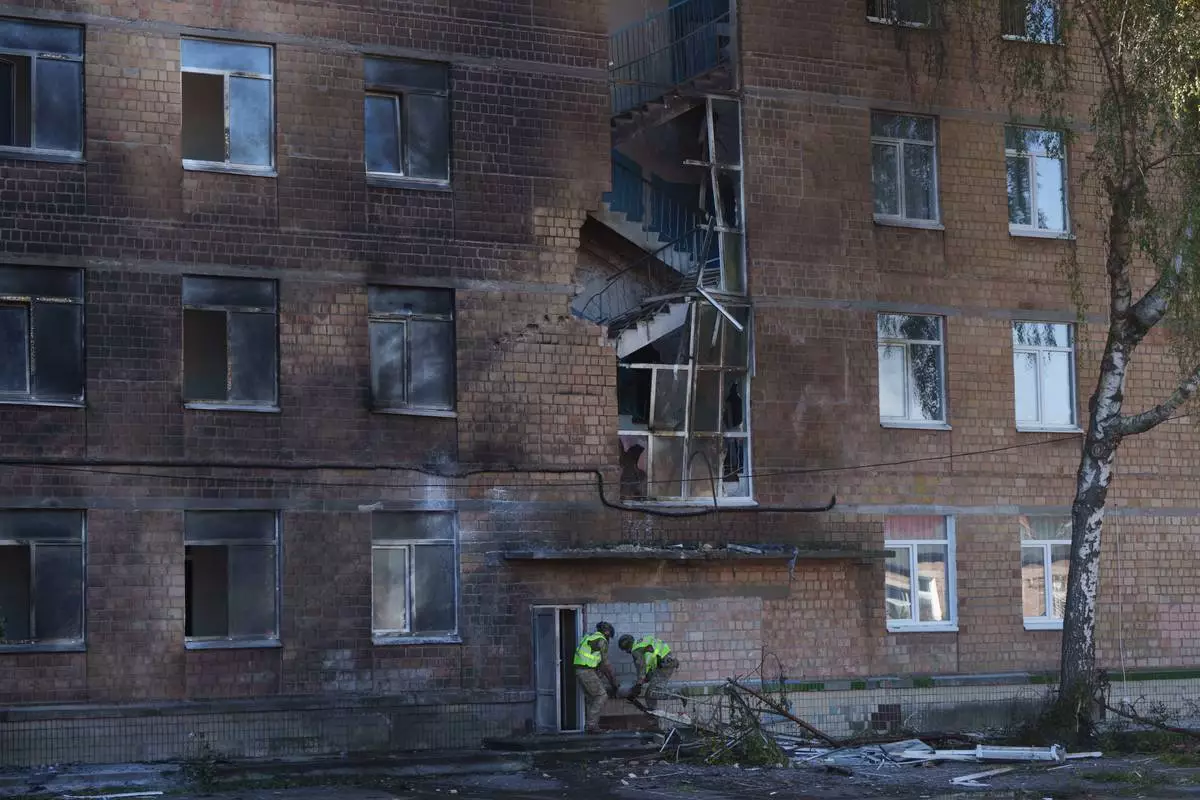
Police officers carry an unexploded warhead from a Shahed drone out of a school damaged by a Russian strike on Kyiv, Ukraine, Thursday, Oct. 1, 2026. (AP Photo/Evgeniy Maloletka)
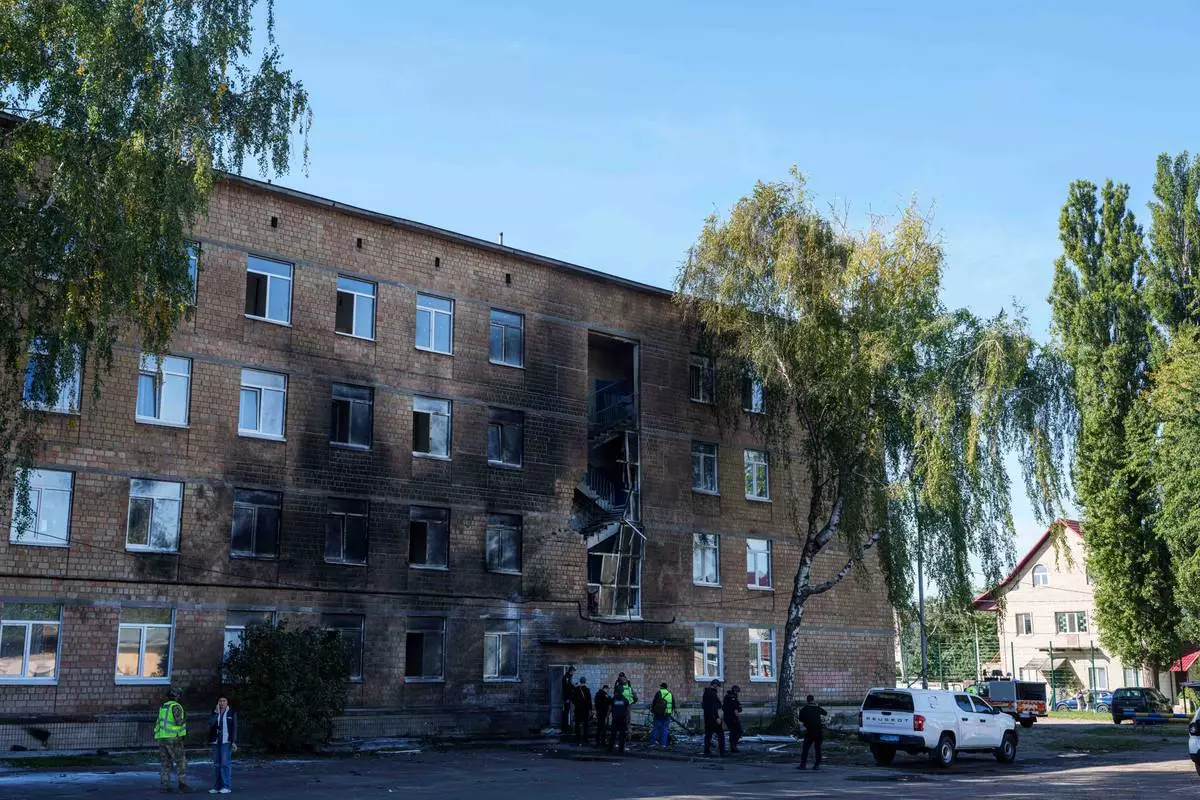
Police officers look at a school damaged by a Russian drone strike in Kyiv, Ukraine, Thursday, Oct. 1, 2026. (AP Photo/Evgeniy Maloletka)