
TEL AVIV, Israel (AP) — Israel will begin repatriation flights on Friday to bring back passengers stranded in the United Arab Emirates after commercial travel between the two countries was suspended in the wake of the attack on a pilot by his co-pilot who tried to crash a Tel Aviv-bound flight this week.
Authorities in Israel, Saudi Arabia, the UAE and beyond are grappling with the fallout from the incident on board the FlyDubai flight from Dubai on Wednesday. The attack has raised questions about the state of aviation security and further unsettled a Middle East already shaken by the ongoing U.S.-Iran war.
Nothing is publicly known about the motive of the co-pilot who came close to crashing the aircraft and killing all 182 people aboard. A regional investigation is underway.
The UAE has canceled all flights to Israel, complicating travel for hundreds of passengers who fly between the countries on a typical day.
Israel and the UAE agreed on the repatriation flights, beginning on Friday, according to an Israeli official who was not authorized to comment publicly and spoke on condition of anonymity. Earlier, the national carrier El Al said the UAE was holding up the necessary landing permits to allow it to fly into Dubai.
The Ben Gurion International Airport in Tel Aviv listed carriers Arkia and Israir with flights scheduled to arrive from Dubai late Friday and early Saturday. El Al was expected to fly passengers from Dubai to Israel on Sunday.
Dubai has been a popular destination for Israelis since Israel and the United Arab Emirates established ties in 2020 as part of the Trump administration's Abraham Accords to normalize ties between Israel and Arab countries.
Israeli Prime Minister Benjamin Netanyahu reiterated his claim on Friday that the co-pilot, identified by Israeli officials as an Omani citizen, had undergone “Islamist radical indoctrination” but provided no evidence to back the assertion.
“We are now investigating whether he was sent, and whoever sent him will pay a very heavy price,” Netanyahu said in a video message.
U.S. President Donald Trump told reporters that early information he's received suggests there are links between the attack and Tehran but did not elaborate.
Trump also said that if it is determined that Iranian agents were behind the attack, the United States will “hit them very hard.”
Israeli investigators are involved in the probe but the Emiratis are in the lead, according to an official who wasn’t authorized to speak to the media and spoke on condition of anonymity. It’s unclear if the attacker was part of a group, said the official, adding that there is currently no evidence of a link with Iran.
UAE senior diplomatic adviser Anwar Gargash on Friday called the FlyDubai attack a “dangerous terrorist act” in a post on X. He credited the flight captain for preventing the incident from turning into a catastrophic event.
The moment is a test for the UAE government, which has burnished a reputation for building effective measures against extremist activities but has also bristled in the past over criticism of security lapses.
“The Emiratis are going to be interested in protecting their reputation,” said Jon Alterman, chair of Global Security and Geostrategy at the Center for Strategic and International Studies in Washington. “They believe people should see them as a place that’s very secure, not a place that has serious lapses.”
Details of the harrowing flight, which made an emergency landing in Tabuk, Saudi Arabia, continue to emerge.
Smit Machchhar, the wounded captain who has been hailed as one of the heroes of the flight, and the co-pilot were transferred on Thursday from Saudi Arabia to the UAE, the kingdom said.
Machchhar is recovering in an Abu Dhabi hospital. He spoke with Indian Prime Minister Narendra Modi in a televised video call Friday, describing the terror he faced after being attacked by his co-pilot in the closed cockpit.
“I had so many wounds. I had fallen down,” he said, his head bandaged, as he broke into sobs. “I was fighting for my life. At one point, I realized that if I didn’t get up … then passengers would lose their lives.”
The captain managed to open the cockpit door, allowing passengers to enter and restrain the attacker as the Boeing 737 — with 174 passengers and eight crew members — descended sharply.
For the passengers on board, most of them Israelis, the first signs of trouble came more than two hours into the flight when the aircraft suddenly dropped down to 16,600 feet — the sharpest drop in altitude recorded by data tracking platforms.
Seconds later, it ascended to 21,725 feet before soon dropping back to 15,000 feet, which it maintained until safely landing more than an hour later.
Soon after leveling off, the plane dispatched its first distress signal, Squawk 7700, a code for general emergency, while flying along the Saudi-Jordanian border. It then sent a second distress signal, 7500, for “unlawful interference,” indicating something more serious like a hijacking attempt or an attack. It lasted for nearly an hour.
About 15 minutes after the second distress call, the aircraft turned west, briefly entering Jordanian airspace, then made a 180-degree turn and headed southwest to Tabuk, where it eventually landed, nearly four hours after taking off from Dubai.
Trump's suggestion that there could be an Iranian link adds a new layer of uncertainty to the on-and-off diplomatic efforts aimed at bringing an end to the seven-month war in Iran.
Iranian officials said Wednesday they received an official U.S. response to Tehran’s latest proposal to end the conflict, which Trump had publicly rejected just days earlier. The officials did not say what the response contained and whether it was a rejection.
The U.S. is meanwhile dispatching roughly 9,000 more troops on ships to the Middle East, a U.S. official said Thursday — a move that could further complicate the political climate in the U.S., with looming midterm elections.
The move could mean there would be three carriers in the region as early as the end of October, according to the official, who spoke on condition of anonymity to discuss military operations.
The move would bring the U.S. naval presence in the Middle East to an unusually high number of more than 20,000 sailors and Marines, as well as hundreds of aircraft. The Navy previously had three carrier strike groups in the Middle East in April for the first time since 2003.
Madhani reported from Jerusalem. AP writers Sally Abou AlJoud in Brussels, Sam Metz in Ramallah, West Bank, and Konstantin Toropin in Washington contributed reporting.
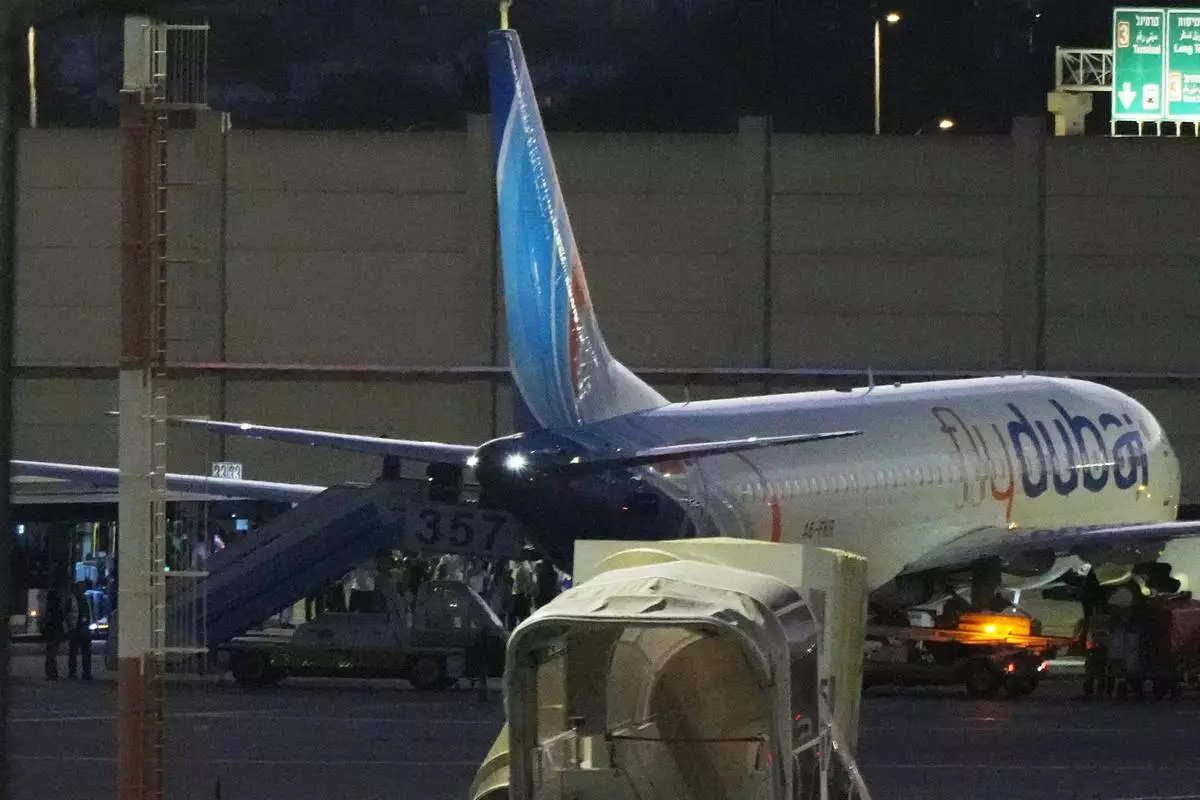
People disembark from a FlyDubai carrying Israeli passengers who had earlier been aboard another FlyDubai aircraft that made an emergency landing in Saudi Arabia approaches Ben Gurion International Airport near Tel Aviv, Israel, Wednesday, Sept. 30, 2026. (AP Photo/Ariel Schalit)
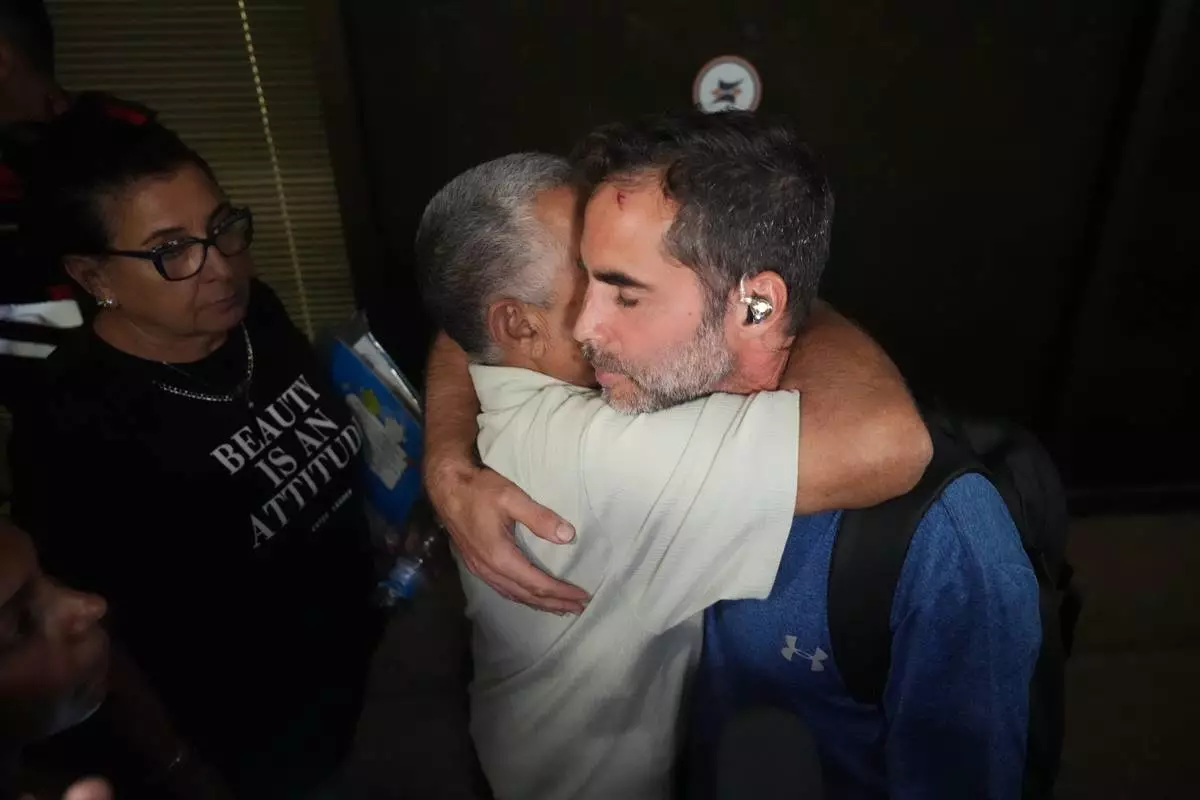
Israeli passenger Asaf Rajuan, right, who experienced an emergency landing in Saudi Arabia, during a flight on a FlyDubai plane, hugs another passenger from the same flight as they arrive at Ben Gurion International Airport, near Tel Aviv, Israel, Wednesday, Sept. 30, 2026. (AP Photo/Ariel Schalit)

Passengers who experienced an emergency landing in Saudi Arabia, during a flight on FlyDubai plane, arrive at Ben Gurion International Airport, near Tel Aviv, Israel, Wednesday, Sept. 30, 2026. (AP Photo/Ariel Schalit)