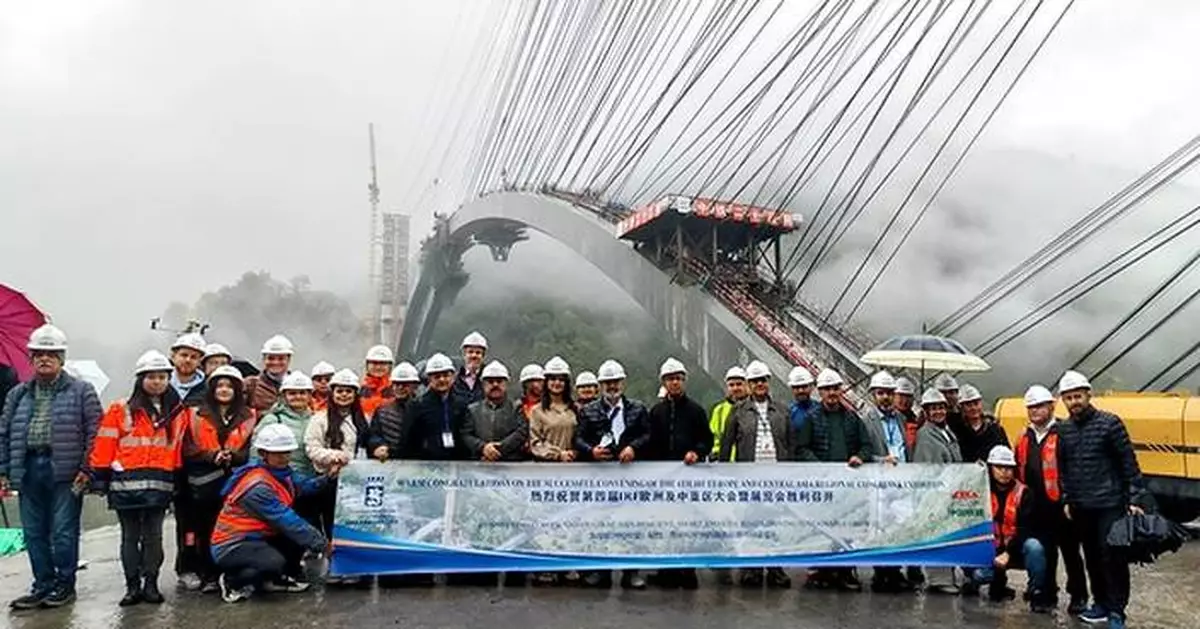
TBILISI, Georgia, Oct. 2, 2026 /PRNewswire/ -- From September 30 to October 2, 2026, the 4th International Road Federation (IRF) Europe and Central Asia Regional Congress was held in Tbilisi, the capital of Georgia. On October 2nd, Roads Department of Georgia led a delegation of congress participants on a special visit to the construction site of the B3 Arch Bridge on the Kvesheti–Kobi section of Georgia's North–South Corridor Highway, undertaken by China Railway 23rd Bureau Group Co., Ltd. The delegation inspected the progress of the project and gained first-hand insight into the capabilities of Chinese enterprises in constructing long-span bridges and implementing standardized project management under the extreme conditions of high-altitude alpine valleys.
The B3 Arch Bridge serves as a key controlling project for the Georgia North-South Corridor Road project. Located in a deep valley of the Caucasus Mountains, the bridge has a total length of 437.875 meters, a main arch net span of 286 meters, and a height difference of 164 meters from the bridge deck to the valley floor. It features a deck-type reinforced concrete separated twin-rib box arch structure, constructed using the cantilever casting method with cable-stayed anchoring. Subjected to extreme environmental challenges—including Beaufort scale 9 strong winds, severe cold down to -20°C, 2-meter-thick snow accumulation, and high-intensity seismic zones—the bridge, upon completion, will become the largest-span reinforced concrete arch bridge in the Caucasus region, with its span ranking among the top worldwide for similar cantilever-cast arch bridges.
During the inspection, the project team of China Railway 23rd Bureau Group delivered a detailed report to the accompanying delegates on core management measures and technical achievements. These included the implementation of European standards, FIDIC contract management, high-precision closure control for the twin-rib main arch, intelligent monitoring, and wind tunnel test verification. The delegation closely inspected and inquired about key structural components, such as the main arch ring construction, anchoring system, and cable hoisting system. They engaged in in-depth exchanges with the Chinese technical team on critical topics, including main arch alignment and stress control, construction procedures, winter construction safety assurance, full-lifecycle maintenance, and follow-up construction organization. The delegation representative stated that the North-South Corridor Road is one of the most vital transportation infrastructure projects in Georgia's national development strategy, playing a decisive role in strengthening the country's status as an Eurasian transit hub. As the most technically challenging controlling project along the entire route, the B3 Arch Bridge fully demonstrates the capability of Chinese enterprises in building large-scale bridges under complex geological and extreme climatic conditions. Strictly adhering to European technical specifications and the FIDIC management system, the project meets world-class standards in quality control, environmental protection, and localized employment, setting a new benchmark for highway and bridge construction in Georgia and across the broader Central Asia–Caucasus region.
Han Shuai, project manager of the China Railway 23rd Bureau Co., Ltd. North–South Corridor Road Project, said that the company would take this visit by the IRF delegation as an opportunity to continue pursuing its overseas business philosophy of "Quality Delivery, Safety First, Standards Alignment and Local Integration." The project team will make every effort to achieve key milestones, including the closure of the B3 main arch in 2026, and develop the project into a model of infrastructure cooperation between China and Georgia and a landmark project for bridge construction in high-altitude mountainous regions under the Belt and Road Initiative.
As a vivid embodiment of the theme of this year's IRF Congress—"Resilient, Intelligent and Safe Roads Driving Sustainable Growth"—the site visit to the B3 Arch Bridge brought delegates from conference halls to the front lines of project construction, transforming conceptual discussions into first-hand evidence from an actual engineering project. The bridge spans not only the deep valleys of the Caucasus, but also represents a new level of mutual trust and cooperation between China, Europe and Central Asia in the field of transportation infrastructure.
** This press release is distributed by PR Newswire through automated distribution system, for which the client assumes full responsibility. **
IRF Delegation Visits B3 Arch Bridge on Georgia's North-South Corridor Road Project