NEW YORK (AP) — Turkish officials have begun to shop around the idea of a former foreign minister joining the list of candidates vying to lead the United Nations as the monthslong race for secretary-general continues with no clear victor.
Feridun Sinirlioglu, a 70-year-old former Turkish foreign minister and U.N. diplomat, floated his candidacy on the sidelines of the U.N. General Assembly’s high-level meeting in New York last week, according to two diplomats briefed on the matter.
The diplomats, who spoke on condition of anonymity to discuss a confidential process, said the potential candidacy being pushed from Ankara appeared to be serious. Turkey would have to formally nominate Sinirlioglu to begin a process that many inside the world body have described as one of the toughest job interviews in the world.
The office of President Recep Tayyip Erdogan and the Turkish foreign ministry did not respond to a request for comment.
Sinirlioglu currently serves as the secretary-general of the Vienna-based Organization for Security and Cooperation in Europe. His current three-year mandate is scheduled to end in December 2027, but the top U.N. job would have a Jan. 1, 2027, start date.
An OSCE spokesperson said Friday that given that Sinirlioglu hasn't been nominated, the organization would not comment.
The OSCE, whose 57 members include the United States and both Ukraine and Russia, was created during the Cold War as a platform for dialogue between East and West. The organization — like the U.N. — has a wide-ranging mandate, including conflict prevention, human rights, election observation and arms control.
The selection of the U.N. secretary-general will be left to the 15-nation U.N. Security Council, especially its five veto-wielding members — the United States, Russia, China, the United Kingdom and France — which remain tight-lipped about their preferences. The 193-member General Assembly must give final approval.
If nominated, Sinirlioglu would likely to face obstacles from several corners of the international community, namely its neighbor Greece, which is one of the 10 elected members of the council. Pushback also would be expected from Israel, a close ally of the U.S.
Turkey, which has close ties with the Syrian government and has been providing assistance to Syria’s military, has tense relations with Israel. The rival countries have sought to curb each other’s influence in neighboring Syria.
During a Security Council meeting on Syria last month, Israel's ambassador to the U.N., Danny Danon, blasted Turkey’s military presence in Syria and warned against allowing Syrian territory to become a military platform used to threaten Israel.
“Turkey is following the Iranian proxy playbook. It is deepening its military foothold in Syria, establishing bases and expanding its influence," Danon told the council. "If Syrian sovereignty truly matters to the international community, it cannot apply one standard to Israel and another to Turkey.”
Liechtenstein reported from Vienna.
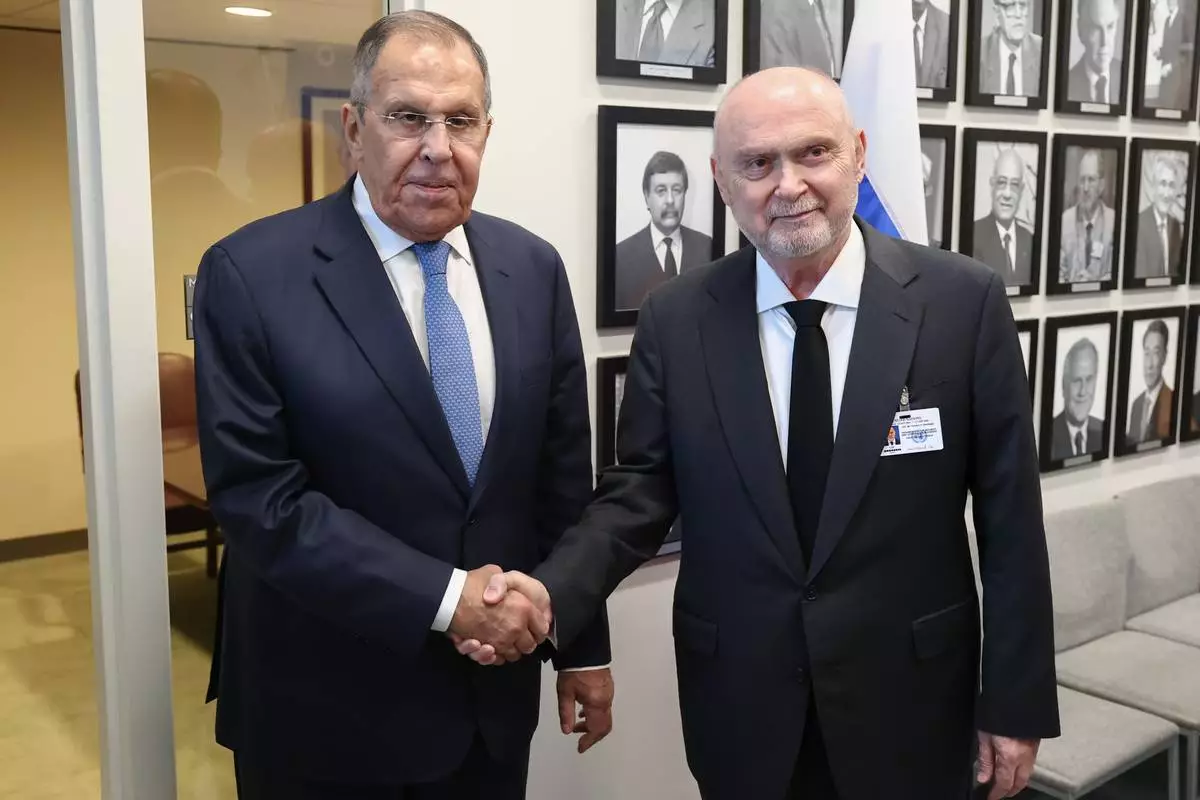
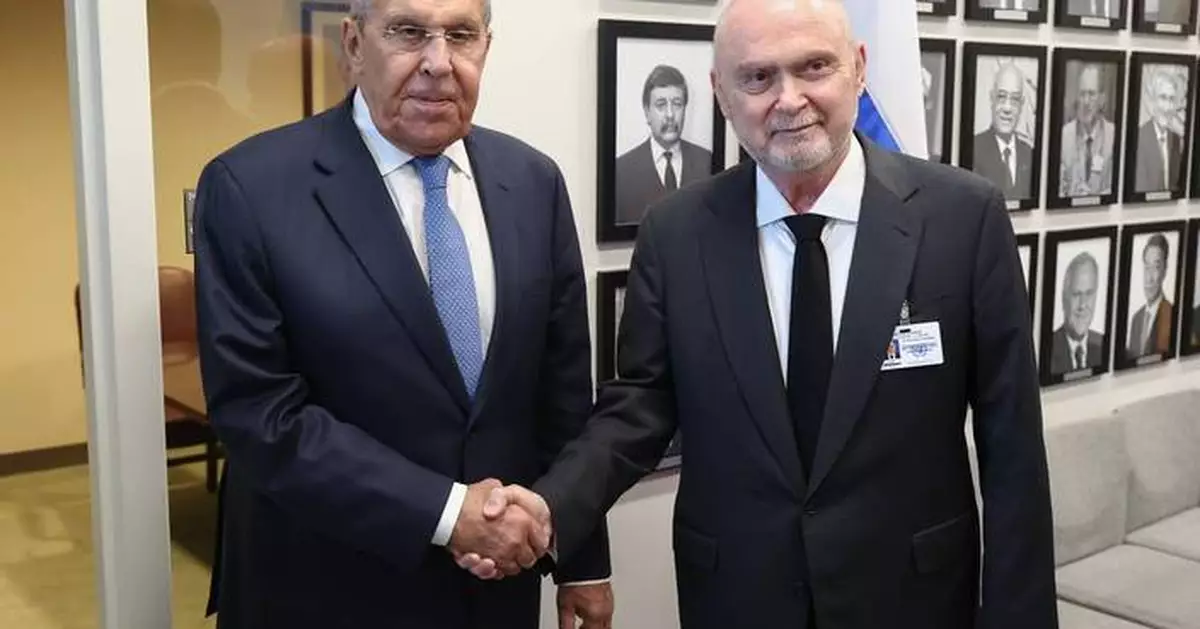
In this photo provided by Russian Foreign Ministry Press Service, Russian Foreign Minister Sergey Lavrov, left, and Secretary General of the Organization for Security and Co-operation in Europe Feridun Sinirlioglu shake hands on the sidelines of the U.N. General Assembly at the United Nations headquarters on Wednesday, Sept. 23, 2026. (Russian Foreign Ministry Press Service via AP)
Brazil's pivotal presidential election is headed to a runoff after incumbent Luiz Inácio Lula da Silva and his ideological opposite, Sen. Flávio Bolsonaro, failed to win a majority vote Sunday.
Brazil’s electoral court in Brasilia had Bolsonaro with just over 55.8 million votes to Lula’s nearly 53.2 million. The runoff will be held on Oct. 25.
Nearly 159 million Brazilians were eligible to vote in Latin America’s largest economy. Bolsonaro is an ally of U.S. President Donald Trump and the son of ex-leader Jair Bolsonaro, whom Lula defeated four years ago.
Here's the latest:
Sen. Flávio Bolsonaro, an ally of U.S. President Donald Trump, and Brazil’s veteran President Luiz Inácio Lula da Silva will face off on Oct. 25 in a runoff election for the top job of Latin America’s powerhouse economy.
The country’s electoral court in Brasilia said neither Lula, the 80-year-old incumbent seeking his fourth non-consecutive term, nor Bolsonaro, the 45-year-old son of former President Jair Bolsonaro, would reach the 50% or more of the total vote needed for a first-round win.
The next presidential term begins on Jan. 5, 2027.
Election authorities have confirmed that Michelle Bolsonaro, wife of former President Jair Bolsonaro and stepmother of presidential candidate Sen. Flávio Bolsonaro, won a Senate seat in the Federal District, home to the capital, Brasilia.
A devout evangelical, the 44-year-old has never previously held public office.
In June, Michelle Bolsonaro had a very public falling out with her stepson, whom she accused of disrespecting her in lengthy videos posted on her social media. The pair later made up.
She has called her candidacy “a mission” entrusted by her husband, who is serving a 27-year sentence under house arrest following his conviction for an attempted coup.
Apprehension filled the air as red-clad voters for President Luiz Inácio Lula da Silva gathered in an LGBTQ-friendly bar in downtown Rio de Janeiro to watch the results trickle in on a huge screen.
Flávio Bolsonaro’s father, Jair Bolsonaro, who was president between 2019 and 2022, was notorious for homophobic remarks.
Lorena Zschaber, a 40-year old photographer, was celebrating her girlfriend’s birthday Sunday with a group of friends around a table laden with beer and snacks.
She said the idea of a Flávio Bolsonaro win worried her deeply. During his father’s presidency, “people felt more at ease to discriminate. … I’m a LGBTQ+ woman. I can’t think of anything worse happening than Flávio Bolsonaro being elected,” she said.
Results from the Superior Electoral Court began to filter in immediately. One hour after polls closed, it had already counted 10% of the total vote.
Brazilian authorities adopted electronic voting machines in the 1990s, replacing old-school ballot boxes. The change resulted in the vast majority of results being reported hours after polls close.
Polls closed at 5 p.m. Brasilia time, except where people were still in line to cast their votes.
As soon as polls close, the counting begins. Voters can follow the tally in real time on the electoral court’s website.
Some have waited for more than two hours to vote, others have done it in less than three minutes.
Brazilians are voting for several positions besides president, which traditionally makes some people queue longer in the first round of voting.
While Brazil has largely been polarized between two political forces in the last election cycles, represented this time by Lula and Flávio Bolsonaro, the two have also faced high levels of rejection.
As the sun began to dip in Rocinha, Rio de Janeiro ’s biggest favela, Gabriel Soares da Silva, a 30-year-old tour guide, said he didn’t feel represented by the big names or the 10 other candidates running on the presidential ballot.
“For me the most important themes are education and health, but no one is doing anything,” he said, as he sat watching a huge line of people waiting for mototaxis to take them up the favela’s winding roads, strewn with electoral propaganda.
Kassio Nunes Maques, the president of the Superior Electoral Court, noted at a news conference that heavy rains and power outages caused some voting disruptions in the southern state of Parana.
But Nunes Marques said that, “We are almost 3 hours away from the end of the voting and everything is proceeding normally and with the greatest possible transparency.”
The winner will lead a country that contains about 60% of the world’s largest rainforest — an ecosystem vital to the global climate.
But conservation of the Amazon has been largely absent from the presidential campaign.
Still, Lula and Bolsonaro represent starkly different visions of how the rainforest should be managed. Climate and conservation experts warn that a Bolsonaro victory could reverse the deforestation-control policies Lula restored after taking office in 2023.
During Jair Bolsonaro’s presidency, from 2019 to 2022, Amazon deforestation surged by about 60%, according to official data. Under Lula, deforestation has reached its lowest level in more than a decade.
Flávio Bolsonaro has pledged to end illegal deforestation by 2029. Lula proposes zero net deforestation by 2030, meaning any forest loss, legal or illegal, would have to be offset through restoration.
For many river dwellers, participating in the democratic process involves long journeys across the Rio Negro.
In Catalão, a floating community in the municipality of Iranduba just across from Manaus, residents arrived by boat to cast their ballots at the floating Nossa Senhora Aparecida municipal school.
Fisherwoman Francisca Oliveira Pontes traveled nearly an hour to reach the floating polling station. “My goal is to have a better country, and to exercise my right, which is the right to vote,” the 31-year-old Pontes said.
The vote center serves as a crucial hub for scattered Amazonian settlements, drawing voters from communities across the region, including Cacau Pirera and Careiro da Várzea.
Lula is watching the count with first lady Rosângela da Silva at his residence in Sao Paulo’s upscale Alto de Pinheiros neighborhood, and then plans to head to a hotel downtown to speak to journalists.
Flávio Bolsonaro is watching with his family in his house in the capital of Brasilia.
Bolsonaro’s father, former President Jair Bolsonaro, cannot host his son in his residence in the same city because he is serving his 27-year prison sentence for an attempted coup.
Brazilian voters expressed confidence and pride in Brazil’s speedy electronic voting system as they cast their votes in downtown Rio de Janeiro, near a market teeming with fresh fruit and vegetables and a colonial-style church perched on a hill.
Josemar Lauriano Pereira, a 46-year-old lawyer, said that the rapid availability of results helped combat fraud and uncertainty.
“When results take a lot of time, it creates an opening for people to cast doubt on the results, to say there’s been a problem,” he said.
Fraud used to be a problem, but is no longer, said Tones José, 42, who works as a doorman. “Things have changed a lot since then. Now the urns are fully trustworthy.”
Failing to cast a ballot in Brazil's election incurs a small fine. Those who are illiterate, above the age of 70, and between 16 and 18 years of age may choose whether to exercise their right.
For Brazilians abroad, voting is required only in the presidential race.
In the last presidential election in 2022, women played a decisive role in handing President Luiz Inácio Lula da Silva a narrow victory over Flávio Bolsonaro’s father, former President Jair Bolsonaro.
In the lead-up to Sunday’s vote, candidates courted women with proposals to combat gender-based violence, a major campaign issue as violence against women reaches record levels and several high-profile cases draw attention.
Aware of women’s electoral weight, activists sought to leverage that power to seek guarantees that such promises won't later be shelved.
In cities across Brazil, Sen. Flávio Bolsonaro’s supporters wore the yellow and green of the Brazilian flag.
President Luiz Inácio Lula da Silva's supporters wore red T-shirts, some with the face of the young Lula in his union days and messages denouncing U.S. influence in Brazilian politics.
International election observers monitored the voting centers, where there was a usual security presence.
Brazilians lined up to vote in Portugal’s capital like those living outside Brazil around the globe.
Some of those waiting to vote in Lisbon showed their Brazilian pride — one wearing a yellow and green Brazil soccer jersey, another a T-shirt with incumbent President Lula’s face emblazoned on the front.
“I will have dual nationality, but I’m still patriotic,” said Michele Sacramento, who’s lived in Portugal for seven years. “I love my country and I hope I can return one day and be able to walk in the street like I walk here, without any fear, any worry.”
Many are casting their ballots under the shadow of rising crime. Fears are most acute in Bahia, the country’s most violent state, a stronghold for President Luiz Inácio Lula da Silva.
They are also high in Rio de Janeiro, Flávio Bolsonaro’s home state, where entrenched criminal factions and urban warfare have plagued communities for decades. Voters head to the polls demanding decisive federal action in the near future.
Brazil’s incumbent president, Luiz Inácio Lula da Silva, voted after 9 a.m. in a school in Sao Bernardo do Campo, outside Sao Paulo.
The 80-year-old Lula said that he was confident that he could get his first outright victory in seven runs for the presidency. He also urged Brazilians above age 70, who aren’t legally required to vote, to show up and cast their ballots.
Wearing a hat to protect his head after a skin cancer diagnosis, Lula told journalists that he needs “to do double what we have done” if reelected and also said that “Brazil will not go forward by making arms sales easier,” in reference to a long-standing pledge of his main opponent, Flávio Bolsonaro.
Brazil's patron saint is Our Lady of Aparecida.
A comment on Jesus by Sen. Flávio Bolsonaro recently went viral, triggering fears among many Catholics that he might intend to remove the patron saint status of Our Lady of Aparecida — a claim Bolsonaro has denied.
In an Aug. 23 video, Bolsonaro said that he would “declare that Brazil belongs to the Lord Jesus Christ.” Some Catholics interpreted that as meaning that the presidential candidate would remove Our Lady of Aparecida as Brazil’s patron saint.
Our Lady of Aparecida is a much-beloved figure among Brazilians. The accusation tapped into Catholics’ fears over losing ground to evangelicals and could weaken the presidential bid of Bolsonaro, who is evangelical.
Bolsonaro has no authority to name or remove patron saints. That’s entirely up to the Vatican.
Brazilian presidential candidate Flávio Bolsonaro has voted in his home state of Rio de Janeiro.
“Brazil needs change, Brazil can’t stand so much suffering,” said Bolsonaro, who arrived at around 8:10 a.m. local time to vote in a school.
He was dressed in a light yellow shirt featuring a “22” sticker, corresponding to the number that Brazilians must punch into electronic voting machines if voting for him.
“I am more than prepared to preside this country to give back to Brazilians the right to dream,” he told journalists.
President Luiz Inácio Lula da Silva's government sees a series of recent U.S. measures — including tariffs and the decision to classify Brazil’s biggest drug-trafficking groups as foreign terrorist organizations — as attempts to tip the scale in Sen. Flávio Bolsonaro’s favor, an accusation that the Trump administration has denied.
A victory by Bolsonaro would mean Brazil would join Argentina, Chile, Colombia, Costa Rica and Peru in electing Trump-friendly governments in recent years.
Lula has made Brazil’s sovereignty a major campaign issue. In the days before the election, his team launched a Portuguese version of the Bad Bunny song, “Lo que le paso a Hawaii,” that uses the U.S. colonization of Hawaii as a cautionary tale.
Brazilian voters prepare number-heavy lists to remember their candidates’ numbers and at the ballot box, punch in the corresponding digits. Brazilian authorities adopted electronic voting machines in the 1990s to tackle longstanding fraud.
In earlier elections, ballot boxes were stuffed or stolen, and individual votes were routinely falsified, according to Brazil’s electoral authority. Now, results are reported mere hours after polls close.
In the lead-up to the 2022 vote, Jair Bolsonaro repeatedly cast unfounded doubts on Brazil’s electronic voting system. No significant fraud has ever been detected.
Alongside regional heavyweights like U.S. President Donald Trump and Nicaraguan President Daniel Ortega, 80-year-old Luiz Inácio Lula da Silva stands among the oldest leaders in the Americas.
If Lula achieves an outright victory against 45-year-old Flávio Bolsonaro, he will cement a historic milestone, becoming the oldest man ever elected to lead the South American nation.
He says he wants to live to be 120. He tried to ease concerns by posting workout videos to attempt to convince voters that age is just a number.
Voting has started in Brazil's high-stakes presidential election, pitting the two main candidates, incumbent Luiz Inácio Lula da Silva and his ideological opposite, Sen. Flávio Bolsonaro, against each other.
Brazilians will also elect 27 state governors, members of state legislatures, all 513 federal members of the lower house of congress and 54 of the country’s 81 senators in Sunday’s vote.
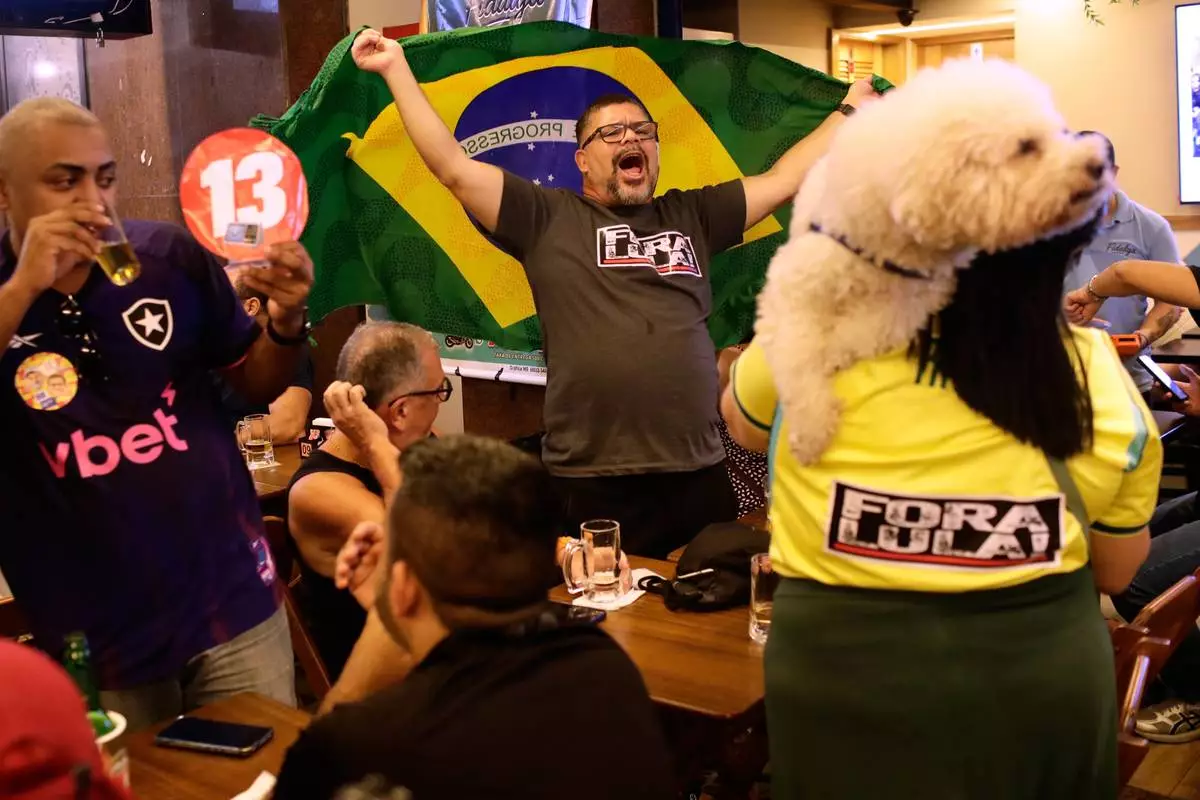
A supporter of opposition presidential candidate Sen. Flavio Bolsonaro, center, and a supporter of President Luiz Inacio Lula da Silva, who is running for reelection, left, react to partial election results at a restaurant in Rio de Janeiro, Brazil, Sunday, Oct. 4, 2026. (AP Photo/Bruna Prado)
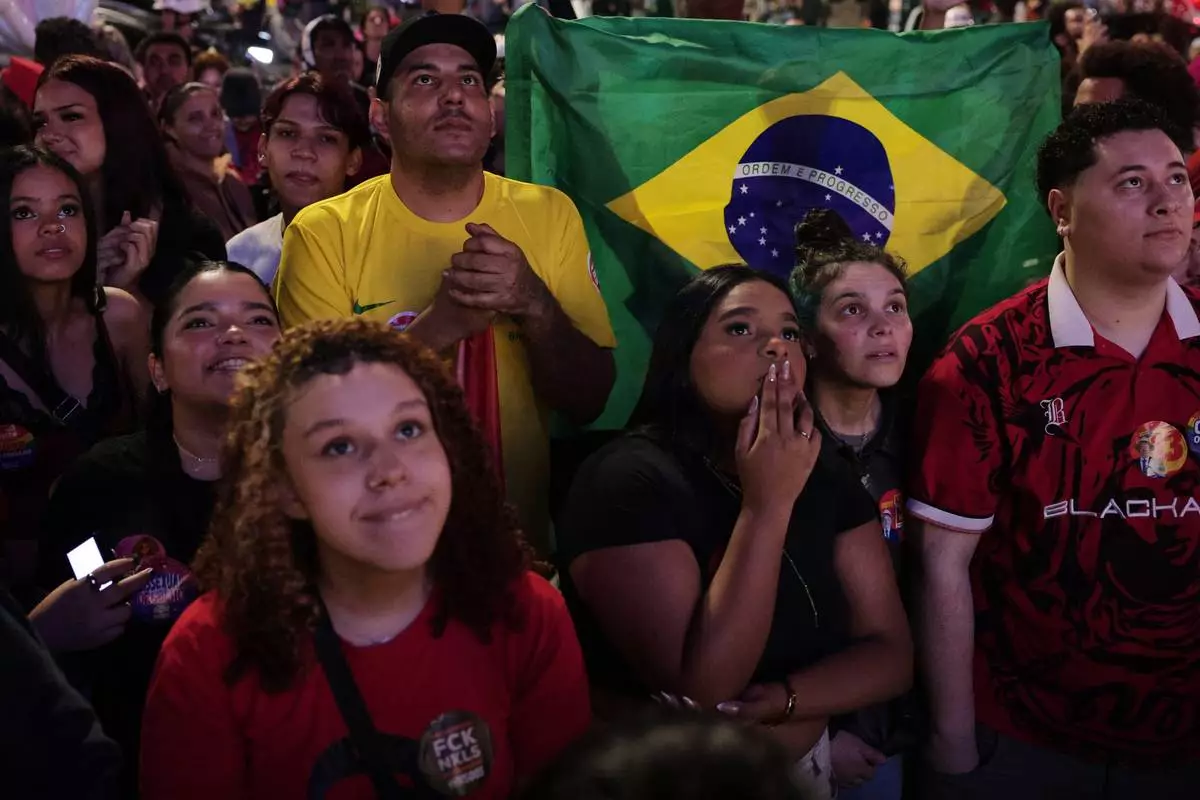
Supporters of President Luiz Inacio Lula da Silva, who is running for reelection, react during a gathering to wait for election results in Sao Paulo, Brazil, Sunday, Oct. 4, 2026. (AP Photo/Ettore Chiereguini)
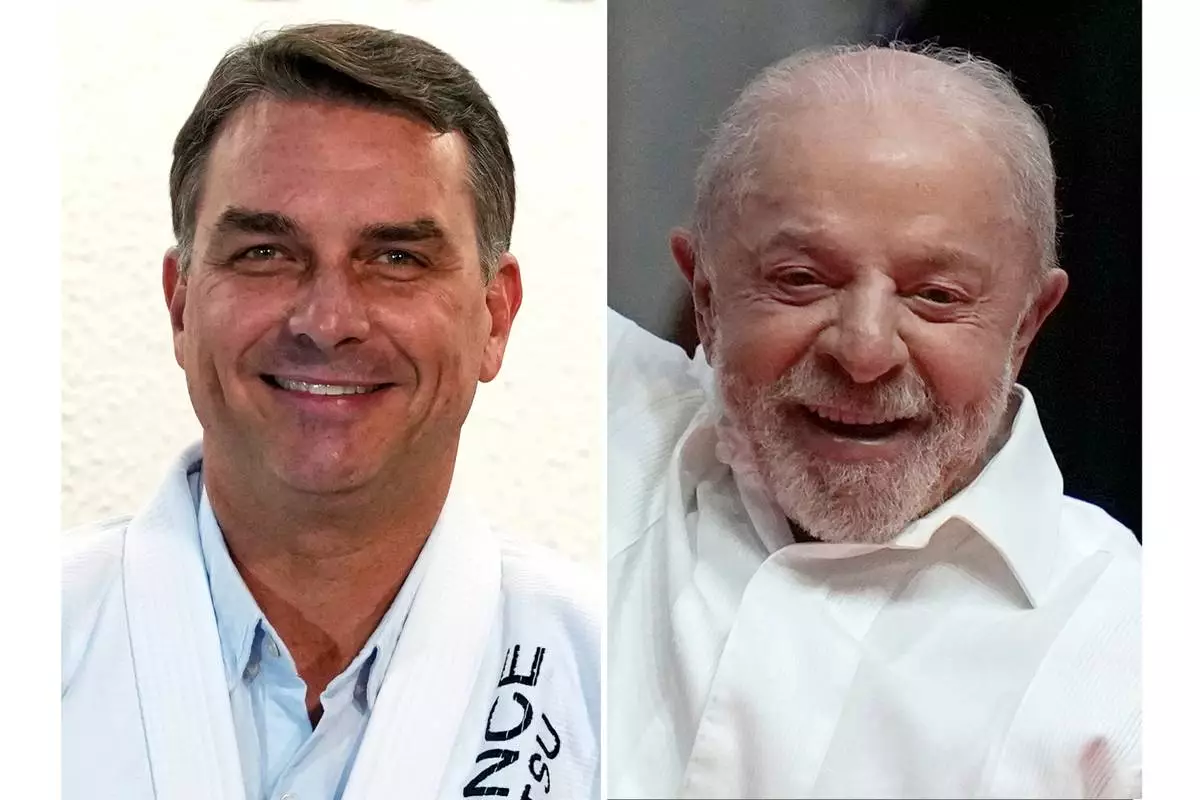
FILE - This combination of photos shows Flavio Bolsonaro, left, in Sao Paulo, on Sept. 29, 2026 and Luiz Inacio Lula da Silva in Rio de Janeiro, on Sept. 23, 2026. (AP Photo, File)
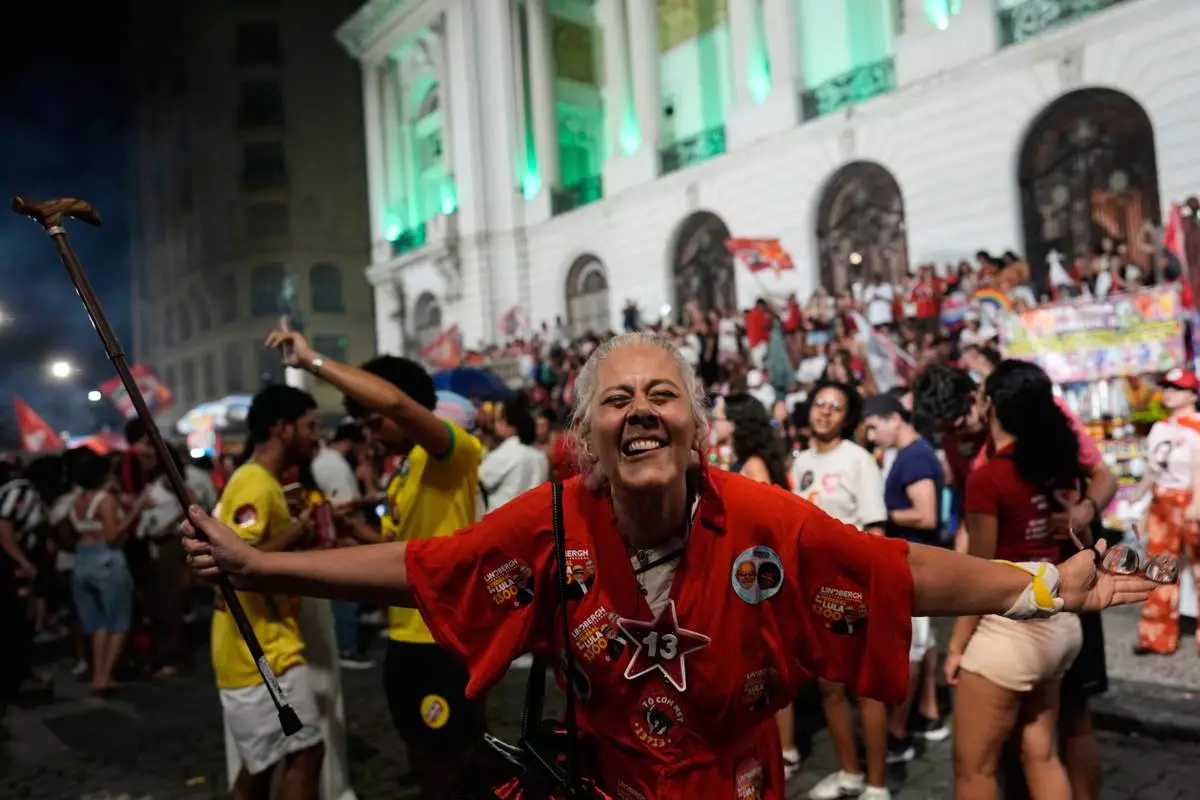
A supporter of President Luiz Inacio Lula da Silva, who is running for reelection, poses for a photo during a gathering to wait for election results in Rio de Janeiro, Brazil, Sunday, Oct. 4, 2026. (AP Photo/Silvia Izquierdo)
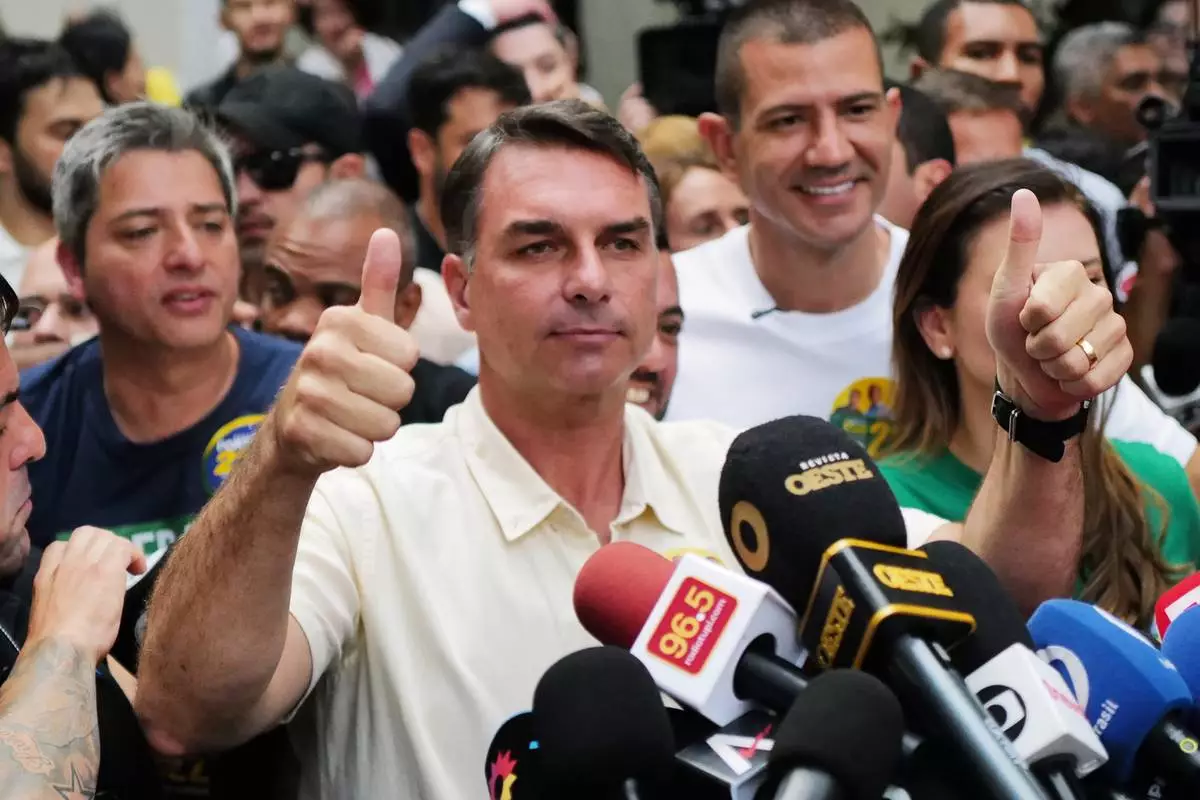
Opposition presidential candidate Sen. Flavio Bolsonaro speaks after voting during general elections in Rio de Janeiro, Sunday, Oct. 4, 2026. (AP Photo/Lucas Landau)
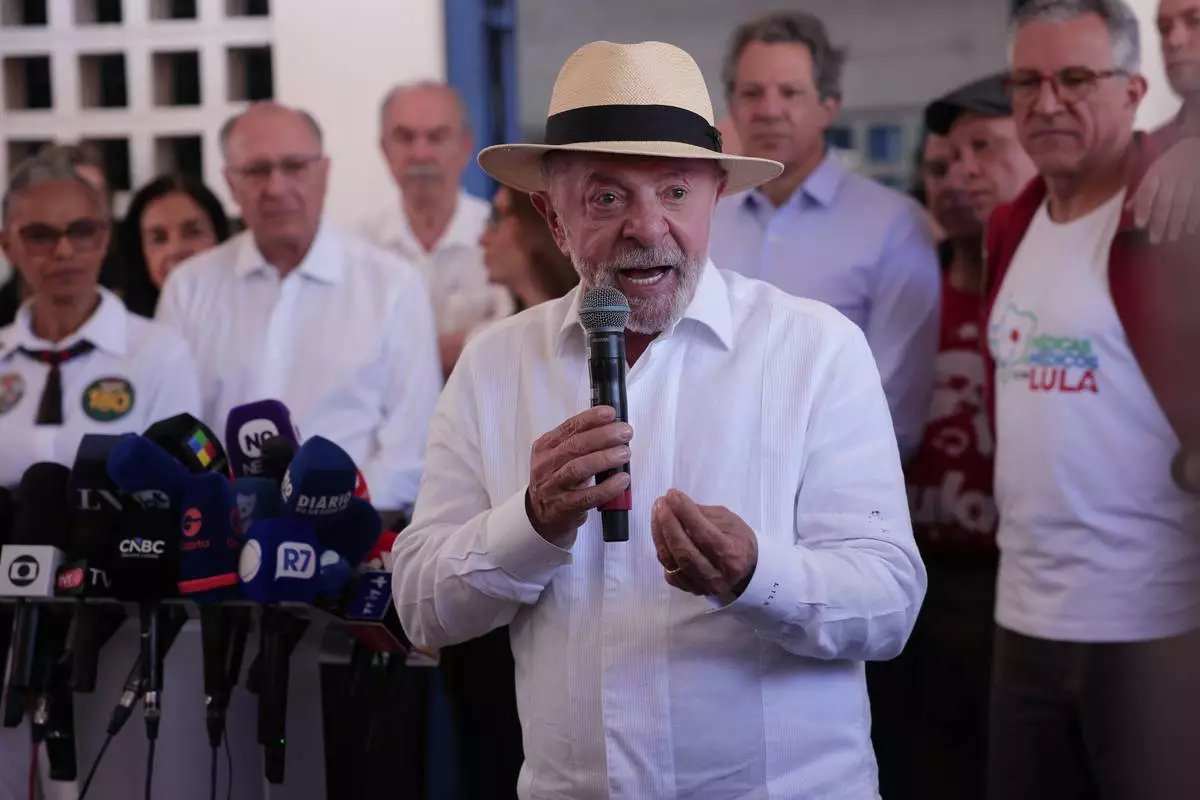
President Luiz Inacio Lula da Silva, who is running for reelection, speaks after voting during general elections in Sao Bernardo do Campo, Brazil, Sunday, Oct. 4, 2026. (AP Photo/Ettore Chiereguini)
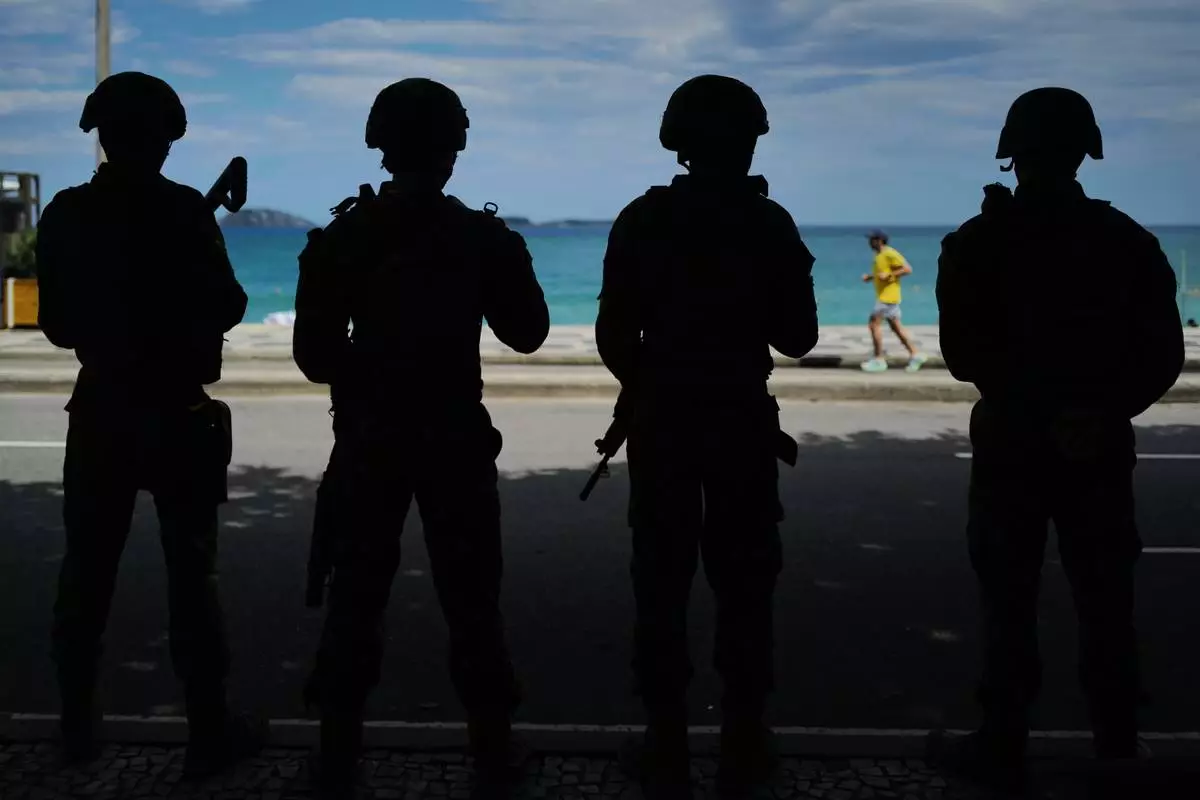
Soldiers guard Leblon beach during general elections in Rio de Janeiro, Brazil, Sunday, Oct. 4, 2026. (AP Photo/Lucas Landau)
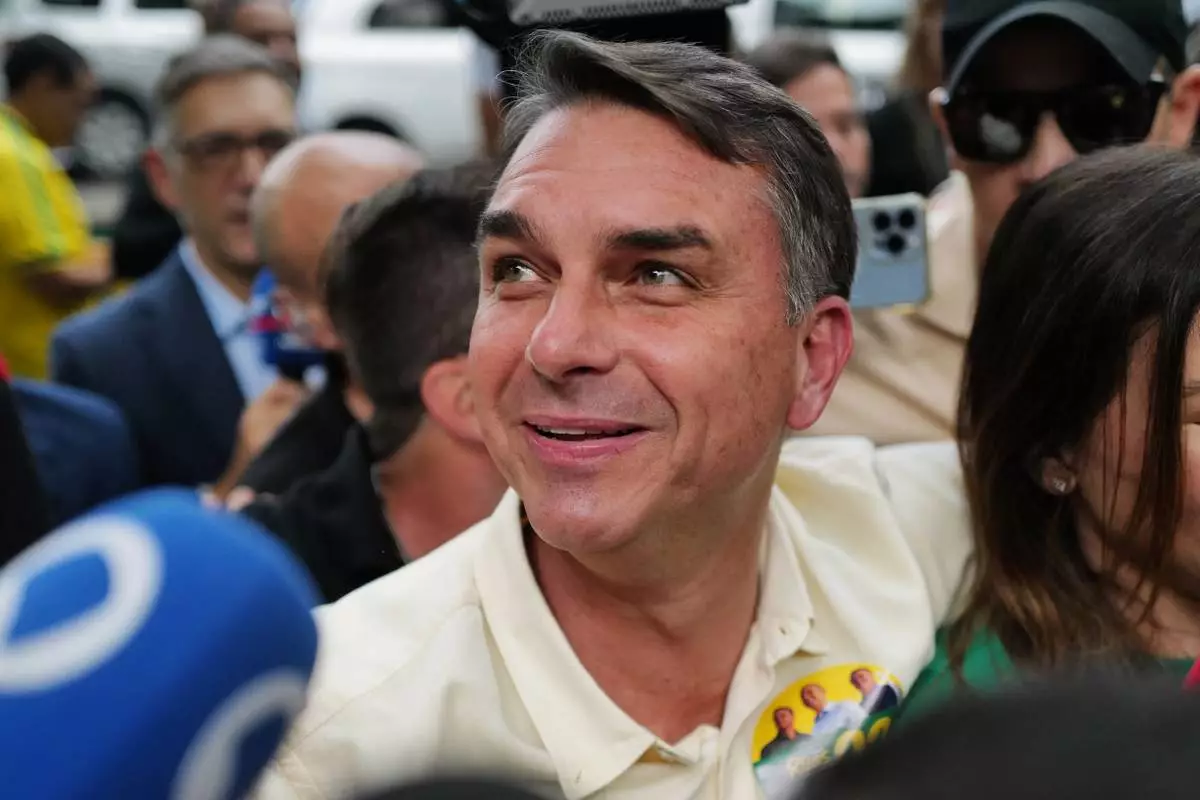
Opposition presidential candidate Sen. Flavio Bolsonaro arrives to vote during general elections in Rio de Janeiro, Sunday, Oct. 4, 2026. (AP Photo/Lucas Landau)
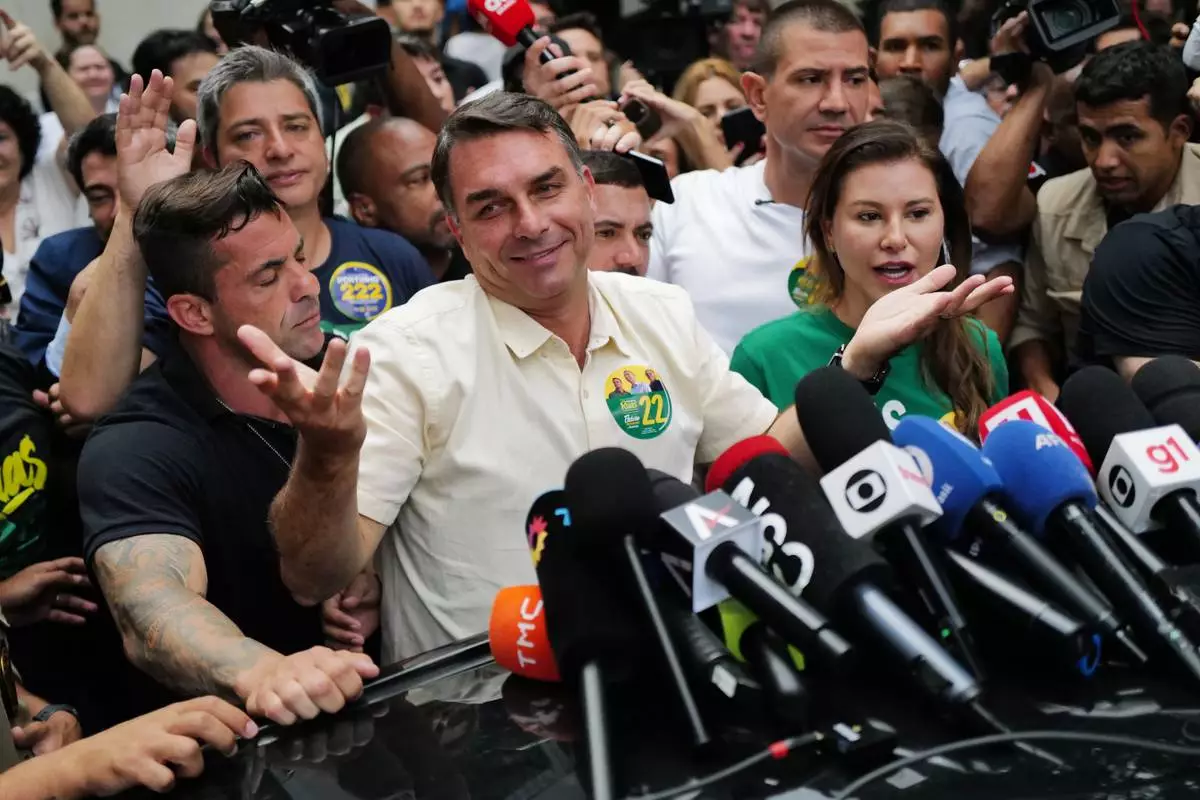
Opposition presidential candidate Sen. Flavio Bolsonaro speaks after voting during general elections in Rio de Janeiro, Sunday, Oct. 4, 2026. (AP Photo/Lucas Landau)
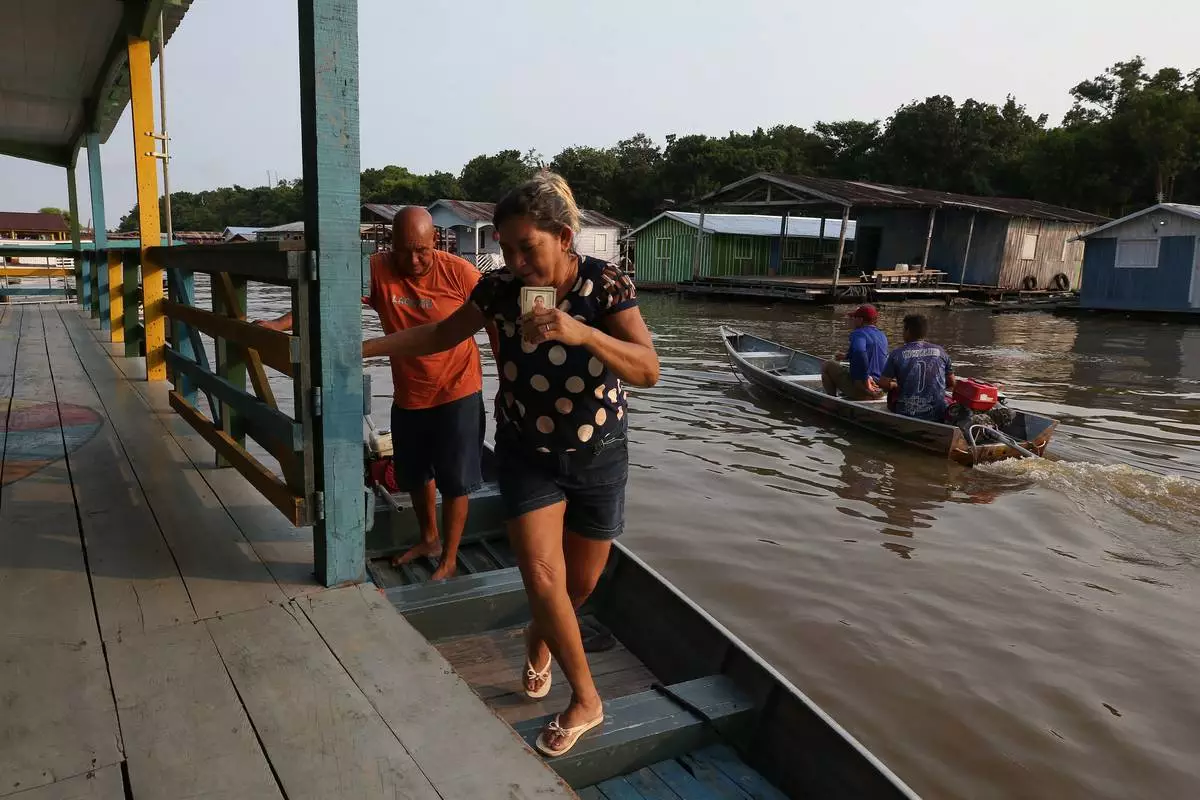
Voters arrive to a polling station during general elections in Iranduba, Brazil, Sunday, Oct. 4, 2026. (AP Photo/Edmar Barros)
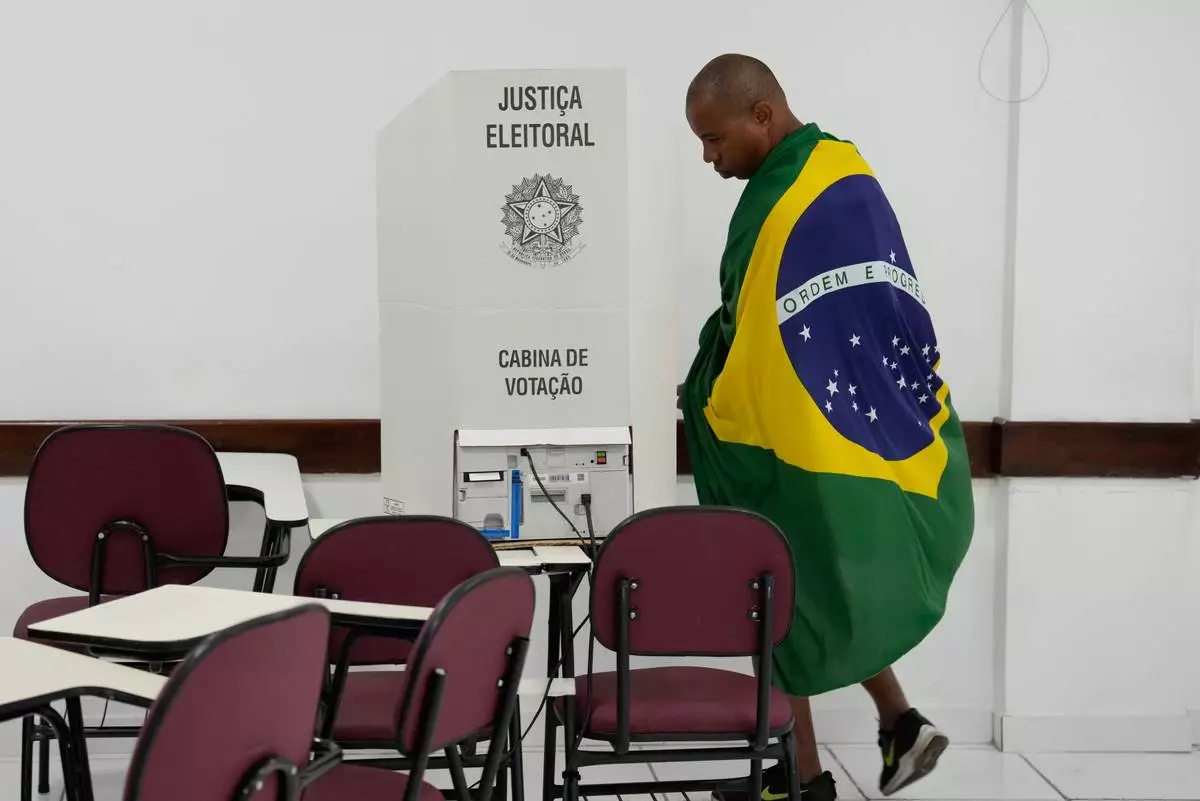
A voter wrapped in a Brazilian flag walks to an electronic voting machine to cast his ballot during general elections in Brasilia, Brazil, Sunday, Oct. 4, 2026. (AP Photo/Eraldo Peres)
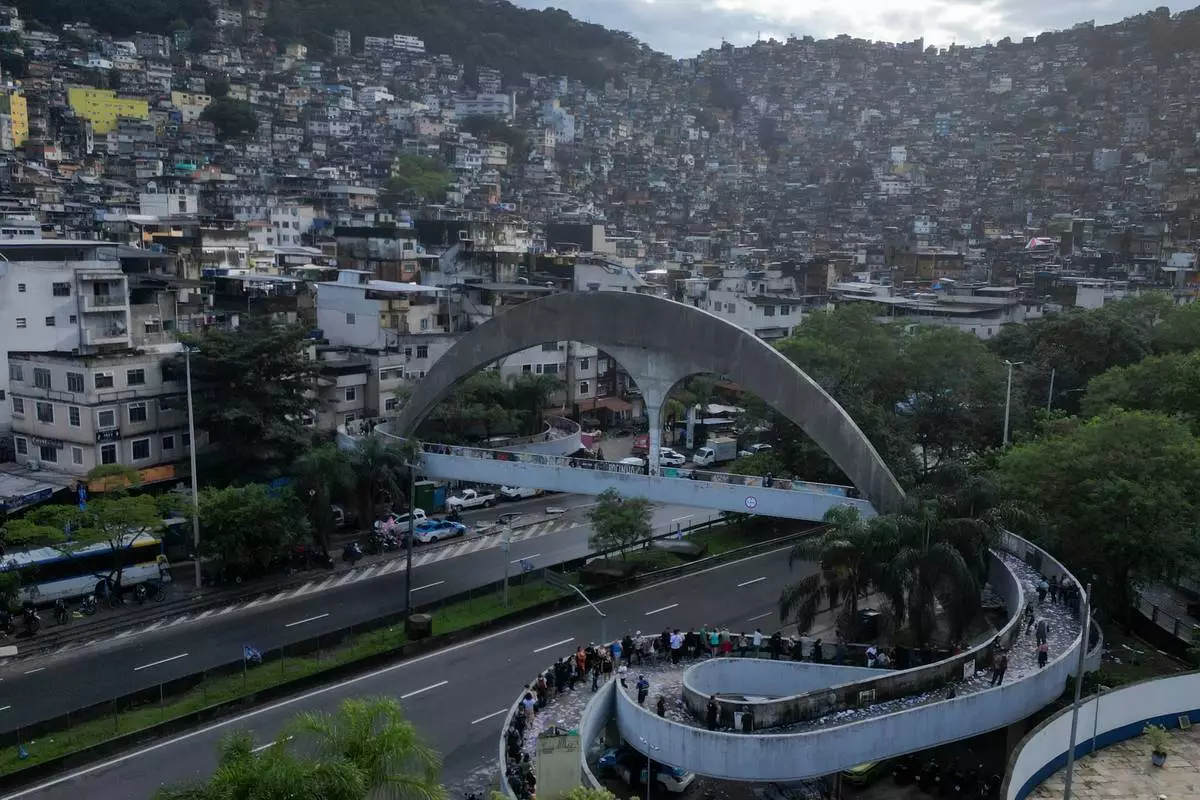
Voters line up to cast their ballots during general elections in the Rocinha favela in Rio de Janeiro, Brazil, Sunday, Oct. 4, 2026. (AP Photo/Bruna Prado)
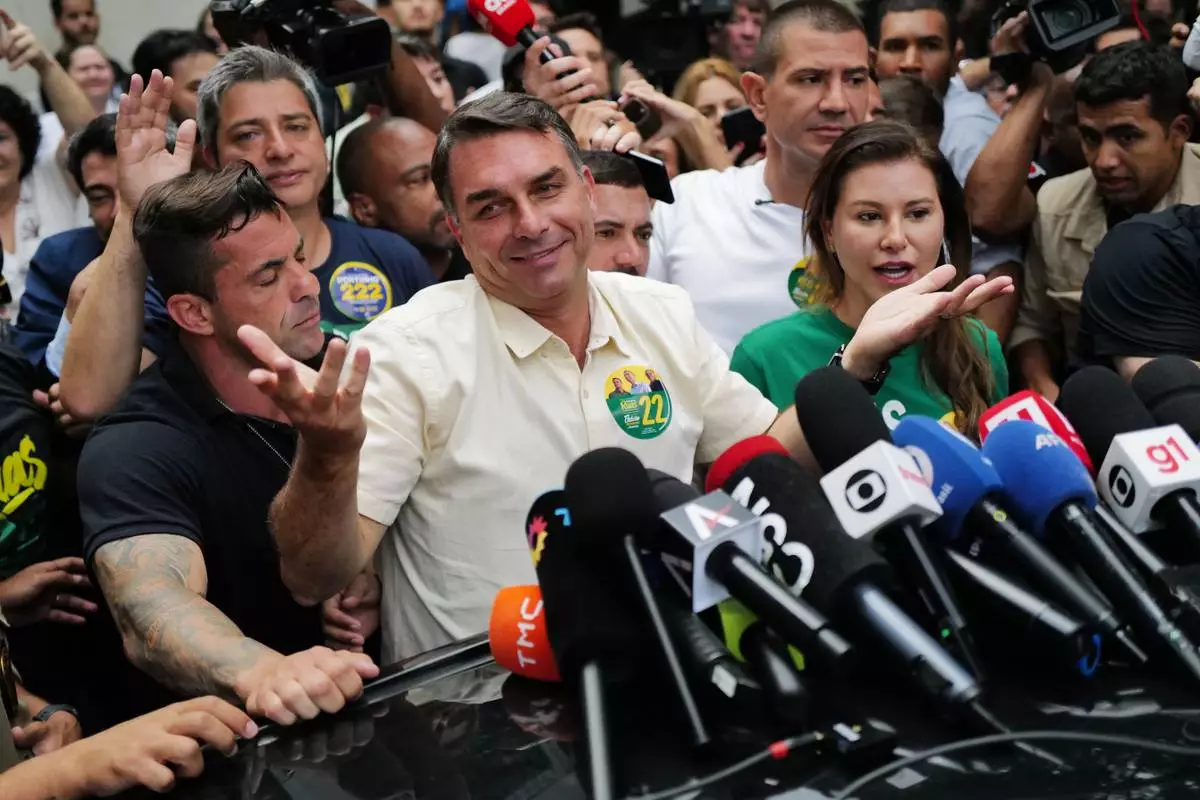
Opposition presidential candidate Sen. Flavio Bolsonaro speaks after voting during general elections in Rio de Janeiro, Sunday, Oct. 4, 2026. (AP Photo/Lucas Landau)
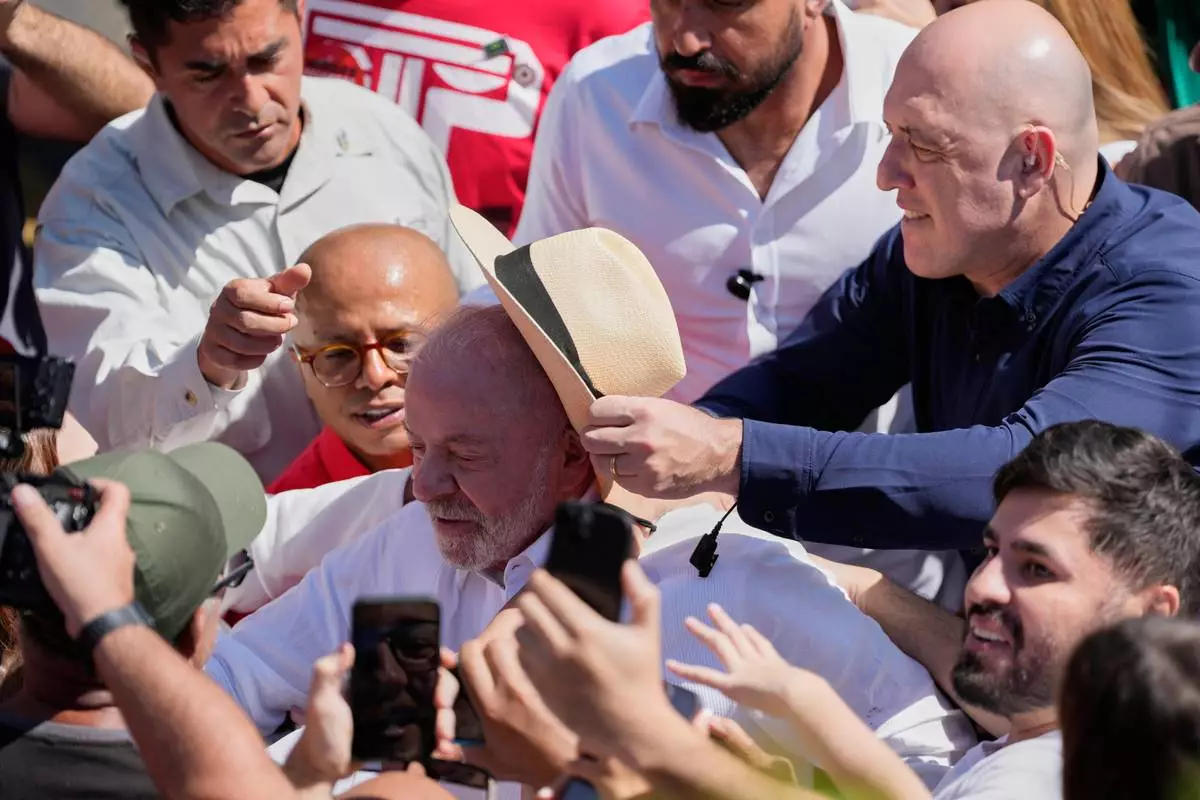
A security officer places a hat on President Luiz Inacio Lula da Silva as he leaves after voting during general elections amid a crowd in Sao Bernardo do Campo, Brazil, Sunday, Oct. 4, 2026. (AP Photo/Andre Penner)
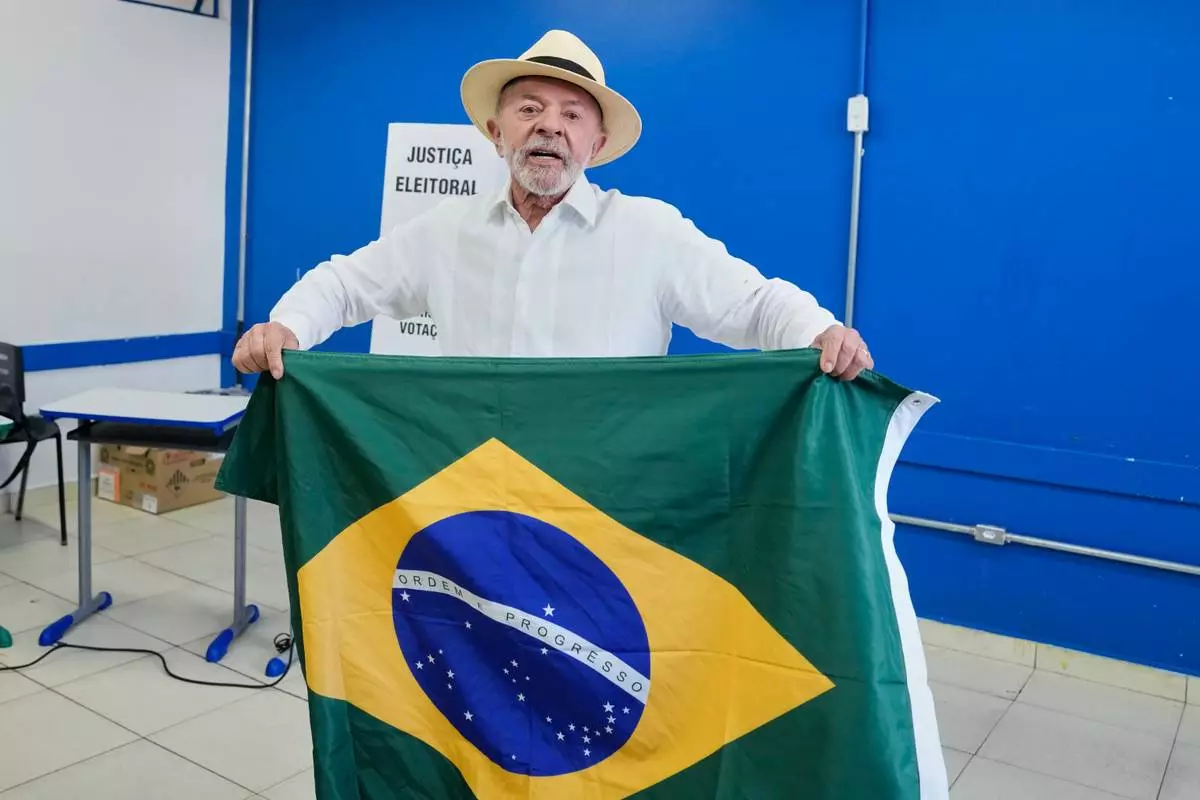
President Luiz Inacio Lula da Silva, who is running for reelection, displays a Brazilian flag after voting in Sao Bernardo do Campo, Brazil, Sunday, Oct. 4, 2026. (AP Photo/Andre Penner)
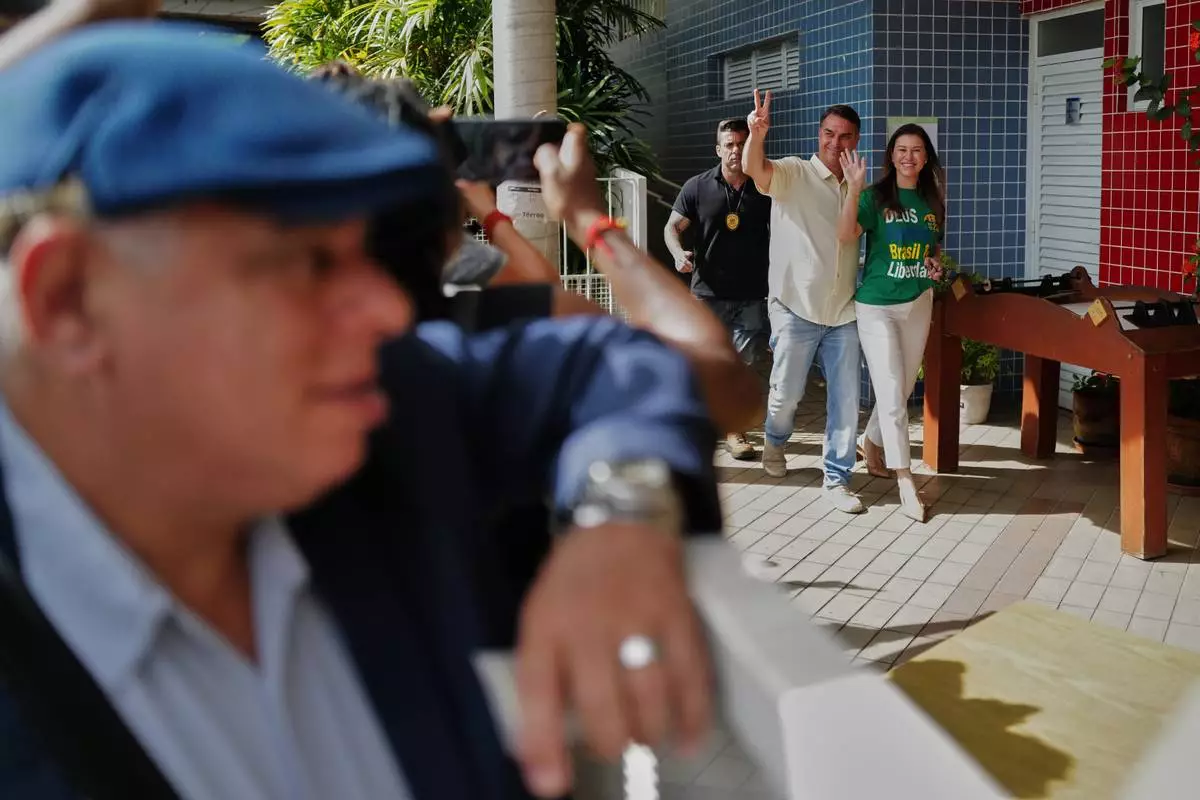
Opposition presidential candidate Sen. Flavio Bolsonaro accompanies his wife Fernanda Bolsonaro to vote during general elections in Rio de Janeiro, Sunday, Oct. 4, 2026.(AP Photo/Lucas Landau)
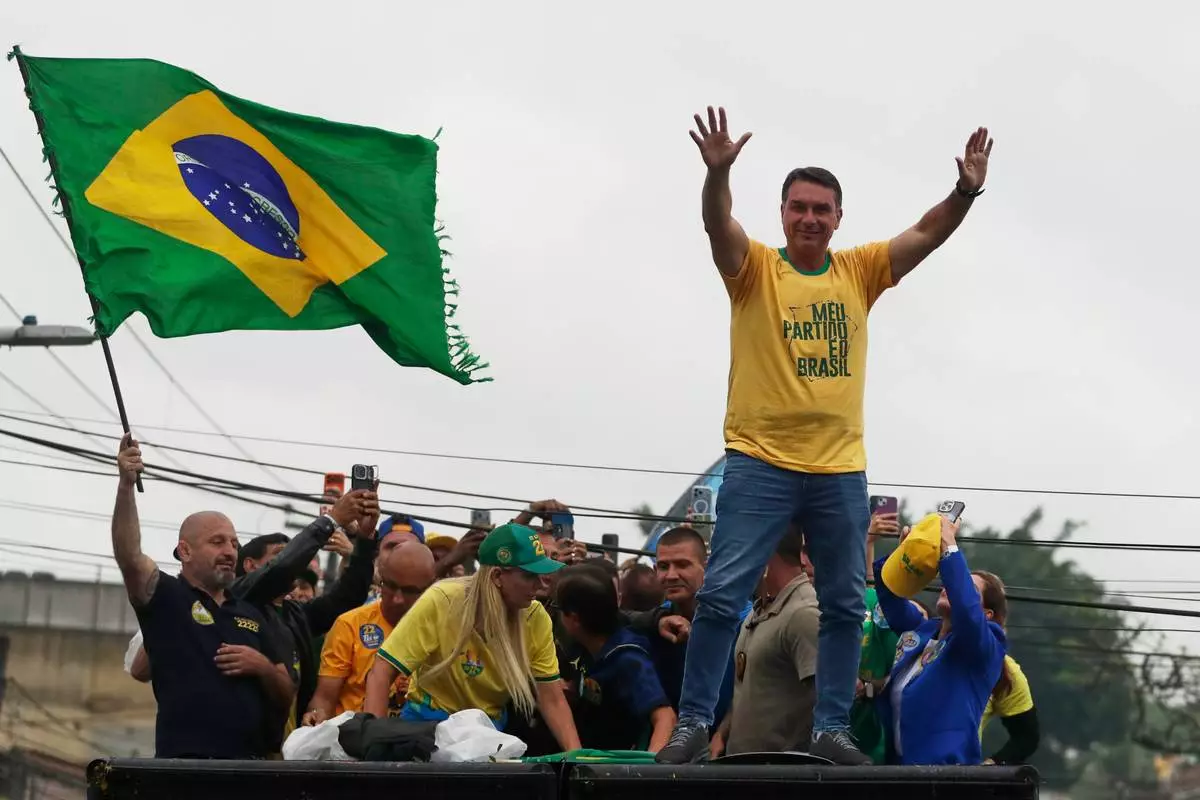
Opposition presidential candidate Flavio Bolsonaro waves to supporters during a campaign rally a day ahead of the country's general election, in Campo Grande, Rio de Janeiro state, Saturday, Oct. 3, 2026. (AP Photo/Bruna Prado)
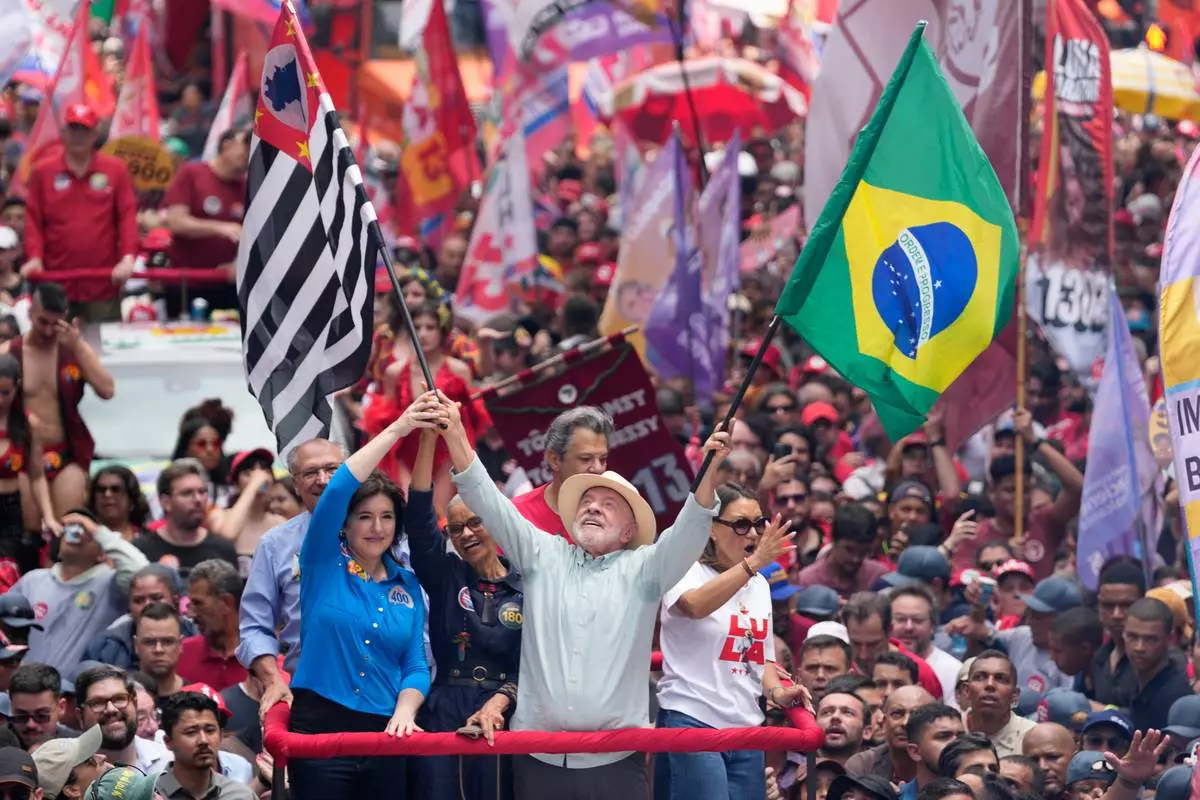
President Luiz Inacio Lula da Silva, who is running for reelection, waves a Brazilian and Sao Paulo state flags during a campaign rally a day ahead of the country's general election in Sao Paulo, Saturday, Oct. 3, 2026. (AP Photo/Andre Penner)
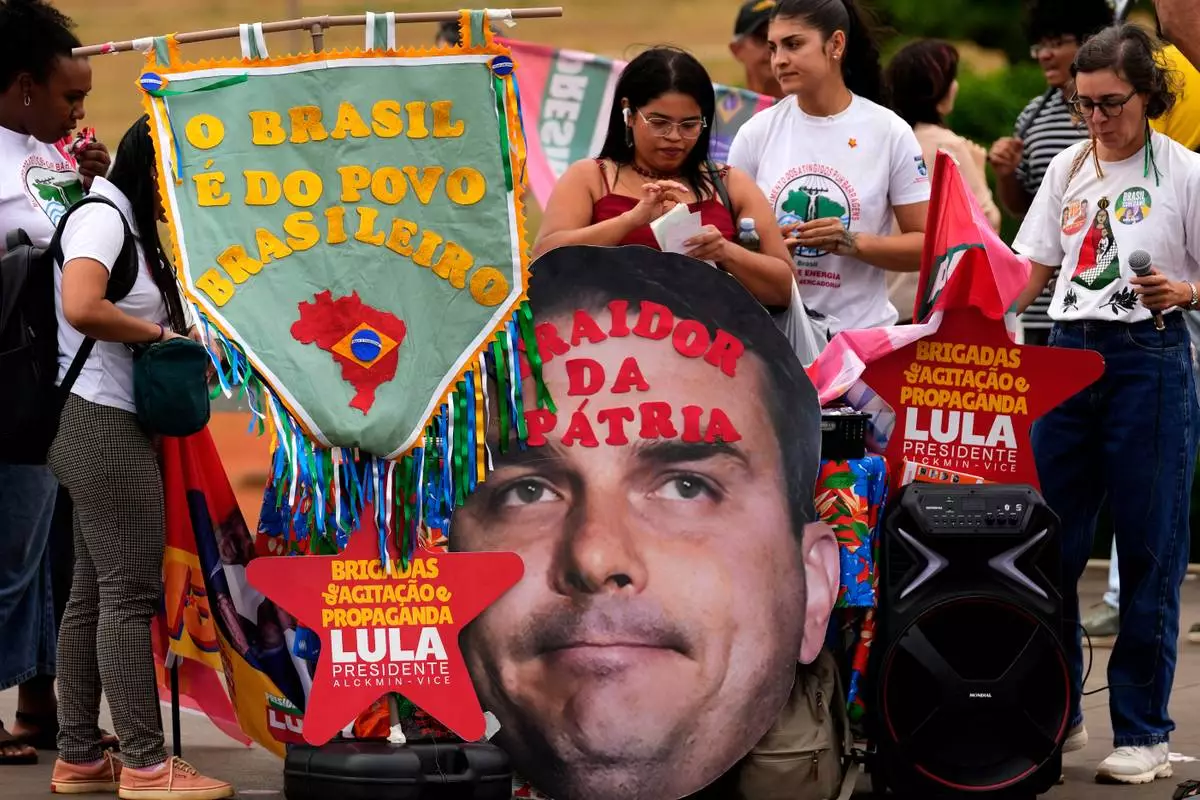
Supporters of Brazilian President Luiz Inacio Lula da Silva, who is running for reelection, display a large-headed effigy of presidential candidate Flavio Bolsonaro with a message in Portuguese that reads "Traitor of Brazil," during a campaign event at central bus station in Brasilia, Brazil, Friday, Oct. 2, 2026. (AP Photo/Eraldo Peres)
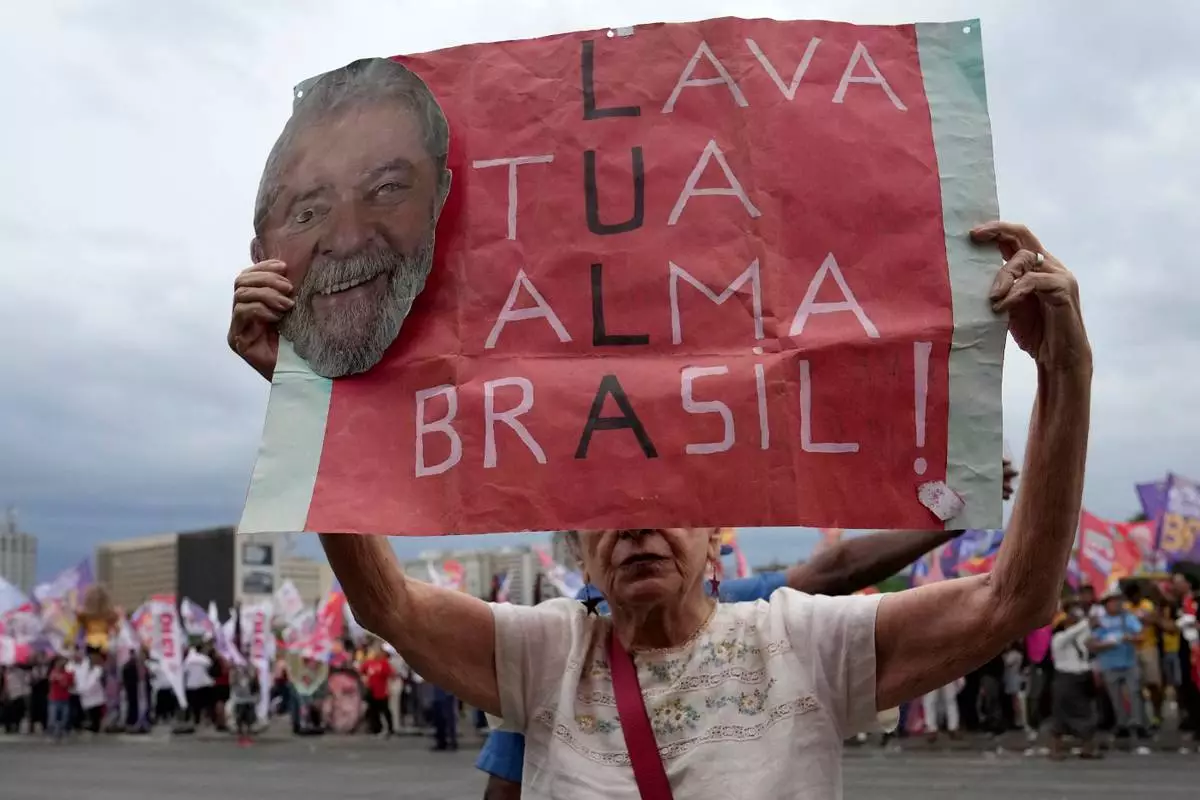
A supporter of Brazilian President Luiz Inacio Lula da Silva, who is running for reelection, holds a sign that reads "Lula, cleanse your soul, Brazil" during a campaign event at central bus station in Brasilia, Brazil, Friday, Oct. 2, 2026. (AP Photo/Eraldo Peres)