Skip to Content Facebook Feature Image

Yemen's government declares a major operation against the Houthis, and other Mideast news

News

Yemen's government declares a major operation against the Houthis, and other Mideast news
News

News

Yemen's government declares a major operation against the Houthis, and other Mideast news

2026-10-05 04:00 Last Updated At:12:20

Yemen's internationally recognized government has announced a major military operation against the Iran -backed Houthi rebels as they advance in the outskirts of a key city.

Meanwhile, the Iranian parliament speaker who was the lead negotiator in direct talks with the U.S. earlier this year says Washington recently put forward proposals via a mediator, without details. And a monitor says a commercial tanker has reported explosions near the Bab el-Mandeb Strait off Yemen.

More Images
A man walks inside a damaged sponge factory in Sanaa, Yemen, Sunday, Oct. 4, 2026. (AP Photo/Osamah Abdulrahman)

A man walks inside a damaged sponge factory in Sanaa, Yemen, Sunday, Oct. 4, 2026. (AP Photo/Osamah Abdulrahman)

A man walks inside a damaged sponge factory in Sanaa, Yemen, Sunday, Oct. 4, 2026. (AP Photo/Osamah Abdulrahman)

A man walks inside a damaged sponge factory in Sanaa, Yemen, Sunday, Oct. 4, 2026. (AP Photo/Osamah Abdulrahman)

Mourners carry the bodies of Palestinians Maisaa Abu Dawood and her daughter Mary, who were killed in an early morning Israeli airstrike, during their funeral at the Church of St. Porphyrius in Gaza City, Saturday, Oct. 3, 2026. (AP Photo/Jehad Alshrafi)
Mourners carry the bodies of Palestinians Maisaa Abu Dawood and her daughter Mary, who were killed in an early morning Israeli airstrike, during their funeral at the Church of St. Porphyrius in Gaza City, Saturday, Oct. 3, 2026. (AP Photo/Jehad Alshrafi)

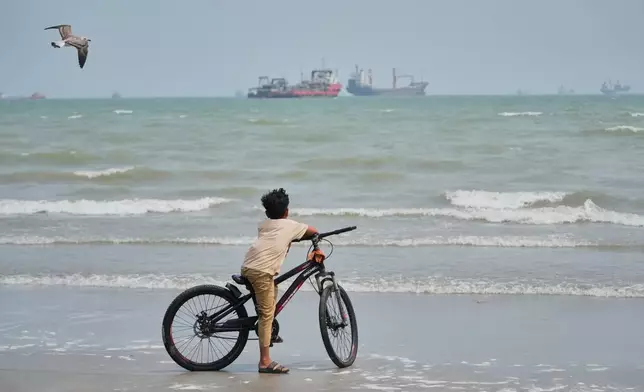
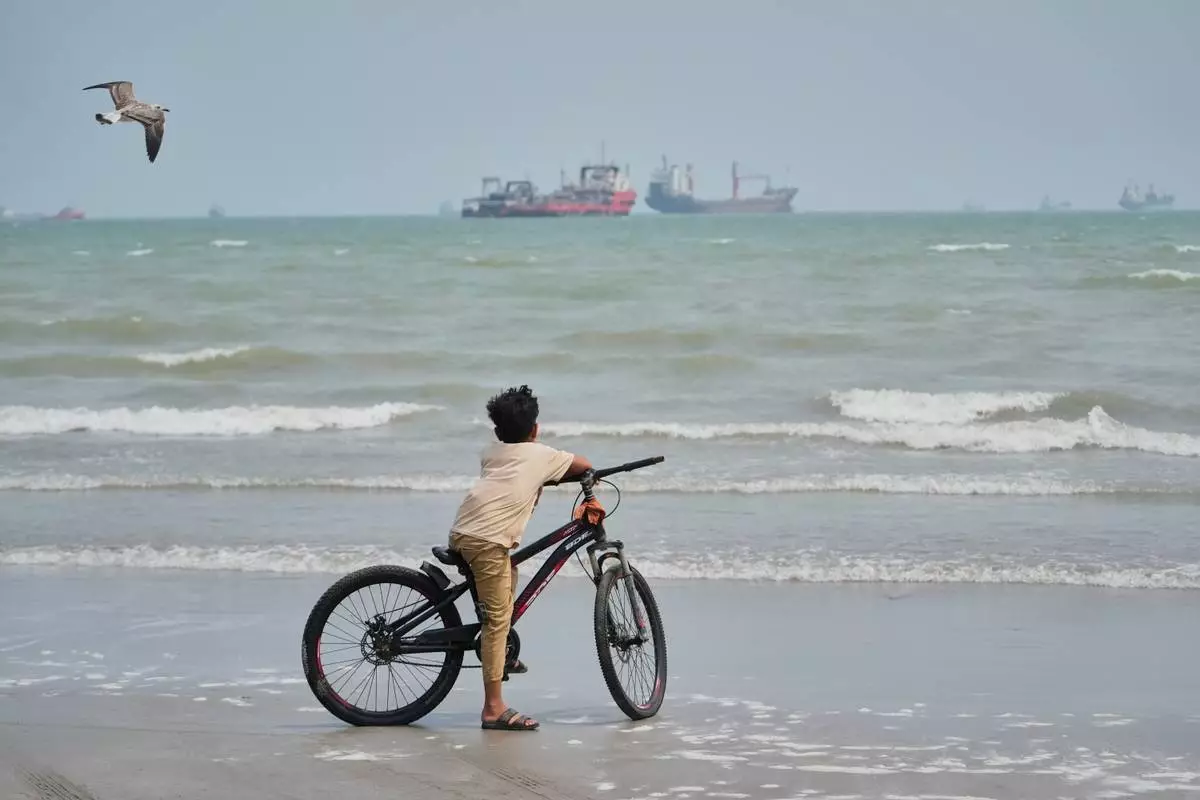
A gull flies overhead as a boy stands with his bicycle on a beach overlooking commercial vessels anchored in the Strait of Hormuz off Bandar Abbas, Iran, Monday, Sept. 7, 2026. (AP Photo/Vahid Salemi, File)

A gull flies overhead as a boy stands with his bicycle on a beach overlooking commercial vessels anchored in the Strait of Hormuz off Bandar Abbas, Iran, Monday, Sept. 7, 2026. (AP Photo/Vahid Salemi, File)

Here is the latest news from the Middle East on Sunday. Full coverage is available here.

Rashad al-Alimi, head of the ruling Presidential Leadership Council, made the declaration as the Iran-backed rebels advanced in the outskirts of a key southwestern city, Taiz.

Speaking from neighboring Saudi Arabia, he said the operation aims at “recovering the remaining territories” controlled by the Houthis, who made their largest land grab in recent years last month when they seized Yemen’s Red Sea coast and the Bab el-Mandeb Strait.

Al-Alimi called for the international community to provide support to his Saudi-backed government. In a separate statement, a Saudi military spokesperson, Maj. Gen. Turki al-Malki, stressed the kingdom's right to take all necessary measures to deter the rebels.

The Houthis have launched a major offensive in recent days against government forces and their allies on the outskirts of Taiz, disrupting a major road linking the city to the port city of Aden, the seat of al-Alimi’s government. The rebels have besieged Taiz for more than a decade.

Earlier, the Houthis said airstrikes hit the capital, Sanaa, overnight, without giving details. The Yemeni military, backed by Riyadh, claimed responsibility, saying it struck “vital targets” in Sanaa as well as the northern province of Saada on the border with Saudi Arabia.

The escalation between Saudi Arabia and the Houthis has revived Yemen’s civil war after a four-year ceasefire.

The United States recently put forward proposals through a mediator, Iran's parliament speaker, Mohammad Bagher Qalibaf, told an open session of Parliament, without details.

U.S. President Donald Trump last week said he rejected Iran’s latest peace offer because it’s not good enough. Qalibaf, the lead negotiator in rare direct talks with the U.S. earlier this year, said Americans “say something different in the media.”

Qalibaf said “the era of dragging out time and dictating unilateral demands is over” and that Iran's seven conditions for fully reopening the Strait of Hormuz remain.

Separately, Foreign Minister Abbas Araghchi told ambassadors and chargés d’affaires of foreign missions in Tehran that “if they seek diplomatic avenues, we remain ready to reach a fair and honorable solution through diplomacy to end this war." But he warned that any renewed military confrontation would bring a stronger response.

Araghchi also rejected a U.S. claim that the Iranian delegation had been expelled from the U.S. days after the annual U.N. gathering of world leaders, where Iran proposed a deal to the U.S. that was turned down. He said Iran had returned according to a previously arranged schedule.

A British military monitor said a commercial tanker has reported explosions “in close proximity” near the Bab el-Mandeb Strait at the southern end of the Red Sea off Yemen.

The United Kingdom Maritime Trade Operations Center said the crew was reported safe and authorities were investigating after the blasts 60 nautical miles south of the port city of Mokha in Yemen. The tanker was not identified.

The Joint Maritime Information Center, overseen by the U.S. Navy, calls the threat level in the area substantial after Iran-backed Houthi rebels last month seized land next to the Strait. The rebels say they are targeting Saudi shipping.

Iran’s oil minister resigned and President Masoud Pezeshkian accepted his resignation, state television reported. Pezeshkian appointed Hamid Bovard as caretaker oil minister following the resignation of Mohsen Paknejad. Bovard has been CEO of the National Iranian Oil Company.

The reason for the resignation was not immediately clear. It came as Iran’s oil exports face intense pressure from tightened U.S. sanctions and a naval blockade.

Iran’s ability to export oil is a crucial source of government revenue. Tehran has demanded that Washington lift sanctions on its oil sales and end the blockade as part of negotiations over reopening the Strait of Hormuz.

An Israeli strike on a civilian vehicle killed one Palestinian and wounded at least 11 others, according to health officials at the Aqsa Martyrs Hospital, where the casualties were taken. Israel’s military said it targeted a known Hamas militant.

Later, a Turkish aid agency, the Deniz Feneri Association, said one of its volunteers was killed in an Israeli attack in Gaza. Israel's military said it “eliminated” a Hamas militant whom it described as the aid group's director.

Palestinians in Gaza have reported a surge in Israeli fire and airstrikes across the enclave over the past month. Israel says it is targeting Hamas and other militants who pose a threat, and in response to ceasefire violations, including occasional attacks.

Israeli strikes have killed at least 1,445 Palestinians in Gaza since a ceasefire was reached with the Hamas militant group nearly a year ago, according to the territory’s Health Ministry. Its figures are seen as generally reliable by U.N. agencies and independent experts. It doesn’t give a breakdown of civilians and militants. Seven Israeli soldiers have been killed in Gaza since the ceasefire.

A projectile struck a tanker on the Strait of Hormuz, damaging the engine room, the United Kingdom Maritime Trade Operations Center said.

It was not immediately clear who launched the attack or when it was carried out. The UKMTO said the crew was reportedly safe.

In a separate report, the Joint Maritime Information Center, overseen by the U.S. Navy, said three tankers were struck on Saturday while transiting the strait, noting that attacks on the Omani side of the strait continue. That's where the U.S. military has been guiding vessels.

Overall ship traffic on the strait has improved but remains below prewar levels, as do shipments of energy products, even though Iran has lost its near-complete grip on the crucial waterway due to the U.S. Navy’s efforts. That, along with various pipelines, has allowed Gulf countries to restore oil exports to nearly prewar levels.

The Houthi military spokesperson, Brig. Gen. Yahya Saree, said the rebels fired missiles and drones at Saudi oil facilities.

In a prerecorded statement, Saree claimed to have targeted facilities of the Saudi state-run Aramco oil company, in the capital, Riyadh, and the Kurais area, which hosts a massive facility 150 kilometers (90 miles) southeast of Riyadh.

He didn’t say when it occurred, provide further details or offer evidence supporting his claim. A fire broke out at an Aramco oil refinery on Saturday, with no details released on the cause.

This report will be updated throughout the day as new developments emerge.

A man walks inside a damaged sponge factory in Sanaa, Yemen, Sunday, Oct. 4, 2026. (AP Photo/Osamah Abdulrahman)
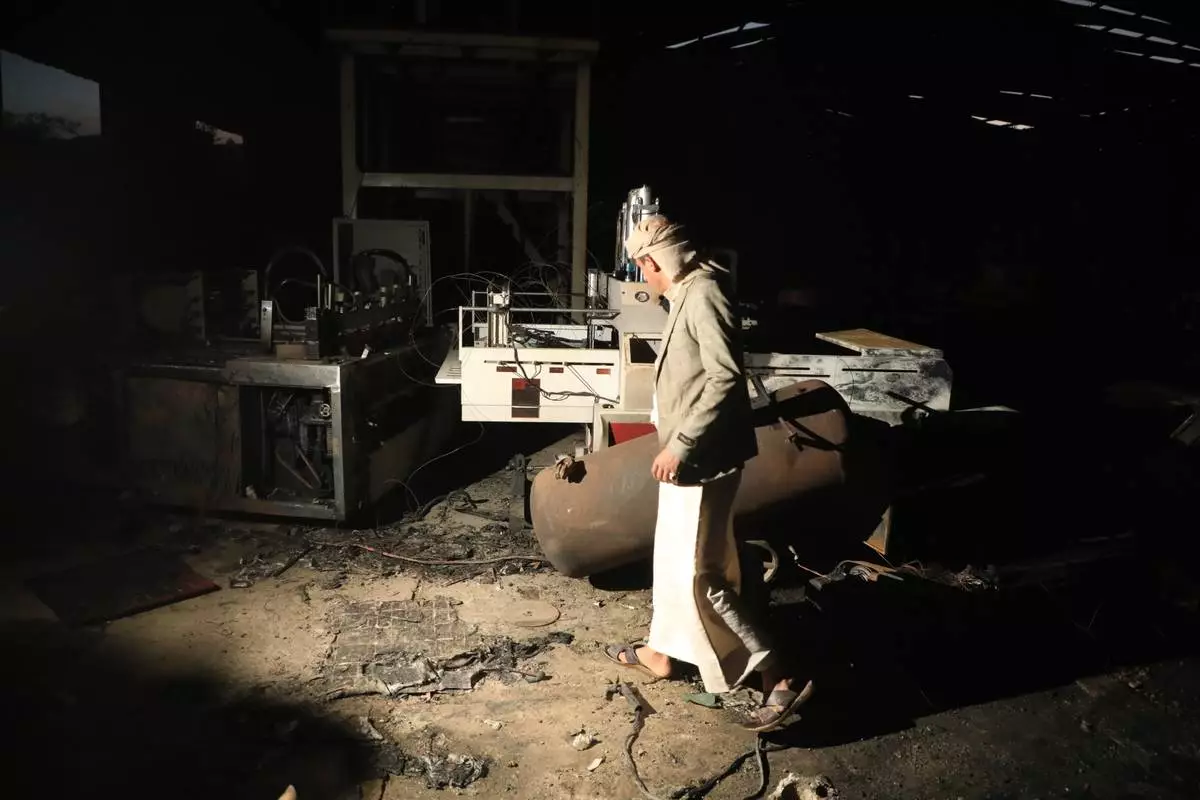
A man walks inside a damaged sponge factory in Sanaa, Yemen, Sunday, Oct. 4, 2026. (AP Photo/Osamah Abdulrahman)

A man walks inside a damaged sponge factory in Sanaa, Yemen, Sunday, Oct. 4, 2026. (AP Photo/Osamah Abdulrahman)

A man walks inside a damaged sponge factory in Sanaa, Yemen, Sunday, Oct. 4, 2026. (AP Photo/Osamah Abdulrahman)

Mourners carry the bodies of Palestinians Maisaa Abu Dawood and her daughter Mary, who were killed in an early morning Israeli airstrike, during their funeral at the Church of St. Porphyrius in Gaza City, Saturday, Oct. 3, 2026. (AP Photo/Jehad Alshrafi)
Mourners carry the bodies of Palestinians Maisaa Abu Dawood and her daughter Mary, who were killed in an early morning Israeli airstrike, during their funeral at the Church of St. Porphyrius in Gaza City, Saturday, Oct. 3, 2026. (AP Photo/Jehad Alshrafi)

A gull flies overhead as a boy stands with his bicycle on a beach overlooking commercial vessels anchored in the Strait of Hormuz off Bandar Abbas, Iran, Monday, Sept. 7, 2026. (AP Photo/Vahid Salemi, File)

A gull flies overhead as a boy stands with his bicycle on a beach overlooking commercial vessels anchored in the Strait of Hormuz off Bandar Abbas, Iran, Monday, Sept. 7, 2026. (AP Photo/Vahid Salemi, File)

NEW YORK (AP) — It was philanthropy, the story goes, that first bonded two of the founders behind artificial intelligence giant Anthropic.

Jared Kaplan, the San Francisco company's chief science officer, and CEO Dario Amodei were doctoral students carpooling to an event organized by an academic fellowship. As Kaplan recalls, he and Amodei spent the ride discussing “this idea of thoroughly investigating what kinds of charitable causes could do the most good.”

“We had so much largesse to, sort of, disperse,” Kaplan joked at a Hertz Foundation discussion in April 2025.

Those once-hypothetical philanthropic ambitions gained new steam as Anthropic debuted on the stock market to a record $1.5 trillion valuation. The Claude AI tool maker already plans to dedicate 5% of its shares for a new Anthropic Public Benefit Fund. Its seven co-founders say they'll give away 80% of their equity — a $112 billion commitment based on its IPO price.

Now suddenly affluent employees, many of whom will become millionaires as they sell their vested stock, may wield enough capital to make transformative donations themselves — riches that are commanding the attention of nonprofits looking to direct some sliver toward causes from global health to animal welfare.

Silicon Valley has great expectations. The napkin math suggests leading U.S. AI firms' valuations could add at least $37 billion annually in intended philanthropy, according to a widely circulated May blog post by Nan Ransohoff, head of public goods at the payments company Stripe.

“This is a once-in-a-lifetime kind of opportunity for people to really make an impact on extreme poverty,” said Peter Singer, the moral philosopher whose writings influence many tech donors.

Nonprofits aren’t counting on an immediate charitable windfall, though. Many Anthropic employees cannot sell or gift the bulk of their shares until next spring. Questions persist about the charitable priorities of these potential philanthropists whose worldviews have been shaped by the increasingly powerful AI models advancing at breakneck speed. The sector's volatility — between high borrowing costs, recent turmoil at the chipmaker Nvidia and warnings about risks to humanity — leaves skeptics doubtful about the amounts actually available to redistribute.

“The challenge is that deploying philanthropic capital is hard,” said Renaissance Philanthropy president Kumar Garg, whose nonprofit matches funders with scientific initiatives. “That’s not an automatic step.”

Will the artificial intelligence wave of wealth creation differ from previous ones that created new philanthropy?

There's reason to believe so, according to Benjamin Soskis, a historian of philanthropy and senior research associate at the Urban Institute's Center on Nonprofits and Philanthropy, even if he finds the number of tech executives who have “actually managed to empty the safe” is low.

The modern philanthropic foundation stemmed from the post-Civil War wave of industrial capitalism. Titans such as oil magnate John D. Rockefeller Sr. and steel tycoon Andrew Carnegie established bureaucratic institutions intended to address the root causes of social problems. Those were followed by the turn-of-the-century technology wealth that brought a more data-centric, risk-taking approach. The Gates Foundation launched to address pressing crises in global health and poverty.

AI wealth, according to Soskis, carries a sense of “extreme peril” and “really transformative promise” that should spur even more urgent action from this emerging class of donors.

At least one of Anthropic's co-founders will donate in the coming weeks to the Trump Accounts children's savings program, according to comments made Friday by U.S. Treasury Secretary Scott Bessent on CNBC.

Anthropic's explosive growth is also fueling some anticipation that its 5,300 employees will want to rapidly scale their charitable impact, too. A generous internal giving program adds another incentive. Employee equity gifts are matched by the company with shares of Class N common stock. Anthropic also partners with donor-advised fund vendors such as Daffy, which offer a tax-efficient tool for grantmaking without the hassle of a more sophisticated charitable foundation.

Daffy CEO Adam Nash expects this younger generation to give more quickly.

“The people working in AI see the impact AI is having already,” Nash said. “And they are giving now, right?"

One organization in particular appears poised to move those rising donation volumes.

Coefficient Giving was formed by San Francisco-based billionaire Cari Tuna and her husband, Dustin Moskovitz, a Facebook co-founder and early Anthropic investor. A spokesperson told The New York Times the couple transferred their Anthropic stake into an undisclosed nonprofit last year to avoid personally profiting.

The philanthropic funder — which has directed more than $8 billion since 2014 in support of global health, animal rights, AI safety and the effective altruism community — has been scaling its pledges. In July, Coefficient Giving increased its commitment to the grantmaker GiveWell to $1 billion.

The move reflected expectations of “considerably more future funding for this kind of work,” according to the announcement.

“We might grow a lot, in part because we want to spend faster in response to these trends,” Coefficient Giving CEO Alexander Berger said during a late July public discussion. "But there is a great deal of room for other organizations and approaches, and I do not expect us to play an overwhelmingly dominant role.”

GiveDirectly has spent months identifying the biggest barriers to rapidly growing its antipoverty work, according to Nick Allardice, its president and CEO. The tech-focused nonprofit sends cash straight to poor households with no strings attached.

Recipients must have mobile phones to receive the digital transfers. GiveDirectly offers phones for about $15, usually subtracted from recipients' first payment. So the nonprofit secured investments this year to build out a supply chain to support many more mobile phones going forward.

The group is betting that its preparations for a charitable boom will be worthwhile.

“I have this level of cautious optimism,” Allardice said. “But I can't foresee the future, and I don't know exactly what's going to happen.”

Wild Animal Initiative executive director Cameron Meyer Shorb shares those tempered expectations.

His nonprofit funds wild animal welfare research. It's the sort of work some observers predict will see the biggest upswings in support: nonprofits connected to effective altruism, a data-driven movement that prioritizes donations to causes with the greatest impact on the most living beings.

The movement's reputation took a hit when Sam Bankman-Fried, one of its leading proponents and financial backers, got a 25-year prison sentence for cryptocurrency fraud. But the ideas are rebounding in the same tech circles that could see big payouts as more AI companies go public.

Effective altruists have learned not to rely too heavily on any one funder, according to Shorb. He expects “quite a bit” of fresh support for animal advocacy and sees an outsize role for midsize donors.

He said he has connected with a couple of Anthropic employees. Perhaps more important, he said, are relationships with the philanthropic advisers who help plan donors' giving.

“As you can imagine, it’s a pretty tricky place for a soon-to-be billionaire to be to have all this potential power coming soon,” Shorb said. “As soon as anyone finds out about that, anyone who can possibly get their email or phone number will just be knocking down their door. So we’ve tried to be gentle and slow and respectful in our approach.”

Associated Press coverage of philanthropy and nonprofits receives support through the AP’s collaboration with The Conversation US, with funding from Lilly Endowment Inc. The AP is solely responsible for this content. For all of AP’s philanthropy coverage, visit https://apnews.com/hub/philanthropy.

The Anthropic logo is displayed on the Nasdaq MarketSite tower as part of the Anthropic IPO in New York, Thursday, Nov. 19, 2026. (AP Photo/Andres Kudacki)

The Anthropic logo is displayed on the Nasdaq MarketSite tower as part of the Anthropic IPO in New York, Thursday, Nov. 19, 2026. (AP Photo/Andres Kudacki)

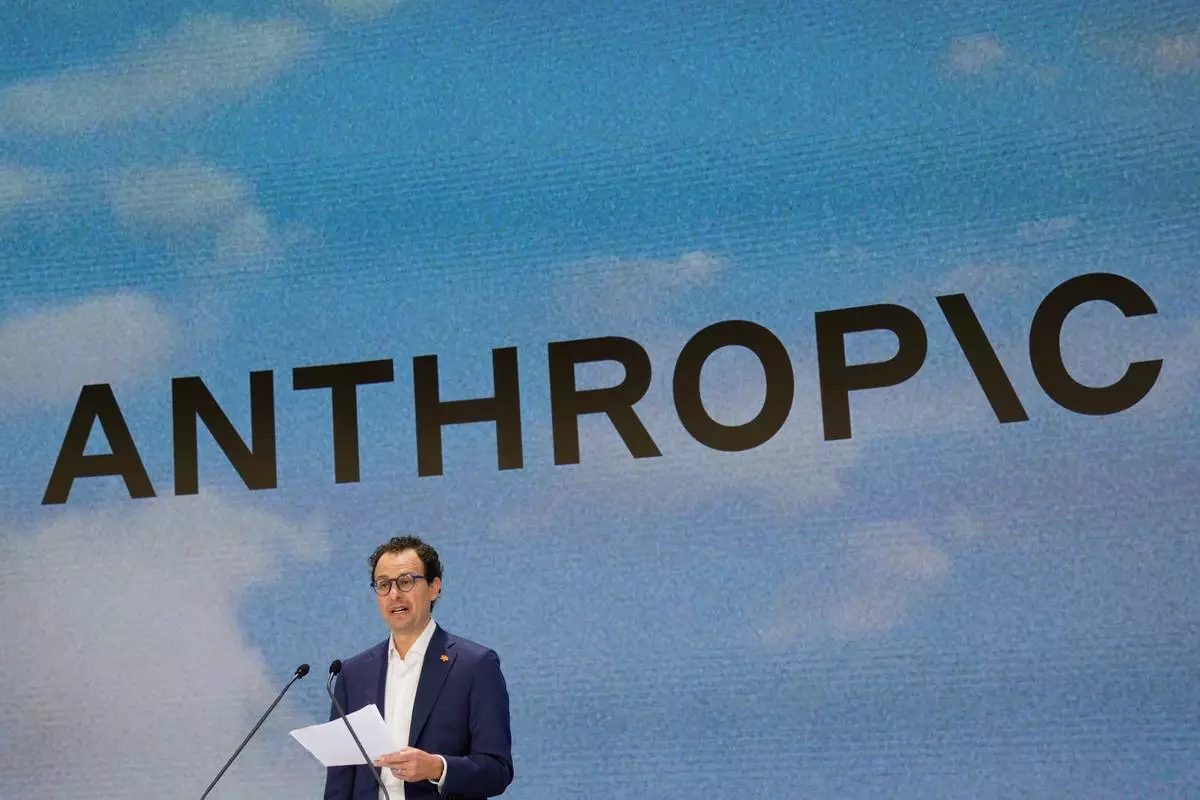
Dario Amodei, co-founder and CEO of Anthropic, speaks during the opening bell ceremony at Nasdaq MarketSite as part of the Anthropic IPO in New York, Thursday, Nov. 19, 2026. (AP Photo/Seth Wenig)

Dario Amodei, co-founder and CEO of Anthropic, speaks during the opening bell ceremony at Nasdaq MarketSite as part of the Anthropic IPO in New York, Thursday, Nov. 19, 2026. (AP Photo/Seth Wenig)

Recommended Articles