Brazilians are voting Sunday in a pivotal presidential election dominated by incumbent Luiz Inácio Lula da Silva and his ideological opposite, Sen. Flávio Bolsonaro.
Preelection polls suggested both have a chance of winning outright, but if neither gets a majority of the vote, a runoff will be held on Oct. 25.
Nearly 159 million Brazilians are eligible to vote in Latin America’s largest economy. Bolsonaro is an ally of U.S. President Donald Trump and the son of ex-leader Jair Bolsonaro, whom Lula defeated four years ago.
Here's the latest:
Lula is watching the count with First Lady Rosângela da Silva at his residence in Sao Paulo’s upscale Alto de Pinheiros neighborhood, and then plans to head to a hotel downtown to speak to journalists.
Flávio Bolsonaro is watching with his family in his house in the capital of Brasilia.
Bolsonaro’s father, former President Jair Bolsonaro, cannot host his son in his residence in the same city because he is serving his 27-year prison sentence for an attempted coup.
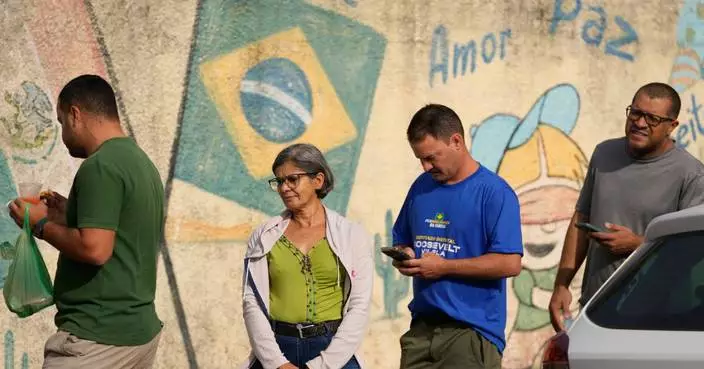
Brazilian voters expressed confidence and pride in Brazil’s speedy electronic voting system as they cast their votes in downtown Rio de Janeiro, near a market teeming with fresh fruit and vegetables and a colonial-style church perched on a hill.
Josemar Lauriano Pereira, a 46-year-old lawyer, said that the rapid availability of results helped combat fraud and uncertainty.
“When results take a lot of time, it creates an opening for people to cast doubt on the results, to say there’s been a problem,” he said.
Fraud used to be a problem, but is no longer, said Tones José, 42, who works as a doorman. “Things have changed a lot since then. Now the urns are fully trustworthy.”
Failing to cast a ballot in Brazil's election incurs a small fine. Those who are illiterate, above the age of 70, and between 16 and 18 years of age may choose whether to exercise their right.
For Brazilians abroad, voting is required only in the presidential race.
Brazilian ex-President Jair Bolsonaro’s wife, Michelle Bolsonaro, is running for Senate in the Federal District, home to the capital, Brasilia.
A devout evangelical, the 44-year-old has never previously held public office.
In June, Michelle Bolsonaro had a very public falling out with Sen. Flávio Bolsonaro, her stepson, whom she accused of disrespecting her in lengthy videos posted on her social media. The pair later made up.
She has called her candidacy “a mission” entrusted by her husband, who is serving a 27-year sentence under house arrest following his conviction for an attempted coup.
Brazilians faced a long line to cast their vote in Paris, but morale was high and the atmosphere festive, with some singing and dancing to forró, a Brazilian style of music, and munching on coxinhas — an iconic, deep-fried savory snack.
Pablo José Feitosa Martins, a 48-year-old truck driver, was in line for an hour and a half to cast his vote. He moved to France in 2002 but grew up in the northeastern state of Pernambuco, as did President Luiz Inácio Lula da Silva.
Feitosa Martins said that the incumbent had his vote because his social and industrial policies had transformed his region.
“There was a huge difference with the southeast,” he said by phone, referencing Brazil’s richer southern region where Sao Paulo and Rio are located. “There was nothing in the northeast, but now there is energy and water in the countryside, and people are no longer dying of hunger.”
In the last presidential election in 2022, women played a decisive role in handing President Luiz Inácio Lula da Silva a narrow victory over Flávio Bolsonaro’s father, former President Jair Bolsonaro.
In the lead-up to Sunday’s vote, candidates courted women with proposals to combat gender-based violence, a major campaign issue as violence against women reaches record levels and several high-profile cases draw attention.
Aware of women’s electoral weight, activists sought to leverage that power to seek guarantees that such promises won't later be shelved.
In cities across Brazil, Sen. Flávio Bolsonaro’s supporters wore the yellow and green of the Brazilian flag.
President Luiz Inácio Lula da Silva's supporters wore red T-shirts, some with the face of the young Lula in his union days and messages denouncing U.S. influence in Brazilian politics.
International election observers monitored the voting centers, where there was a usual security presence.
In one voting center in Sao Paulo, the energy was more subdued than four years ago, when Lula beat the senator’s father, former President Jair Bolsonaro.
“There’s definitely much less of an election vibe now,” said Celso Gaspar, 67, a retired teacher, who didn’t disclose who he voted for.
“Most people here feel they have a civic duty to fill, but there’s not that much passion for any candidate. A runoff between Lula and Flávio Bolsonaro can change that.”
Maria Ribeiro, a 50-year-old cellphone vendor from Brasilia, said that she voted for Flávio Bolsonaro to become Brazil's president because she wants freedom to express her evangelical religion.
She hopes that Bolsonaro follows in the footsteps of his father, Jair Bolsonaro.
“I voted for his father, and I don’t regret it,” she said, donning a yellow and green Brazil shirt at the voting center.
Rosangela Resende da Rocha, a 69-year-old who was previously a stay-at-home mom, said that she supported Lula’s social policies that help the “less fortunate” and how he stands up to U.S. President Donald Trump.
“That crazy guy wants to come in here to buy our country, so that our country will be like it is over there,” she said at a voting center in Brasilia. “He won’t succeed if Lula wins.”
“Win or lose, we are for Lula.”
Brazilians lined up to vote in Portugal’s capital like those living outside Brazil around the globe.
Some of those waiting to vote in Lisbon showed their Brazilian pride — one wearing a yellow and green Brazil soccer jersey, another a T-shirt with incumbent President Lula’s face emblazoned on the front.
“I will have dual nationality, but I’m still patriotic,” said Michele Sacramento, who’s lived in Portugal for seven years. “I love my country and I hope I can return one day and be able to walk in the street like I walk here, without any fear, any worry.”
Many are casting their ballots under the shadow of rising crime. Fears are most acute in Bahia, the country’s most violent state, a stronghold for President Luiz Inácio Lula da Silva.
They are also high in Rio de Janeiro, Flávio Bolsonaro’s home state, where entrenched criminal factions and urban warfare have plagued communities for decades. Voters head to the polls demanding decisive federal action in the near future.
Brazil’s incumbent president, Luiz Inácio Lula da Silva, voted after 9 a.m. in a school in Sao Bernardo do Campo, outside Sao Paulo.
The 80-year-old Lula said that he was confident that he could get his first outright victory in seven runs for the presidency. He also urged Brazilians above age 70, who aren’t legally required to vote, to show up and cast their ballots.
Wearing a hat to protect his head after a skin cancer diagnosis, Lula told journalists that he needs “to do double what we have done” if reelected and also said that “Brazil will not go forward by making arms sales easier,” in reference to a long-standing pledge of his main opponent, Flávio Bolsonaro.
Rosane Wink, 67, a retired engineer with German origins who voted in the same school as Flávio Bolsonaro, is a lifelong conservative voter who supports the former president’s son and his promise to classify criminal groups as terrorist organizations.
“It’s a kind of terrorism that they’re doing with us,” said Wink, who was wearing a T-shirt with Brazil’s national colors.
Last month, a robber held a gun to her stomach and then bit her hand and removed her wedding ring, she said.
“We’re not going to succeed in putting an end to crime, but we have to find a way to diminish it.”
Brazil's patron saint is Our Lady of Aparecida.
A comment on Jesus by Sen. Flávio Bolsonaro recently went viral, triggering fears among many Catholics that he might intend to remove the patron saint status of Our Lady of Aparecida — a claim Bolsonaro has denied.
In an Aug. 23 video, Bolsonaro said that he would “declare that Brazil belongs to the Lord Jesus Christ.” Some Catholics interpreted that as meaning that the presidential candidate would remove Our Lady of Aparecida as Brazil’s patron saint.
Our Lady of Aparecida is a much-beloved figure among Brazilians. The accusation tapped into Catholics’ fears over losing ground to evangelicals and could weaken the presidential bid of Bolsonaro, who is evangelical.
Bolsonaro has no authority to name or remove patron saints. That’s entirely up to the Vatican.
Brazilian presidential candidate Flávio Bolsonaro has voted in his home state of Rio de Janeiro.
“Brazil needs change, Brazil can’t stand so much suffering,” said Bolsonaro, who arrived at around 8:10 a.m. local time to vote in a school.
He was dressed in a light yellow shirt featuring a “22” sticker, corresponding to the number that Brazilians must punch into electronic voting machines if voting for him.
“I am more than prepared to preside this country to give back to Brazilians the right to dream,” he told journalists.
President Luiz Inácio Lula da Silva's government sees a series of recent U.S. measures — including tariffs and the decision to classify Brazil’s biggest drug-trafficking groups as foreign terrorist organizations — as attempts to tip the scale in Sen. Flávio Bolsonaro’s favor, an accusation that the Trump administration has denied.
A victory by Bolsonaro would mean Brazil would join Argentina, Chile, Colombia, Costa Rica and Peru in electing Trump-friendly governments in recent years.
Lula has made Brazil’s sovereignty a major campaign issue. In the days before the election, his team launched a Portuguese version of the Bad Bunny song, “Lo que le paso a Hawaii,” that uses the U.S. colonization of Hawaii as a cautionary tale.
Brazilian voters prepare number-heavy lists to remember their candidates’ numbers and at the ballot box, punch in the corresponding digits. Brazilian authorities adopted electronic voting machines in the 1990s to tackle longstanding fraud.
In earlier elections, ballot boxes were stuffed or stolen, and individual votes were routinely falsified, according to Brazil’s electoral authority. Now, results are reported mere hours after polls close.
In the lead-up to the 2022 vote, Jair Bolsonaro repeatedly cast unfounded doubts on Brazil’s electronic voting system. No significant fraud has ever been detected.
Alongside regional heavyweights like U.S. President Donald Trump and Nicaraguan President Daniel Ortega, 80-year-old Luiz Inácio Lula da Silva stands among the oldest leaders in the Americas.
If Lula achieves an outright victory against 45-year-old Flávio Bolsonaro, he will cement a historic milestone, becoming the oldest man ever elected to lead the South American nation.
He says he wants to live to be 120. He tried to ease concerns by posting workout videos to attempt to convince voters that age is just a number.
Voting has started in Brazil's high-stakes presidential election, pitting the two main candidates, incumbent Luiz Inácio Lula da Silva and his ideological opposite, Sen. Flávio Bolsonaro, against each other.
Almost 159 million Brazilians are eligible to vote in this tense political showdown.
Brazilians will also elect 27 state governors, members of state legislatures, all 513 federal members of the lower house of congress and 54 of the country’s 81 senators in Sunday’s vote.
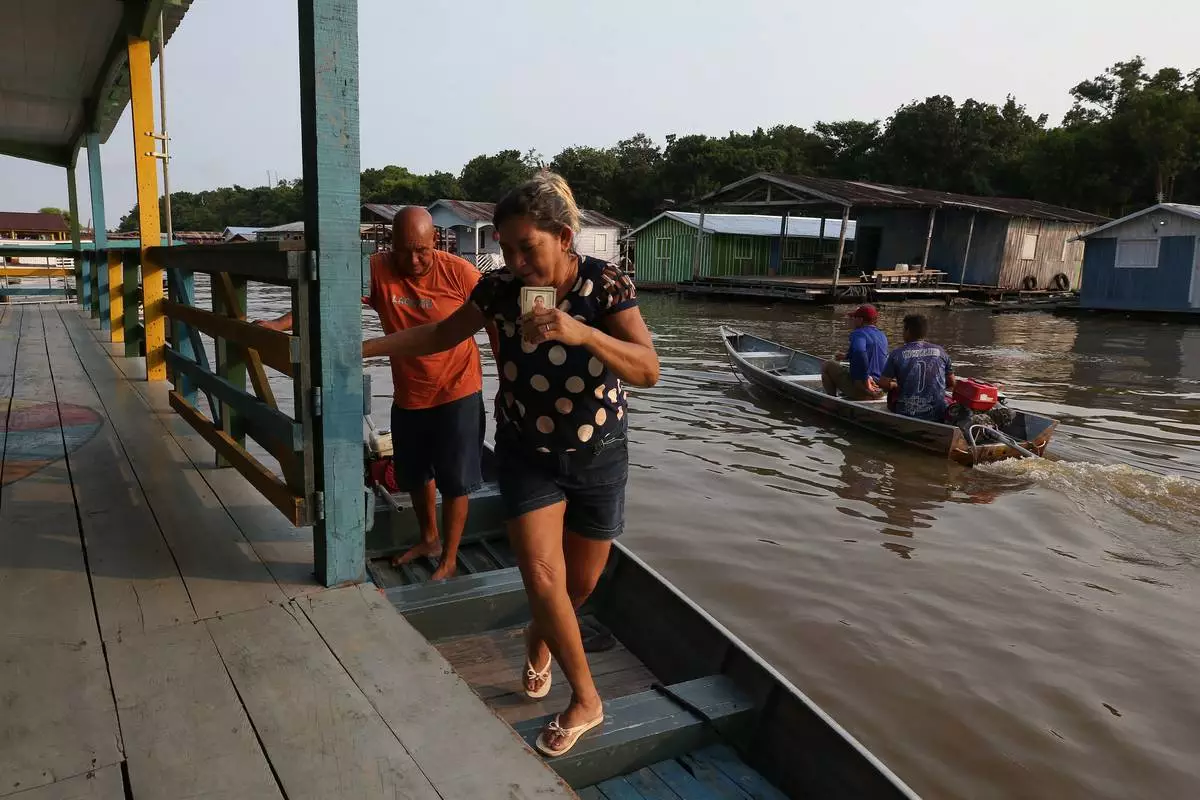
Voters arrive to a polling station during general elections in Iranduba, Brazil, Sunday, Oct. 4, 2026. (AP Photo/Edmar Barros)
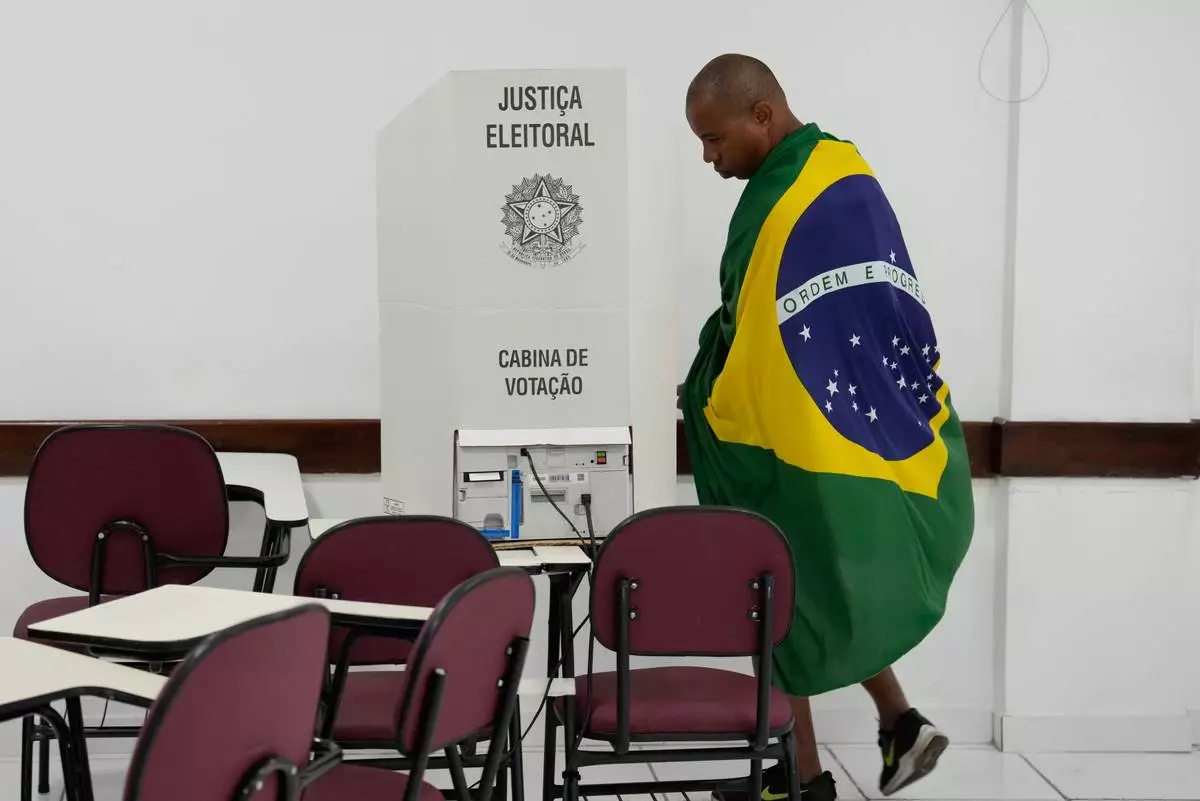
A voter wrapped in a Brazilian flag walks to an electronic voting machine to cast his ballot during general elections in Brasilia, Brazil, Sunday, Oct. 4, 2026. (AP Photo/Eraldo Peres)
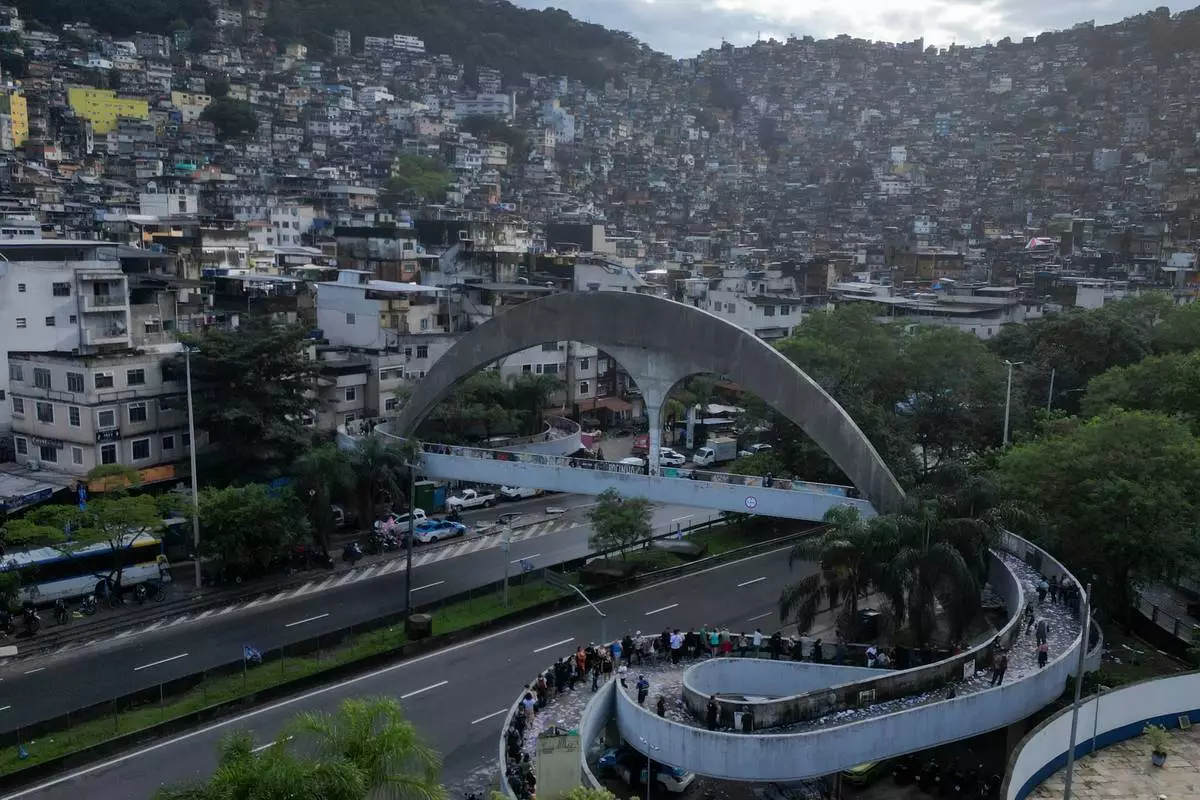
Voters line up to cast their ballots during general elections in the Rocinha favela in Rio de Janeiro, Brazil, Sunday, Oct. 4, 2026. (AP Photo/Bruna Prado)
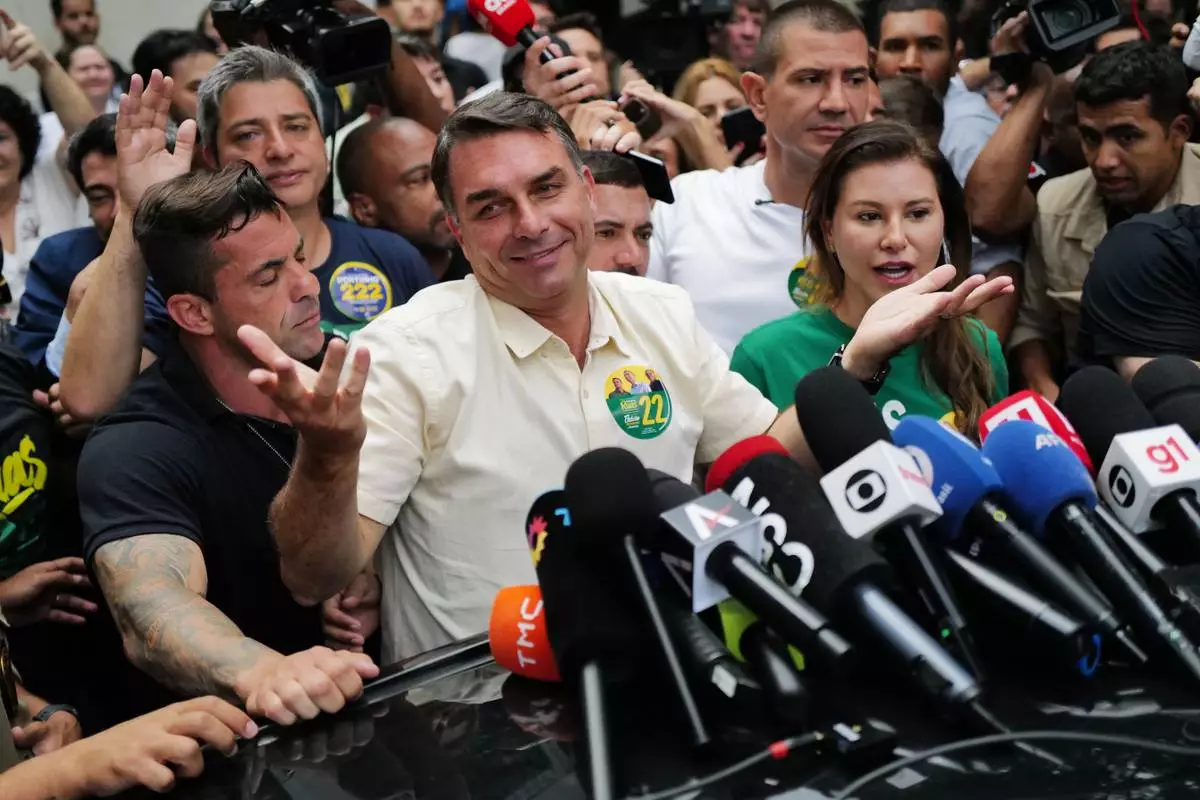
Opposition presidential candidate Sen. Flavio Bolsonaro speaks after voting during general elections in Rio de Janeiro, Sunday, Oct. 4, 2026. (AP Photo/Lucas Landau)
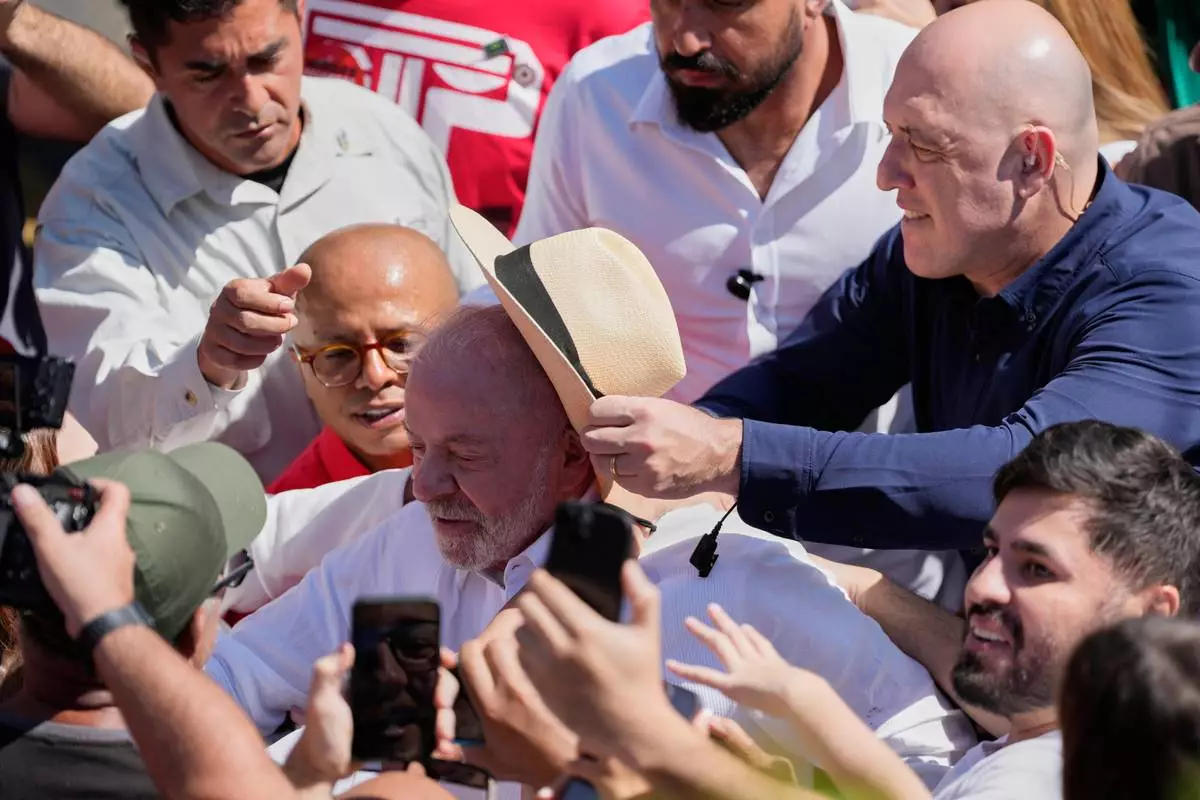
A security officer places a hat on President Luiz Inacio Lula da Silva as he leaves after voting during general elections amid a crowd in Sao Bernardo do Campo, Brazil, Sunday, Oct. 4, 2026. (AP Photo/Andre Penner)
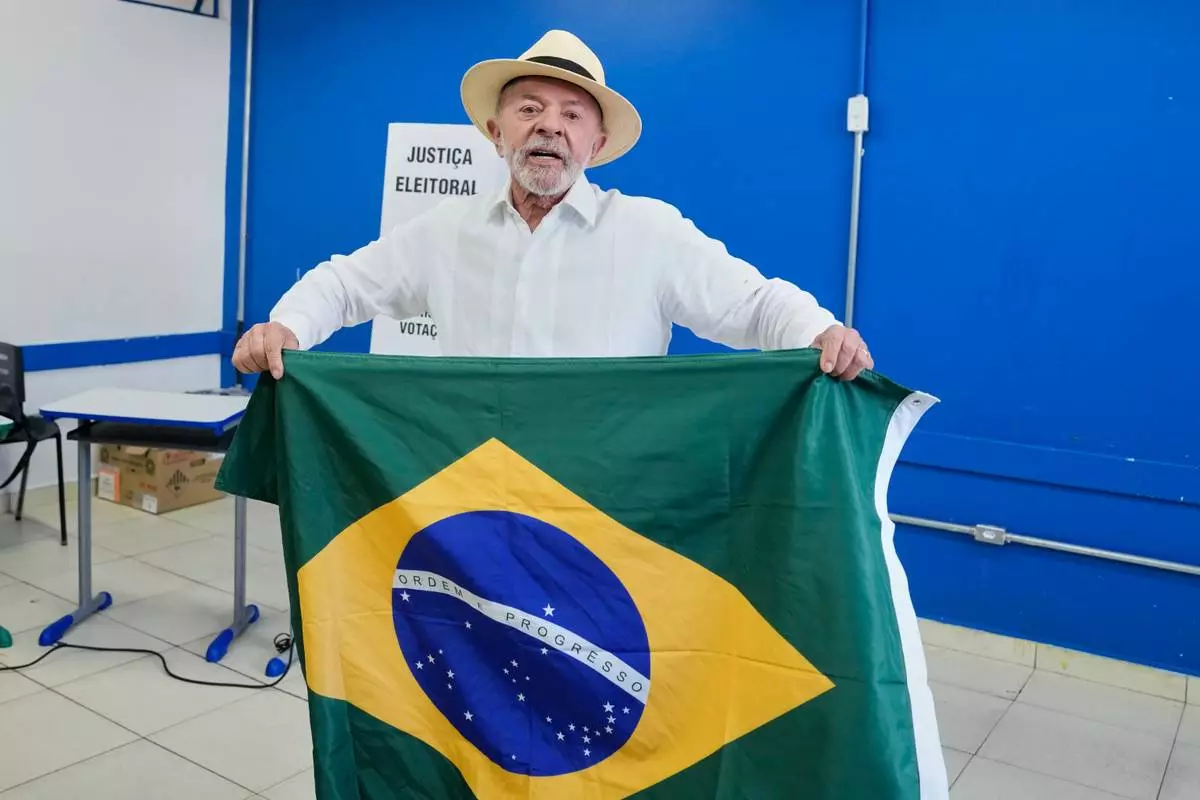
President Luiz Inacio Lula da Silva, who is running for reelection, displays a Brazilian flag after voting in Sao Bernardo do Campo, Brazil, Sunday, Oct. 4, 2026. (AP Photo/Andre Penner)
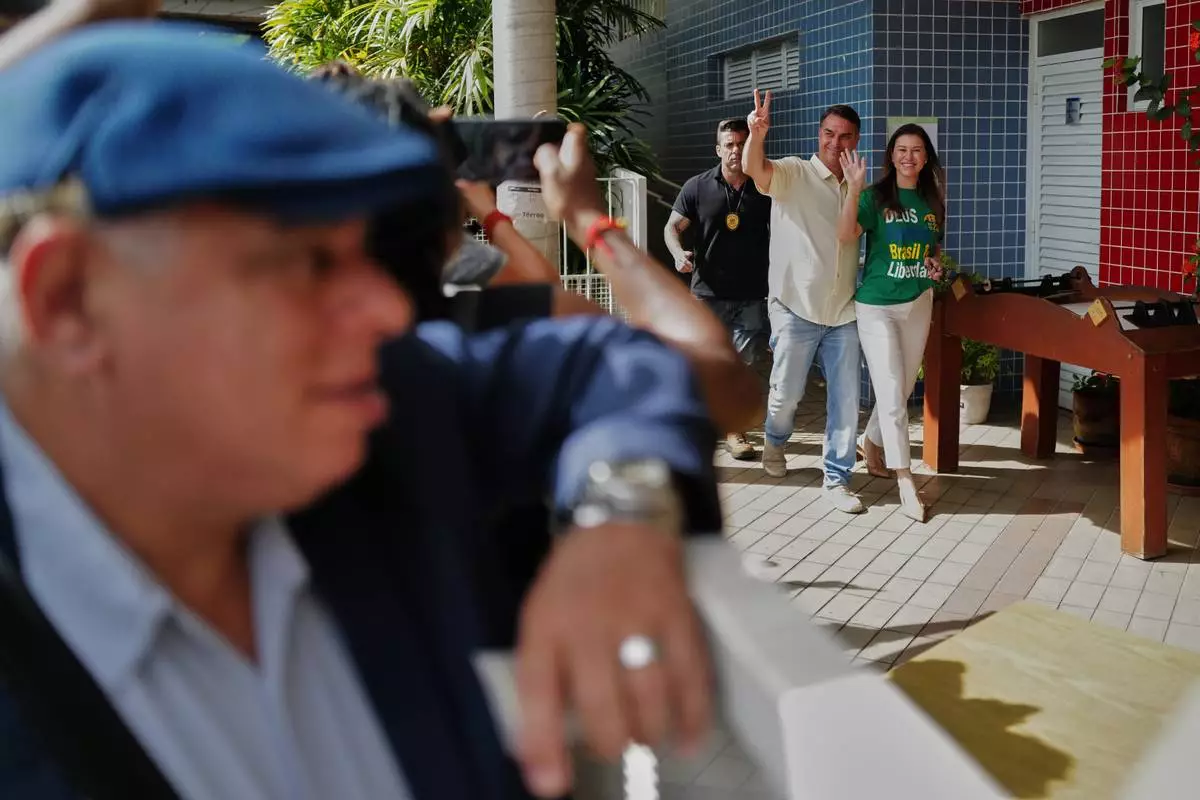
Opposition presidential candidate Sen. Flavio Bolsonaro accompanies his wife Fernanda Bolsonaro to vote during general elections in Rio de Janeiro, Sunday, Oct. 4, 2026.(AP Photo/Lucas Landau)
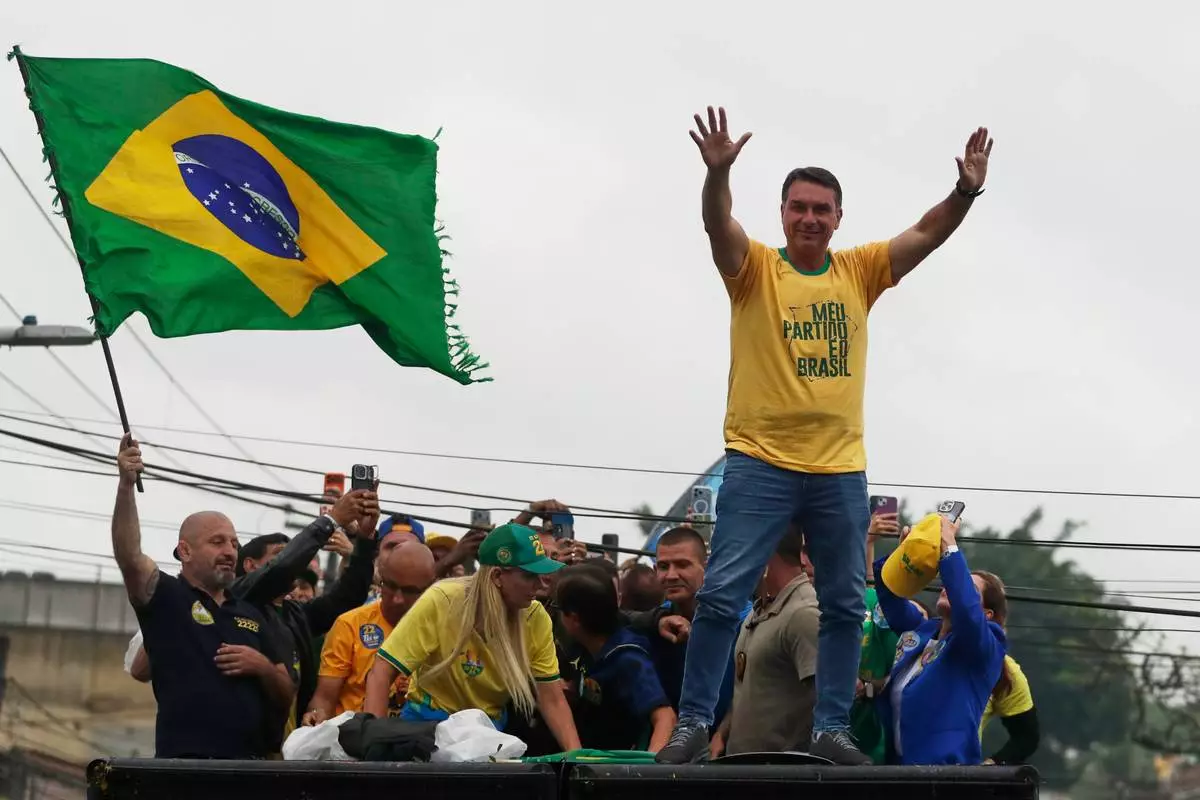
Opposition presidential candidate Flavio Bolsonaro waves to supporters during a campaign rally a day ahead of the country's general election, in Campo Grande, Rio de Janeiro state, Saturday, Oct. 3, 2026. (AP Photo/Bruna Prado)
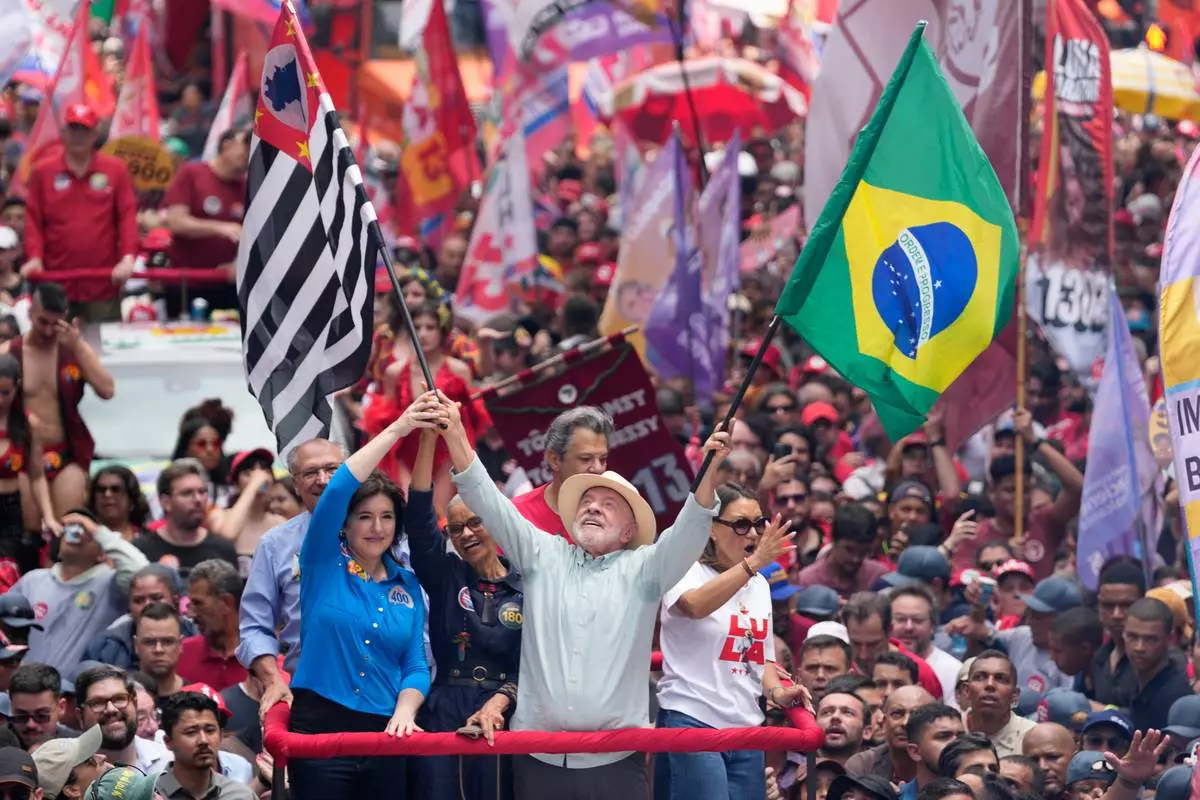
President Luiz Inacio Lula da Silva, who is running for reelection, waves a Brazilian and Sao Paulo state flags during a campaign rally a day ahead of the country's general election in Sao Paulo, Saturday, Oct. 3, 2026. (AP Photo/Andre Penner)
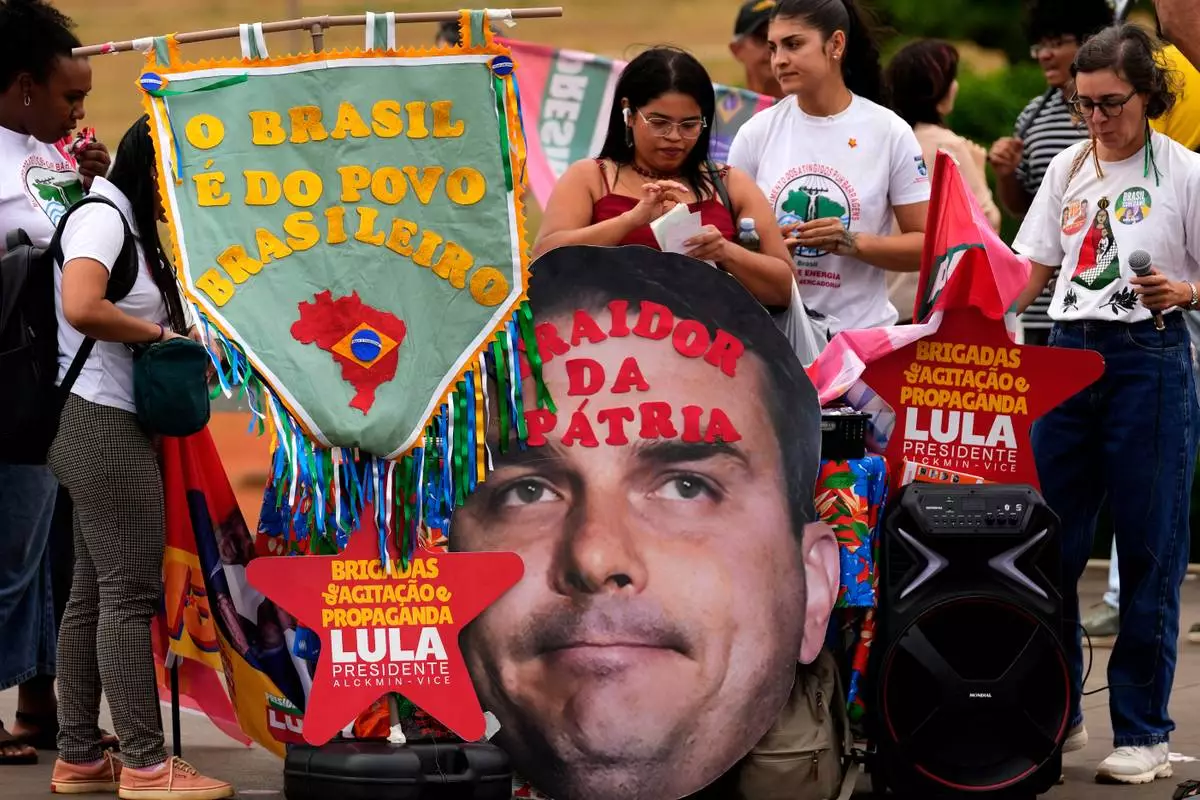
Supporters of Brazilian President Luiz Inacio Lula da Silva, who is running for reelection, display a large-headed effigy of presidential candidate Flavio Bolsonaro with a message in Portuguese that reads "Traitor of Brazil," during a campaign event at central bus station in Brasilia, Brazil, Friday, Oct. 2, 2026. (AP Photo/Eraldo Peres)
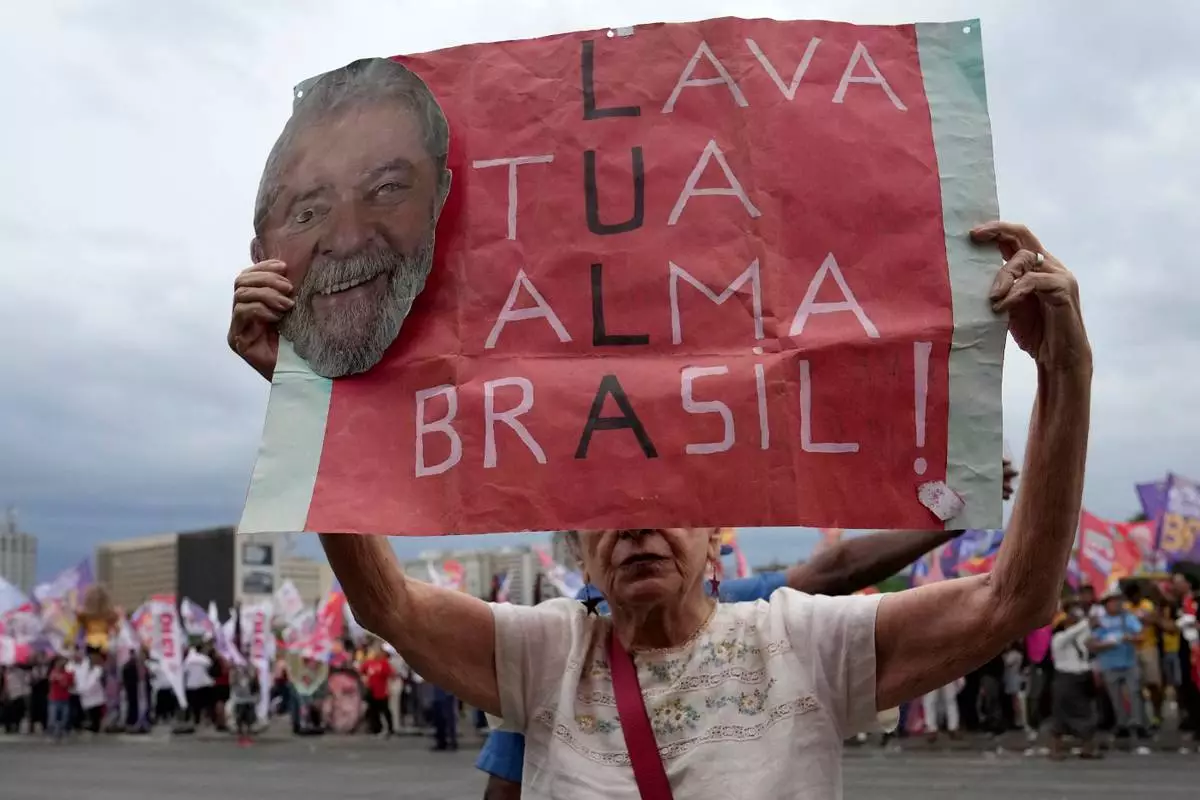
A supporter of Brazilian President Luiz Inacio Lula da Silva, who is running for reelection, holds a sign that reads "Lula, cleanse your soul, Brazil" during a campaign event at central bus station in Brasilia, Brazil, Friday, Oct. 2, 2026. (AP Photo/Eraldo Peres)