ABU DHABI, United Arab Emirates--(BUSINESS WIRE)--Oct 5, 2026--
The Technology Innovation Institute (TII) has revealed the UAE-built probe it has developed for the Emirates Mission to the Asteroid Belt (EMA). The probe will soon travel to Colorado, USA, for final integration with the MBR Explorer spacecraft ahead of its planned 2028 launch. In a historic first, TII’s probe will image two planets and seven asteroids — flying past six asteroids in the main belt before culminating in a rendezvous with and landing on the seventh, 269 Justitia. If successful, the landing will make Justitia only the seventh asteroid in history to be reached on the surface by the probe.
This press release features multimedia. View the full release here: https://www.businesswire.com/news/home/20261006586478/en/
Designed, built and tested end-to-end in Abu Dhabi by TII’s Propulsion and Space Research Center, in collaboration with the UAE Space Agency, as well as HEX20, Khalifa University and UAE University’s National Space Science and Technology Center, the TII-built probe is the mission’s only deployable payload. It will separate from MBR Explorer to make contact with Justitia’s surface at the furthest point of the mission and operate fully autonomously in deep space, capturing close-range images and excavating its surface to provide new insights into its composition and physical characteristics. 269 Justitia is thought to have formed in the Kuiper Belt before migrating into the main asteroid belt during the early formation of the Solar System.
H.E. Faisal Al Bannai, Secretary General, Advanced Technology Research Council, the Abu Dhabi Government entity overseeing TII, and Member of the UAE Supreme Space Council, said: “If you want to build serious technological capability, you take on a problem that forces you to push further. For this mission, that means a probe that must make decisions and operate on its own in deep space. And our teams have built that technology here in the UAE. The mission might still be ahead, but we have already expanded what we know how to build. That is how sovereign capability grows. We solve a difficult problem, then set our sights on a bigger one.”
269 Justitia is among the reddest bodies ever observed in the main asteroid belt. Its spectrum more closely resembles objects in the Kuiper Belt beyond Neptune than neighboring asteroids, suggesting it may have formed in the cold outer Solar System, beyond the distance at which methane and methanol freeze, before migrating inward early in the Solar System’s history to its current orbit in the main asteroid belt. Its surface is thought to be covered in complex organic material produced by the irradiation of that ice. Reaching such a body without a decade-long voyage to the Kuiper Belt itself gives the international scientific community access to material that is otherwise far beyond practical reach, and to evidence bearing on how water and volatiles were distributed as the planets formed.
Dr. Najwa Aaraj, Chief Executive Officer, TII, said: “EMA Probe demonstrates what becomes possible when advanced research is translated into mission-ready engineering. Our teams at TII have developed a system designed to withstand extreme conditions, operate with exceptional precision, and deliver meaningful science billions of kilometers from Earth. The mission reflects not only the caliber of our talent, but the depth of scientific and engineering capability the UAE has built to contribute to some of the world’s most ambitious space missions.”
The MBR Explorer spacecraft will travel approximately 5 billion kilometers over eight years, using gravity-assist maneuvers at Venus, Earth and Mars, and conducting close encounters with six asteroids before arriving at 269 Justitia. The spacecraft is scheduled to launch from Japan in March 2028 within a narrow three-week launch window aligned to interplanetary conditions. Because the spacecraft itself cannot safely approach within a few kilometers of the surface, the probe will separate, make contact with the surface, and deliver the mission’s closest observations.
Dr. Elias Tsoutsanis, Chief Researcher, Propulsion and Space Research Center, TII, said: “The engineering challenge is not simply reaching Justitia, but ensuring the probe can survive an eight-year journey and still perform precisely when it matters most. Every element – from the hardware and thermal design to the onboard software – has been engineered and tested for that final encounter.”
The probe operates fully autonomously throughout its mission, receiving no command from Earth or the MBR Explorer spacecraft after launch. Its onboard software determines when to image, how many images to capture, and which are worth keeping, a capability that rests on the digital processing unit designed and developed by TII – the board that handles the probe’s processing, image selection and power management. The probe does not wait until reaching Justitia to begin; it images throughout the cruise alongside the spacecraft’s other payloads, transmitting data back at approximately six-month intervals. Two cameras, one wide-field and one narrow-field, cover both context and high-resolution data.
Dr. Anton Ivanov, Principal Investigator and Executive Director, Propulsion and Space Research Center, TII, said: “What makes this probe distinctive is the level of independence engineered into such a compact system. Once deployed, it must sense, decide and operate on its own, far beyond Earth. The program has also helped train Emirati engineers and strengthen the advanced capabilities needed to build a globally competitive space technology ecosystem in the UAE.”
On arrival, the MBR spacecraft will spend approximately seven months in orbit around Justitia, beginning at 250 kilometers and descending through a series of lower orbits. The probe will deploy during a low-altitude pass in early 2036, then descend and make contact with the surface, imaging continuously and transmitting to the spacecraft above. The subsequent images will then allow scientists to study material beneath the surface layer that cannot be characterized from orbit.
EMA is the UAE’s second interplanetary mission and the first in which the spacecraft element has been designed, engineered, assembled and tested within the country. The mission sits within a broader national commitment to the sector. In May 2026, the Supreme Space Council approved a AED 1 billion International Space Cooperation Program intended to connect UAE research institutions with counterparts internationally, localize advanced space technologies, and develop Emirati talent, in support of the National Space Strategy 2031.
For more information, visit www.tii.ae
Source:AETOSWire
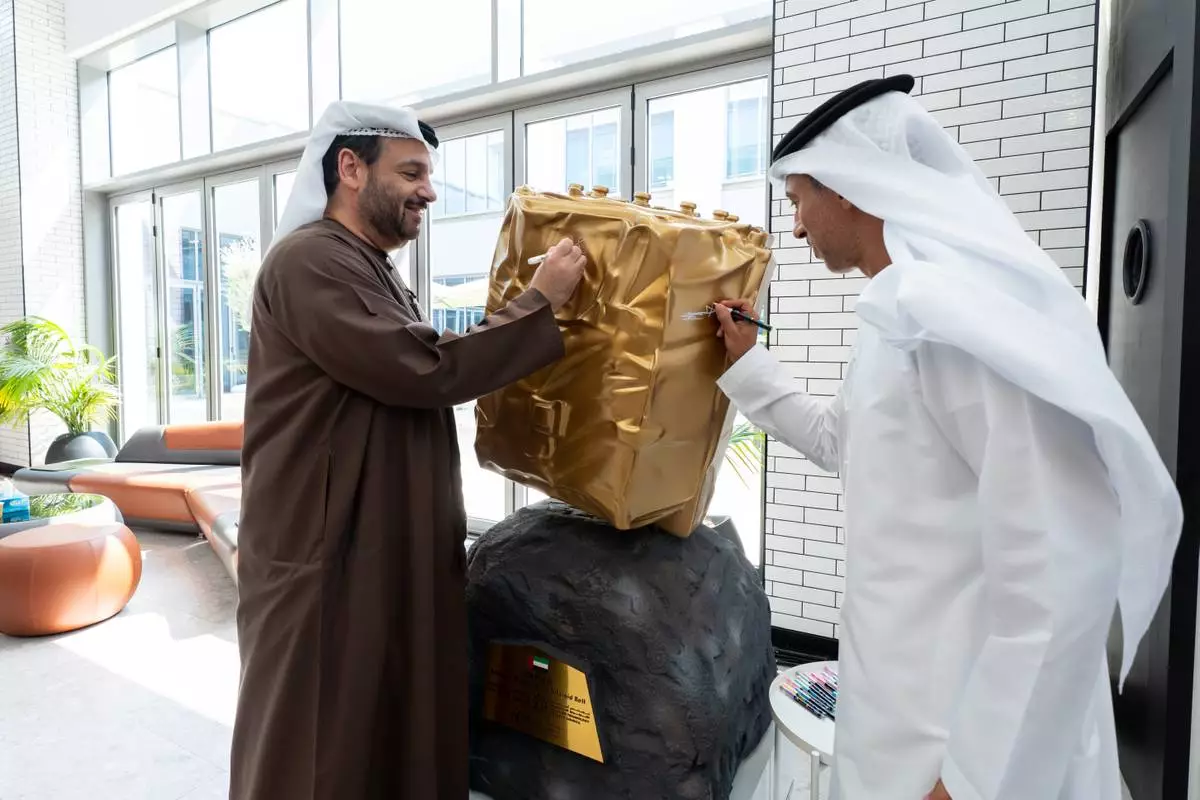
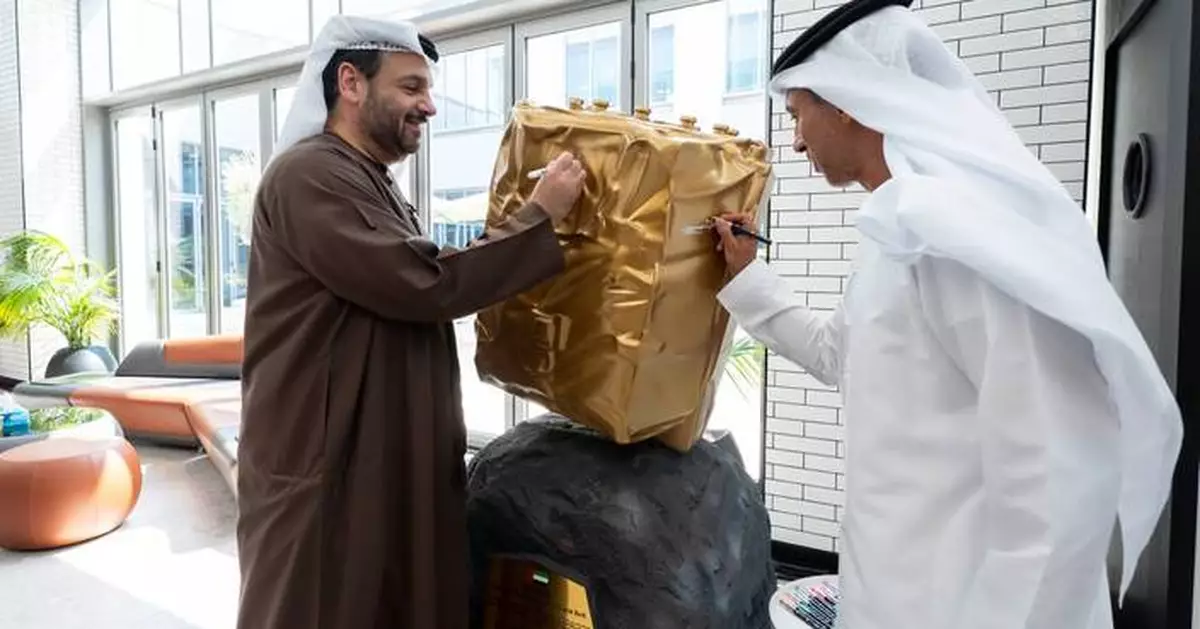
H.E. Faisal Al Bannai, Secretary General of the Advanced Technology Research Council (ATRC), and H.E. Belhoul Al Falasi, Chairman of the UAE Space Agency, sign a model of the UAE-built probe developed by the Technology Innovation Institute (TII) for the Emirates Mission to the Asteroid Belt (EMA). The probe was designed, built and tested in the UAE by TII (Photo: TII)