SAN JUAN, Puerto Rico (AP) — It took six words after a soccer match to unleash racial, political and economic tensions that have long simmered between Haiti and the Dominican Republic.
“L’Hispaniola c’est Haiti! This is Haiti!” star player Wilson Isidor shouted after helping Haiti beat the Dominican Republic 4-1 in Santo Domingo.
Hispaniola is the Caribbean island shared by Haiti and the Dominican Republic, two neighbors with a long and troubled history. The reaction was swift.
“We have very bad news for…Haiti’s team,” Dominican Sports Minister Kelvin Cruz said Friday as he announced that Haiti would no longer be allowed to play in the Dominican Republic.
Reached Monday, he said only that he stood by his announcement.
Cruz did not mention Isidor or his remarks, but accused Haitian fans of damaging the stadium's infrastructure. Dominican authorities also used pepper spray on Haitians as some peacefully streamed into the stadium for Thursday's game, with some Dominicans blaming their government for not controlling the crowd.
On Saturday, the Dominican Soccer Federation filed a formal complaint with CONCACAF, the Confederation of North, Central America and Caribbean Football Association, about what occurred on Thursday. A CONCACAF spokesperson did not immediately respond to a message seeking comment.
As the Dominican Republic prepares for its 2028 elections, presidential hopefuls have seized on the incident to promise an intensified crackdown on Haitian migrants, with one going as far as to say he would enslave them.
The fallout from the game is the latest flashpoint to drive a wedge between the two countries that share a bloody history.
The game was played a day before the 89th anniversary of the Parsley Massacre, when Dominican dictator Rafael Trujillo ordered the killing of thousands of Haitians along the shared border.
One fan held up a sign Thursday in Haitian Creole that read, “A great tribute to those who fell on Oct. 2, 1937. Today this match is played in your memory.”
Isidor’s remarks about La Hispaniola being Haitian have gone viral, with social media users debating historical facts and wishing a good day to everyone “except the Haitians;” one person even compared Isidor’s comments to a German player giving a Nazi salute.
One video posted online and captioned “4-1” streams wealthy areas of the Dominican Republic above impoverished areas in Haiti.
The Haitian Soccer Federation said it supports its players and asserted that Isidor’s comments were “an expression of attachment” to his roots.
“This attachment to Haiti cannot...be interpreted as a sign of hostility or disrespect toward another people or nation,” it said. “Sporting rivalry, however intense, must never make us lose sight of the mutual respect that should unite players, fans, and nations.”
One person on X noted that the comments by Isidor, who was born in France, are similar to the “Ici c’est Paris” chant by Paris Saint-Germain fans, even during away games: “No one thinks they’re reclaiming territory.”
Garry Jean-Pierre saw the game at his home in Port-au-Prince, Haiti’s capital. He doesn’t believe Isidor’s comments were political but was not surprised by the Dominican government's response.
“We understand why they did it. They were humiliated at home in front of their supporters,” he said.
Haiti and the Dominican Republic each finished with nine points in League A of CONCACAF’s Nations League tournament, but only Haiti advanced to the quarterfinals because of best goal differential.
André Joseph, a 20-year-old accounting student in Port-au-Prince, said he expected post-match fallout: “There’s always going to be a war between the Haitians and the Dominicans because of the way the Dominicans treat the Haitians."
The Dominican Republic has long been criticized for arresting and deporting people born there who are of Haitian ancestry; for leaving them stateless; and for the way immigrants are treated when they’re detained. Dominican officials have said the country cannot sustain the increasing number of immigrants fleeing Haiti's poverty and violence.
Joseph and other Haitian soccer fans have called on their government to ensure the team has a place to train and play in Haiti.
The main stadium in Port-au-Prince and a nearby training facility has been overrun by gangs that control an estimated 70% of the capital. Haiti’s home matches leading up to the World Cup had to be played elsewhere, with Haiti qualifying for the first time since 1974.
Haitian content creator Windy Phele wrote on X that Haitian politicians have left them greatly dependent on the Dominican Republic.
"Dominicans have every reason to be proud of their country, whereas I personally don’t see any reason today to say I’m proud of Haiti,” he wrote on X. “We should fight to create the conditions so the national team can stop playing away from home.”
Joining the debate was Sarodj Bertin, a lawyer and former beauty queen who was born in Haiti but was sent to the Dominican Republic after her mother was killed.
She posted a video in Spanish and French asserting that people must respect their neighbors to earn respect. Bertin called on Isidor to retract his “inappropriate” comments, at least for his “brothers,” if not for his country.
“In the end,” she said, “those who are going to suffer are the Haitians who live in the Dominican Republic.”
Associated Press reporters Evens Sanon in Port-au-Prince, Haiti and Martín Adames in Santo Domingo, Dominican Republic contributed to this story.

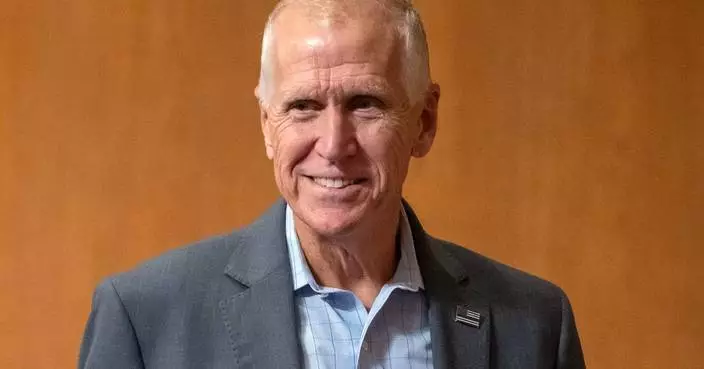
FILE - Sunderland's Wilson Isidor runs into position during the English Premier League soccer match between Ipswich Town and Sunderland, in Ipswich, England, Aug. 22, 2026. (AP Photo/Dave Shopland, File)
WASHINGTON (AP) — The Supreme Court grappled Monday with whether local governments can sue oil and gas companies in state court to help cover costs associated with climate change, an issue with potentially billions of dollars at stake.
Key justices appeared wary about the potential sweep of litigation, but torn over the complex questions of federal and state law raised by the case.
Officials in Boulder argue their lawsuit is an attempt to hold energy companies Suncor and ExxonMobil accountable for their contributions to climate change.
They say that worsening disasters such as floods and wildfires put a heavy financial burden on local communities, and the industry should bear part of that cost.
The city and county of Boulder first sued the oil companies in 2018, years before the 2021 Marshall Fire destroyed nearly 1,100 homes and left two people dead. Total damage was estimated at $2 billion, the costliest wildfire in Colorado history.
The companies say that a flurry of lawsuits in state courts is not the way to deal with the global issue.
Governments from largely blue-leaning areas around the country have filed similar lawsuits seeking damages that could total billions of dollars, part of a wave of legal action worldwide seeking to leverage action through the courts.
“Presumably, if you prevail, the next day, a municipality in every single state will file a lawsuit,” said Chief Justice John Roberts. “How do you think that will work out on the ground?”
A win for the oil and gas companies at the Supreme Court could shut down dozens of similar cases filed in recent years.
Suncor and Exxon argue that the Clean Air Act gives the federal government – not the states – the power to regulate emissions.
They have the support of the Trump administration, which argues the lawsuits are an unconstitutional attempt to regulate planet-warming emissions and impose Colorado’s state law beyond its borders.
But Roberts and other justices pointed out that state courts consider lawsuits about a myriad of issues that have nationwide reach. “I guess I’m not quite sure what makes this situation different from those,” Roberts said.
The court is also weighing a jurisdictional question that could allow it an “off-ramp" to avoid deciding the issues right away. Justice Ketanji Brown Jackson seemed like a vote in favor of that path.
“Why shouldn’t we wait and hear all of these claims once the state courts are done?" she asked.
The case was heard without Justice Samuel Alito, who recused himself just a week before arguments after facing calls to step aside because he owns stock in oil companies. That raises the possibility of a tie vote.
A deadlock leave in place a decision from Colorado’s highest court allowing the case to proceed.
Attorney Kannon Shanmugam, representing the industry, urged the justices to reverse that ruling. He said the Boulder case was attempting to use the courts to decide a public policy issue that is properly up to Congress and other elected officials.
“Climate change is certainly one of the most pressing issues” facing the country, but the lawsuit “is exactly the wrong way to go about” addressing it, he said.
Principal Deputy Solicitor General Sarah Harris said Boulder’s case “egregiously exceeds” the state’s authority. The county essentially declares itself a victim of actions that occurred largely out of state, she said.
But Kevin Russell, an attorney representing Boulder, argued that state lawsuits can address damage in Colorado, regardless where the fossil fuels are produced.
Boulder is not trying to regulate greenhouse gas emissions or stop the companies from continuing to produce oil and gas, Russell said. Instead officials are seeking to hold the companies accountable for allegedly misleading the public about their contribution to global warming by burning fossil fuels, he said.
Justice Elena Kagan compared the climate case to previous state-based lawsuits against the tobacco industry and opioid makers.
“This is Chapter 3,” she said, noting the similarities of states claiming harms from products produced nationally and even internationally.
“This is a different book,″ replied Shanmugam, the industry lawyer. Harms claimed by Boulder ”are diffused nationwide and indeed worldwide,” he said.
Trump's Republican administration has rolled back environmental regulations, including a move last month by the Environmental Protection Agency to repeal rules that limit emissions from power plants fueled by coal and natural gas. States and cities have already sued over the repeal of the power plant rule.
The conservative-majority Supreme Court has been skeptical of environmental regulations in the past, including in a 2022 decision limiting the EPA’s authority to regulate carbon dioxide emissions from power plants.
A decision is expected in the coming months.
Associated Press writer Nicholas Riccardi in Denver contributed to this story.
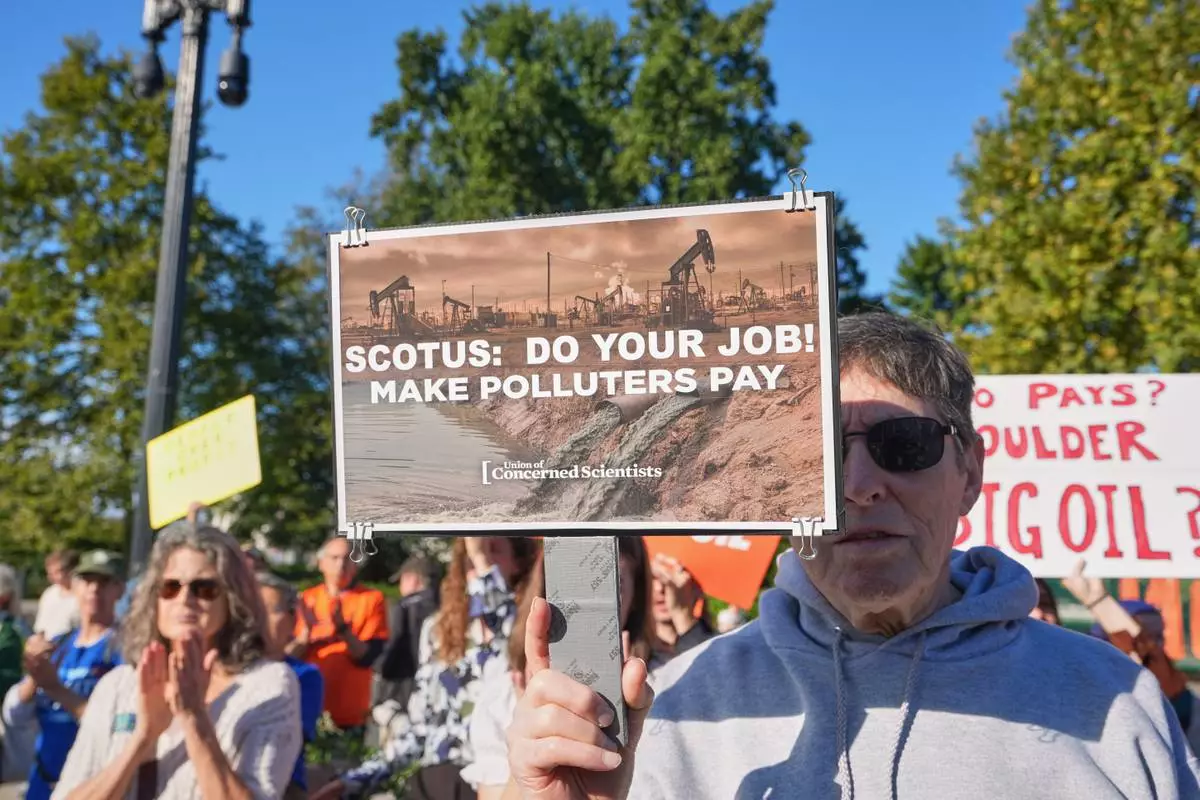
An activist carries a sign at the Supreme Court as the court begins its new term with a case about whether oil and gas companies should help pay for damage caused by disasters linked to climate change, on Capitol Hill, Monday, Oct. 5, 2026, in Washington. (AP Photo/Mariam Zuhaib)
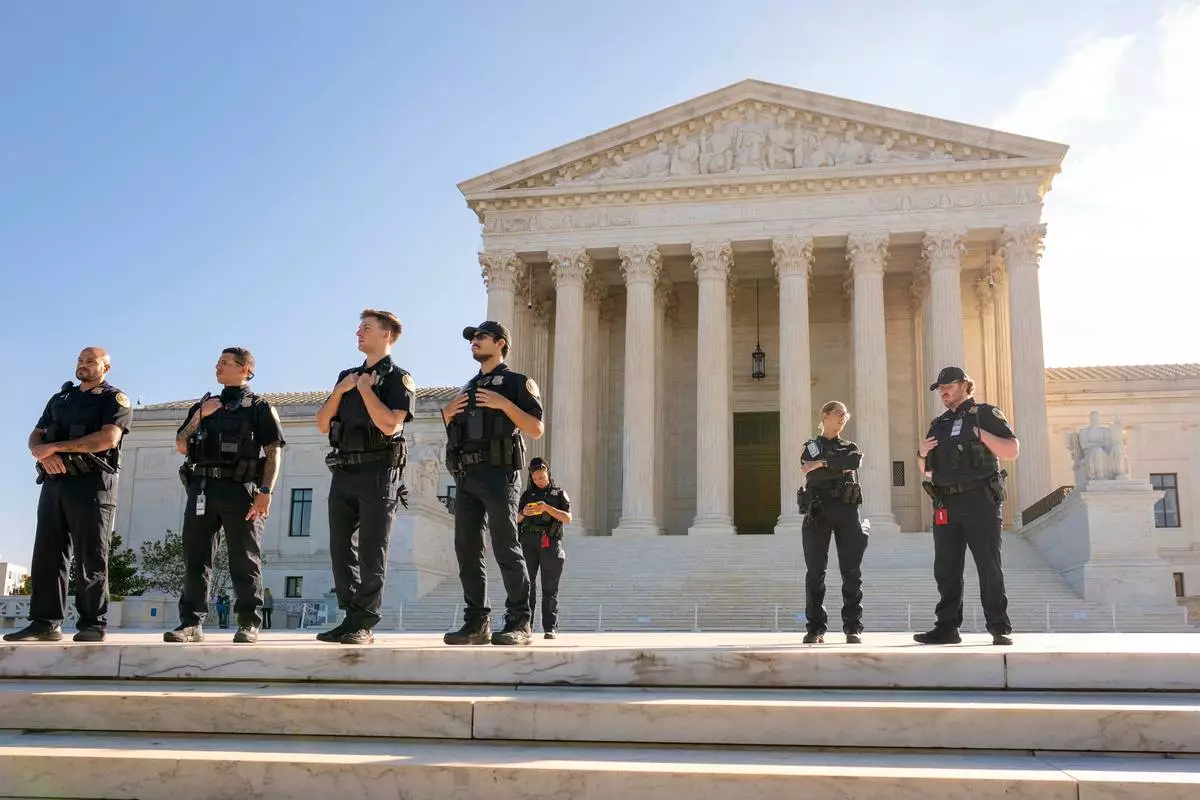
Officers with the Supreme Court Police stand watch as the hight court begins its new term with a case about whether oil and gas companies should help pay for damage caused by disasters linked to climate change, on Capitol Hill in Washington, Monday, Oct. 5, 2026. (AP Photo/J. Scott Applewhite)
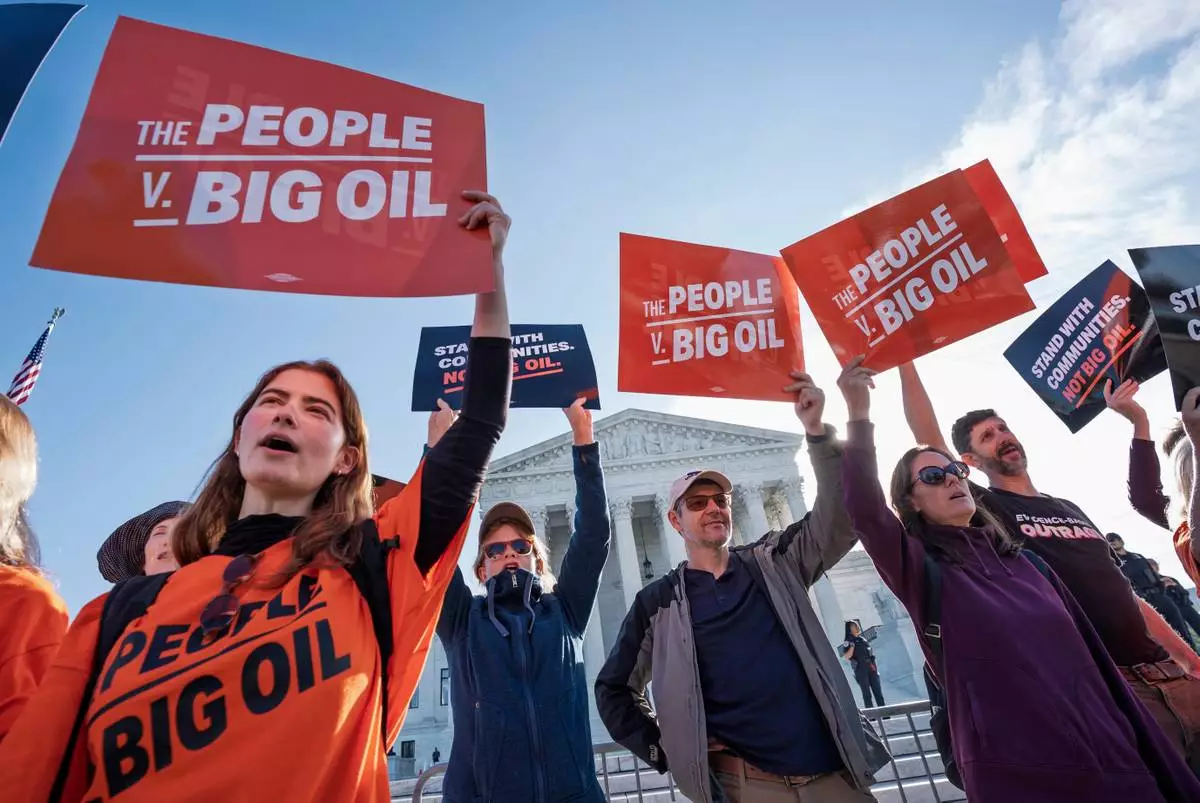
Activists take a stand as the Supreme Court begins its new term with a case about whether oil and gas companies should help pay for damage caused by disasters linked to climate change, on Capitol Hill in Washington, Monday, Oct. 5, 2026. (AP Photo/J. Scott Applewhite)
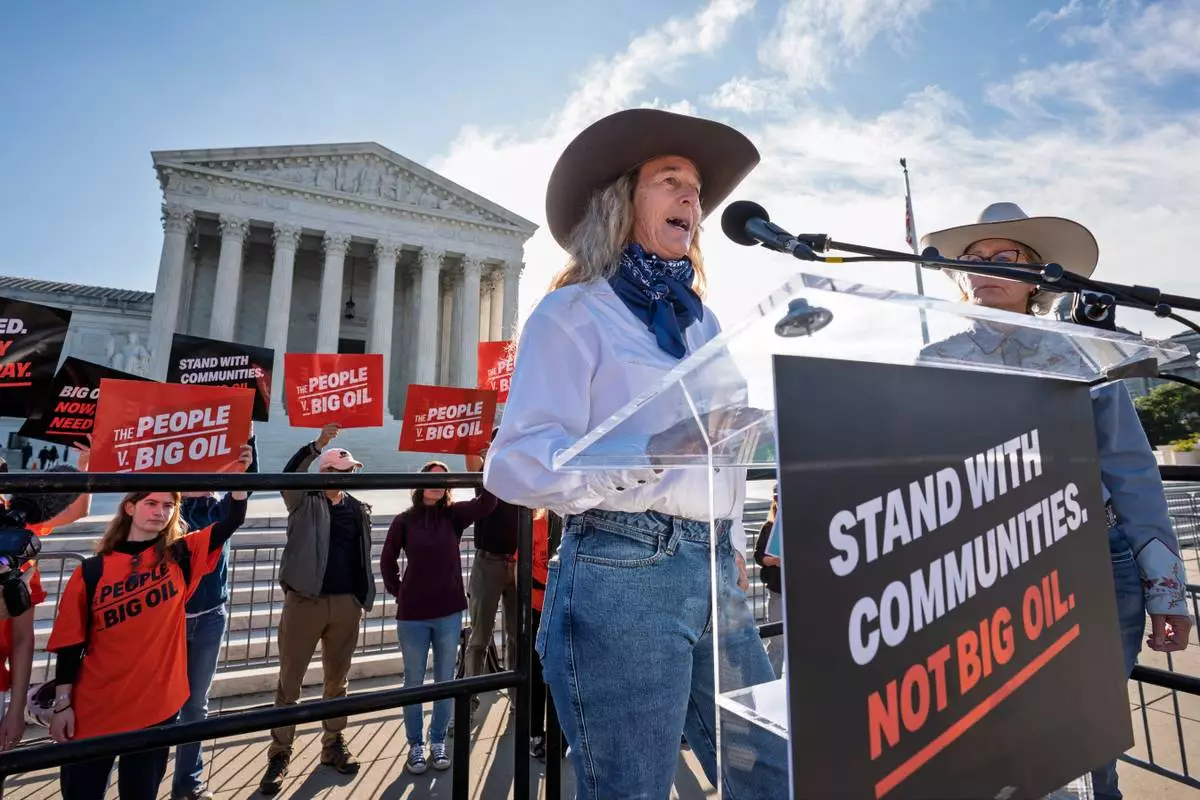
Colorado rancher Kathryn Bedell talks about the impact of droughts on her business as activists gather at the Supreme Court for a case about whether oil and gas companies should help pay for damage caused by disasters linked to climate change, on Capitol Hill in Washington, Monday, Oct. 5, 2026. (AP Photo/J. Scott Applewhite)