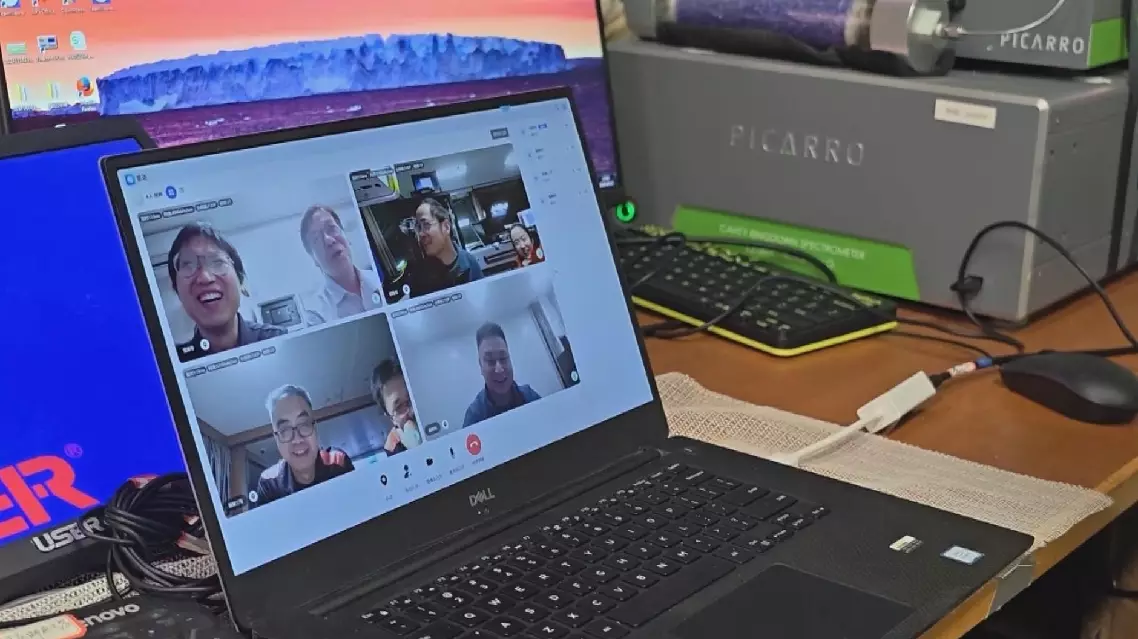
China's 16th Arctic Ocean expedition achieved the country's first video call spanning the North and South Poles on September 25, coinciding with the Mid-Autumn Festival, using a domestically developed satellite system with a delay of no more than one second.
The expedition deployed four vessels -- Xuelong, Xuelong 2, Jidi, and Tansuo 3 -- to study extreme environmental changes in the Arctic amid accelerating global warming. On September 29, China's research icebreakers Xuelong and Xuelong 2 returned to Shanghai after completing their missions, while Jidi and Tansuo 3 continue their expedition tasks and are expected to return in mid-October following a three-month journey.
The expedition team held a satellite video conversation with China's Antarctic Qinling Station, extending festive greetings to their polar scientific research counterparts and testing a large-scale constellation designed to provide global broadband internet and support integrated space-Earth 6G networks.
"This is the first time that China has used a domestically developed communications satellite system to make a video call across the largest latitude span," said Liu Feng, a senior engineer at the National Marine Data and Information Service.
The around-13,000-satellite GW constellation, led by China Satellite Network Group (SatNet), is China's first mega low Earth orbit satellite internet project. During the polar test, the maximum uplink and downlink speed reached around 30 megabits per second, equivalent to taking about 10 minutes to download a 1GB file. The equipment can also be used for emergency rescue and maritime communications.
"During the test period, it also supported real-time communications among Xuelong, Jidi, Tansuo 3, the National Marine Data and Information Service and the Polar Research Center. After Jidi and Tansuo 3 entered ice zone operation areas, their communication could not be guaranteed. So file transfers and navigation logs had to be transmitted through the SatNet equipment," said Zhang Bin, an engineer at the National Marine Data and Information Service. The successful test of the domestically produced satellite communication equipment marks China's independent control over polar region communications. The equipment ensures that data remains within the country, effectively safeguarding data security.
China holds first video call between North, South Poles via homegrown satellite system
Despite relentless Israeli bombardment and widespread destruction, Palestinians in the war-ravaged Gaza Strip are pressing ahead with preparations for their first legislative elections in two decades.
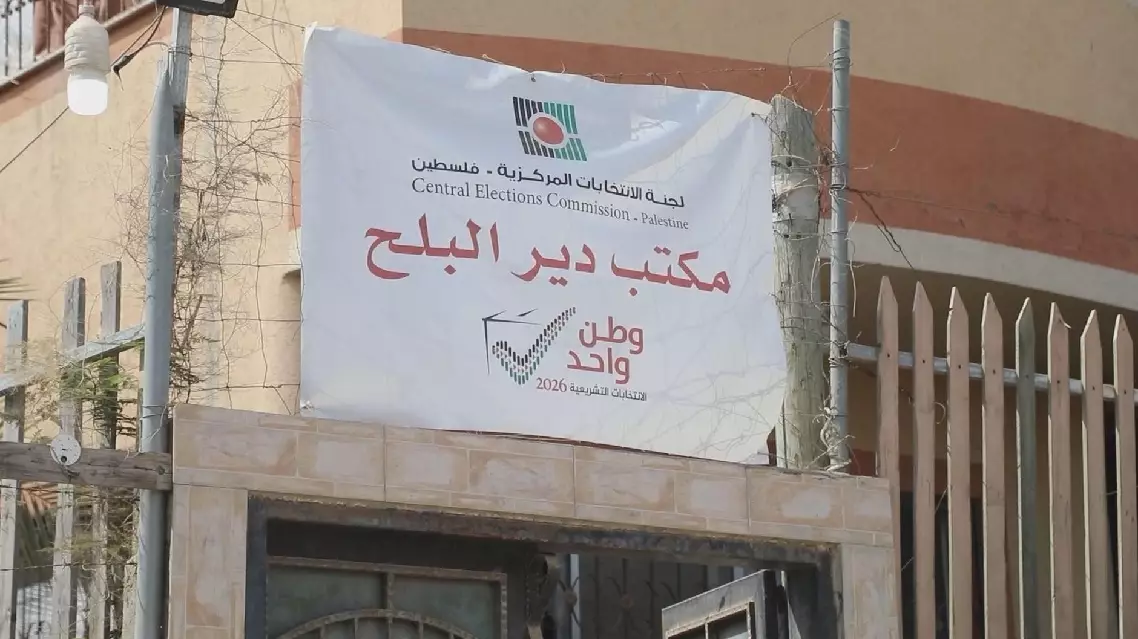
The vote is scheduled for Nov 28, with electoral lists currently being submitted in Deir al-Balah, in central Gaza.
The upcoming election has sparked a surge of political engagement among young Palestinians, who hope it will open the door to new voices and a fresh political future.
"As independent Palestinian young people, we see a lack of effective roles by political parties and the government in Gaza. Our candidacy is a natural response to the lack of government action in meeting people's needs. This is why we are submitting our candidacy today," said Fadi Al-Sheikh Youssef, who is currently leading an independent youth electoral list.
The Palestinian territories have not witnessed a legislative election since 2006, when Hamas secured a decisive victory.
A violent political schism the following year left Hamas in control of the Gaza Strip, while the Palestinian Authority retained governance over parts of the occupied West Bank.
Political analysts suggest that Hamas views the upcoming vote as a vital gateway to maintaining its foothold in the Palestinian political system, especially as the United States and Israel actively seek to strip the group of any political influence.
"Hamas' approach to the upcoming elections is linked to its desire to reestablish itself within the Palestinian political system. Hamas believes that one of the objectives of the war and the U.S.-Israeli position are to remove it from political influence. Therefore, it sees the elections as a gateway to remaining part of the Palestinian political system," said Ahmed Al-Tanani, a political researcher.
However, organizing an election in an active war zone faces unprecedented challenges. Three years of devastating conflict have left Gaza in ruins, with millions of Palestinians still displaced and border crossings tightly restricted.
Jamil al-Khalidi, regional director of the Central Elections Commission (CEC) in the Gaza Strip, highlighted the severe logistical hurdles facing the vote.
"Ballot boxes, ballot papers and electoral ink, all these materials are prohibited from entering Gaza. Even international election monitoring missions have been prevented from entering. But this will not stop elections from being held in Gaza. We have alternatives if these materials and foreign delegations continue to be denied entry," said al-Khalidi.
Beyond the logistical obstacles, the dire security situation remains the most formidable challenge. With Israeli airstrikes on the enclave showing no signs of abating, the physical safety of the electoral process is in question.
"With the ongoing bombardment and strikes in Gaza affecting the movement of election commission staff, candidates and voters, we are calling on the international community to help provide a safe and suitable environment for the elections," said al-Khalidi.
Palestinians in Gaza preparing for 1st legislative elections in 20 years amid Israeli attacks