WASHINGTON (AP) — The primary Senate Republican super PAC is sending reinforcements to deep red South Carolina as President Donald Trump prepares to travel there to boost Sen. Darline Graham.
The Senate Leadership Fund is putting $5 million in the state to shore up Graham, who was appointed this summer as an interim replacement for her brother, the late Sen. Lindsey Graham. The spending was confirmed by a person with direct knowledge of the plans.
The spending is meant more as an insurance policy, said the person, who was granted anonymity because they were not authorized to speak publicly, and Republicans remain confident in their chances to retain the seat.
Meanwhile, Trump’s midterm blitz is tentatively scheduled to take him to the state ahead of the Nov. 3 midterms, according to a separate person familiar with the plans who also spoke on condition of anonymity because they were not authorized to speak publicly.
Trump rallied with Graham days before the August runoff primary, helping to boost her chances against Ralph Norman as they faced off for the Republican Senate nomination. Graham is running against Democrat Annie Andrews, a pediatrician.
SLF’s spending plans, first reported by Axios, come several days after news that the deep-pocketed super PAC was pulling back in North Carolina and pouring money into Kansas, another conservative state that has become more competitive in recent weeks.
The funding also comes after Trump attacked Andrews on social media, using an anti-transgender slur.
“Darline is a High Quality person, maybe the Highest,” Trump wrote in his post. Using the slur, Trump said Andrews is “not, in particular, as it pertains to representing the Values of the Great People of South Carolina.”
In a response shortly after Trump’s post, Andrews said she is in the Senate race to “fight for my patients, my three kids, and South Carolina.”
“And I’m going to work with anyone to put South Carolina first, because lowering costs and making life better for families across our state is going to take all of us working together,” Andrews said.

President Donald Trump speaks with reporters before departing on Marine One from the South Lawn of the White House, Tuesday, Oct. 6, 2026, in Washington. (AP Photo/Alex Brandon)

FILE - Sen. Darline Graham, R-S.C., gestures during a news conference, Aug. 24, 2026, in Columbia, S.C. (AP Photo/Meg Kinnard, File)
The shock gloves immigration agents could soon use to control detainees and protesters worked so powerfully during a military exercise that participants felt intense pain, stopped fighting immediately and feared additional exposures, according to a previously unreleased Army study.
Immigration and Customs Enforcement leaders were aware of the findings before signing a $16.7 million contract to purchase 6,000 pairs of shock gloves in August, according to records obtained by the watchdog group American Oversight and shared with The Associated Press.
The shocks had a profound impact on Army employees who played the role of combative prisoners during the exercise, which took place at the military prison at Fort Leavenworth in Kansas in October 2024. The participants, several of whom were large-statured men, stopped resisting seconds after officers applied shocks by touching gloves to their skin, and were left with “fatigue, soreness and excessive apprehensiveness to being shocked again,” the study found.
“After experiencing the effects of the GLOVE, ... participants stated just seeing the GLOVE was enough to make them want to comply,” the authors wrote.
ICE has called the gloves “distraction and de-escalation devices" that will be safer than other non-lethal options to subdue targets for arrest and deportation and protesters who create civil disturbances. The agency has argued the rapid compliance they cause will keep officers safer and prevent incidents from requiring potentially lethal force.
But critics have warned the gloves will give ICE another weapon to intimidate and brutalize people even as the agency is under fire for excessive force that has left a trail of deaths and injuries across the nation. The gloves, they note, are easy to discharge, do not leave a mark and have not been extensively used in settings outside of jails. The manufacturer warns they should not be used on high-risk populations such as kids, pregnant women or disabled people.
“The military assessment in ICE’s own files shows that these gloves can cause ‘intense pain’ and force compliance. It does not establish that they are safe,” said Chioma Chukwu, executive director of American Oversight. “Everyone should be alarmed that ICE is preparing to deploy a tool designed to inflict, at best, intense pain, without showing that it is safe for the people who will be subjected to it.”
ICE released the study and other documents to American Oversight as part of the group's Freedom of Information Act lawsuit against the agency seeking records related to its use of force.
The military prison study assessed whether the gloves could be used effectively to forcibly remove combative prisoners from their cells, to respond to disturbances in common areas and to transport uncooperative inmates. Role-playing employees conducted several scenarios with and without the gloves to test their impact, including violent encounters in which inmates were to fight as hard as they could.
The study found the devices “increased the efficiency” of teams carrying out forced cell extractions and responding to disturbances by reducing the length of physical encounters, keeping guards from becoming exhausted and preventing injuries. They did not “significantly change” the time it took to control inmates during escorts but required less effort.
“GLOVE provides a boost in confidence to smaller or less trained members,” the study found. “Inmate compliance was immediate” compared to other methods, it added.
The electric jolt does not cause the body to freeze like a Taser shock does, but instead “works by overloading the peripheral nerve endings” of the skin to cause pain, the study said. Participants who were wet or had oil on their skin described even more powerful shocks, with one reporting discomfort for 30 minutes afterward.
ICE's contract requires the manufacturer, Compliant Technologies LLC, to deliver the gloves within six months. Its owner, Jeff Niklaus, said he was unavailable for an interview, citing a busy workload.
White House border czar Tom Homan has said it could “be awhile” before the gloves are in the field because ICE is still ironing out training and policy issues. A statement released Tuesday by ICE did not address questions about the study and the status of the rollout, but said "officers are highly trained in de-escalation tactics.”
U.S. Sen. Catherine Cortez Masto of Nevada said ICE has not responded to an Aug. 27 letter in which she and 15 other Democratic Senate colleagues called for ICE to abandon its plan to buy the gloves or explain how they would be used and managed to avoid abuse. She said she still wants answers.
“Without ICE’s responses to legitimate questions from 16 United States Senators, the American public is being left in the dark about how these electric shock gloves are being deployed and what, if any, training the agents who use them have received,” she said.
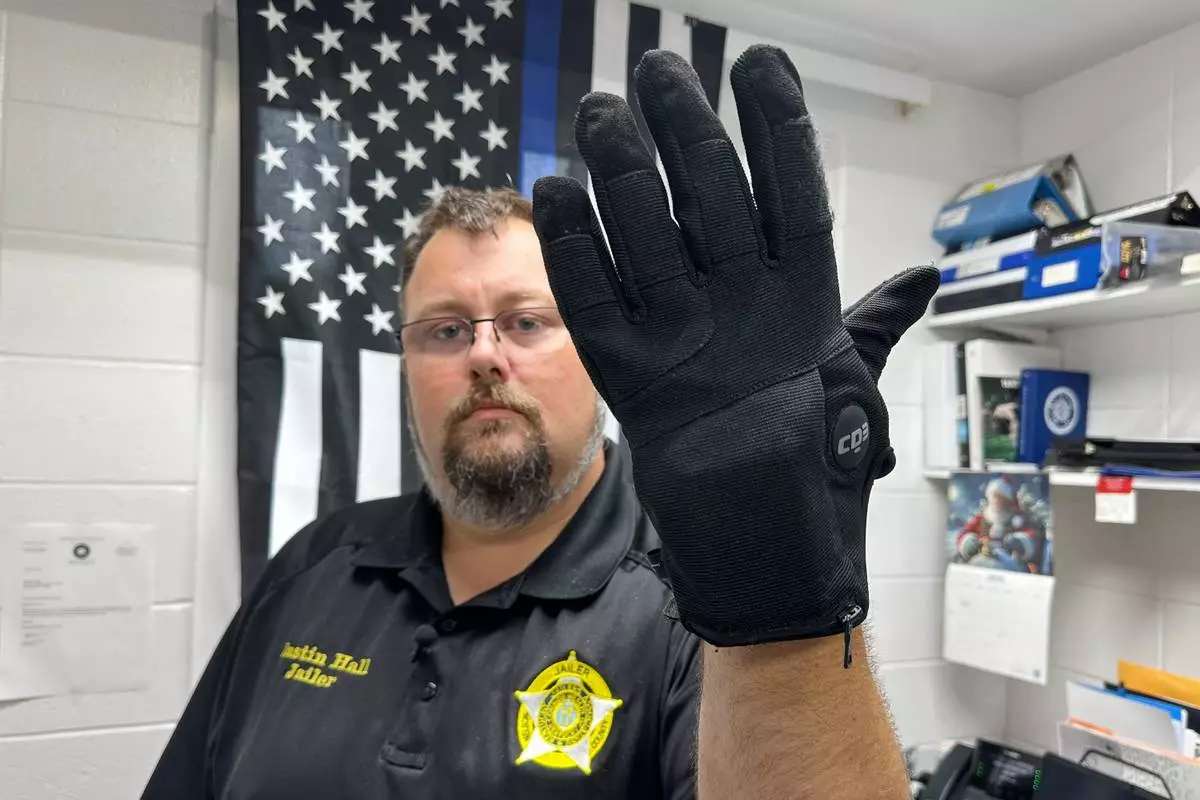
FILE - Nelson County, Ky., jailer Justin Hall shows an electric shock glove that is used at his facility, Aug. 13, 2026, in Bardstown, Ky. (AP Photo/Dylan Lovan, File)