MENLO PARK, Calif.--(BUSINESS WIRE)--Oct 7, 2026--
MedaSystems, a SaaS platform for managing Expanded Access, Post-Trial Access and Investigator-Initiated Study programs, today announced the release of MedaSystems Version 3.3, one of the company’s most significant platform updates to date.
This press release features multimedia. View the full release here: https://www.businesswire.com/news/home/20261007186324/en/
The release introduces new capabilities designed to help pharmaceutical and biotechnology organizations manage increasingly complex patient access programs with greater efficiency, consistency and control. Version 3.3 expands MedaSystems’ capabilities across team collaboration, workflow automation, document management, privacy, external HCP governance and administrative configuration.
“As Expanded Access programs grow across therapies, geographies and stakeholders, technology needs to do more than digitize existing processes. It needs to make those processes easier to govern and scale,” said Matt Rosen, CEO of MedaSystems. “Version 3.3 reflects what we keep learning from the organizations running these programs every day, from global companies managing thousands of patients and requests to oncology and rare disease biotechs bringing novel therapies forward. We’re giving teams more flexibility and control while cutting the administrative complexity that stands between them and the patients they are working to support.”
Scaling Collaboration with Reusable Case Teams
One of the most significant additions in Version 3.3 is Case Teams, which enables organizations to create reusable groups and assign them across cases, checklist tasks and automation rules. Tasks can now be routed to an entire Case Team, allowing individual team members to pick up work while keeping the broader team informed.
For organizations operating across multiple products, countries and functions, this provides a more scalable approach to coordinating responsibilities and maintaining consistent workflows.
Greater Control Over Global Program Workflows
Version 3.3 gives administrators additional control over how programs are configured and managed. Organizations can now configure case-closure reasons and determine which countries are available in internal and public intake forms, including automatically declining requests originating from countries that have not been enabled.
A redesigned Automation Tool also makes case-creation logic easier to configure, including the ability to generate case names from intake-form responses and identify potentially conflicting automation rules.
Simplified Document Distribution
New Document Bundles allow related documents to be grouped and released together rather than shared individually. Bundles can also be incorporated directly into workflows so an entire set of documents is automatically released at the appropriate stage of a case. Physicians receive a single summary email for each release rather than separate emails for every document.
Stronger Privacy and HCP Governance
Version 3.3 introduces additional controls over how external HCP users interact with cases. Administrators can prevent physicians from skipping required tasks, lock forms following submission and restrict physicians from deleting forms.
The release also adds an optional in-case redaction capability. Authorized users can permanently remove personal or health information from messages, discussions and form fields without deleting the underlying case or inquiry. The surrounding clinical information and history remain intact, while every redaction is logged without retaining the removed information.
“Version 3.3 is about making sophisticated workflows easier to manage without sacrificing control,” said Jeff Thibeault, CTO of MedaSystems. “We’ve expanded the platform architecture around reusable teams, configurable workflows, privacy controls and auditability while also improving performance across the application. The result is a platform that can support increasingly complex programs while remaining intuitive for the people using it every day.”
Expanded E-Signature and Audit Capabilities
Version 3.3 also adds support for Adobe Sign, giving customers a second 21 CFR Part 11 compliant e-signature option in addition to DocuSign.
Activity histories in Version 3.3 are written for the people who read them. Each entry describes what changed, where it changed and who made the change in plain language, so quality teams, auditors and program leads can follow the record without interpretation. The same clarity applies at the organization level, where changes to users, access and configuration are captured alongside program activity.
A Faster, More Intuitive Experience
Beyond the new functionality, Version 3.3 includes platform-wide performance enhancements, with improvements particularly noticeable when working with long lists and heavily filtered screens.
Case filtering has also been redesigned to help teams find and manage information more efficiently. Enhancements include active-filter indicators, quick filters, saved filter preferences, searchable dropdowns and automatic application of filter changes. For users working across multiple drug companies, additional filtering and safeguards help prevent bulk actions from inadvertently spanning organizations.
Version 3.3 Highlights
Key enhancements include:
Together, the enhancements are designed to give life sciences organizations greater flexibility to configure MedaSystems around their operating models while strengthening governance and reducing manual administrative work.
About MedaSystems
MedaSystems provides a SaaS platform purpose-built to help life sciences organizations manage Expanded Access,Post-Trial AccessandInvestigator-Initiated Studyprograms. The platform centralizes workflows, communications, documentation and program data in a secure environment, helping cross-functional teams streamline operations, strengthen governance and support programs at global scale. MedaSystems is a trusted partner for global organizations that offer managed access, pre-approval access, compassionate use and expanded access programs.
To learn more about MedaSystems or request a personalized demonstration, visitMedaSystems.com.

MedaSystems, a SaaS platform for managing Expanded Access, Post-Trial Access and Investigator-Initiated Study programs, today announced the release of MedaSystems Version 3.3, one of the company’s most significant platform updates to date.
DEIR AL-BALAH, Gaza Strip (AP) — It’s perhaps the most dramatic wound inflicted on the Gaza Strip by Israel’s military campaign over the past three years: The city of Rafah, once home to a quarter million people, has been erased.
Satellite imagery shows the Israeli military has systematically razed the southern city and other towns and districts to the ground and in some places plowed away the rubble. Demolition, using bulldozers and explosives, has continued unabated since the Israel-Hamas ceasefire deal reached a year ago, as the military solidifies its hold on just over 60% of the territory that it still controls.
Gaza’s mangled landscape is just one of the wounds on top of wounds that the enclave's 2 million Palestinians have endured since Israel launched its campaign to destroy Hamas after the militants’ Oct. 7, 2023, attack on southern Israel.
More than one out of every 10 people from Gaza’s prewar population has been killed or wounded by Israeli fire. While nearly every family mourns dead or cares for wounded, most also had to move multiple times to escape fighting and Israeli evacuation orders. With almost the entire population homeless, the coastal territory is now effectively one of the world's most populated tent cities. Ramshackle canvas and nylon shelters blanket beaches and former agricultural lands and fill empty lots.
Little is likely to change for the foreseeable future. While the ceasefire deal stopped the offensives and heaviest bombardment, Israel hits tents, cars and buildings almost daily in strikes that it says target Hamas members — but that regularly kill women, children and other family members.
People no longer have to flee from place to place, but few can rebuild homes because Israel bars most construction material from entering Gaza. The ceasefire agreement’s plan for the large-scale reconstruction of Gaza has never gotten off the ground because Israel and Hamas have failed to reach a deal on disarming the militant group.
Najwa Abu Eita lost her 7-year-old daughter when Israeli forces struck her home in the central refugee camp of Nuseirat in September 2024, and her three other children were injured in the attack. Abu Eita lost an eye, her face remains heavily damaged and scarred, and she has trouble breathing.
A hairdresser before the war, she now has no work, living in a tent by the ruins of her home. Worst of all, she says, her children are frightened by her face and avoid looking at her.
“My 4-year-old son tells me, ‘Momma, I’ll give you one of my eyes.’ And inside, I’m weeping,” she said.
Gaza’s population is squeezed into about 40% of the tiny territory, and Israel’s military controls the rest. Satellite imagery by Planet Labs PBC shows that the vast majority of buildings in the Israel-held part have been bulldozed or exploded down to piles of rubble, much of it after major fighting ended a year ago.
The Israeli military says it demolishes buildings to prevent their use by Hamas militants or to destroy the group’s tunnel networks.
But a U.N.-appointed expert said in a February report that the scale of destruction of civilian housing and infrastructure in Gaza “is unprecedented even by the terrible standards of modern warfare since the 20th century.”
The report warned that it could constitute a crime against humanity or reach the level of genocide, which under international law includes “deliberately inflicting conditions of life calculated to bring about physical destruction.”
Israel rejects accusations of genocide, saying it targets Hamas militants and their infrastructure that are interwoven with civilian areas.
The Planet Labs imagery shows at least 50 Israeli military outposts built throughout the Israeli-held part of Gaza, at least 18 of them constructed since the ceasefire began. Many have been put on top of former neighborhoods where the rubble of demolished buildings nearby has been cleared away.
Most of Rafah was razed before the ceasefire, but images show that troops continue to demolish the few remaining buildings. Several abandoned U.N. buildings have been spared, as well as a municipal sports field that now appears to contain a military base.
A new base also stands on what was once the main intersection of the southern town of Bani Suheila. Leveled over the past year, the town is now a wasteland intersected by a spiderweb of dirt paths that were once streets.
In Jabaliya in the north, most of the al-Awda Hospital Complex was reduced to rubble in recent months, as were a number of U.N.-run school buildings, satellite images show. Jabaliya was once home to the Gaza Strip’s biggest refugee camp, home to some 120,000 refugees and tens of thousands of other residents in a densely built urban district.
Now one of the few buildings still standing is the octagonal-shaped Indonesian Hospital, empty since troops shut it down in June 2025. The Israeli military built a new base nearby.
Similarly, most of Beit Hanoun, once a town of some 70,000 people in Gaza's far northeast corner, and Shijaiya, a Gaza City neighborhood founded 800 years ago, are now block after block of leveled houses and apartment towers.
An increased flow of aid and commercial products brought Gaza back from famine that arose in some areas last year under a monthslong Israeli ban on food and other goods. But most of the population remains dependent on international relief. Jobs are few, mostly connected to selling in the market.
Shadi Barawi lost his father early in the war. Soon after that, Barawi was hit by shrapnel from a strike near his home in Gaza City, and his leg was amputated — one of some 6,000 amputees left by the war.
After losing his leg, “I lost all hope in life,” the 35-year-old said. But he was the sole support, he said, for his own family of six and his five sisters.
A barber before the war, he returned to giving haircuts to earn some money. With no prosthetic limb, he balances on his crutches as he works in the same tent where he lives.
“I’m working in tough circumstances,” he said. “I’m on one leg. I might do cuts for three customers, then I get tired and stop and rest, but then I keep going,” he said.
Thousands of bodies remain buried under buildings smashed by Israeli strikes. Since the ceasefire, Gaza authorities have slowly been going from site to site to try to find them.
Last week, a search team finally came to the Gaza City home of Haneen al-Khodari. When her building was hit in December 2023, al-Khodari was thrown into a nearby tree, and after weeks in the hospital, she was told her parents, siblings and many of her cousins were killed, she said. The bodies of 17 of them remained trapped under wreckage ever since.
But after eight hours digging through the ruins, the team only recovered the remains of a small child and two bones. The search for the rest was called off.
Al-Khodari sat on the pavement, her hopes dashed. “We had been waiting for this moment for three years,” she said.
A plastic sheet on the ground in front of her contained what they’d found, labeled with the words, “Mixed bones.”
Keath reported from Cairo.
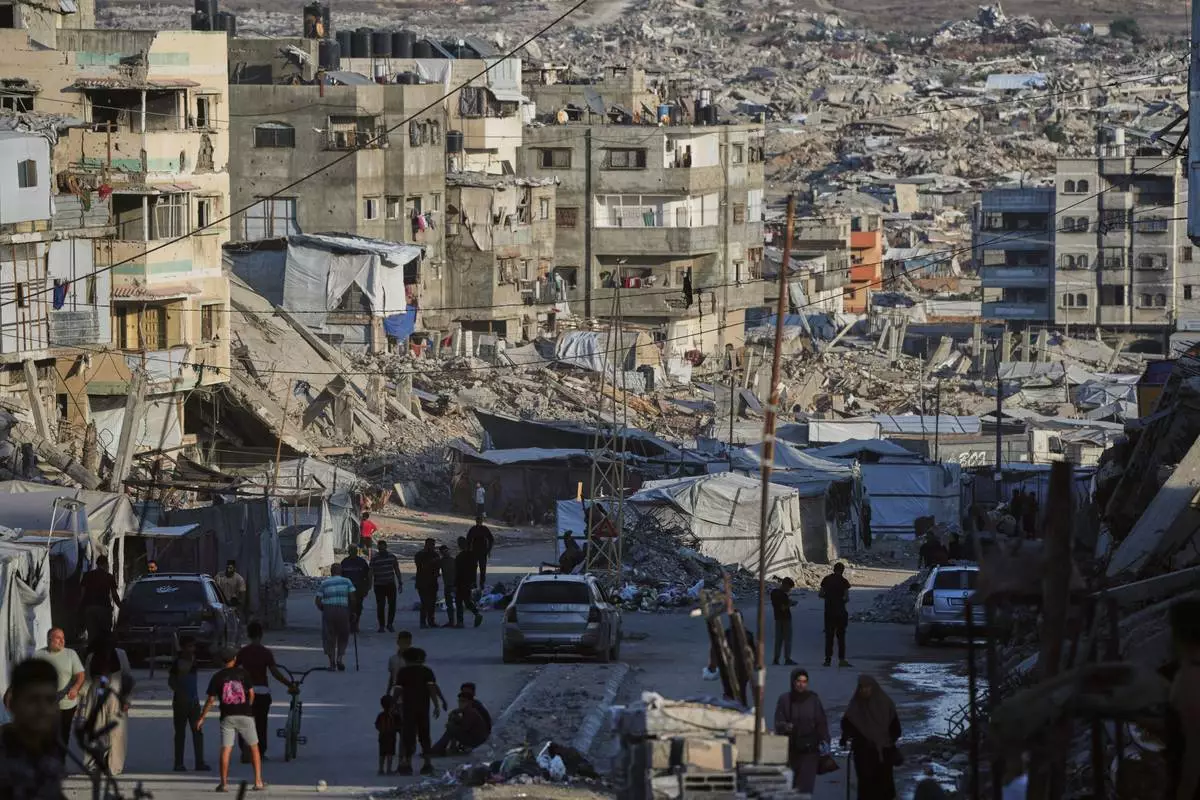
Palestinians walk along a street surrounded by buildings destroyed in Israeli military strikes during the Israel-Hamas war in Gaza City, Tuesday, Oct. 6, 2026. (AP Photo/Jehad Alshrafi)
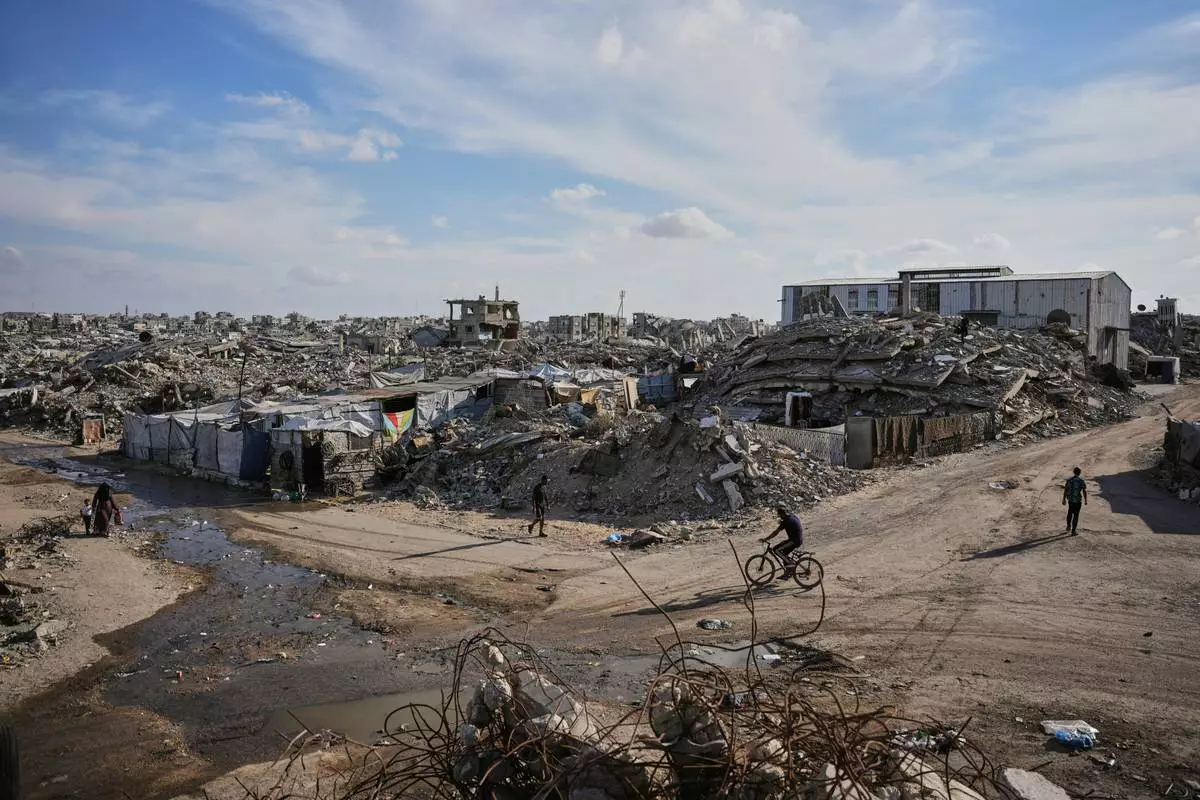
Palestinians walk along a street surrounded by buildings destroyed in Israeli military strikes during the Israel-Hamas war in Gaza City, Tuesday, Oct. 6, 2026. (AP Photo/Abdel Kareem Hana)
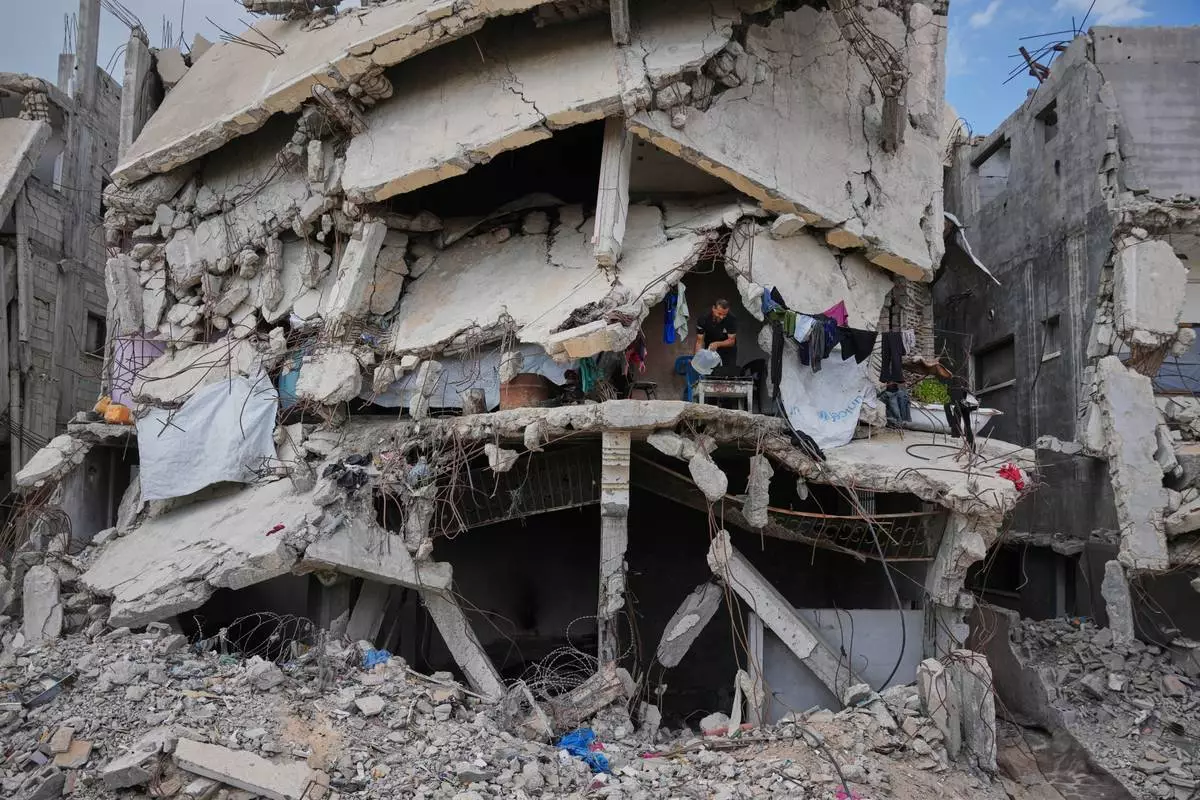
Murid Akhziq, 43, lights a fire for cooking inside his home, which was destroyed during the Israel-Hamas war, in Gaza City, Tuesday, Oct. 6, 2026. (AP Photo/Abdel Kareem Hana)
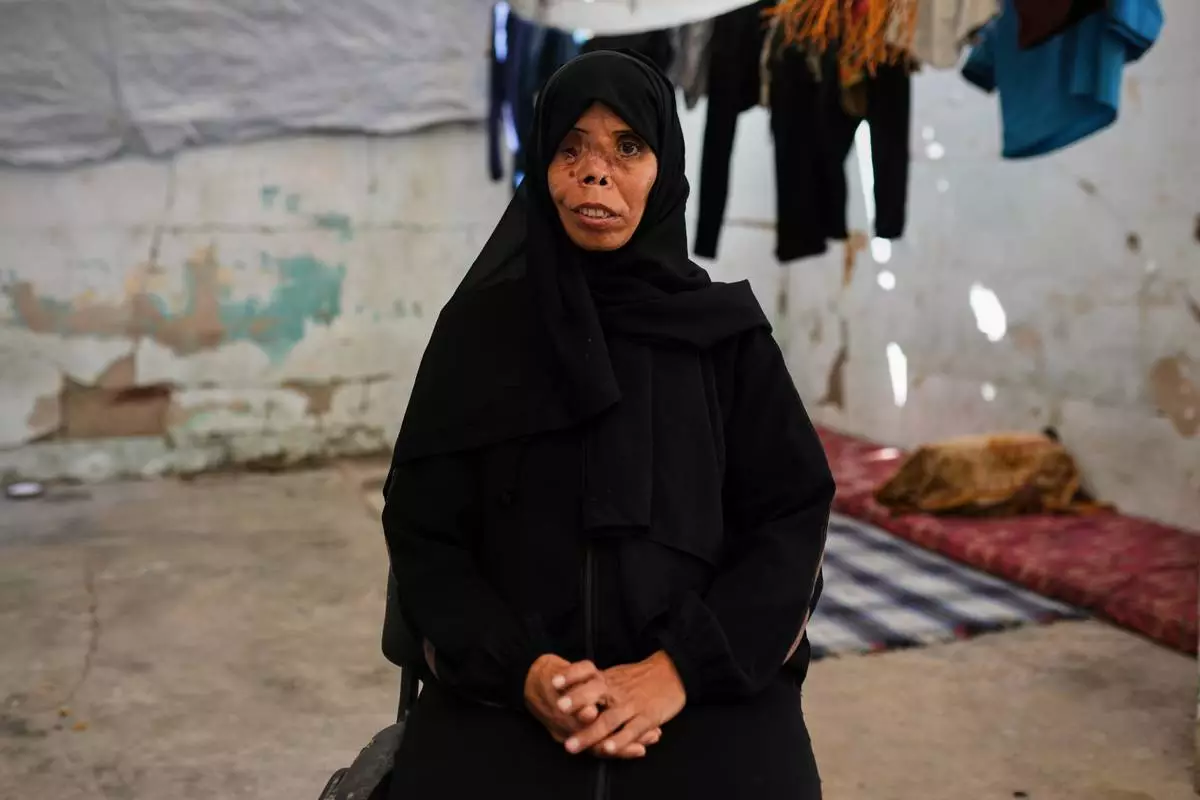
Najwa Abu Eita, who was injured in an Israeli army bombardment during the Israel-Hamas war and lost her 7-year-old daughter in 2024, poses for a photo in her tent in Nuseirat, central Gaza, Tuesday, Oct. 6, 2026. (AP Photo/Jehad Alshrafi)
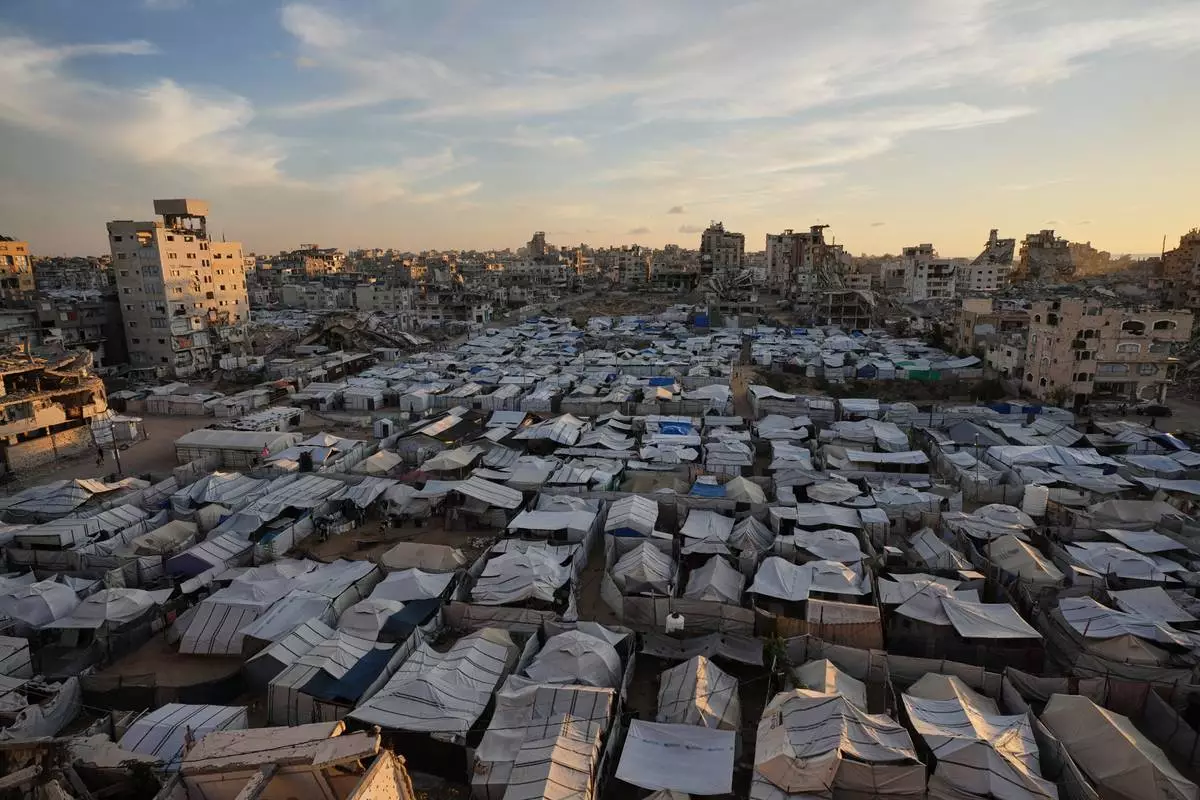
A makeshift tent camp for displaced Palestinians who lost their homes during the Israel-Hamas war stretches across Gaza City, Tuesday, Oct. 6, 2026. (AP Photo/Jehad Alshrafi)