SAN FRANCISCO--(BUSINESS WIRE)--Oct 7, 2026--
Nextdoor Holdings, Inc. (NYSE: NXDR), the essential neighborhood network, today announced Neighborhood Intelligence, a proprietary data engine that uses Nextdoor’s unique data set to enable advertisers to target, message and measure down to the neighborhood, not just the ZIP code. Nextdoor will discuss Neighborhood Intelligence and its capabilities at Advertising Week New York on October 7, 2026 on a panel titled “ Why National Brands Need a Local Data Upgrade.”
This press release features multimedia. View the full release here: https://www.businesswire.com/news/home/20261007728878/en/
Where a neighbor lives shapes what they buy. Some of that comes down to their physical surroundings — the weather, the geography, even the home projects they’re planning. And some of it comes down to the people nearby, since a recommendation from a neighbor carries more weight than a stranger's review online. Yet most media plans still treat location as a targeting checkbox, using ZIP codes that flatten real differences between neighborhoods just miles, or even blocks, apart. Nextdoor has spent 15 years building the infrastructure to understand those differences and empower marketers to use them to unlock truly scaled, local advertising.
Neighborhood Intelligence is powered by Nextdoor’s neighborhood graph — the foundation of the platform, built over years from verified neighbors tied to real addresses. That verification is what makes the graph different: it starts with real people, in real neighborhoods, sharing real conversations and engaging with local content, alerts, news from neighbors, businesses, and public agencies. Nextdoor has worked directly with communities around the world to draw accurate boundaries for 350,000 real neighborhoods. Nextdoor’s neighborhood graph provides a verified, block-level understanding of where people live and what’s happening around them that no other platform can match.
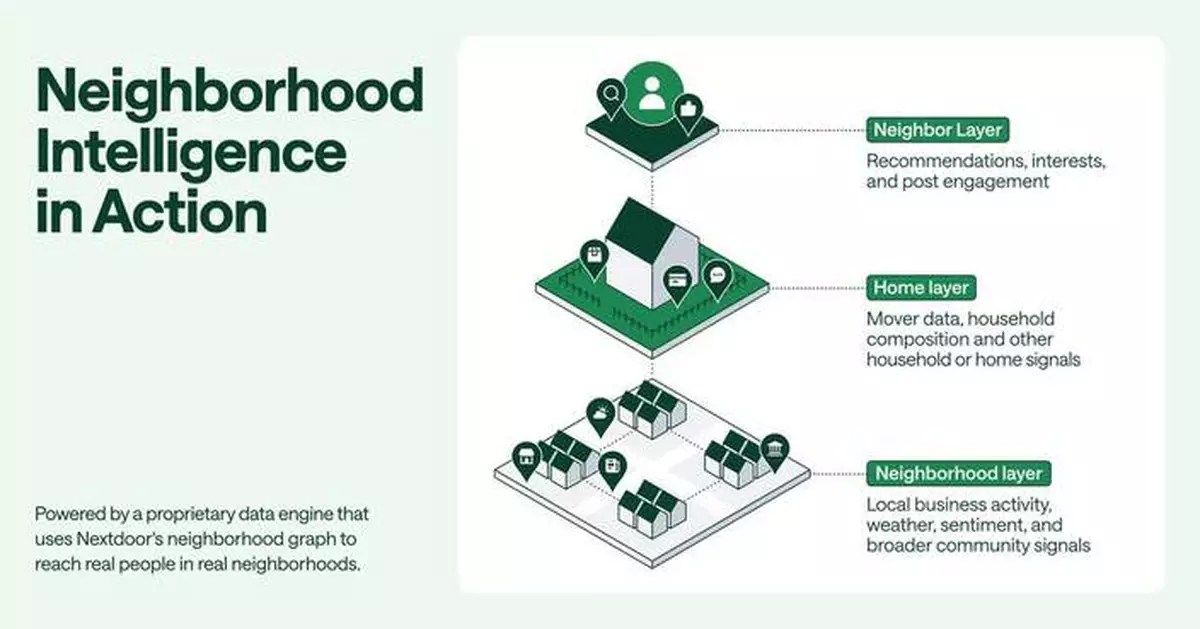
Neighborhood Intelligence brings greater precision to hyperlocal advertising by using AI to make sense of local signals and connect them to the household. The engine layers three types of signals on top of Nextdoor’s neighborhood graph to inform more precise targeting and creative:
Neighborhood Intelligence can complement an advertiser's existing targeting with local context that ZIP codes alone can't provide. In ZIP codes where Nextdoor has neighborhood coverage, there are an average of 12 distinct neighborhoods per ZIP, each with its own character, businesses and conversations.
“We kept hearing the same thing from customers across every vertical: they wanted a better way to understand and reach their audiences at the neighborhood level. That’s why we deployed Neighborhood Intelligence, and we’re excited to make it more broadly available to Nextdoor advertisers,” said Michael Kiernan, Chief Revenue Officer at Nextdoor.
In local market testing conducted between Q2 2025 and Q2 2026, pilot campaigns using Neighborhood Intelligence tactics delivered a 1.28x lift in brand awareness, a 1.16x lift in ad recall and a 1.28x lift in brand favorability compared to previous strategies that relied on ZIP code. Neighborhood Intelligence also delivers roughly 12x greater granularity than ZIP-code-based targeting, on average, in ZIP codes where Nextdoor has neighborhood coverage.
Capabilities powered by Neighborhood Intelligence are now available on request. To learn more, visit https://business.nextdoor.com/en-us/blog/introducing-neighborhood-intelligence.
About Nextdoor
Nextdoor (NYSE: NXDR) is the essential neighborhood network for over 110 million verified neighbors, offering trusted local news, real-time safety alerts, neighbor recommendations, for sale and free listings, and events. Nextdoor connects neighbors to the people, places, and information that matter most in their local communities. In addition, businesses, news publishers, and public agencies use Nextdoor to share important information and engage with neighborhoods at scale. Download the app or join the neighborhood at nextdoor.com. For more information and media assets, visit nextdoor.com/newsroom.
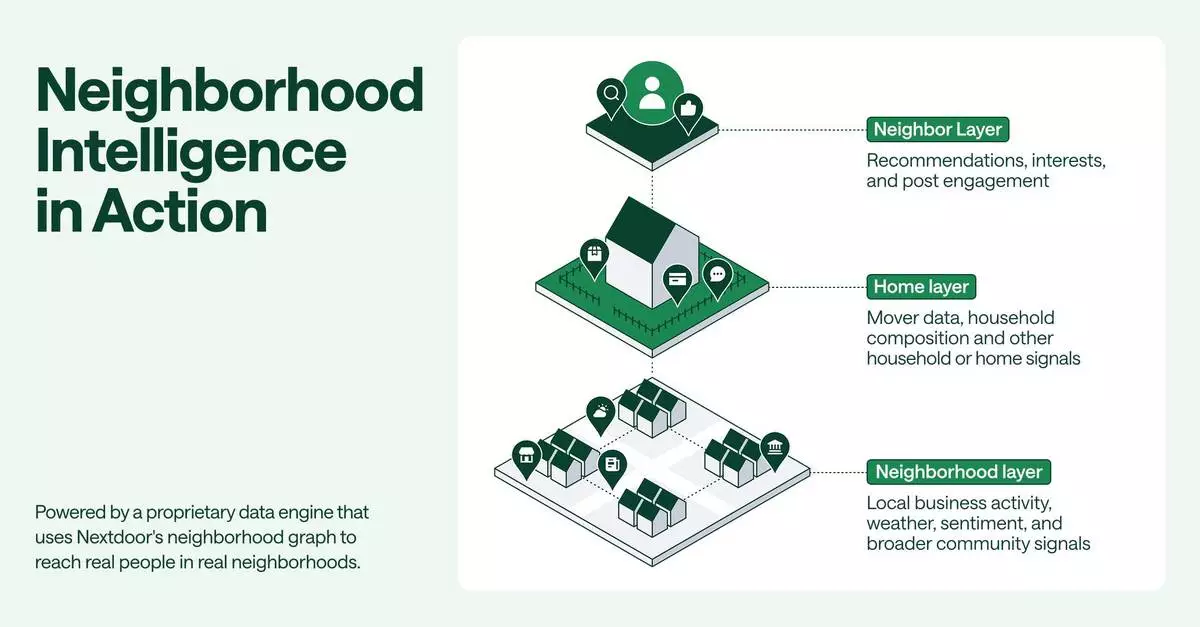
Nextdoor's Neighborhood Intelligence in Action
STOCKHOLM (AP) — Henri B. Kagan and Kenso Soai won the Nobel Prize in chemistry Wednesday for their efforts to resolve mysterious mirror images in chemical molecules.
Many molecules of life come in versions that look alike but aren’t exactly identical, like right and left hands. One mirror-image of the chemical carvone smells like mint, for example, while the other has a whiff of caraway.
When designing drugs to treat diseases, scientists want to be choosy about which mirror-image they’re getting. They want the version of a molecule that’ll treat a cold, not the kind that’ll make the sniffles worse.
Kagan and Soai found ways to make chemistry pick a side, designing and manipulating reactions to produce the desired mirror-image.
“This is probably the coolest experiment in organic chemistry,” said Peter Somfai, a member of the Nobel Committee for Chemistry. “Taken together, the groundbreaking discoveries by Henri Kagan and Kenso Soai have reshaped our understanding of molecular chirality — how it is created, amplified and transmitted.”
“Chirality” comes from the Greek word for ““hand.”
Soai, in 2003, successfully created the first-ever chemical reaction which produced only one of a molecule’s mirror-images. “Other than life itself, no one had previously achieved this feat,” the committee said in a news release.
“It might be difficult to say that this drug, or that drug, was developed using this,” Somfai said. “I would say all of them, because we use this as a tool, we use this as an understanding, how to develop catalysts, how they function.”
“The medicines we have today would not be possible without this chemistry,” said Rigoberto Hernandez, president of the American Chemical Society.
Kagan, 95 years old and born in France, is affiliated with the Université Paris-Sud in Orsay, France, and Soai, born in 1950 in Japan, with the Tokyo University of Science.
The French Academy of Sciences, of which Kagan is a member, did not immediately respond to AP request for comment, nor did the Université Paris-Sud.
The Tokyo University of Science did not immediately respond either.
Kagan’s research dates back to the 1980s, when he found a new way to manipulate chemical reactions.
“I’m very excited to receive the very nice news,” Soai told the committee and journalists by phone. “Of course this is one of the most exciting days in my life.”
He said he was shopping near his home when he was reached by the Nobel committee.
The Royal Swedish Academy of Sciences announced the winner in Stockholm.
Last year, three scientists won the chemistry Nobel for their development of new molecular structures that can trap vast quantities of gas inside, laying the groundwork to potentially suck greenhouse gases out of the atmosphere or harvest moisture from desert environments.
This year's prizes began with the Nobel for medicine, awarded Monday to three scientists whose work led to a tool that uses light to help unravel how the brain works. The physics award Tuesday recognized a scientist's efforts to demystify a rare group of neutrinos.
The literature prize is set to be awarded Thursday. After Friday’s peace prize is awarded, the Nobel Memorial Prize in Economic Sciences will be announced Monday.
The prize money this year is 12 million Swedish kronor (about $1.2 million), whether for an individual, a small group of laureates or an organization.
———
This story has been corrected to clarify that Kagan, and not Soai, is 95 years old.
Ramakrishnan reported from New York and Dazio reported from Berlin. Associated Press journalist Alexa St. John contributed from Detroit.
AP Nobel Prizes: https://apnews.com/hub/nobel-prizes
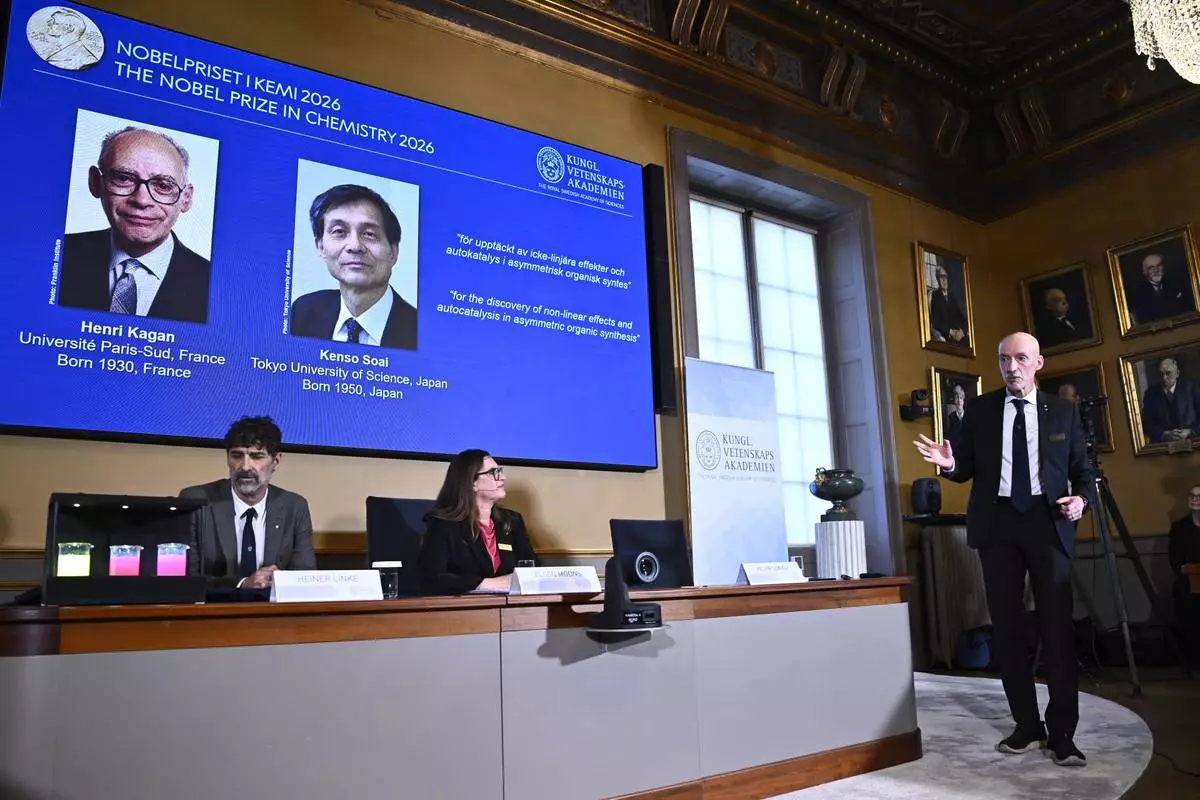
Portraits of Henri Kagan and Kenso Soai are shown on the screen as they are awarded the 2026 Nobel Prize in Chemistry, at the Royal Swedish Academy of Sciences in Stockholm, Sweden, on Oct. 7, 2026. Photo: (Fredrik Sandberg/TT News Agency via AP)

Portraits of Henri Kagan and Kenso Soai are shown on the screen as they are awarded the 2026 Nobel Prize in Chemistry, at the Royal Swedish Academy of Sciences in Stockholm, Sweden, on Oct. 7, 2026. Photo: (Fredrik Sandberg/TT News Agency via AP)
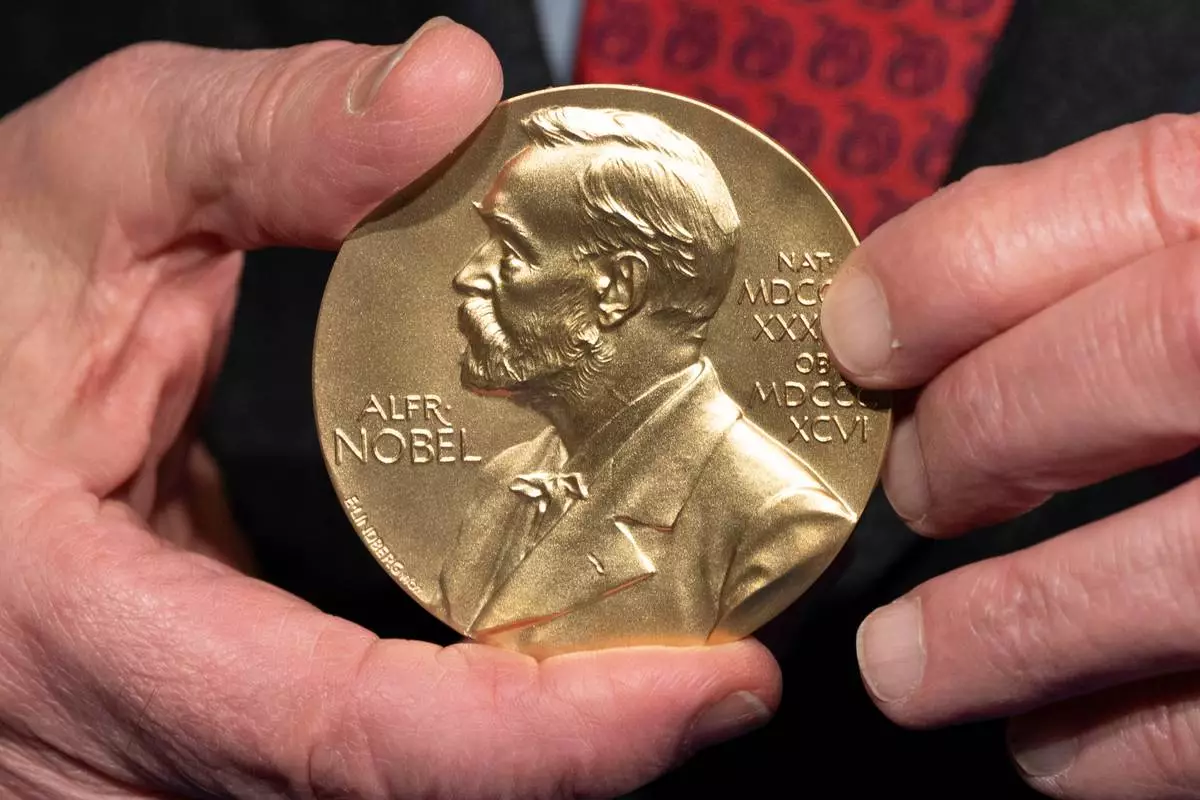
FILE - A close-up view of a Nobel Prize medal at the National Institutes of Health (NIH) in Bethesda, Md., Dec. 8, 2020. (AP Photo/Jacquelyn Martin, File)