Moviegoers have flocked to cinemas across China during the National Day holiday, pushing the box office past 1.1 billion yuan (around 164 million U.S. dollars), including presales, for the Oct. 1-7 period, according to online ticketing platform data.
The holiday lineup featured a mix of domestic and imported films, while a growing "film plus" model combining moviegoing with cultural tourism drove the industry toward multi-format consumption. The releases spanned family, animation, crime, comedy and real-life drama, with domestic productions forming the mainstay of the lineup.
Directed and co-written by Chen Sicheng, "Traces of Justice" is based on the life and work of Cui Daozhi, a renowned trace-evidence expert and recipient of the July 1 Medal, one of China's highest honors.
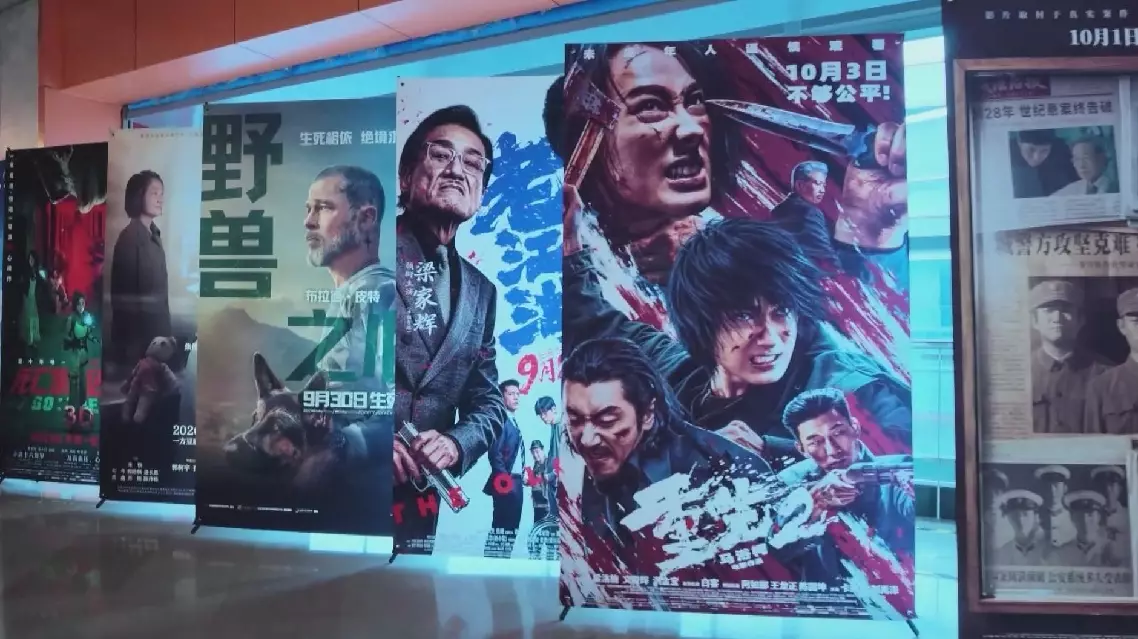
Other releases include the family comedy "Mr. and Mrs. Pardon," the crime action film "Go for Broke 2," "Waiting for Myself," a drama exploring the emotional lives of middle-aged and older viewers, and the family animation "Peppa Pig: Perfect Holiday."
That variety has kept cinemas busy throughout the holiday, with moviegoers queuing at ticket counters and self-service kiosks, waiting out front of film posters and collecting souvenir stamps between screenings.
The holiday momentum is also carrying Chinese films overseas.
"Traces of Justice" leads the way, opening on Oct. 15 in Hong Kong, Macao, Singapore and Germany, and reaching Britain, Ireland, North America and Oceania by the end of the month, with more Asian markets to follow. "Go for Broke 2" opens the same day in Australia, New Zealand and Malaysia, arriving in Britain and Ireland a day later and crossing to the U.S. and Canada the following week. "Mr. and Mrs. Pardon" is also set for release in North America, Australia and New Zealand.
Meanwhile, in Beijing, one cinema has turned back the clock 90 years, with a themed event marking the anniversary of the victory of the Long March, the Red Army's strategic retreat of 1934-1936.
The event invites visitors to retrace the march with free daily screenings of "Light Chaser," a market featuring intangible cultural heritage crafts and an immersive VR film, "Long March: Heroes," recreating the trek.
For some, the stop rounds out a day devoted to history.
"After visiting the Museum of the Communist Party of China, I came to the theater here. It really helped me better understand the history of the Long March," said Yu Ying, a visitor.
The event is no holiday one-off -- in June, the China Film Administration and the State Administration for Market Regulation issued a notice on promoting diversified cinema operations, proposing 10 measures on format, business model and service innovation.
Since then, cinemas in many cities have embraced what the industry calls the "film plus" model, adding specialty offerings and turning theaters into all-in-one spaces combining film, socializing, entertainment and shopping.
"We are putting the 'film plus' crossover model into practice, combining revolutionary culture-themed screenings with an intangible cultural heritage market to boost spending," said Wu Peng, general manager of the company organizing the themed event.
Behind the holiday rush is a rapid build-out of the country's cinema infrastructure -- China recorded a net increase of more than 400 cinemas and over 2,600 screens in the first nine months of this year, bringing the national total to nearly 96,000, according to the China Film Administration.
Among the upgraded venues is the IMAX GT theater inside the Liaoning Science and Technology Museum in Shenyang, northeast China, which boasts the country's largest IMAX screen and has drawn audiences from other cities.
Family films have been a highlight this holiday, making the giant-screen theater a key stop on cultural tourism routes.
"I came to Shenyang during the National Day holiday just for this screen. The experience was great, and it was really worth the money," said Zhang Baoyu, a visitor.
Cinemas are also partnering with nearby commercial complexes and cultural venues to offer ticket-stub discounts on dining, cultural products and parking, encouraging moviegoers to stay for a meal, a browse or some shopping.
"With the 638-square-meter IMAX screen and the science museum's science education space, we combine cultural tourism with film viewing to create a new landmark for Shenyang," said Dai Zhantao, manager of IMAX GT Theater of Wanda Cinema.
China's National Day box office tops 1.1 bln yuan as cinemas turn into cultural destination