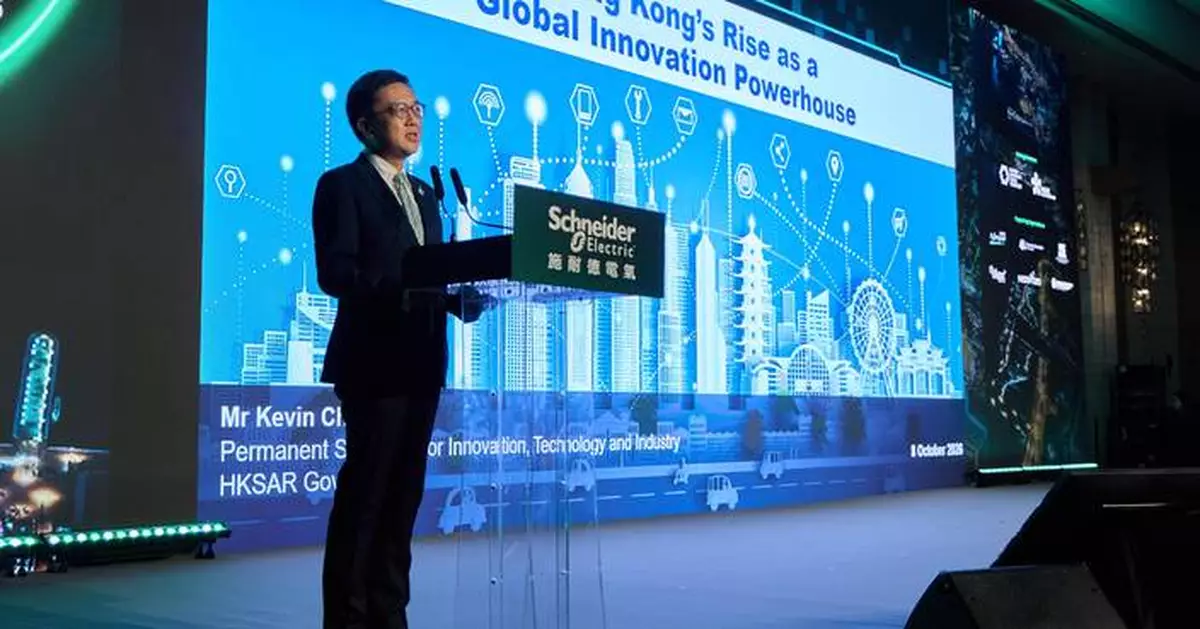
Keynote speech by PSITI at Schneider Electric Innovation Summit Hong Kong 2026
Following is the keynote speech by the Permanent Secretary for Innovation, Technology and Industry, Mr Kevin Choi, at the Schneider Electric Innovation Summit Hong Kong 2026 today (October 8):
Distinguished speakers and guests, ladies and gentlemen,
Good morning. It is my pleasure to join you at this Summit to share our insights on powering Hong Kong's next growth era through AI innovation. I would like to share how Hong Kong is building a dynamic AI ecosystem, one that supports innovation, strengthens business competitiveness and enables a smarter, more sustainable future.
Alignment with National 15th Five-Year Plan (2026-2030)
First and foremost, this year marks the start of the National 15th Five-Year Plan, which recognises AI as an important engine for economic and social development and calls for the further advancement of "Digital China" and the "AI+" Initiative.
To align with national development strategies and better integrate into our country's overall development, the Hong Kong Government announced its First Five-Year Plan for Economic and Social Development last month. It provides a strategic framework for long-term, high-quality development, building on Hong Kong's unique strengths and enhancing our attractiveness as an international business and investment destination.
At the heart of this strategy is our commitment to deepen "AI+" and digital transformation across the economy and society. Building on this, we will accelerate Hong Kong's development as an international I&T (innovation and technology) centre by strengthening frontier research, technology transfer and commercialisation, through closer collaboration among the Government, industry, academia and research sectors.
People are central to this effort. We will nurture local talent, attract high-calibre professionals from around the world, and open up more opportunities for young people to contribute to Hong Kong's I&T development.
Finally, the Northern Metropolis will provide the strategic space and platform for the next stage of growth.
Driving AI+ Development in HK
We are placing AI at the core of our digital economy strategy and accelerating both "industries for AI" and "AI for industries" to foster Hong Kong's AI development. This means building the essential foundations for AI development, including research capability, computing infrastructure, data, talent, capital and commercialisation, while promoting AI adoption across industries and public services to enhance productivity, improve services and create new business opportunities.
Among all, the Government has formed the Committee on AI+ and Industry Development Strategy. Chaired by the Financial Secretary, the Committee brings together representatives from Government, industry and the professional sectors to formulate priorities and strategies for AI-driven industrial transformation, strengthen co-ordination across the ecosystem, and foster the deep integration of AI with different industries.
To build the city's AI ecosystem, the Government has been continuously strengthening our support for R&D (research and development) transformation and the digital infrastructure that underpins it.
In parallel, we are actively empowering public services with AI to speed up Government's digital transformation and streamline processes.
As we scale AI adoption, we are putting in place AI governance safeguards that ensure responsible and transparent deployment. And through our "AI for All" Inclusive Programme, we are promoting AI literacy and broader adoption, so that the benefits of AI can be shared across society.
Research and Development
On the R&D front, the Hong Kong Artificial Intelligence Research and Development Institute (AIRDI) will start operation this year. It plays a pioneering role in Hong Kong's AI ecosystem by advancing frontier AI research, promoting the integration of AI in key sectors, and providing a platform that matches AI solutions with industry needs, thereby driving the commercialisation of AI R&D outcomes.
InnoHK is another major government initiative to develop Hong Kong as a hub for global research collaboration. Its AIR@InnoHK research cluster has established 16 R&D laboratories focused on AI and robotics, bringing together around 1 200 world-class talents.
Under the "one river, two banks" and "one zone, two parks" framework, we are accelerating the Hetao Shenzhen-Hong Kong Science and Technology Innovation Co-operation Zone and facilitating the safe flow of research data between its Shenzhen and Hong Kong parks. Together with the San Tin Technopole, this will form an end-to-end ecosystem linking research, pilot testing and mass production, supported by the Northern Metropolis University Towns in San Tin, Hung Shui Kiu and Ta Kwu Ling to nurture AI talent.
Digital Infrastructure
In the AI era, computing power is crucial to Hong Kong's competitiveness. Our total computing power has reached 5 000 PFLOPS (peta-floating point operations per second), of which 3 000 PFLOPS comes from Cyberport's AI Supercomputing Centre.
To help make use of this capacity, the Government launched a $3 billion AI Subsidy Scheme in 2024. It has so far supported nearly 40 R&D projects, in areas such as local large language models, new materials, synthetic biology and medical large models. As announced in the Policy Address this year, a further HK$1 billion will be injected into the Scheme to support the AIRDI's frontier research.
Looking ahead, the Sandy Ridge Data Facility Cluster in the Northern Metropolis is under construction, with the first phase starting operation next year. By 2032, it is expected to provide 180 000 PFLOPS, 36 times Hong Kong's current computing power.
At the same time, the Government will take forward a study on power usage effectiveness, or PUE, for data centres. Guided by the principles of "high-efficiency computing power, stable electricity supply and low-carbon transition", we will also assess the market demand for computing power to optimise the city-level layout of computing power, supporting the sustainable development of our intelligent computing industry.
Empower Public Services through AI
Recognising the immense potential and value of AI in public services, the Government is spearheading the adoption of AI across public services to boost efficiency and effectiveness.
For example, the Digital Policy Office (DPO) is going to launch an AI Assistant for users of "iAM Smart" and the upcoming Digital Corporate Identity Platform , to answer enquiries about online government services, and recommend suitable funding schemes and public service support for enterprises, especially SMEs (small and medium enterprises).
To drive technological reform and steer government departments to apply AI, the Government set up the AI Efficacy Enhancement Team (AIEET) last year. To date, the AIEET has facilitated and implemented the first batch of 30 efficacy enhancement project across 13 departments.
To help government departments swiftly adopt suitable AI technologies, DPO has introduced the "AI Solution Catalogue" and the "AI Toolbox", featuring over 260 AI-related solutions and tools meeting the departments' operational needs. In addition, we are piloting the use of AI Agents within the Government.
AI Governance
To support the responsible development and wider adoption of AI, Hong Kong takes a pragmatic, adaptive and risk-based approach to governance.
The Government has issued the Ethical Artificial Intelligence Framework and the Hong Kong Generative Artificial Intelligence Technical and Application Guideline. These provide practical guidance for developers, service providers and users, covering areas such as ethics, data security, system robustness and appropriate human oversight.
In parallel, the Inter-Departmental Working Group led by the Department of Justice is reviewing legislation to support the wider application of AI, while ensuring appropriate safeguards.
Building on these foundations, the latest Policy Address sets out an AI risk-governance strategy with seven areas of action. They address the risks of AI at every level: tackling misuse such as AI-enabled crime, protecting vulnerable underage users, ensuring ethical and safe application across industries, clarifying legal liability, and preparing our workforce for the changes AI will bring.
To drive this work across the Government, the Chief Secretary for Administration will co-ordinate the implementation of the strategy. A new Commissioner for AI post will also be created under the DPO to assist bureaux with the related work.
Together, these measures will help ensure that Hong Kong can foster innovation while maintaining a safe, orderly and trusted environment for AI development and application.
"AI for All" Inclusive Programme
To promote AI awareness and responsible use, the Government will, through Cyberport, the HKSTP (Hong Kong Science and Technology Parks) and the HKPC (Hong Kong Productivity Council), roll out over 200 training courses and activities under the "AI for All" Inclusive Programme by the first quarter of 2028.
The Programme will adopt a tiered, collaborative model to support the needs of different community segments:
- Tier 1 aims to promote AI awareness and a culture of responsible AI use while bridging the digital divide. It targets students, parents, the elderly and underprivileged groups.
- Tier 2 targets university students, young researchers and professionals. It aims to translate AI knowledge into practical skills and employability.
- Tier 3 targets mainly SMEs and working professionals. It focuses on practical training and optimisation tailored to workplace scenarios, promotes knowledge sharing, and enhances efficiency and competitiveness.
Closing
In closing, Hong Kong's ambition goes beyond adopting AI. We are building a complete AI ecosystem: frontier research, world-class computing infrastructure, AI-enabled public services, responsible governance, and a talent base that reaches every part of society.
But no government can do this alone. Turning AI into real economic and social value needs industry, research institutions and the community working together. Schneider is a clear example of how our business leader, the world's most sustainable company ranked by the Time Magazine, can connect the community and contribute to R&D and application of energy and AI solutions to better the world. With our international connectivity and our close links with the Mainland, Hong Kong is well placed to be your partner in this journey. We welcome you to develop, test and scale your innovations here.
I wish this Summit every success today, and look forward to driving innovation together, forward. Thank you.
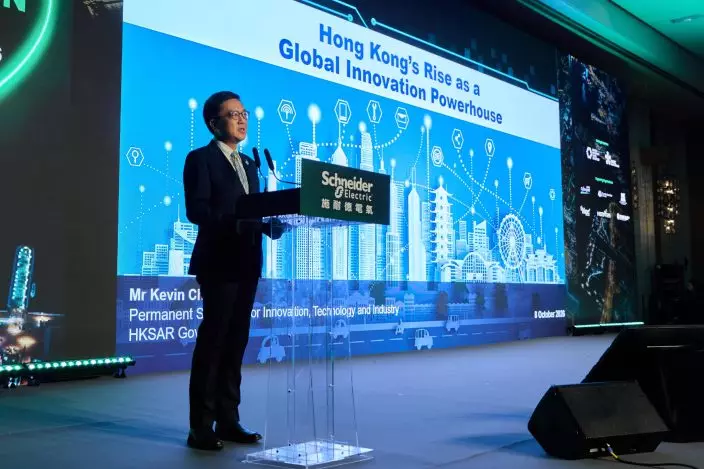
The Permanent Secretary for Innovation, Technology and Industry, Mr Kevin Choi, delivers a keynote speech at the Schneider Electric Innovation Summit Hong Kong 2026 today (October 8). Source: HKSAR Government Press Releases