Isaias surged toward the U.S. Gulf Coast on Thursday as the first hurricane of the Atlantic season, prompting mandatory evacuations and school closures in parts of Florida.
Isaias was forecast to intensify rapidly and bring strong winds and a life-threatening storm surge to the Florida Panhandle, southern Alabama and southern Mississippi when it makes landfall on the northern Gulf Coast late Friday or early Saturday. Heavy rain with the risk of flooding was possible into the weekend as far inland as the Tennessee Valley.
The hurricane had maximum sustained winds around 75 mph (121 kph) and was moving east-northeast at 9 mph (15 kph) early Thursday morning, the National Hurricane Center in Miami said. It was centered about 445 miles (715 kilometers) south-southwest of the mouth of the Mississippi River.
Coastal communities moved quickly to prepare. Some Gulf oil wells paused production, and at least four Florida school districts canceled classes for later in the week while Okaloosa County announced mandatory evacuations for some coastal areas. Governors in Florida and Alabama declared a state of emergency for dozens of counties.
The National Weather Service told communities from Ocean Springs, Mississippi, to Gulf County, Florida, to prepare for the possibility of “long-duration power outages.”
Isaias developed more than four months into the Atlantic hurricane season and was short by one day of tying a 121-year-old record for the area’s latest-forming hurricane. According to the National Weather Service, the record dates to 1905, when the year’s first Atlantic hurricane formed on Oct. 8.
The Atlantic hurricane season has been unusually quiet this year because of a strong El Niño, which disrupts storm formation over that ocean. Storm activity has been above average in the Pacific, where Tropical Storm Simon formed Wednesday off Mexico.
Isaias is expected to strike a swath of coastline that’s familiar with major hurricanes.
One of the 20th century’s worst storms, Hurricane Camille, killed more than 250 people after hitting land near Waveland, Mississippi, in 1969. Hurricane Katrina in 2005 razed neighborhoods in Mississippi, flooded New Orleans and killed nearly 1,400 people. And Hurricane Michael leveled homes and buildings near Panama City, Florida, in 2018.
Ahead of the storm, oil and gas producers shut down a significant share of offshore production in the Gulf, which accounts for almost 15% of crude pumped annually in the U.S.
As of Wednesday about 25% of the oil production in the region was temporarily halted, taking about 511,000 barrels a day off the market, according to the Marine Minerals Administration. It said eight of the Gulf's 371 manned oil platforms were evacuated.
With oil prices already high, the production cuts are steep enough to affect markets, though other Gulf hurricanes have caused larger disruptions, said Jim Burkhard, global head of crude oil market research for S&P Global Energy. More concerning, he said, is whether Isaias strikes as a powerful storm near refineries.
As it moves inland, Isaias might also disrupt Saturday’s college football showdown between rivals Georgia and Alabama, a game President Donald Trump has planned to attend.
In Alabama, the cities of Gulf Shores and Orange Beach issued a statement encouraging people in low-lying areas to voluntarily evacuate.
Gulf Shores resident Maranie Adams gathered water and other supplies as her family moved belongings, including a hot tub motor, to higher ground. Her family planned to ride out the storm at home, roughly a half-mile from shore, sheltering indoors alongside their flock of chickens.
“We’re having to get crates to bring them into the house so they don’t blow away,” Adams said. “It’s going to be noisy.”
Alabama Gov. Kay Ivey issued a state of emergency for 40 counties, while Florida Gov. Ron DeSantis declared one for 25 counties in the Panhandle and Big Bend regions. The state also planned to deploy a Miami-based urban search and rescue task force.
In Pensacola, electric utilities were pre-positioning crews to quickly repair any power outages. City officials provided sand for residents to fill sandbags to protect their homes against flooding. And Mayor D.C. Reeves urged people to check on older adult neighbors and others who might need help.
“Obviously no need to panic at this point,” Reeves told a news conference. “This is really about preparation.”
Rico reported from Atlanta, Collins from Hartford, Connecticut, and Golden from Seattle. Associated Press journalists Russ Bynum in Savannah, Georgia, and Julie Walker in New York contributed to this report.
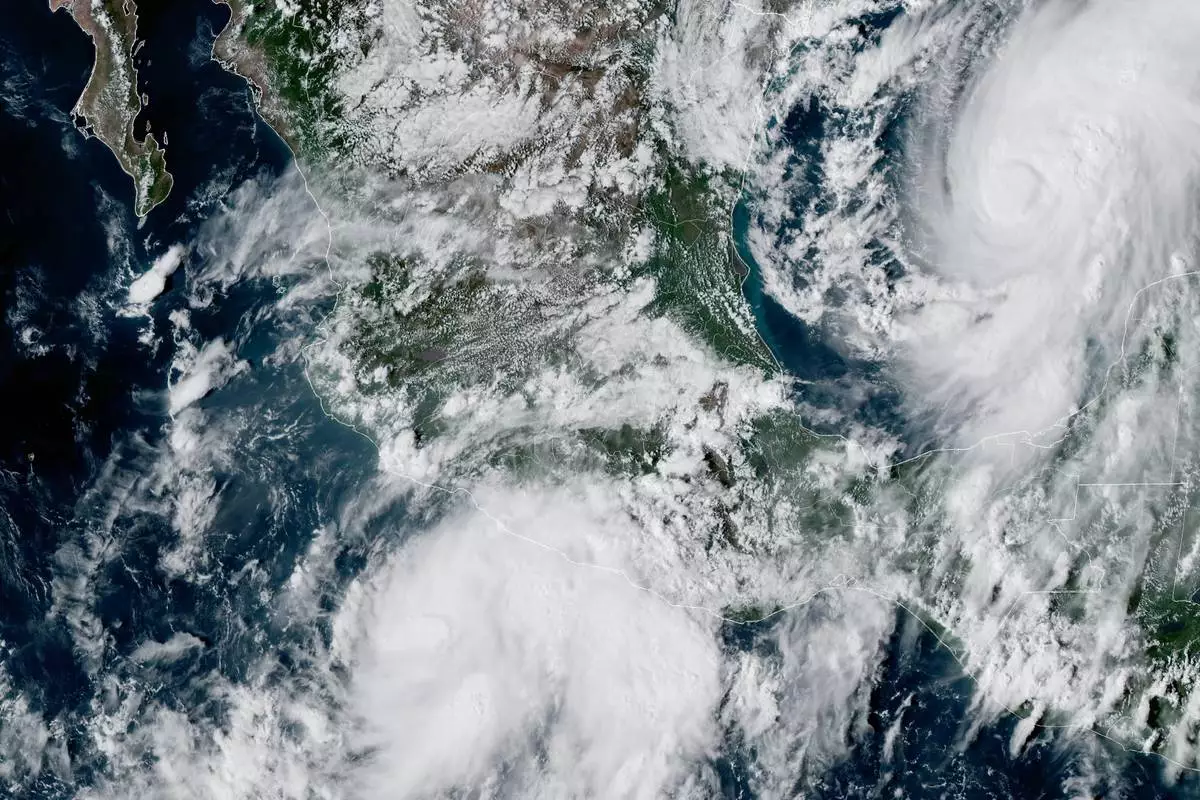
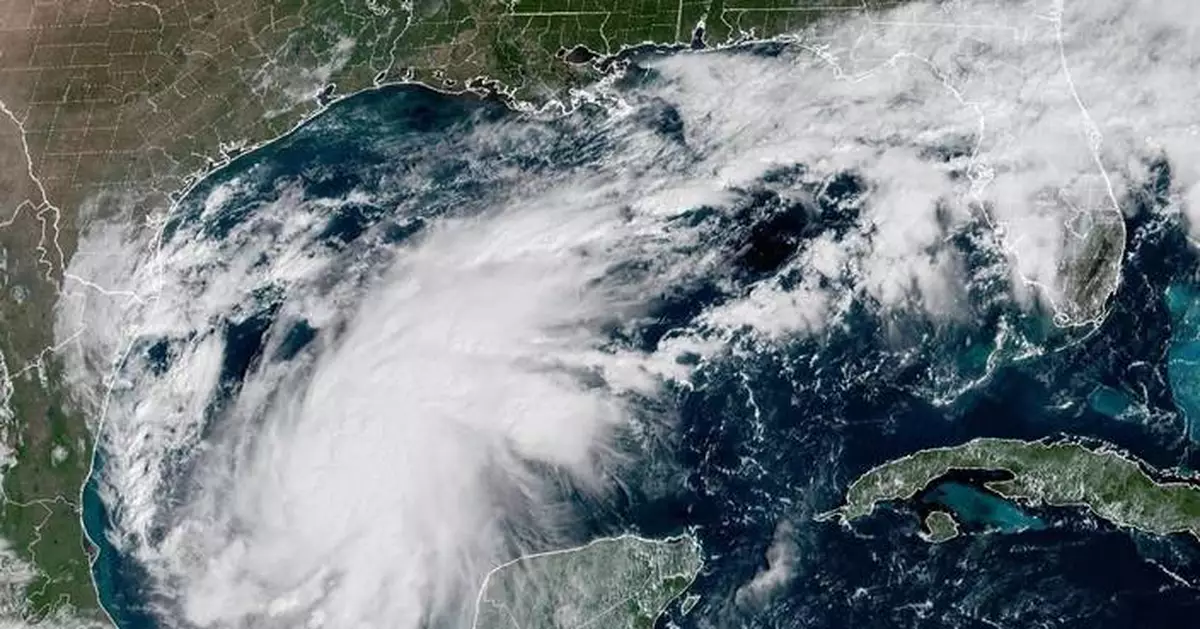
This GOES-19 GeoColor satellite image provided by the National Oceanic and Atmospheric Administration (NOAA) and taken at 4:57 p.m. EDT, Wednesday, Oct. 7, 2026, shows Tropical Storm Simon, bottom center, in the Pacific Ocean, off the southwestern coast of Mexico, and Tropical Storm Isaias, upper right, east of Mexico in the Gulf of Mexico. (NOAA via AP)
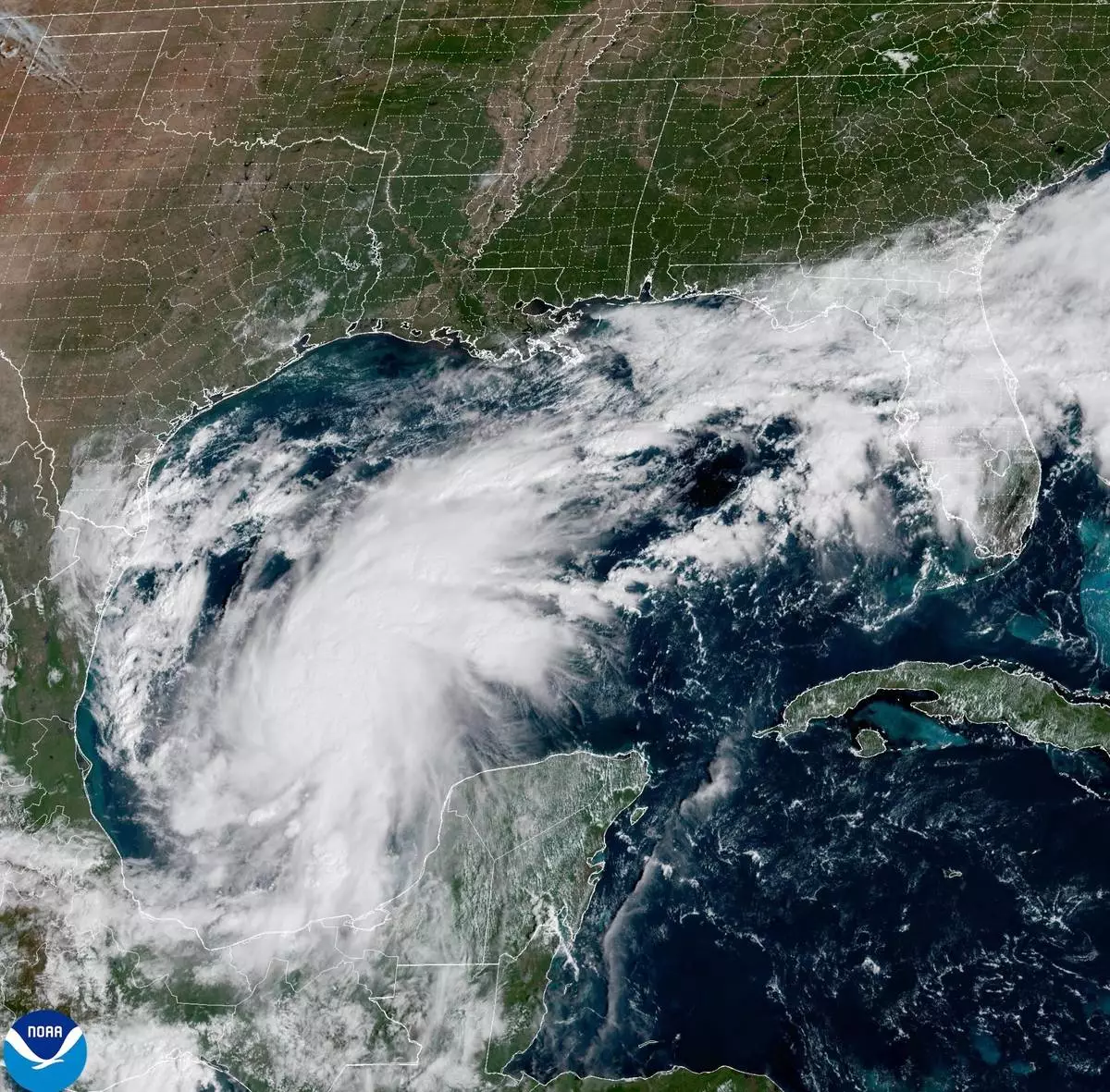
This satellite image from the National Oceanic and Atmospheric Administration shows Tropical Storm Isaias off the eastern coast of Mexico on Wednesday, Oct. 7, 2026. (National Oceanic and Atmospheric Administration via AP)
WASHINGTON (AP) — The midterm elections are looming and the first hurricane of the Atlantic Season is menacing the Gulf Coast.
But President Donald Trump is really, really hoping the weather doesn’t stop him from going to another big college football game — this one in Alabama on Saturday night.
“Well, hurricane and football? I love Alabama. I gotta go to the game. It’d be awfully hard,” Trump said Wednesday, when asked if Hurricane Isaias — and a forecast track which has parts of Alabama, Mississippi and Florida bracing for significant impacts — might alter his plans.
Trump had been set to visit Bryant-Denny Stadium in Tuscaloosa when Alabama hosts Georgia in a Top 10 matchup, following an afternoon rally in Tennessee.
Officials are still discussing how the storm might affect the game. But if it happens and Trump is there, it would be the 10th college football game he’s attended as president since 2017 — including the late September game in Knoxville when Texas topped Tennessee 20-17.
Trump told reporters on Wednesday “if there’s a hurricane, I don’t want to do anything" to take the focus of first responders and law enforcement away from the storm, saying he wanted people to be safe.
“We'll have to see," he said.
A president trying to give his party a midterm boost typically wouldn't even contemplate going to two college football games so close to Election Day. But Trump's longtime love of sports — and big crowds — are often key factors in his travel schedule.
Live sports — especially big games that attract casual fans nationwide — are one of the few televised programs that can still draw large, real-time audiences. But mixing sports and politics can be tricky: Trump received cheers but also boos when he was shown on Tennessee's jumbotron, despite being in a deep red state.
“I think what they’re trying to do is get this broad cast: trying to raise enthusiasm, particularly among young men,” said University of Richmond political scientist Dan Palazzolo, who has researched, written and taught about the intersection of politics and sports.
Tennessee and Alabama are “safe turf,” Palazzolo said, and Trump “clearly sees sports as a kind of way to connect with a certain part of the base.”
While presidents usually visit key swing states leading up to elections, Trump's sinking approval ratings mean some GOP candidates may be looking to distance themselves from the increasingly unpopular Iran war and the higher gasoline prices it's caused.
The White House says Trump attending football games — even in reliably Republican states — can energize his core supporters around the country. White House spokesperson Taylor Rogers described the president as “the greatest champion of college sports in American history" and said that Trump has used his executive powers and championed congressional efforts to try to overhaul how the sport is governed.
Trump is now a week into what he said would be 32 days of travel ahead of Election Day on Nov. 3 — including a visit last week to Alabama and other stops in Texas, Oklahoma, Ohio and Nebraska. Swings in coming weeks will take him to Georgia, North Carolina, Michigan, Kansas and Alaska, among other places.
Richard Nixon publicly leaned into his fierce love of football to ”make a difference politically by capturing the Midwest, working class values," Palazzolo said. His successor, Gerald Ford, was a standout University of Michigan center and used his playing days as a key component of his folksy personal style when campaigning.
But Trump has made sporting events a big part of his second term. A onetime owner of the USFL's New Jersey Generals, Trump recently attended the Presidents Cup and flew to his golf course for the Irish Open.
He was at the World Cup final, the NBA finals and the NCAA football championship game, while marking his 80th birthday with a UFC extravaganza on the White House lawn.
In 2025 alone, Trump went to the Super Bowl, the Daytona 500, the Ryder Cup, a New York Yankees game and the U.S. Open men's final, as well as UFC fights and the NCAA wrestling championships.
“I think it helps the brand more than anything else. Because, I think his brand is ‘Sports Guy,’" said Dave Mowery, an Alabama-based consultant who has worked on campaigns for both parties.
“I know everything is political," Mowery said. “But it almost puts him above politics and into that type of guy that is seen in the box with the people.”
Mowery, a Georgia fan who plans to attend Saturday’s game against Alabama, said a presidential visit means fans have to cope with additional security and arriving early to sit in the stands long before the game begins.
He said not everyone there will support Trump, though few will be frustrated enough about the disruptions to vote for Democrats on that issue alone. Seeing the president flash on the scoreboard, or wave to the crowd from a private box, probably won't win him votes from the crowd, either, Mowery said.
Palazzolo said he thinks it’s a “time-drain” for a president to go to a football game when there's no evidence it can sway voter behavior — and he said it risks backlash, especially in parts of the country where football remains bipartisan with “conservatives and liberals finding common ground at the ballpark."
Mowery said the difference between attending a big game in the South versus other parts of the country is that college football is the top attraction. That's in contrast to NFL games, which might be bigger draws in other, more northern battleground states.
He also said it's no accident that Trump has stuck to attending marquee college matchups.
“If ‘Sports Guy’ helps drive the brand, then you want to be at the top of that food chain," Mowery said. “He wants to go to the best game on the board. He wants to go to the top of the pops."
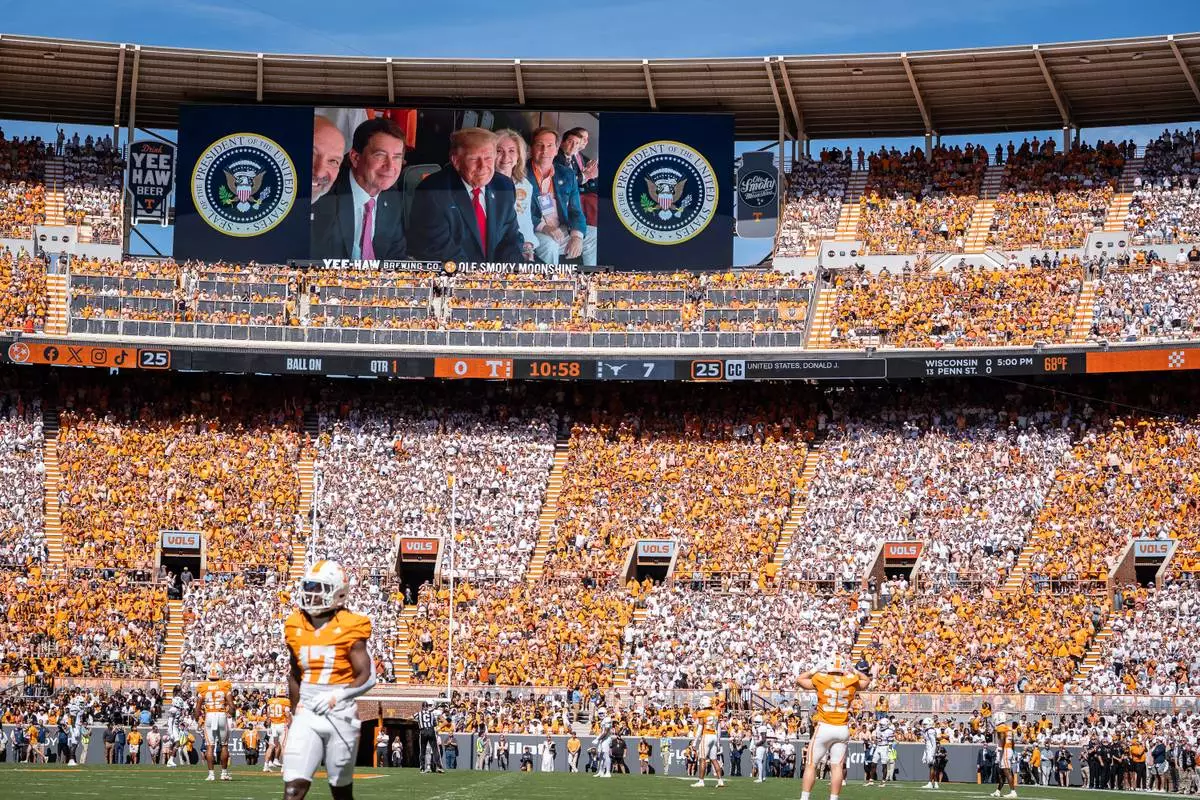
President Donald Trump is displayed on the scoreboard as he attends the Tennessee-Texas NCAA college football game in Knoxville, Tenn., Saturday, Sept. 26, 2026. (Sara Diggins/The San Antonio Express-News via AP)