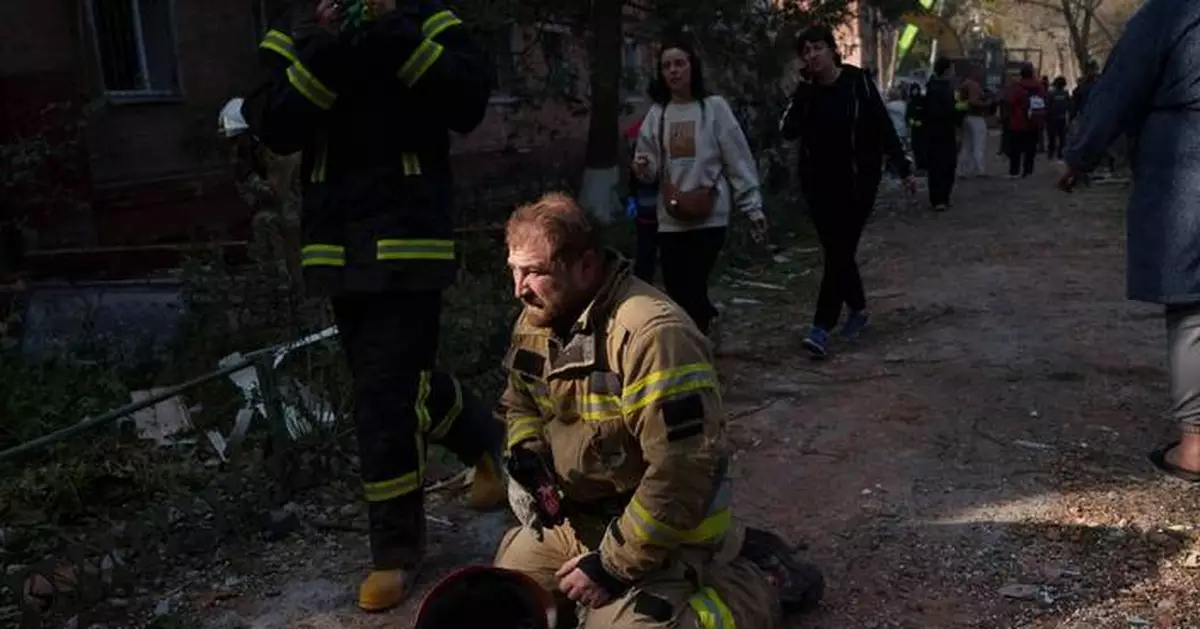
KYIV, Ukraine (AP) — Rescuers searched through the rubble of a residential building hit by a Russian missile in the northern Ukrainian town of Pryluky on Thursday as the death toll rose to 22, including five children, Ukraine’s State Emergency Service said.
The strike Wednesday in the country's Chernihiv region also injured 54 people, seven of them children, the agency said. In the immediate aftermath, rescuers had pulled 15 survivors out, including a child.
Ukrainian President Volodymyr Zelenskyy said that a cruise missile directly hit the building in Pryluky, some 150 kilometers (93 miles) east of Kyiv, the country's capital.
The strike was part of a massive Russian missile and drone barrage on Kyiv and a dozen other regions on Wednesday, coinciding with Russian President Vladimir Putin’s 74th birthday.
“This is the kind of ‘gift’ Putin gave himself for his birthday,” Zelenskyy said in a nightly video address Wednesday. “The killing of children, the killing of people.”
Zelenskyy warned that Russia will likely escalate daily missile and drone attacks as winter approaches.
Ukraine's energy company DTEK said the national grid operator Ukrenergo had ordered emergency power outages in Kyiv, and explained that this is separate from regular, rolling outages scheduled across the country and would not be applied during those shutdowns.
Russia and Ukraine are locked in a long-range aerial war while their armies remain largely deadlocked on the front line, more than 4 1/2 years since Moscow’s full-scale invasion.
Late Wednesday, Russian drones struck Kyiv’s Obolonskyi and Desnianskyi districts, police said.
In Obolonskyi, north of central Kyiv, a drone hit a courtyard between apartment buildings, killing two people and injuring seven, including a 12-year-old boy and a 16-year-old girl.
In Desnianskyi, on the capital’s northeastern outskirts, a drone hit a residential building, killing two women and injuring five, among them girls aged 1 and 6.
Follow the AP’s coverage of the war in Ukraine at https://apnews.com/hub/russia-ukraine
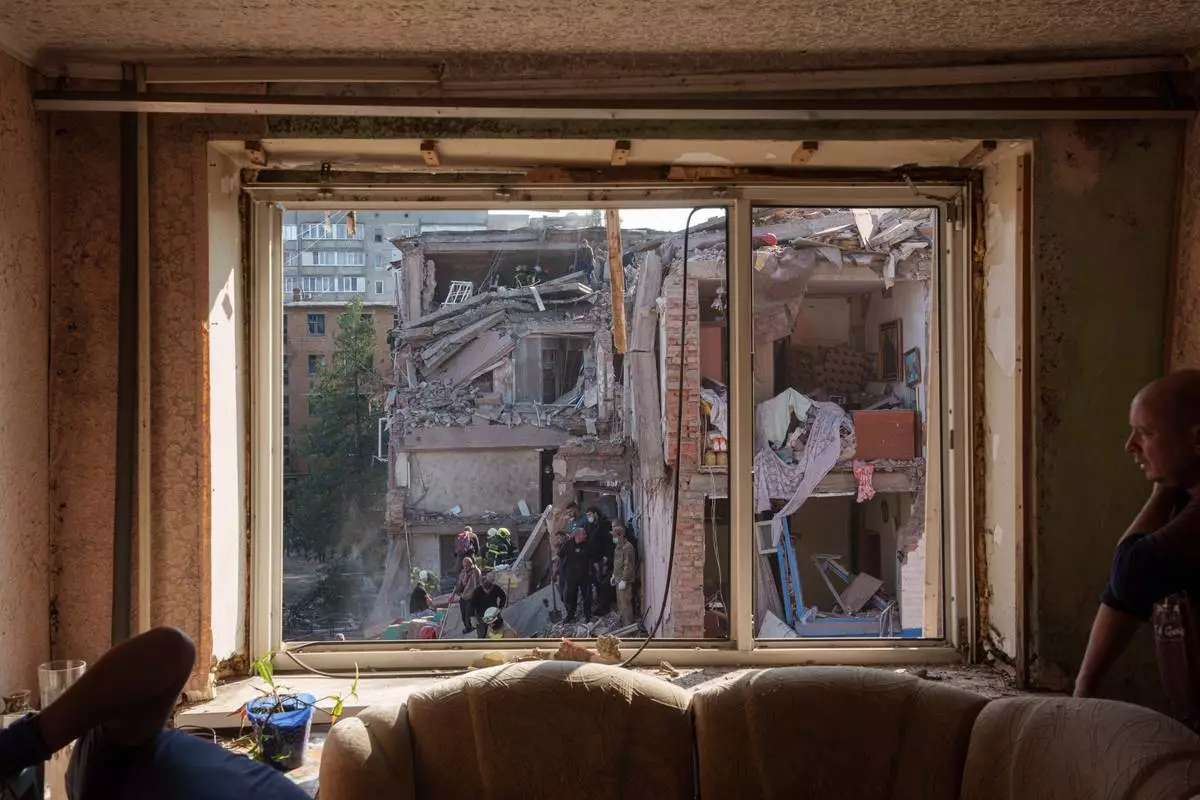
Locals and rescuers clear the rubble of a residential building destroyed in a Russian missile strike on Pryluky, Ukraine, Wednesday, Oct. 7, 2026. (AP Photo/Evgeniy Maloletka)
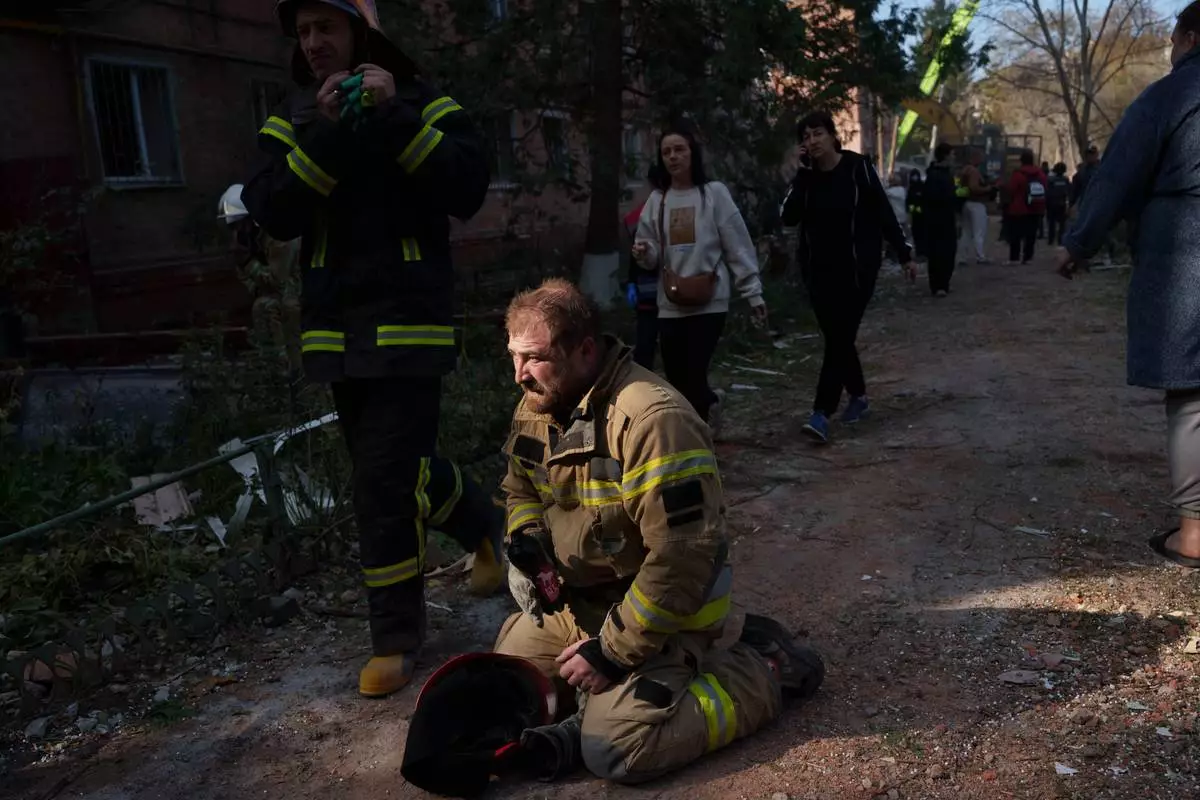
A rescue worker sits on the ground next to a residential building destroyed in a Russian missile strike on Pryluky, Ukraine, Wednesday, Oct. 7, 2026. (AP Photo/Evgeniy Maloletka)
KYIV, Ukraine (AP) — Ukraine’s advances in drone technology and tactics have captured the world’s attention. Despite those innovations, one problem has plagued the country since the start of Russia’s invasion: a shortage of combat-ready troops.
Ukraine always has been outmanned by Russia, but as the war drags through its fifth year, the need for personnel is increasingly acute, commanders and analysts say, with some units at only half strength. There just aren't enough forces to fully exploit the battlefield advantages resulting from the drone innovations.
“Based on the equipment and the number of people we have today, we barely have enough to hold the sector we currently have,” said a deputy commander of the Da Vinci Wolves battalion in eastern Ukraine's Pokrovsk area, a focus of Russia’s offensive.
“To move forward would inevitably mean greater losses,” said the deputy commander, who insisted on identifying himself only as “Afer” because of military rules.
Long-standing mobilization problems, including draft dodging and desertion, make it harder for Ukraine to build its reserves, according to military experts, resulting in only incremental changes along the 1,250-kilometer (775-mile) front line.
Ukraine needs to be able to commit forces quickly without taking them from elsewhere on the front. Otherwise, commanders have fewer options to turn a temporary advantage into a sustained operation, said Nick Reynolds of the U.K.-based Royal United Services Institute, a defense and security think tank.
The shortage means that units can't be rotated often enough, he said, “leading to exhaustion and, in turn, exacerbating casualties.”
The Defense Ministry, which in July underwent a shake-up by President Volodymyr Zelenskyy, is trying to tackle the problem with reforms to mobilization, training and the way the army is organized.
Uneven performance by front-line units worsens the problem. Weaker formations suffer heavier losses, creating a cycle of high attrition and constant replenishment.
The ministry did not respond to Associated Press requests for comment, but one of its officials summarized the problem by saying, “There just are not enough people.”
Developing a new mobilization policy, including encouraging deserters to return to duty, is among the most sensitive issues under consideration, said the official, who was not authorized to brief the media and spoke on condition of anonymity.
Former Defense Minister Mykhailo Fedorov, who was replaced by Yevhenii Khmara in the summer shake-up by Zelenskyy, had sought to reorganize the military around fewer but stronger units. He wanted to reinforce those that performed well and disband the weaker ones.
Khmara has said he wants to continue those changes.
But the reforms will take time. Yehor Cherniev, a member of parliament's defense committee, said lawmakers have yet to see mobilization initiatives.
In June, Fedorov introduced reforms to military contracts designed to make infantry service more attractive by offering higher salaries and fixed terms of service.
Convincing Ukrainians who have little incentive to fight is a major challenge after more than four years of war, and the country is struggling to recruit enough troops from its estimated population of 39 million.
The pool of men aged 25-60 is relatively small following years of demographic decline from war-related displacement and migration. There are about 6.8 million men aged 25-59, according to U.N. figures provided by Ukraine's National Health System, but that includes wounded veterans and men otherwise unable to serve.
Official figures put the military’s strength at about 1 million, with only a small fraction deployed at the front.
Compulsory service applies only to men. Women are allowed to volunteer, and those with medical or pharmaceutical training are required to register with the military. Over 70,000 women are serving in the army, according to Defense Ministry statistics in January 2025.
In March, Fedorov said about 2 million Ukrainian men were evading service, while about 200,000 soldiers had deserted or left their units without authorization. The penalty for desertion is imprisonment of up to 12 years.
Some men flee the country illegally or hide at home. Recruiters sometimes stop them on streets and trains, and those without valid exemptions are sent into the army. In January 2025, the government said about 950,000 men had deferments at the request of businesses.
Russia, with an estimated population of 143 million, also is struggling to fill its military ranks. It launched a widely unpopular partial mobilization of 300,000 reservists months after launching the invasion, and hundreds of thousands of men fled abroad. Since then, the Kremlin has relied on volunteers lured by relatively high pay and benefits to sustain its force of what President Vladimir Putin has said numbers about 700,000 men fighting in Ukraine.
Ukraine's problem is not so much a shortage of personnel but how they are managed and deployed, said military analyst Taras Chmut, who also heads Come Back Alive, a charity providing assistance to the army.
Increasing the number of personnel in the defense forces does not necessarily increase their effectiveness, Chmut said.
Exhaustion, poor organization, inadequate training and the lack of a clear end-of-service date drive recruits to desert, according to soldiers and military analysts.
The consequences are felt immediately at the front, with fewer troops to replace battered units or available for emergencies, and a diminished ability to divert forces when an opening appears. Drones can sometimes alleviate the shortages.
With replacements scarce, some troops have spent up to a year at the front with little opportunity for rotation, said Afer, the deputy commander of the Da Vinci Wolves battalion. His unit is operating at only about half its strength while its area of responsibility has doubled, he said, meaning the same number of forces must defend about twice the territory.
Ideally, at least twice as many men are needed simply to hold current positions, but that doesn't take into account that a constant reserve of troops is needed to replace casualties, he said.
It's also a struggle to find qualified specialists who can operate increasingly sophisticated equipment on the battlefield, Afer said, adding that troops “who know how to think” are in short supply.
Ukraine can conduct localized offensives but not enough to shift the broader battlefield balance, despite mounting Russian losses. Even so, it has retaken territory in several areas, including in operations near the eastern city of Lyman.
Pavlo Narozhnyi, a Ukrainian military analyst, said he did not consider manpower an insurmountable problem for simply holding the defensive line.
“We can do limited offensives,” he said, pointing to recent actions in the Dnipropetrovsk and Lyman areas, “but it’s relatively small.”
Russian forces have occupied roughly 990 square kilometers (about 380 square miles) of Ukrainian territory since the beginning of 2026, while Ukrainian forces have retaken about 820 square kilometers (316 square miles), according to figures cited by Zelenskyy, who added that Kyiv aims to bring those figures closer to parity by year's end.
But RUSI's Reynolds said there would not be fundamental changes to the broader battlefield balance, with the front line essentially remaining the same.
——
Associated Press reporter Volodymyr Yurchuk contributed.
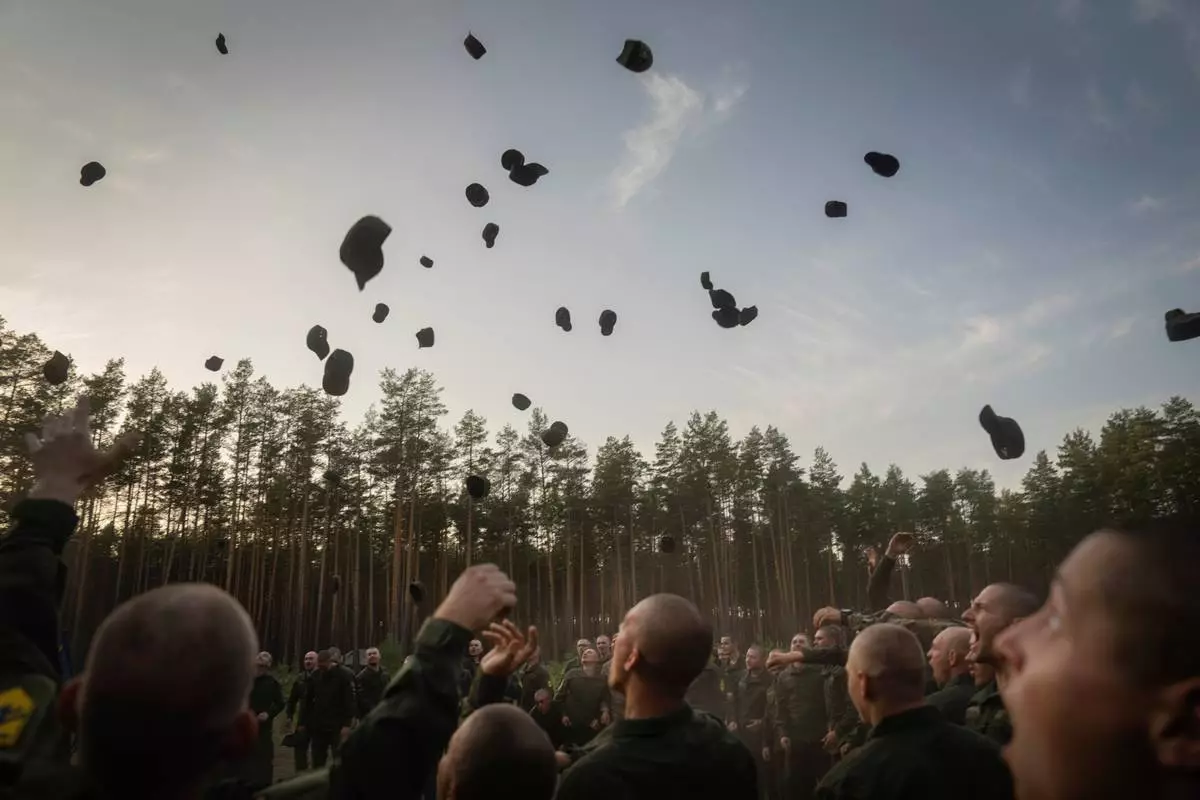
FILE - Newly recruited soldiers toss their hats as they celebrate the end of their training at a military base close to Kyiv, Ukraine, Monday, Sept. 25, 2023. (AP Photo/Efrem Lukatsky, File)
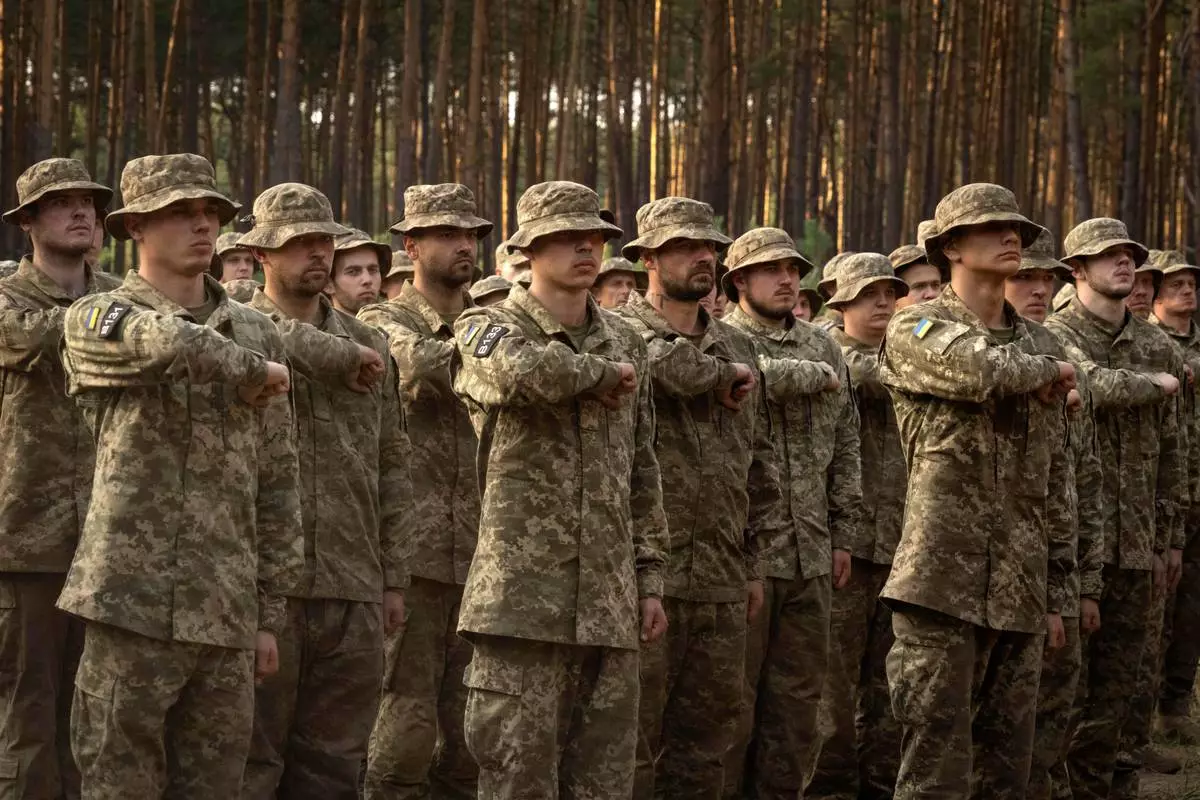
FILE - Newly recruited soldiers of Ukraine's 3rd Assault Brigade shout slogans at a military base close to Kyiv, Ukraine, Monday, Sept. 25, 2023. (AP Photo/Efrem Lukatsky, File)
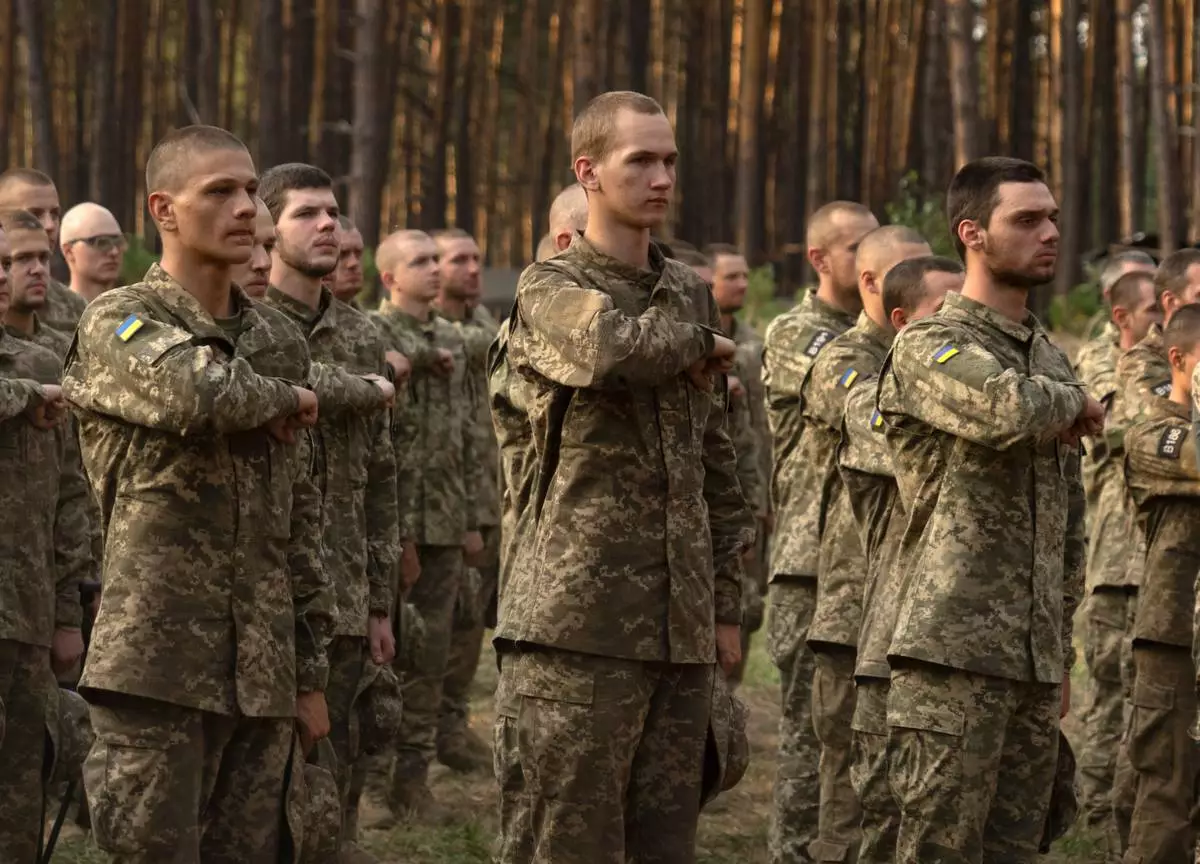
FILE - Newly recruited soldiers of Ukraine's 3rd Assault Brigade line up at a military base close to Kyiv, Ukraine, Monday, Sept. 25, 2023. (AP Photo/Efrem Lukatsky, File)
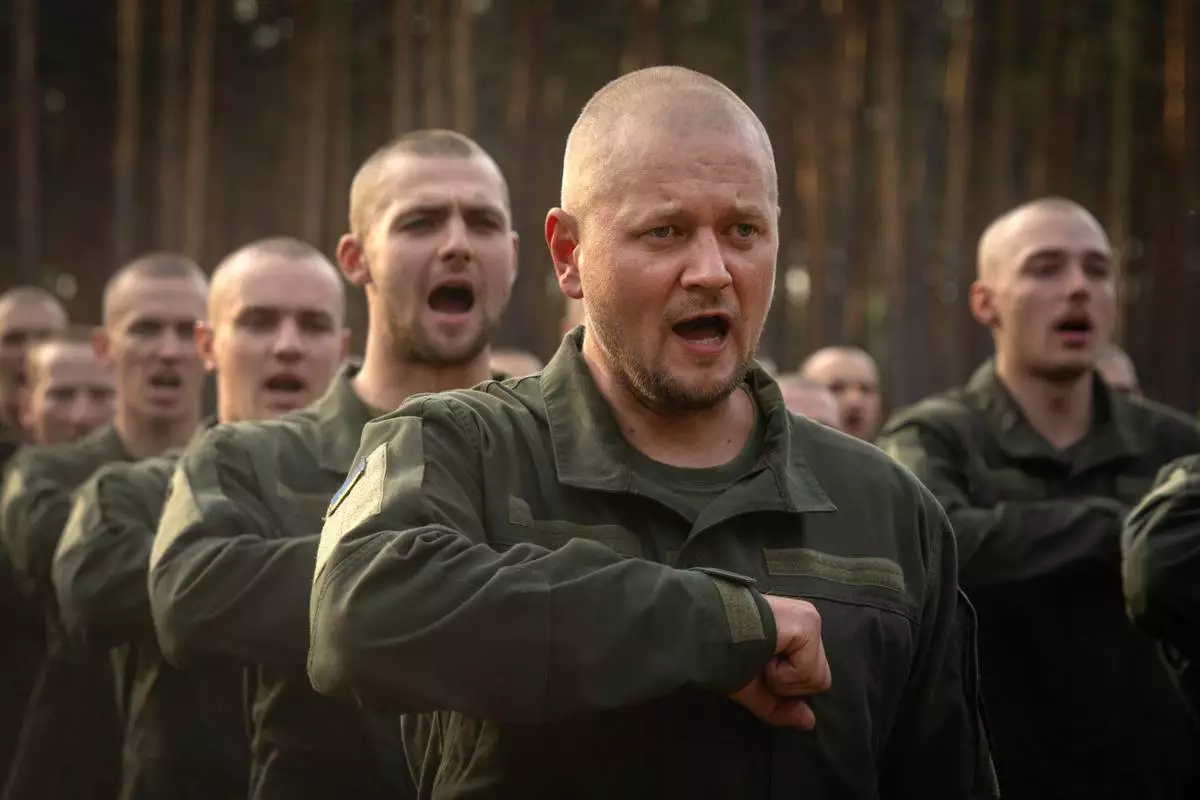
FILE - Newly recruited soldiers toss their hats as they celebrate the end of their training at a military base close to Kyiv, Ukraine, Monday, Sept. 25, 2023. (AP Photo/Efrem Lukatsky, File)