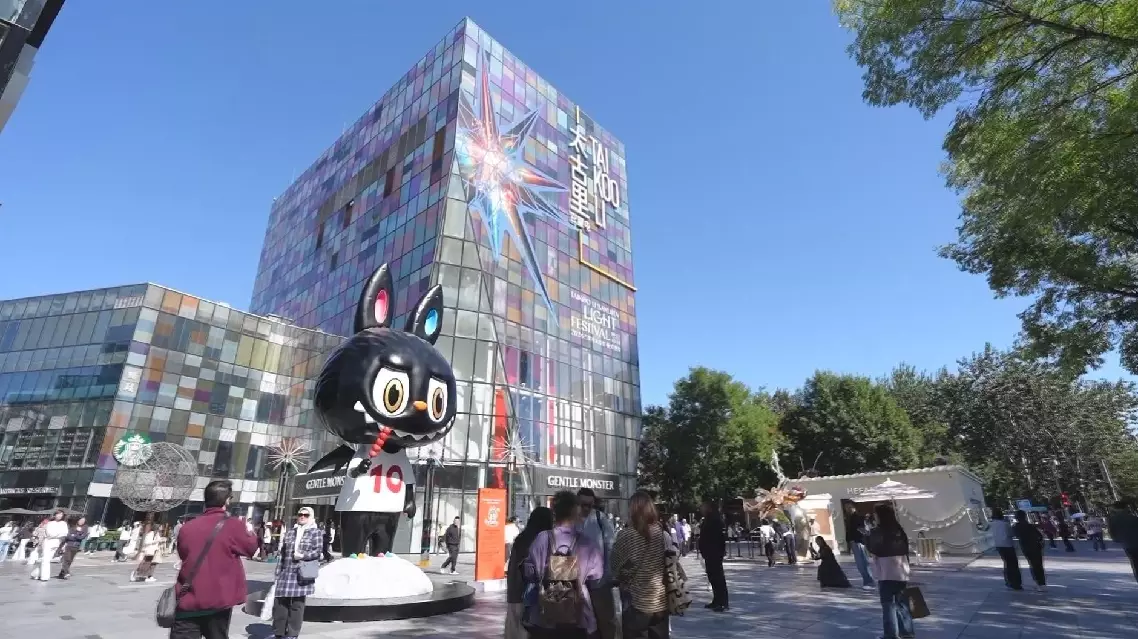
Sanlitun, an iconic commercial hub in Beijing and one of Beijing's most famous and vibrant districts, is transforming itself from a trendsetter into a global center for commerce, culture and youth exchange.
As a magnet for young people, global brands and international visitors, the neighborhood is looking beyond fashion and retail, seeking to become a place where business and culture can thrive side by side.
"Since 2022, we have upgraded Sanlitun Road with the vision of creating an international-style boulevard. A dedicated pedestrian system now gives people more space to slow down, sit and stay, making the streets part of the experience, rather than simply a way to get from one place to another," said Sun Shuguang, Party secretary of the Sanlitun Subdistrict.
The spirit of urban renewal is also taking shape in the neighborhood's landmarks and public spaces, with creative structures installed along the famous pedestrian street.
"We call it the 'Gift Box,' a new landmark in Sanlitun. Designed like a giant present, it captures the spirit of a neighborhood that is always changing. Today, it features trendy collectibles and Sally, the digital avatar of Sanlitun's international volunteer team. And the idea is simple: every time you come back, there's something new to discover," Sun said.
With embassies and international communities nearby, Sanlitun also has a distinctly global character. It has established an exchange center to bring young international talent together.
"With more than 30,000 people working here and around 70,000 daily visitors from around the world, Sanlitun is naturally a place for international exchange. Since this international youth exchange space was established, it has hosted around 120 events a year, creating opportunities for international talent to connect, exchange ideas and collaborate," Sun said.
And in the same building, another space is opening a window onto China's traditional culture.
"As an international window for cultural exchange, Sanlitun has a role to play in promoting traditional Chinese culture. Last year, we opened a new space showcasing China's intangible cultural heritage. It brings together international visitors and embassy communities, giving them opportunities to experience traditional craftsmanship firsthand. It is becoming a platform for sharing China's cultural stories with the world," Sun said.
For Sun, all these efforts point to one bigger idea: making Sanlitun a place where people can pursue their own possibilities.
"Sanlitun may cover just 2.9 square kilometers, but the energy and possibilities it carries are limitless. It is a place where people can plant the seeds of their dreams, nurture them with their own ideas and hard work, and turn those dreams into tangible goals," he said.
Beijing's Sanlitun evolves into global hub for youth, culture through urban renewal
As cities around the world look for faster ways to respond to residents, locals in London have been sharing their experiences with Britain's public services -- along with their questions about how China handles citizens' grievances, ahead of the 2026 Beijing Forum on Swift Response to Public Complaints.
The event will be held on Oct. 12 and 13 in the Chinese capital under the core concept of "People's City, Better Life," focusing on the modernization of digital and intelligent technologies in cities and the empowerment of urban governance. More than 3,200 participants are expected to attend, including over 240 international guests from more than 70 countries and regions.
In the run-up to the forum, a reporter for the China Global Television Network (CGTN) hit the streets of London to hear what local residents think about public services, and what they want to know about China's system for handling public complaints.
Some residents said they have used the UK's emergency hotline 999 and the National Health Service's non-emergency helpline 111, and found the public service websites fairly easy to use and navigate.
"I'm a citizen of Camden Council, so I have used Camden Council a lot for any of the issues that I had, especially in my buildings. I have used services like 999, 111, and they've all been really great, to be honest. I haven't had many issues with the public sector in terms of any questions or support that I needed," said Ikram Bride, a fundraiser.
Marissa Gupta, a branch manager, said she regularly uses the website of her local council in Cornwall, in southwest England, to report problems in her area.
"I live in Cornwall and, as most people around the country, we've had a lot of potholes and so I often go on the Cornwall Council website and report the potholes. I found that the websites are good and you get a lot of feedback from them. Emails to say what the process is, what point of the process it's in. And also asking for feedback to find out how you found that service, so I found those really good," said Gupta.
However, not all the feedback was positive, with some finding that help could be slow to arrive.
"I've used 999 to ask for help for my grandparents. Sometimes it's not effective because they can take long in case of emergencies. It was fairly easy to use and navigate, but they did take a while to respond," said Emily Carter, a student.
The residents were also asked about Beijing's "Swift Response to Public Complaints" mechanism, with many expressing a keen interest in it.
"I would love to know more about the way in which they work," said Bride.
"I'd like to know if citizens can track their complaints and see if action has been taken upon it," said Carter.
Others were curious about the technology behind China's public service system, including whether artificial intelligence is used.
"Does the government use artificial intelligence to analyze citizens' data and information?" asked Justine Barton, an office worker.

Londoners eye China's public services ahead of Beijing forum on swift response to public complaints