ARLINGTON, Texas (AP) — Jerry Jones had his fingers entwined in front of him as he glanced up toward the big video board with a concerned look on his face. Right after his Dallas Cowboys fell behind against winless Tampa Bay, Dak Prescott threw an interception.
Things were just starting to really unravel for the Cowboys, and the owner's expression would only get more bleak, even though they had a chance late to escape without a loss.
Click to Gallery
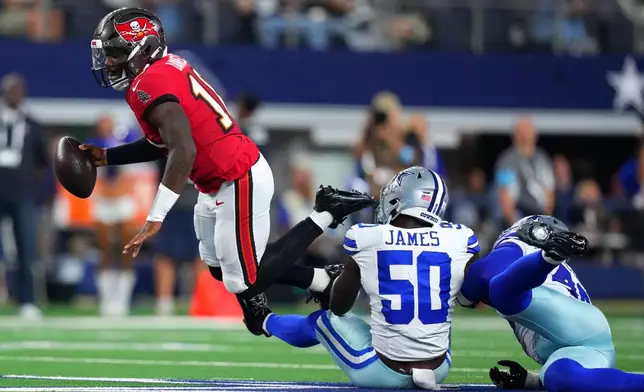
Tampa Bay Buccaneers quarterback Jalon Daniels (10) is sacked by Dallas Cowboys linebackers Shemar James (50) and Von Miller (40) in the first half of an NFL football game in Arlington, Texas on Thursday, Oct. 8, 2026. (AP Photo/Julio Cortez)
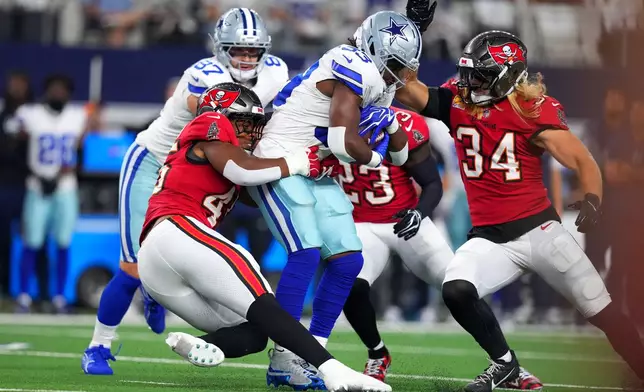
Tampa Bay Buccaneers linebacker Josiah Trotter (45) stops Dallas Cowboys running back Javonte Williams (33) in the first half of an NFL football game in Arlington, Texas on Thursday, Oct. 8, 2026. (AP Photo/Julio Cortez)
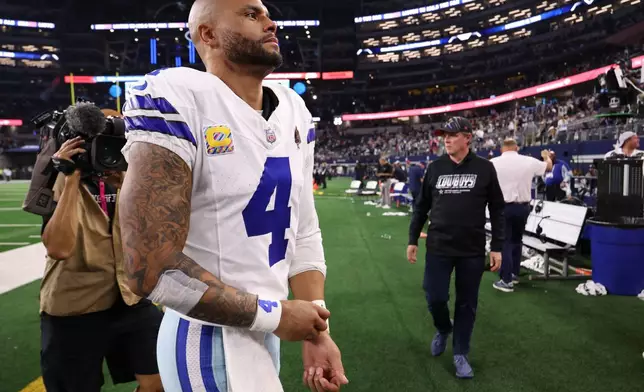
Dallas Cowboys quarterback Dak Prescott (4) leaves the field after a loss to the Tampa Bay Buccaneers in an NFL football game in Arlington, Texas on Thursday, Oct. 8, 2026. (AP Photo/Sam Hodde)
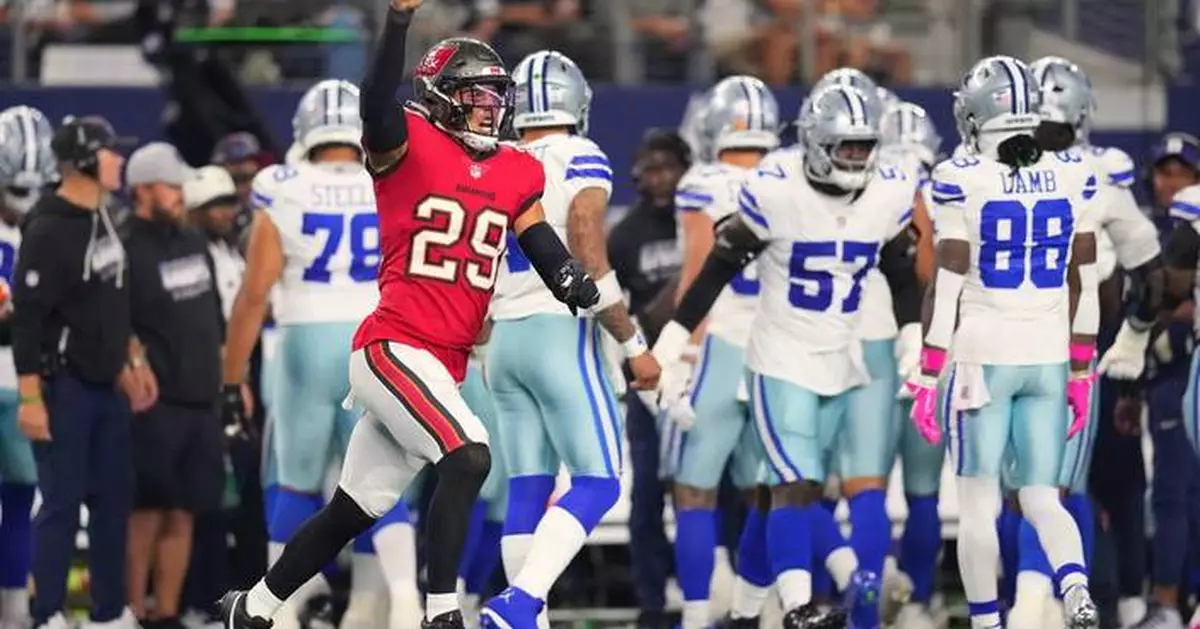
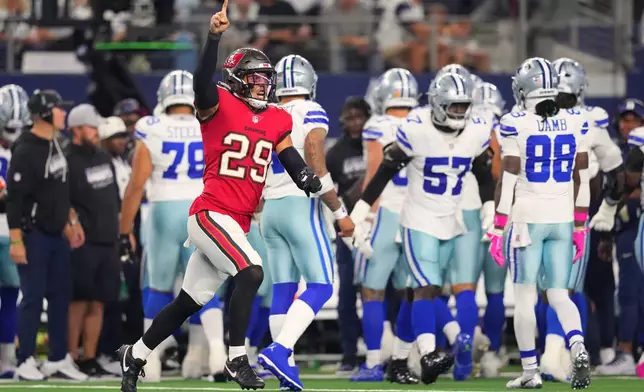
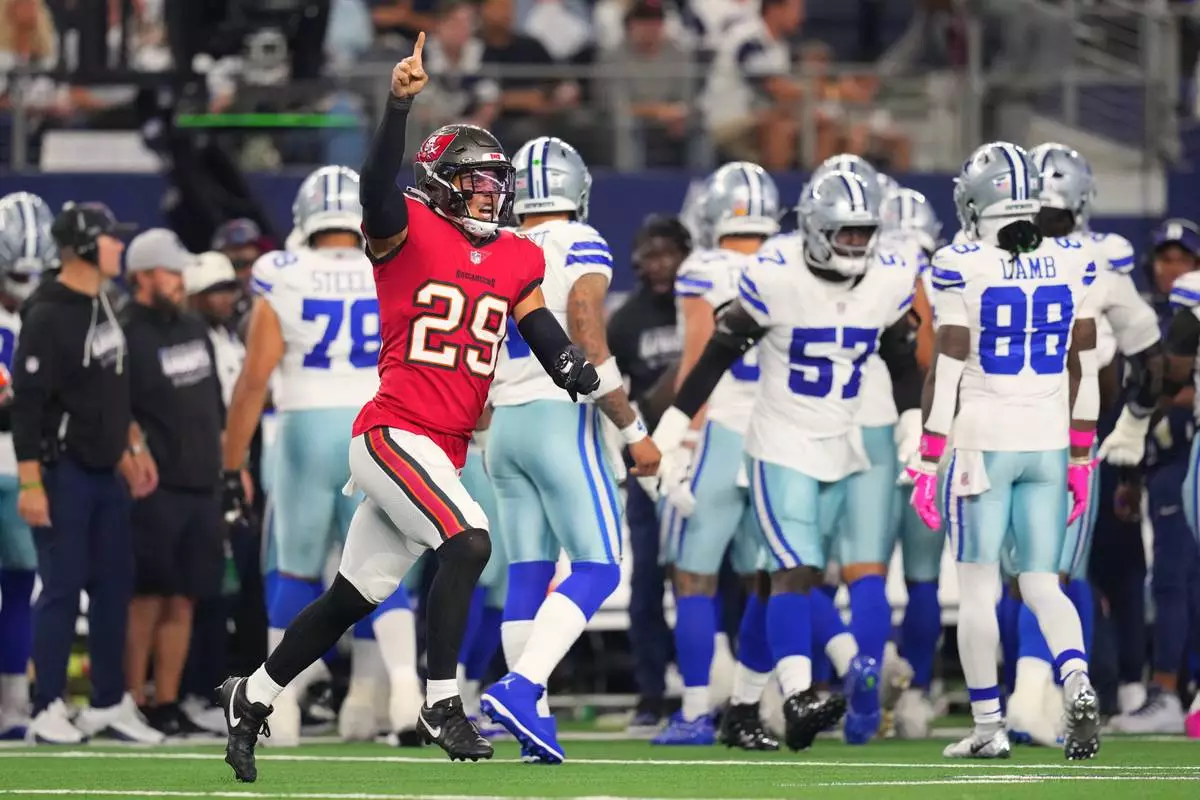
Tampa Bay Buccaneers safety Miles Killebrew (29) celebrates after the Buccaneers recovered a fumbled kickoff return by the Dallas Cowboys in the second half of an NFL football game in Arlington, Texas on Thursday, Oct. 8, 2026. (AP Photo/Julio Cortez)
The Cowboys (2-3) fell 24-16 on Thursday night to a Bucs team with undrafted rookie quarterback Jalon Daniels filling in for the injured Baker Mayfield.
“Extraordinarily, extraordinarily disappointed,” team owner Jones said afterward. “You really do need to get it done when it’s there to take.”
Prescott had another interception with 1:16 left when his throw deflected off reliable tight end Jake Ferguson's hands at the Bucs 12.
Playing at home for the only time in October, and in primetime for all to see, this was a chance for the Cowboys to build some momentum in the NFC East. And the opportunity for a second win in five days against another winless team before a bit of a break.
Instead, there will only be more questions before they play again after a nine-day gap between games.
“You wanna get right back to it, but it’s good to dwell on things sometimes,” Prescott said. “To really make the changes or make the adjustments that we need to for the better of our team, for the better of the offense, for the better of the individuals. ... Be accountable to yourself, to your unit, to your position group, and let’s push forward.”
The Cowboys play Oct. 18 at Green Bay, then go to Philadelphia before playing at home again Nov. 1 against Arizona.
“This isn’t fold the tents here. We are 2-3. We didn’t expect to be 2-3,” Jones said. “We didn’t expect this. ...We didn’t expect this Tampa team to come in here 0-4, either.”
The Bucs (1-4), whose touchdown before halftime was a 15-play drive that took just shy of 11 minutes, started must faster after the break. They went ahead to stay on two big runs that took only a minute. Bucky Irving ran for 72 yards, immediately followed by Emeka Egbuka's 14-yard TD run that gave them a 14-10 lead.
Then came the first pick by Prescott deep in Tampa Bay territory, and Irving added a 1-yard TD run before KaVontae Turpin fumbled the ensuing kickoff return. The Bucs then converted a third-and-21 on the drive that ended with Chase McLaughlin's 41-yard field for a 24-10 lead.
The Cowboys played their third game in 12 days, a stretch that began with 10-hour flights to and from Rio de Janeiro, where they lost 34-31 to Baltimore after the Ravens got a big play and game-ending field goal in the final 7 seconds.
Dallas rebounded last Sunday with a 34-30 victory at winless Houston, when CeeDee Lamb capped his career-high 17 catches for 189 yards with a 12-yard TD in the final minute.
But Lamb had only two catches for 9 yards against the Bucs before getting sidelined by a quad injury.
After Tampa Bay bypassed a field goal chance and was stopped on fourth-and-goal from the 1 with 8 1/2 minutes left, the Cowboys went 99 yards in 10 plays for Prescott's 18-yard TD to George Pickens before they failed on a 2-point conversion.
Dallas got a defensive stop with just under four minutes left, though on the third-down incompletion cornerback DaRon Bland had his hands on what could have been an easy pick-6. He had an NFL-record five interception returns for TDs in 2023.
That still gave Prescott and the Cowboys another chance, which ended with his late interception.
"We’ve got to trust the work that we’re putting in and then more importantly, we’ve got to come out and just execute better,” Prescott said. “I think our plan, the way we practice, the way we approach things is the right way, is the correct way. We’ve just got to come up in the games and execute better and get it done.”
See AP’s full NFL coverage here
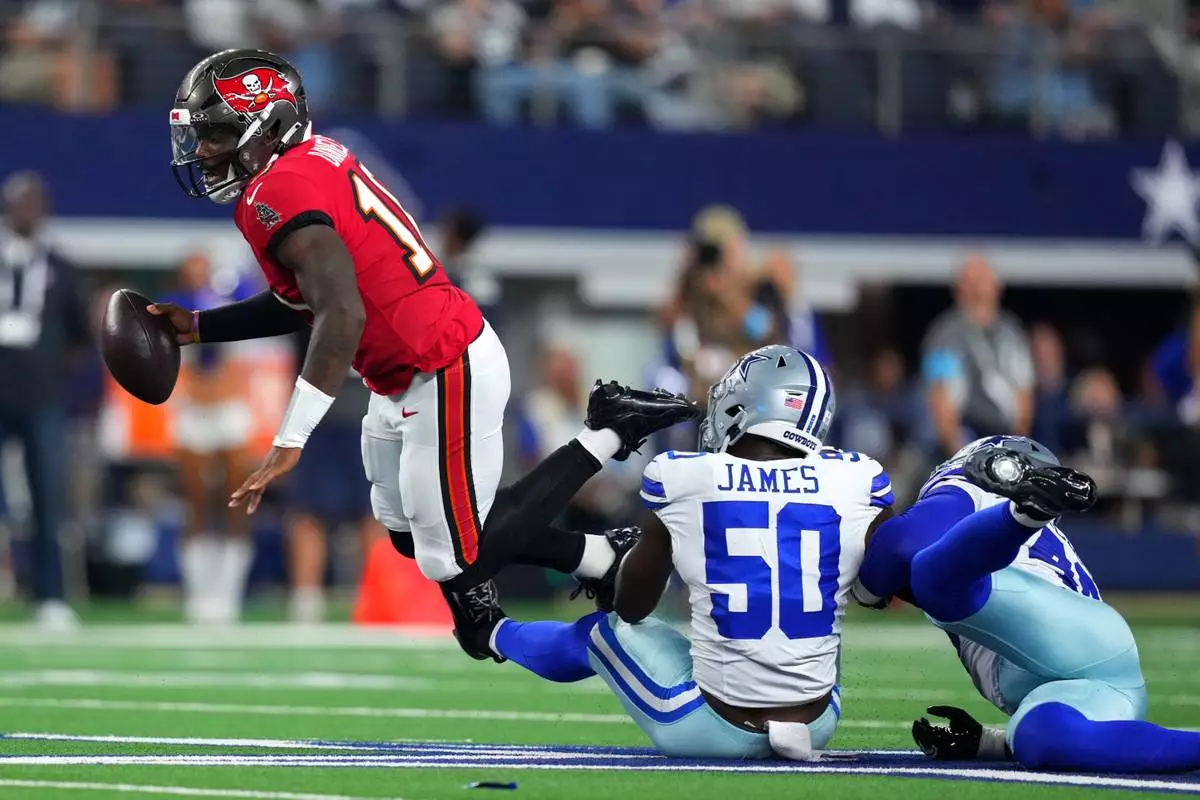
Tampa Bay Buccaneers quarterback Jalon Daniels (10) is sacked by Dallas Cowboys linebackers Shemar James (50) and Von Miller (40) in the first half of an NFL football game in Arlington, Texas on Thursday, Oct. 8, 2026. (AP Photo/Julio Cortez)
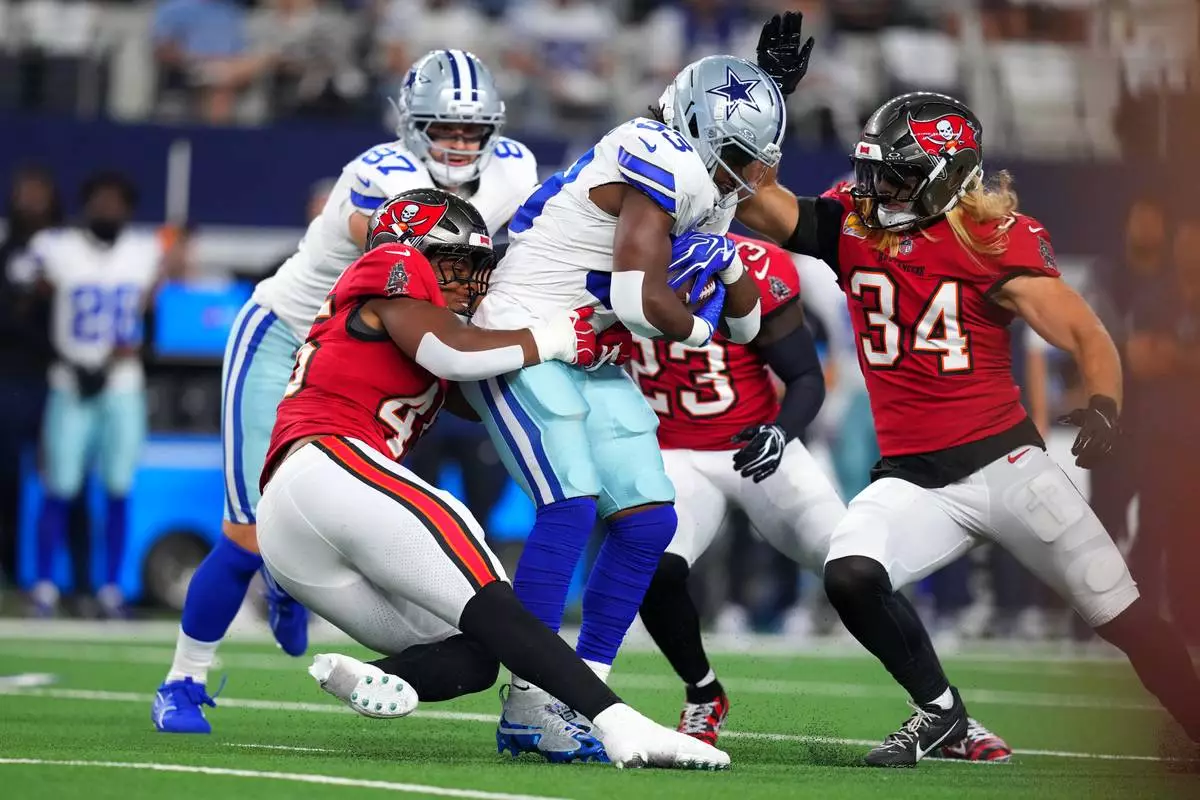
Tampa Bay Buccaneers linebacker Josiah Trotter (45) stops Dallas Cowboys running back Javonte Williams (33) in the first half of an NFL football game in Arlington, Texas on Thursday, Oct. 8, 2026. (AP Photo/Julio Cortez)
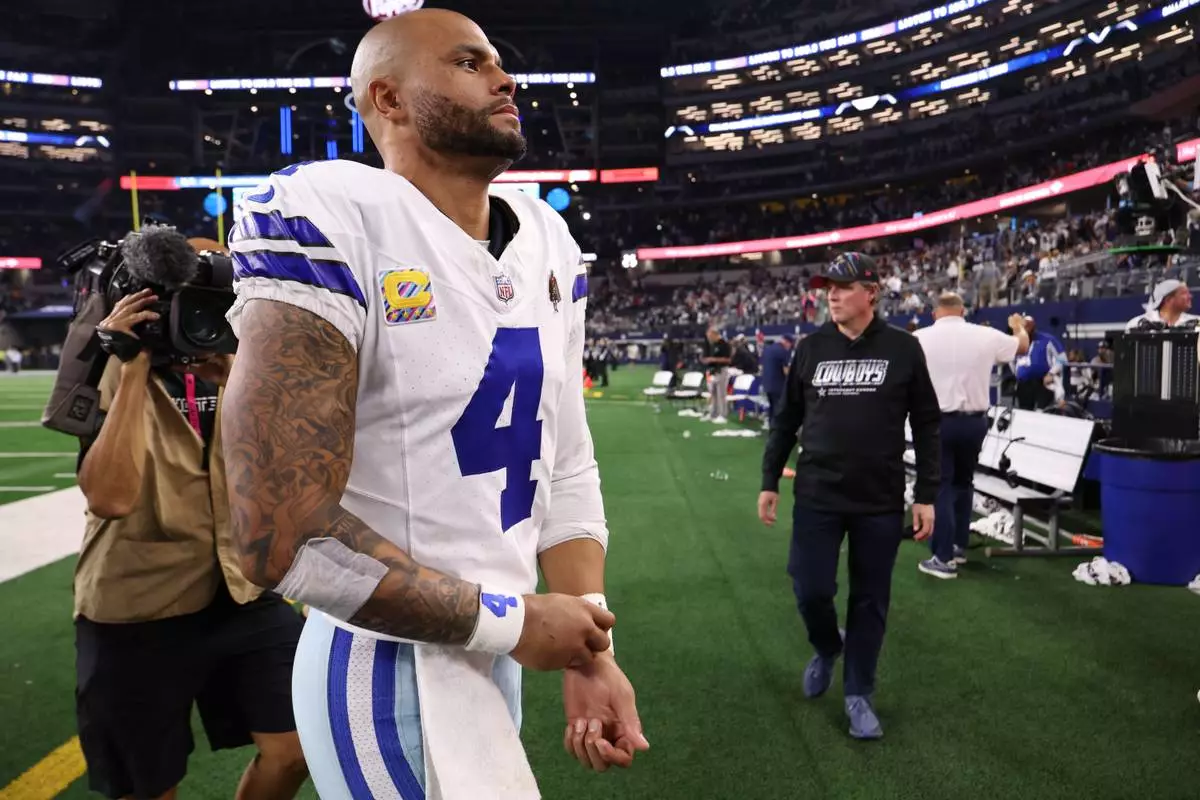
Dallas Cowboys quarterback Dak Prescott (4) leaves the field after a loss to the Tampa Bay Buccaneers in an NFL football game in Arlington, Texas on Thursday, Oct. 8, 2026. (AP Photo/Sam Hodde)
Tampa Bay Buccaneers safety Miles Killebrew (29) celebrates after the Buccaneers recovered a fumbled kickoff return by the Dallas Cowboys in the second half of an NFL football game in Arlington, Texas on Thursday, Oct. 8, 2026. (AP Photo/Julio Cortez)
A U.S. charity in Gaza is worried that teachers at its schools might stray from a curriculum it says promotes peace and tolerance, so it plans to record classroom conversations and use artificial intelligence to flag speech deemed “hateful” or “inciting.”
The plans laid out by the founder of the Gaza Children Village in a webinar last month have elicited ethical, safety and privacy concerns from some Palestinian and advocacy groups and at least one of the charity's partners.
There is no indication the charity intends to share its classrooms’ recordings with anybody else, but fears about the potential misuse of surveillance technology are heightened in Gaza after three years of war. The Israeli military has used AI to sift through intercepted communications and find suspicious speech, including to identify targets for strikes.
Palestinian rights groups have been critical of the charity's education agenda more broadly, saying it is unaccountable to local and U.N. agencies that have long managed Gaza’s schools. Who controls education in Gaza is one of many unresolved questions about its postwar governance.
It is unclear when the classroom monitoring is supposed to begin, what specific language will be flagged, and whether teachers, students and their families have been told about the plans.
The charity's founder and CEO is Dr. David Hasan, a neurosurgeon born in Kuwait to Palestinian parents who now teaches at Duke University medical school in Durham, North Carolina.
He conceived the idea for the charity after volunteering at hospitals in Gaza during the war and wanting to end generations of violence between Palestinians and Israelis. Hasan says he was taught at an early age to look unfavorably upon Jews and Israelis, and that it wasn’t until he attended college in the U.S. that he learned other perspectives; he wants kids in Gaza to gain these perspectives early in life.
The charity has raised money largely from individual donors, including American Jews, and says it's partnering with North American, Israeli and European aid organizations and hospitals. Its schools, called Academies of Hope, provide meals and medical and psychological care. The first school opened last summer.
The schools' lessons are mostly built around the Palestinian Authority curriculum, but language that he says glorified violence or encouraged anti-Israel or antisemitic beliefs was removed, Hasan has said.
Hasan declined to comment for this story or provide examples of curriculum changes. But a 2026 report by the U.S. Government Accountability Office that examined “problematic textbook content” flagged by the U.N. in Gaza identified the kinds of issues that Israel has long complained about: the use of “the number of martyrs” to teach a mathematical concept, a reference to “Jerusalem as the capital of Palestine,” and a description of a boy shot while demonstrating in support of Palestinians held in Israeli prisons.
On a webinar last month with humanitarian groups, Hasan said the reason to monitor classrooms is to help train teachers in how to uphold a curriculum that he had previously said was aimed at “de-radicalization.”
“I know it’s controversial, but trust me, it’s the only way we feel for us to survive and deliver this curriculum,” Hasan said.
This isn’t the first organization to face such difficulties. The U.N. agency for Palestinian refugees, UNRWA, has attempted to modify the PA curriculum to remove content that didn't align with values of neutrality, nonviolence and nondiscrimination; but it, too, was met with teacher and community resistance, according to the GAO report.
A Gaza Children Village staffer said some teachers and other employees are afraid of being questioned by Hamas about the curriculum or uncomfortable working for an organization supported by Israeli aid groups. The staffer spoke on condition of anonymity because they were not authorized to speak to the media.
Two people affiliated with the charity expressed concerns when notified about the possibility of classroom monitoring.
“Cameras to monitor the performance of students and teachers is acceptable. But cameras to silence students and teachers from being able to have a free exchange in a classroom are not acceptable,” said Bishara Bahbah, a Palestinian American political activist on the charity's board. He said he wasn't aware of the monitoring plans and that they haven't been raised with the board.
Bahbah said that with so few functioning schools in Gaza, the charity's top priority is getting more kids in classrooms.
An official at an aid group that partners with the Gaza Children Village said the use of cameras could prompt it to reconsider working with them. Using AI to monitor people’s words opens a “Pandora’s box,” said the official, who spoke on condition of anonymity for fear of jeopardizing the group's work in Gaza.
Six current and former teachers at Academies of Hope declined to comment.
UNICEF estimates that hundreds of thousands of children in Gaza are not in school, and that most schools were destroyed or damaged during the war. The Gaza Children Village says its schools in central and southern Gaza serve thousands of children, many of whom lost parents or other relatives during the war.
Under the plans outlined by Hasan in various communications, recordings of classroom conversations will be analyzed by an AI-powered system to detect “antisemitic,” “inciting" or “hateful” language.
If problematic language is detected, a warning will be sent to Hasan, who can then contact the teacher to understand the context and provide feedback, Hasan said in the September webinar. He said recordings are stored for 72 hours.
The monitoring technology has been tested and the plan is to deploy it in dozens of classrooms, according to a text message Hasan sent sometime before August that was seen by The Associated Press.
In the text, Hasan said the system was created in collaboration with PollyLabs, a New York-based nonprofit that promotes the use of technology to solve problems in crises. PollyLabs says it has had no role in developing or deploying such technology.
Fears about surveillance technology are strong in Gaza after three years of war with Israel's high-tech army.
"Israel has weaponized information to such a dystopian degree that many Palestinians feel they cannot utter a word, type a thought, or twitch an eye without fearing it could be seized upon,” said Amjad Iraqi, senior Israel and Palestinian Territories analyst for the International Crisis Group.
Groups opposed to the charity's curriculum say Palestinians are being stripped of their autonomy in deciding what to teach their children.
“It is very concerning, they’re trying to control the minds of new generations,” said Ines Abdel Razek, co-director of the Palestine Institute for Public Diplomacy, an advocacy group.
The Palestinian Authority, which has limited autonomy in parts of the Israeli-occupied West Bank, and UNRWA should be supported in rebuilding schools in Gaza, she said. Israel has accused UNRWA of being infiltrated by Hamas, a charge the agency denies.
A Palestinian government spokesperson, Mohammad AbuAlrob, says the PA curriculum focuses on tolerance and justice. He said he doesn’t have enough information about the charity's curriculum to comment on it. But he said using surveillance in classrooms would cross “an important line.”
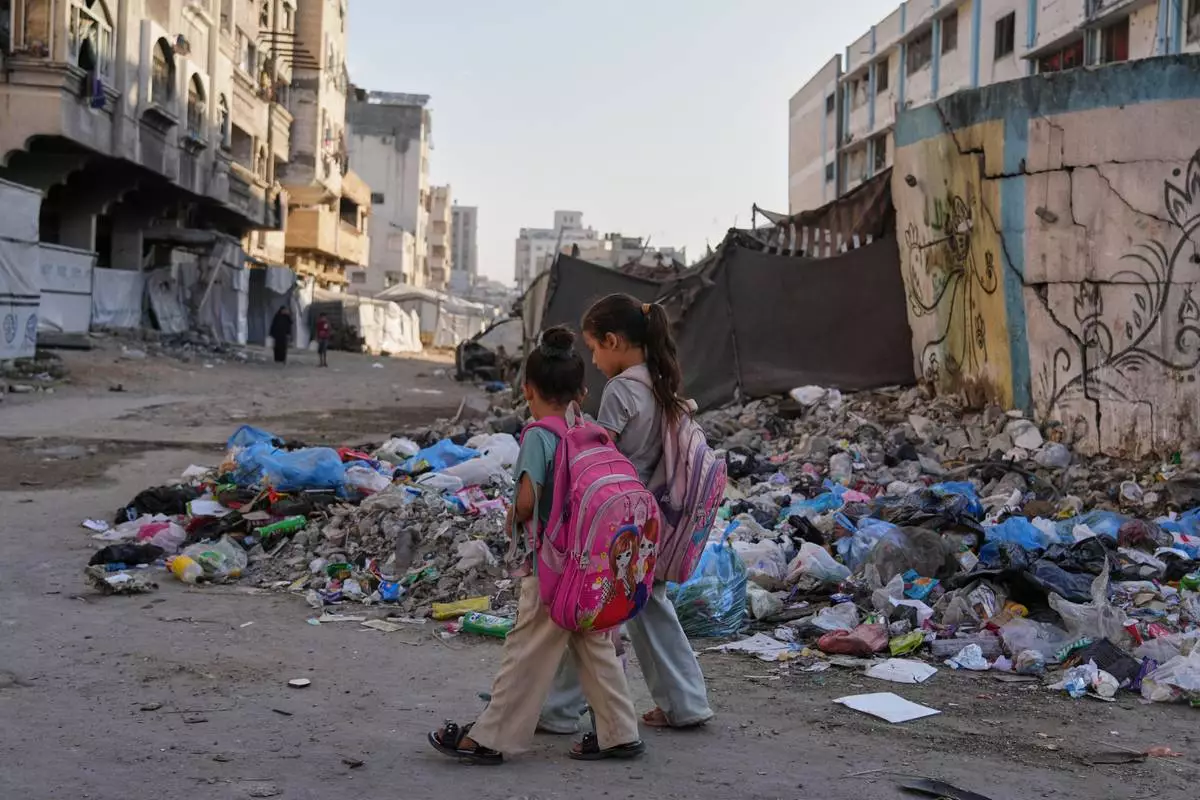
Young Palestinian students make their way to school in Gaza City, Monday, Sept. 28, 2026. (AP Photo/Jehad Alshrafi)
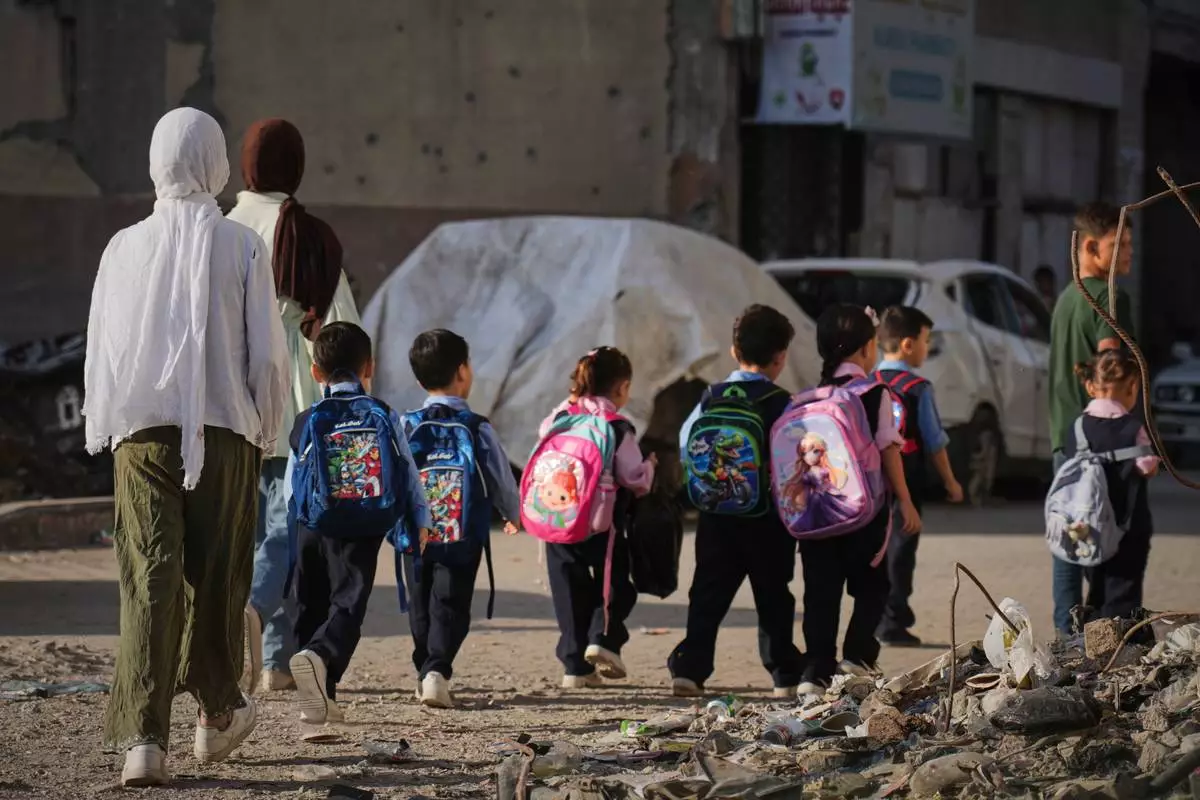
Young Palestinian students make their way to school in Gaza City, Monday, Sept. 28, 2026. (AP Photo/Jehad Alshrafi)