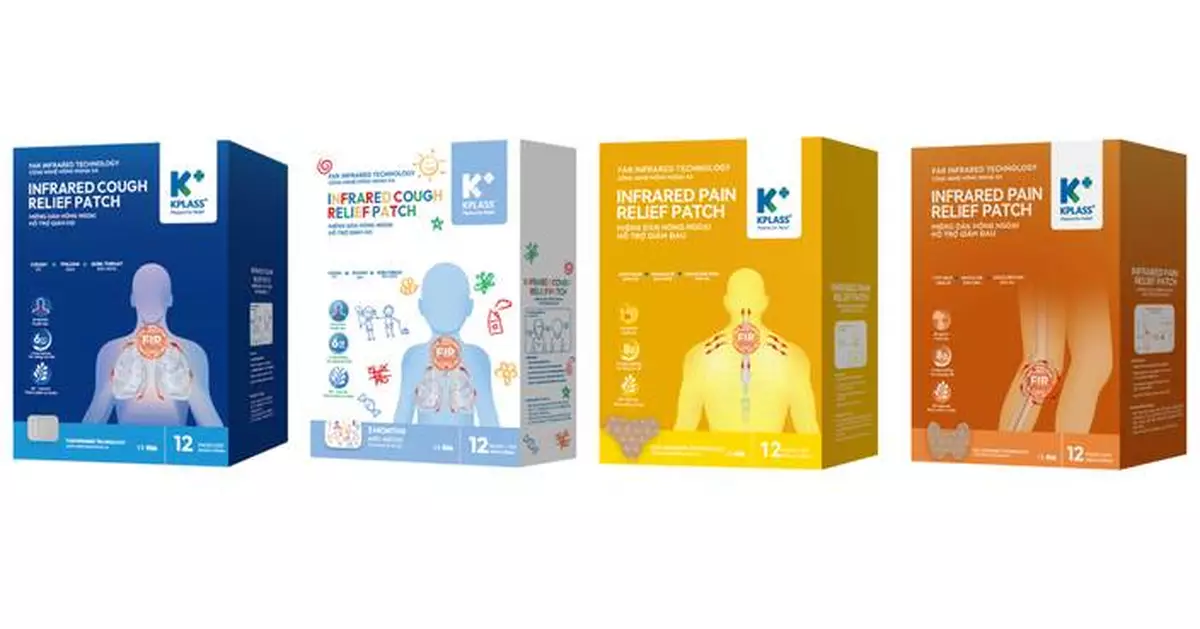
Combining far-infrared (FIR) technology with traditional medicine acupoint principles, KPLASS introduces convenient, drug-free and non-invasive wellness solutions for Vietnamese families.
VIETNAM – Media OutReach Newswire – 9 October 2026 – KPLASS, a Singapore-based brand specialising in far-infrared relief patches, has officially entered the Vietnamese market through its exclusive distributor, SAV Trading Joint Stock Company. The launch marks another milestone in KPLASS's expansion across the Asia-Pacific region, offering Vietnamese consumers greater access to convenient wellness solutions powered by modern technology.
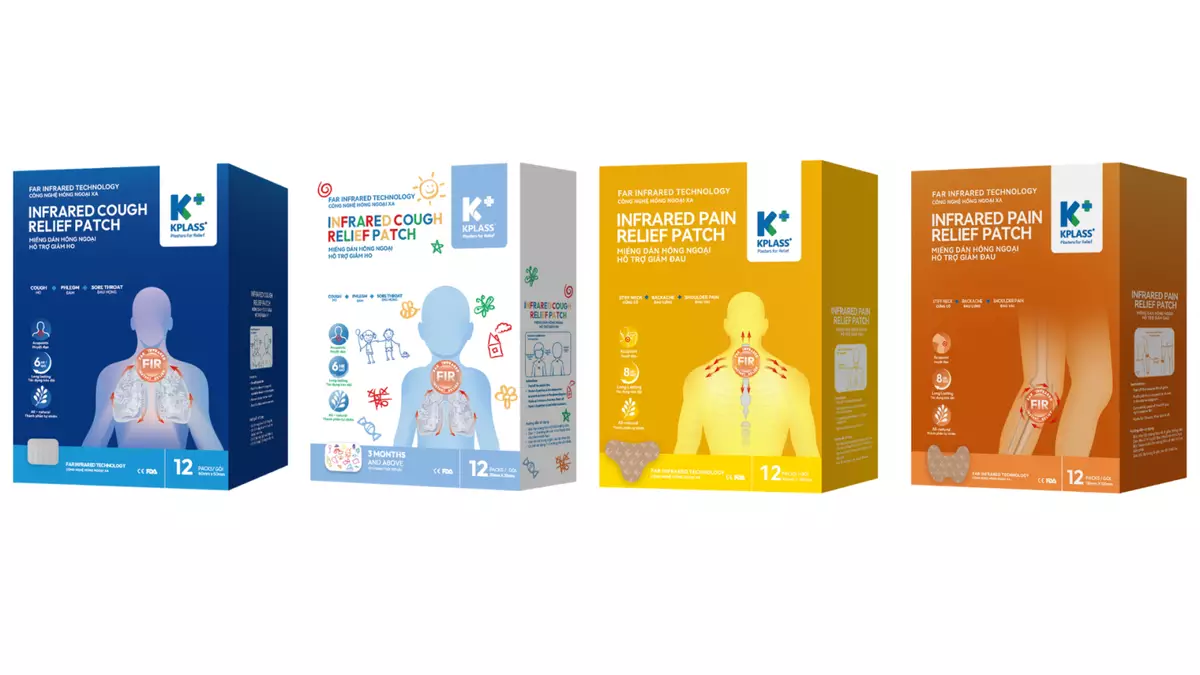
(left to right) Far-Infrared Cough Relief Patch (Adult), Far-Infrared Cough Relief Patch (Child), Far-Infrared Pain Relief Patch (Neck and Shoulder) and Far-Infrared Pain Relief Patch (Joint and Muscles).
Far-infrared technology meets acupoint therapy: A wellness solution from Singapore
KPLASS distinguishes itself through its combination of far-infrared (FIR) technology and the principles of acupoint stimulation in traditional medicine. By applying FIR technology at selected acupoints, KPLASS products are designed to help alleviate common discomforts, including cough symptoms, neck and shoulder pain, and muscle and joint aches.
Unlike conventional heat pads that provide surface warmth, Far Infrared rays penetrate deeper layers of the skin and help in blood circulation and other bodily functions. When applied to acupoints, the patch is activated to emit gentle heat through the acupoints that could improve blood flow, reduce inflammation and provide relief from through a non-invasive method.
Compact, easy to use, drug-free and non-invasive, KPLASS patches offer a flexible approach to everyday wellness that complements modern lifestyles.
Four KPLASS product lines make their debut in Vietnam
At its Vietnam launch, KPLASS is introducing four far-infrared patch product lines developed to address the wellness needs of different family members:
- Far-Infrared Cough Relief Patch (Adult)
- Far-Infrared Cough Relief Patch (Child)
- Far-Infrared Pain Relief Patch (Neck and Shoulder)
- Far-Infrared Pain Relief Patch (Joint and Muscles)
Beyond the four product lines making their debut in Vietnam, KPLASS plans to further expand its portfolio with additional products featuring advanced infrared technology. The company aims to address a broader range of wellness needs and deliver practical, convenient solutions for Vietnamese families.
A Singapore brand backed by 25 years of research and development
Building on its parent company's 25 years of experience in research, development and manufacturing, KPLASS has achieved several notable milestones in international markets. These include recognition as the Best-Selling Cough Patch at Watsons Singapore in 2022, 2024, 2025 and 2026, as well as the Best Seller Award from Guardian Singapore and Unity in 2026.
At Osaka World Expo 2025, KPLASS received further three honours: the Special Honour Product and Innovative Product Award, Distinguished Manufacturer Award and Outstanding Contribution Award. These accolades mark important milestones in the brand's development and reflect its continued commitment to innovation and technology-driven wellness solutions.
Michael Hu, Founder and CEO of KPLASS Singapore, said:
SAV appointed exclusive distributor of KPLASS in Vietnam
Through its partnership with SAV Trading Joint Stock Company, KPLASS is progressively building its authorised distribution network in Vietnam. Its far-infrared patch products will reach consumers through pharmacies, mother-and-baby stores, e-commerce platforms and other retail channels.
KPLASS's entry into Vietnam broadens the range of technology-enabled wellness products available to consumers, helping meet the evolving needs of Vietnamese families.
For more information about KPLASS and its products, visit www.kplass.sg.
Hashtag: #KPLASS #FarInfrared #Technology #Health
http://www.kplass.sg
Press Kit: https://drive.google.com/drive/folders/1veLGRK3K1Z7x2FzKAsmbXsLBPKPCD6M7?usp=sharing
The issuer is solely responsible for the content of this announcement.
About KPLASS
KPLASS is a Singapore brand using leading edge of technology and healthcare innovation to alleviate daily body discomforts. It uses the Far Infrared technology, which is natural, safe and effective that helps to relieve the cough symptoms and various body pains. Backed by 25 years of R&D and manufacturing competency of its parent company, the marketing and offering are differentiated by combined Infrared technology and TCM Acupoints in everyday health care solutions that is drug free, non-invasive and thus convenient and user-friendly. Bring home the Infrared treatment at your comfort and convenience.
** This press release is distributed by Media OutReach Newswire through automated distribution system, for which the client assumes full responsibility. **
HONG KONG SAR – Media OutReach Newswire – 25 November 2026 – Kaspersky Principal Security Researcher Vladimir Dashchenko recently published findings indicating that when we think about cyberattacks, we usually imagine stolen information, ransomware or financial losses. Few people immediately think of supermarket refrigerators, or other cooling equipment. Yet recent cyberattacks against refrigeration systems across Europe have demonstrated that even ordinary cooling equipment can become a target for cybercriminals, with consequences extending far beyond spoiled food.
These incidents highlight a broader problem: the expanding attack surface of the Internet of Things (IoT) and industrial control systems (ICS).
Modern refrigeration systems are typical cyber-physical systems, and many belong to the Industrial Internet of Things (IIoT). Commercial refrigerators and cold-storage installations often contain connected sensors, programmable controllers, and centralized management platforms. These allow operators to monitor temperatures, initiate defrost cycles, receive alarms and modify settings remotely.
While convenient, such functionality also creates opportunities for attackers. Unauthorized access to a refrigeration management platform could allow someone to manipulate temperatures, disable alarms or disrupt multiple connected units simultaneously.
Kaspersky's latest IoT threat statistics demonstrate why these risks deserve attention. To monitor attacker activity, Kaspersky uses specially designed systems that imitate vulnerable internet-connected devices and record attempts to attack them. In Q3 2026, the proportion of unique devices attempting to gain unauthorized access through SSH, a communication protocol commonly used to remotely manage connected equipment, increased from 14.42% in Q2 to 18.42%. More notably, the share of attack sessions using this method more than doubled, rising from 1.95% to 4.21%. Although another remote communication protocol, Telnet, remained the most frequently targeted, these figures indicate that attackers are increasingly using different methods to target connected devices.
The geographical distribution is diverse, with the Netherlands accounting for 27.7% of outgoing SSH attack sessions in Q3, compared with 21.2% in Q2. Bulgaria's share almost quadrupled, increasing from 5.5% to 20.1%, while Germany's fell from 16.7% to 8.4%. Our figures demonstrate persistent, geographically diverse malicious activity targeting IoT.
Industrial infrastructure faces similar challenges. According to Kaspersky ICS CERT, malicious objects were blocked on 19.2% of protected industrial control system computers globally in Q2 2026. Many industrial networks remain exposed to malware, malicious internet resources and other threats that could disrupt operational processes.
The potential for physical damage is not theoretical. In an attack against an Israeli food-processing facility involving the manipulation of industrial CO2 refrigeration controllers, attackers reportedly modified operating parameters and safety thresholds, meaning the incident caused mechanical damage and refrigerant release.
Security researchers have also uncovered vulnerabilities in refrigeration equipment itself. In August 2026, Claroty Team82 published findings concerning Danfoss AK-SM 800A refrigeration controllers, identifying weaknesses including authentication bypass and command injection enabling remote code execution.
Exposure to the public internet compounds these risks. Search engines such as Shodan and Censys can identify connected industrial equipment, including refrigeration controllers. While exposure does not necessarily mean compromise, it substantially increases opportunities for attackers, and the consequences could extend far beyond supermarkets.
Hospitals, pharmaceutical manufacturers, research laboratories and fertility clinics rely on precise temperature control to preserve medicines and biological samples. Fertility clinics, for example, typically store eggs, sperm and embryos in specialized liquid-nitrogen cryogenic systems at as low as -196°C.
These systems differ from commercial refrigeration equipment, but may also incorporate connected monitoring, remote alarms and automated liquid-nitrogen management. Compromising such infrastructure could potentially interfere with monitoring or delay responses to dangerous conditions.
The human consequences of storage failures can be devastating. In 2018, a cryogenic storage failure at University Hospitals in Cleveland affected more than 4,000 eggs and embryos belonging to approximately 950 patients. Although this was not a cyberattack, failures involving monitoring and alarms demonstrated how technical problems can destroy irreplaceable reproductive material and undermine years of fertility treatment and family planning.
This is why cybersecurity and physical safety must increasingly be considered together.
Preventing similar incidents requires responsibility from manufacturers and operators alike. Manufacturers should incorporate cybersecurity throughout the software life cycle, enforce strong authentication, eliminate insecure default configurations and provide timely security updates. Equipment controlling sensitive processes should remain safe even if its management software is compromised.
The most effective way to minimize internet-based attacks against operational technology is to keep OT systems fully offline and physically isolated from external networks wherever possible. Refrigeration controllers and other critical industrial equipment rarely need direct internet connectivity for their core functions. Organizations should avoid connecting them to the public internet merely for administrative convenience.
Where remote access is genuinely unavoidable, it should be provided through properly secured gateways, with multi-factor authentication, restricted privileges, network segmentation and continuous monitoring. Remote connections should be enabled only when necessary, including for authorized maintenance, and disconnected afterward.
Organizations should also maintain complete inventories of connected equipment, regularly assess vulnerabilities, apply critical security updates and replace unsupported devices. For particularly sensitive environments, independent temperature monitoring, separate alarm mechanisms, backup power and tested emergency procedures are essential.
"From France to Belgium, the targets under attack are not sophisticated ones, but the most ordinary freezers and cold storage rooms in supermarkets," said Alvin Cheng, General Manager of Kaspersky Greater China. "In October this year, the refrigeration systems of supermarkets in France were remotely controlled. At multiple Carrefour stores, freezers heated up to 50°C and 60°C overnight, resulting in mass spoilage of fresh and frozen food with losses running into millions of euros. Weeks later, supermarkets in Belgium and several other European countries were hit using the same method. What makes such incidents most alarming is that attackers do not need to steal any data or encrypt any files. Simply altering a temperature setting or turning off an alarm is enough to disrupt the entire food supply chain. For industries reliant on precise temperature control such as retail, pharmaceuticals and healthcare, bringing internet-connected refrigeration equipment under the same stringent security management as IT systems is no longer optional."
Ultimately, the recent incidents illustrate a fundamental change in the consequences of cybercrime. Attackers do not necessarily need to steal information or encrypt files to inflict serious damage. Sometimes, changing a temperature setting or disabling an alarm is enough.
As more physical infrastructure becomes connected, the role of cybersecurity expands. Today it is increasingly about protecting food supplies, medical treatments, and industrial operations.
Hashtag: #Kaspersky
https://www.linkedin.com/company/kaspersky/
The issuer is solely responsible for the content of this announcement.
** This press release is distributed by Media OutReach Newswire through automated distribution system, for which the client assumes full responsibility. **