WASHINGTON (AP) — The Trump administration has imposed sweeping new sanctions on the International Criminal Court as part of its campaign to dismantle the tribunal over investigations into the United States and its allies, including Israel.
Secretary of State Marco Rubio announced the sanctions Friday, after the Nobel Peace Prize was awarded to South African jurist Navi Pillay, a former judge at the ICC and other international courts. Trump has coveted that prize for himself.
“We will ban transactions with this rogue court, cutting off their resources and crippling its ability to operate against us,” Rubio said in a video address posted to social media. “The United States and the American people are not subject to the jurisdiction of this fake ICC.”
The sanctions cut the court off from U.S.-based financial services, technology companies and even using U.S. dollars. They set a six-month timeline for U.S. companies and individuals that have business with the court to wind that business down.
The ICC denounced the step as an attack on the rule of law and the foundations of international order, themes that Rubio had appeared to embrace only two days ago in a speech in front of the Acropolis in Athens.
“It is an attempt to obstruct the course of justice and to prevent the court from doing what it was created to do," the court said in a statement. "It is an assault on the rule of law and on the very foundations of the international legal order which strikes at the simple principle that no one stands above the law.”
ICC President Tomoko Akane, a citizen of U.S. ally Japan, said the court would “continue to fully discharge its mandate, with independence and impartiality, acting only on the basis of the law and the evidence, for the sake of the countless victims of grave crimes.”
She also appealed to other ICC members for support. “This is not just about defending a single institution, but about safeguarding the international order grounded upon the rule of law.”
Rights groups also denounced the sanctions.
“This existential attack must fail," said Erika Guevara Rosas, an Amnesty International senior director. “States must take concrete action to resist the imposition of these measures and actively protect the Court.”
The court's host country of the Netherlands has been preparing for weeks for the move. One possible measure to mitigate sanctions is the EU “blocking statute,” which could be used to protect European court staff by preventing European companies from complying with the U.S. measures. Dutch Foreign Minister Tom Berendsen has called the blocking statute the “nuclear option” in countering possible sanctions, but said the Netherlands has been in talks with the European Commission to ensure that if it is necessary it can be quickly enacted.
In a joint statement, Canada, Denmark, Germany, France, Italy, Japan, the Netherlands and the United Kingdom expressed strong disagreement with the U.S. sanctions.
“We will continue to work together to support the court’s vital work, uphold the rules-based international system, and advance accountability," the statement said.
“If put into effect, these sanctions will have a significant impact on the court’s work, its dedicated staff and their families. They work every day to bring those accused of the most serious international crimes to justice and to support their victims.”
Rubio said U.S. allies should join in the U.S. actions. “If they do not, the United States will continue its campaign to dismantle the ICC, piece by piece, until Americans are threatened no longer,” he said.
A number of countries have withdrawn from the court this year, including Venezuela and Chad. The South Pacific island nation of Naoero was the most recent to announce it would quit.
Quell reported from The Hague, Netherlands. Associated Press writer Mike Corder contributed from The Hague.

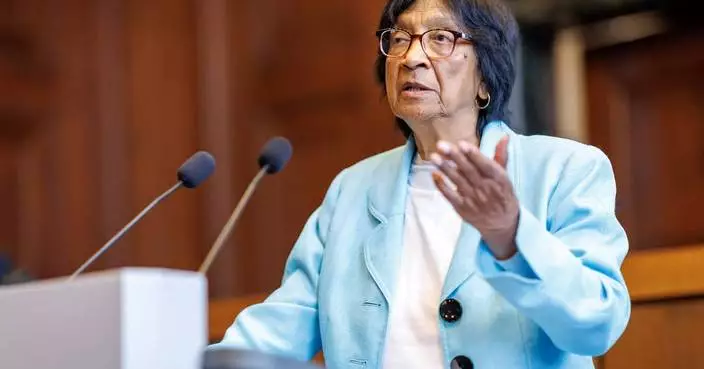
South African-born jurist and former U.N. human rights chief Navanethem "Navi" Pillay, center, poses with the former president of the International Criminal Court (ICC), Silvia Fernández de Gurmendi, and the director of the International Academy of the Nuremberg Principles, Christoph Safferling, at the Nuremberg Forum in Nuremberg, Germany, Friday, Oct. 9, 2026, following the announcement that she had been awarded the 2026 Nobel Peace Prize. (Daniel Karmann/dpa via AP)
SACRAMENTO, Calif. (AP) — It is not just tech moguls and venture capitalists fighting a California proposal to tax the net worth of billionaires, even though they are putting up the majority of the money in one of the most expensive ballot fights in state history.
Lining up alongside them is a coalition of prominent Democratic voices and party allies like Gov. Gavin Newsom, Planned Parenthood and the California Teachers Association, as well as most Republicans. They say it will drive wealthy people — and their tax money — out of California, creating bigger budget problems in the years ahead.
They have raised more than $300 million in opposition to the measure, with nearly a third of that coming solely from Google co-founder Sergey Brin. That is roughly 10 times the amount raised by the “yes” side, which includes some labor unions, California Rep. Ro Khanna and Vermont Sen. Bernie Sanders. With much less money to spend, the “yes” campaign is relying heavily on Sanders and the attention he commands among progressives to make their case ahead of the Nov. 3 deadline to vote.
“Are we destined to live in an oligarchic society begging for crumbs while our economic and political lives are controlled by a handful of the wealthiest people on Earth?” Sanders declared at one of three recent California rallies. “Brothers and sisters, that is the question on the ballot.”
The measure, known as Proposition 40, is not a long-term wealth tax like the one Sanders and some other progressives have long championed. It would impose a one-time, 5% tax on the wealth of Californians whose net worth exceeds $1 billion, with most of the revenue dedicated to replacing federal funding cuts to healthcare. It would be the nation’s first tax on the wealth of billionaires — targeting the main way the ultra-wealthy make their money, through their investments, rather than simply raising taxes on the paycheck they receive from work.
Voters were largely split on the measure in a September poll by the Public Policy Institute of California. About half, 52%, of likely voters said they would vote yes on the measure, while 46% said they would vote no.
With mail ballots being sent to voters, opponents are aggressively ramping up their campaign, spending or booking roughly $96 million of airtime and digital messaging, compared with just $209,000 by supporters, according to data compiled by the ad-tracker AdImpact.
A few hundred billionaires live in California, according to the nonpartisan Legislative Analyst’s Office.
Opponents are concerned the proposal is already driving wealthy people away. That could deal a blow to California’s budget because the state relies on its top 1% of earners for nearly half its personal income tax revenue.
“We’re not opposed to the concept of a wealth tax,” said Jodi Hicks, CEO of Planned Parenthood’s California chapter. “We just believe this proposal is seriously flawed and could do more damage than good.”
Some Silicon Valley tech moguls began cutting ties with the state in anticipation of the tax, including Brin and his fellow Google co-founder, Larry Page. The tax would apply to billionaires living in the state as of Jan. 1, 2026.
Newsom has walked a fine line on the issue as he prepares to leave office and considers a bid for president in 2028. He has largely opposed tax increases during his eight years as governor. But he has called for a national tax on billionaires, arguing a single-state proposal will not be effective and could hurt California's bottom line.
His opposition to the California proposal wasn't enough to dissuade the state Democratic Party's executive board from endorsing the measure earlier this year.
Billionaires including Brin, venture capitalist John Doerr and former Google CEO Eric Schmidt have given millions to a political committee called Building a Better California. The committee is fighting the tax and backing other ballot measures that would nullify it, including a proposal to ban new taxes on financial assets and other personal property, excluding real estate.
In one ad funded in part by Building a Better California, doctors wearing white coats warn it will cost California revenue in the long run and force the state to cut funding to hospitals and clinics.
Under the measure, 90% of the money would go toward funding healthcare, and the rest would go toward education and food assistance programs.
Debra Schade, president of the California School Boards Association, said there is no guarantee public schools will substantially benefit from the tax.
“The devil is in the details,” she said.
Cristobal Young, a sociology professor at Cornell University, said previous California tax increases on millionaires didn't lead to a mass exodus of wealthy people.
“These really high-income folks — they’re already doing great, and they don’t need to move somewhere else,” he said.
But the latest proposal is poorly designed, he said. The state, and the country, should instead pass tax code reforms to prevent wealthy people from shielding their financial assets from taxation, he said.
The SEIU United Healthcare Workers West, the union behind the ballot measure, says it is necessary to replace an estimated $100 billion that will be lost in federal healthcare funding over five years. The union forged ahead earlier this year despite pleas from fellow Democrats to drop the measure.
The campaign has raised $32.4 million, and another group backing the billionaire tax, Tax the Ultra-Rich Now, has received about $369,000.
One ad the campaign plans to release digitally and on cable next week warns that children make about 1.5 million emergency room visits a year in California, and the federal funding cuts could threaten the hospitals that serve them.
They have also released ads urging voters to “join Bernie Sanders, tax the billionaires, stop California’s healthcare collapse” and showing a Planned Parenthood employee object to Hicks' opposition to the measure.
The billionaire tax fight grew more contentious last month after the lead proponent of the measure, SEIU UHW President Dave Regan, was accused of harassing female colleagues and threatening other union leaders to urge them to back the measure.
Regan called the allegations a distraction.
“For the first time in the history of the country, the billionaires are going to have to be accountable to regular people who only wish they could have one tiny speck of what the most fortunate people on planet Earth have,” he said at a news conference.
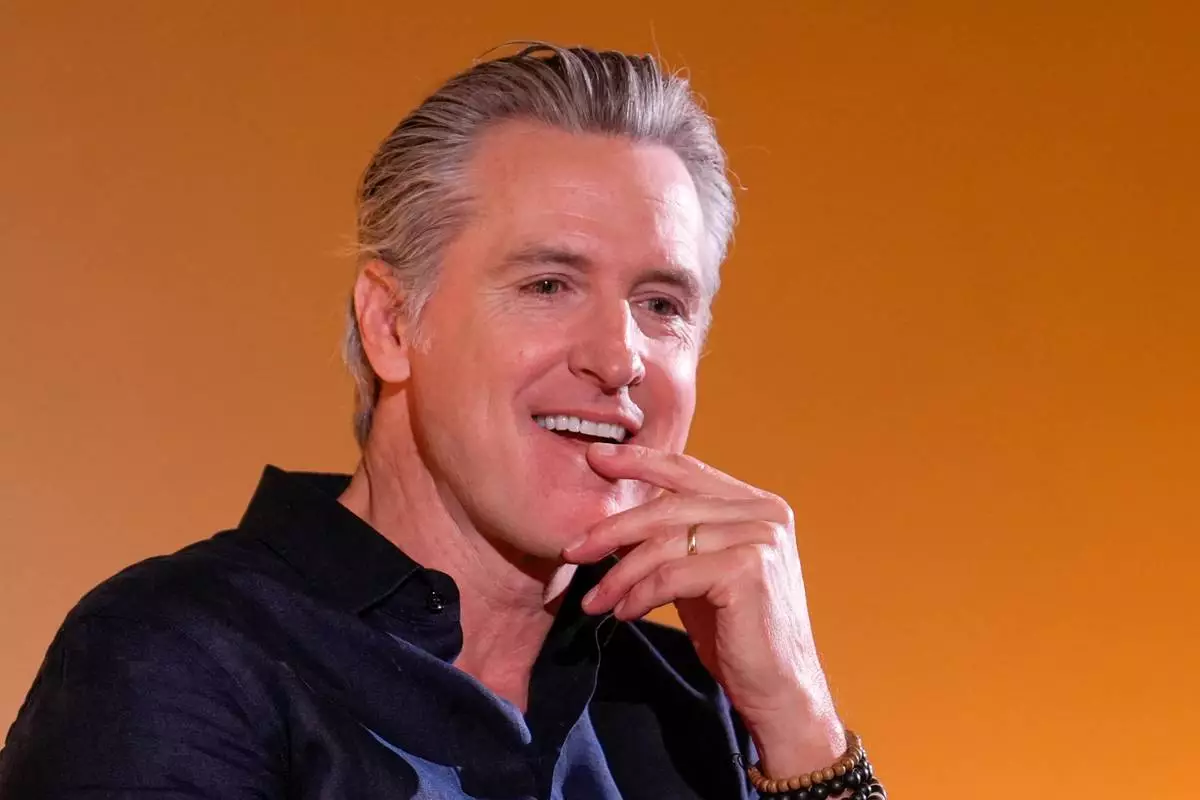
California Gov. Gavin Newsom pauses while discussing environmental issues in San Francisco, Tuesday, Sept. 29, 2026. (AP Photo/Rich Pedroncelli)

Nvidia CEO Jensen Huang, from left, Google co-Founder Sergey Brin, Microsoft CEO Satya Nadella and Lisa Su, CEO of Advanced Micro Devices, listen to Donald Trump speak at the U.S. Institute of Peace, Thursday, Oct. 8, 2026, in Washington. (AP Photo/Julia Demaree Nikhinson)
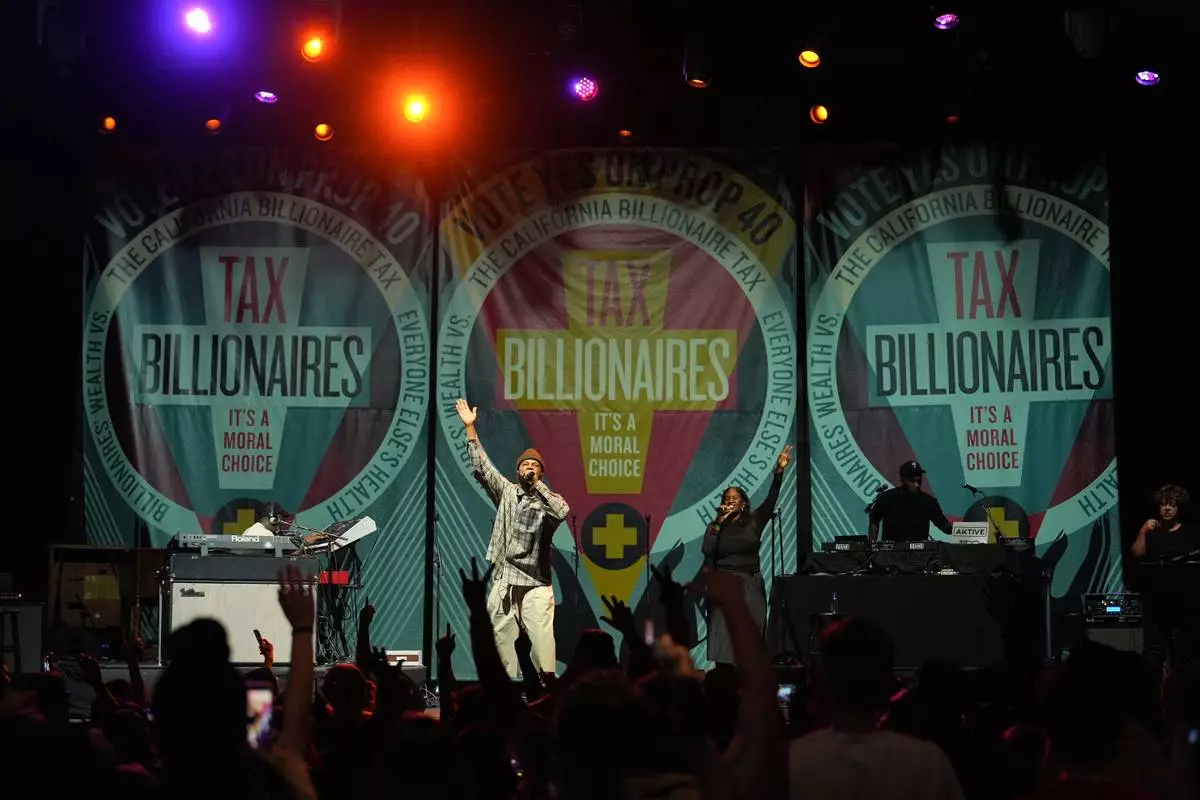
Rapper Common performs during a campaign rally in support of California Proposition 40, known as the billionaire tax, in Los Angeles, Monday, Oct. 5, 2026. (AP Photo/Jae C. Hong)
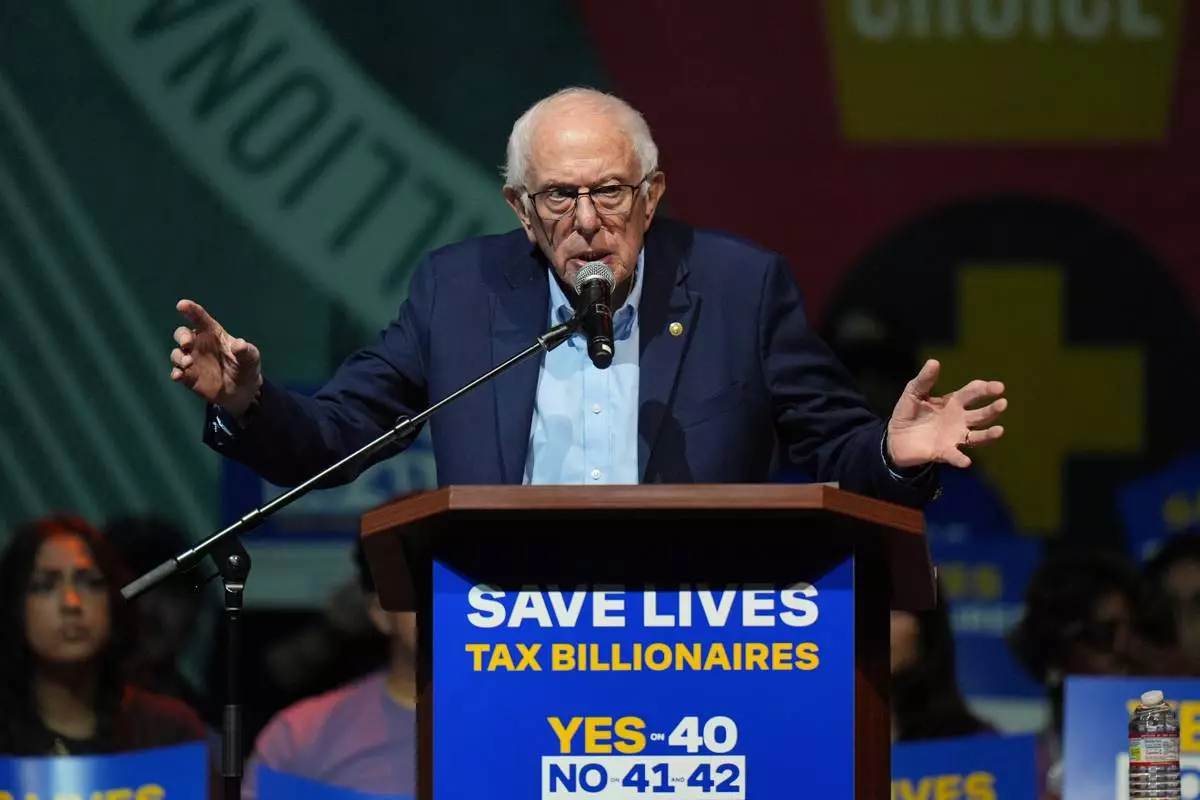
Sen. Bernie Sanders, I-Vt., speaks during a campaign rally in support of California Proposition 40, known as the billionaire tax, in Los Angeles, Monday, Oct. 5, 2026. (AP Photo/Jae C. Hong)