NEW DELHI (AP) — Since completing the career Grand Slam, Rory McIlroy has been constantly looking for new ways to inject some freshness and spark into his golf.
Turns out two of his longtime Ryder Cup teammates are providing some inspiration.
For this week’s DP World India Championship, McIlroy has brought along a new look — baggy golf pants.
After all, Tommy Fleetwood has been wearing them for a while.
“I have watched and I have admired Tommy Fleetwood over the past year,” McIlroy said, with a smile, on Wednesday's DP World Locker Room show about his style that has generated plenty of chatter in New Delhi this week.
“And in my everyday life, when I don’t have to wear what is my golf uniform, I wear a lot of wide-legged pants. It is the in-thing, the fashionable thing.”
But how, McIlroy was asked, do they feel to play golf in?
“These hit a little low, maybe a little short … I understand they are maybe not as well-fitting as they need to be,” he said, “but they are a work in progress.”
Also in the works for the Northern Irishman is a replica of what he calls his “performance trailer” that he uses in the United States to aid his fitness and recovery during and between PGA Tour events, in an effort to gain an edge over rivals.
Now, he wants one for when he plays on the European tour, too.
McIlroy said that idea came from tennis great Novak Djokovic but also fellow golfer Justin Rose.
“I decided to pull the trigger on it when Justin won in Memphis last year,” McIlroy said. “He’s 45 years old, playing great, contending in major championships, and at that time I was 36. I was like, I want to play really well for the next 10 years — I feel like I need to do something like this.”
McIlroy hopes to have that up and running by the summer of 2027 — by which time, who knows, he might have a record-tying eighth Order of Merit title that crowns the year’s No. 1 player on the European tour.
There are four events remaining in this season’s Race to Dubai and McIlroy will play in three of them, starting in India.
He is third in the standings, behind Patrick Reed and Eugenio Chacarra, but there's little between the three players and plenty of points on offer in the season-ending events in India, South Korea, Abu Dhabi and finally Dubai.
While Reed has stumbled of late thanks to an injury-prompted withdrawal at the BMW PGA Championship and a missed cut at the Spanish Open, Chacarra is finishing fast by climbing above McIlroy thanks to a tie for third at the French Open and a tie for second in Spain.
“It’s still anyone’s game,” Reed said Wednesday.
The American said he was swinging freely after the shoulder injury he sustained at Wentworth. He didn't play in France or at the Alfred Dunhill Links Championship and returned to shoot 73-71 in Spain, failing to make the weekend.
“For me, I was itching about getting back and getting out and playing,” Reed said. “Did I come back too early? Who knows. At the end of the day the good thing is I can’t hurt it worse, and because of that, I have the confidence and the comfort level to come out here and execute and perform at the highest level.”
See AP’s full golf coverage here

England's Tommy Fleetwood, center, plays a shot on the 5th hole during the day two of the 2026 Alfred Dunhill Links Championship at the Kingsbarns Golf Course in St Andrews, Scotland, Friday, Oct. 2, 2026. (Steve Welsh/PA via AP)
Cornell University’s handling of an alleged fraternity house gang rape is raising questions about how a decades-old federal civil rights law shapes colleges' treatment of campus sexual assault.
The focus on Title IX, which prohibits sexual discrimination in education, comes after a woman identified only as Jane Doe filed a lawsuit last month against Cornell and seven fraternity members.
She said she was assaulted at the Chi Phi fraternity house in October 2024 after being pressured into snorting the fast-acting sedative ketamine, smoking marijuana and drinking alcohol. The accused men have all denied her allegations, either saying the sexual activity was consensual or they weren’t involved.
Title IX was best known for most of its 54 years for opening doors for female athletes. But guidance issued in 2011 under President Barack Obama's administration made clear it also protects people who say they were sexually assaulted or harassed.
The rules have changed with new presidential administrations, but Title IX proceedings are intended to help colleges decide how to discipline the people involved, regardless of whether they face criminal or other legal repercussions.
A sexual assault case can be handled in criminal court and through the campus-run Title IX disciplinary process at the same time.
In theory, the criminal proceeding could lead to prison time and the Title IX case to expulsion.
In reality, serious consequences are rare in either system, said Megan Greeson, a professor of community psychology at DePaul University. She was among the authors of a review of studies involving 288,066 cases that found around 20% of those reported to police are prosecuted and 8% lead to convictions.
Jane Doe was no exception. Days after she gave her first substantial interviews to campus police, the county district attorney in upstate New York decided not to prosecute.
Long after that, Jane Doe believed the criminal investigation was ongoing. Her attorney, Thomas Giuffra, said she was “misled.”
Her case illustrates a common complaint with the dual-track system. Greeson said she often hears: “What do you mean there’s two different investigations?”
On the surface, Title IX investigations look a lot like police investigations. Witnesses are interviewed, and the accused often hire attorneys. The process is so demanding that many victims drop their case or choose to go an informal route, in which the accused might be asked not to take classes with the accuser, or to switch universities — often with no mark on their record.
When cases proceed to a hearing, schools have a lower bar for determining culpability than the justice system’s standard of beyond a reasonable doubt. Title IX requires schools to find an accused student responsible if the evidence shows the allegations are more likely true than not.
Beyond expulsions, consequences can include suspensions, loss of scholarships or withholding of a degree. A culpability finding can be noted on transcripts, which can make it difficult to get into graduate school or to obtain a state license in certain fields.
At some universities, including Cornell, Title IX offices handled fewer complaints after regulations narrowed the definition of sexual harassment during President Donald Trump’s first term.
Critics argued the rules discouraged students from coming forward with abuse allegations. Those who did faced a live hearing and cross-examination by a person of their alleged attacker’s choosing.
Former President Joe Biden's administration overhauled the rules to expand the type of behavior that’s considered sexual harassment. Rules finalized in 2024 also provided recognition that Title IX protects LGBTQ+ students and made live hearings optional.
A federal judge in Kentucky overturned Biden’s changes in early January 2025. Trump's current administration subsequently reverted to the 2020 rules in a change that became official last month.
Cornell’s Title IX complaints fluctuated as the regulations changed, falling from 205 in 2019 to 98 in 2020, when COVID-19 also shut down campuses, before rising to 166 in 2024.
Additionally, the Education Department ’s Office for Civil Rights used to serve as a powerful enforcer in cases of campus sexual violence. Under Obama and Biden, it brought the weight of the government against schools that mishandled sexual assault complaints involving students. But investigations have dwindled since Trump returned to office.
“There’s become fewer and fewer avenues for accountability and support that students are able to access with the way the current administration is enforcing or really choosing not to enforce Title IX,” said Emma Grasso Levine, the manager of Know Your IX, which works to address campus sexual violence.
It started about three weeks after the alleged assault, when Jane Doe went to campus police. That same day, the head of Cornell’s fraternities contacted the school’s Title IX office. The Chi Phi fraternity house was immediately suspended and later closed for good.
The following week, Jane Doe met twice with Title IX and campus police investigators, according to court records filed after one of the accused students sued Cornell over his punishment.
Investigators ultimately conducted 50 interviews with 32 witnesses and gathered evidence that included social media messages. The process led to a disciplinary hearing that stretched over 12 days in May 2025.
Although the alleged gang rape happened during the brief time Biden’s versions of the rules were in place, Jane Doe faced a live hearing because an injunction had stalled them from going into effect at hundreds of colleges, including Cornell.
At least one accused student wasn’t happy with the process. At one point, a hearing panel member listened to testimony over Zoom while driving for 45 minutes, according to the accused student's lawsuit. The student alleged it was a distraction that hurt his defense.
Ultimately, some of the accused students were suspended or expelled. Two were asked to write reflection essays as part of their punishments.
Those were unusual outcomes. From 2018 to 2024, 1,216 Title IX complaints were reported to Cornell, with just 4% resulting in a finding that one of the accused was responsible. Only 14 cases led to suspensions and seven to expulsions or dismissals. Lighter consequences, such as written reprimands, were more typical.
Amid calls for Cornell President Michael Kotlikoff to resign over the handling of the investigation, the school announced Tuesday that it was suspending parties at fraternity houses and will give New York State Police a role in investigating sex crimes on campus.
Kotlikoff also committed to adding a case manager to the school’s Office of Civil Rights to help those who report sexual misconduct navigate the process. A review of Cornell's handling of sexual assault claims also is underway.
“I believe,” Kotlikoff said in an earlier apologetic video, “we as an administration and we as a community must do better.”
The Associated Press’ education coverage receives financial support from multiple private foundations. AP is solely responsible for all content. Find AP’s standards for working with philanthropies, a list of supporters and funded coverage areas at AP.org.
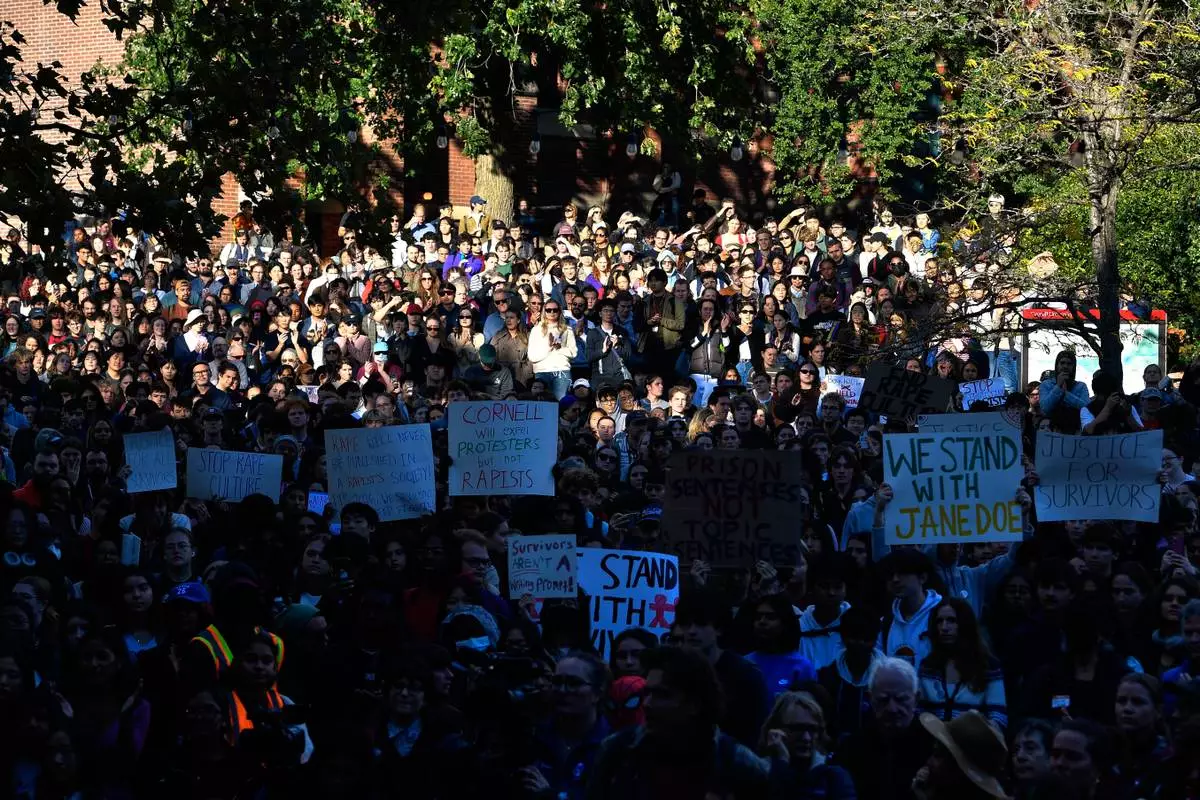
Demonstrators attend a protest against Cornell University's handling of the 2024 fraternity-house gang rape allegations at the campus, Monday, Oct. 5, 2026, in Ithaca, N.Y. (AP Photo/Adrian Kraus)
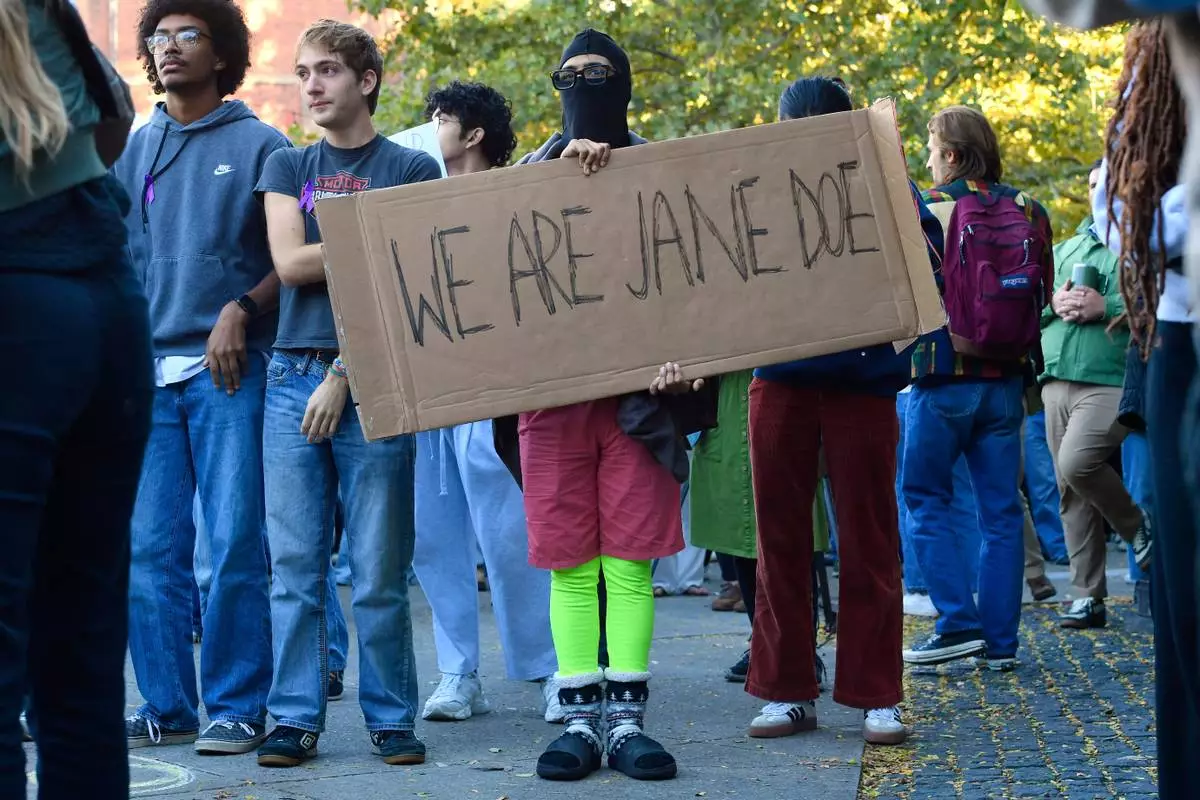
A demonstrator holds a sign reading "WE ARE JANE DOE" during a protest against Cornell University's handling of the 2024 fraternity-house gang rape allegations at the campus, Monday, Oct. 5, 2026, in Ithaca, N.Y. (AP Photo/Adrian Kraus)