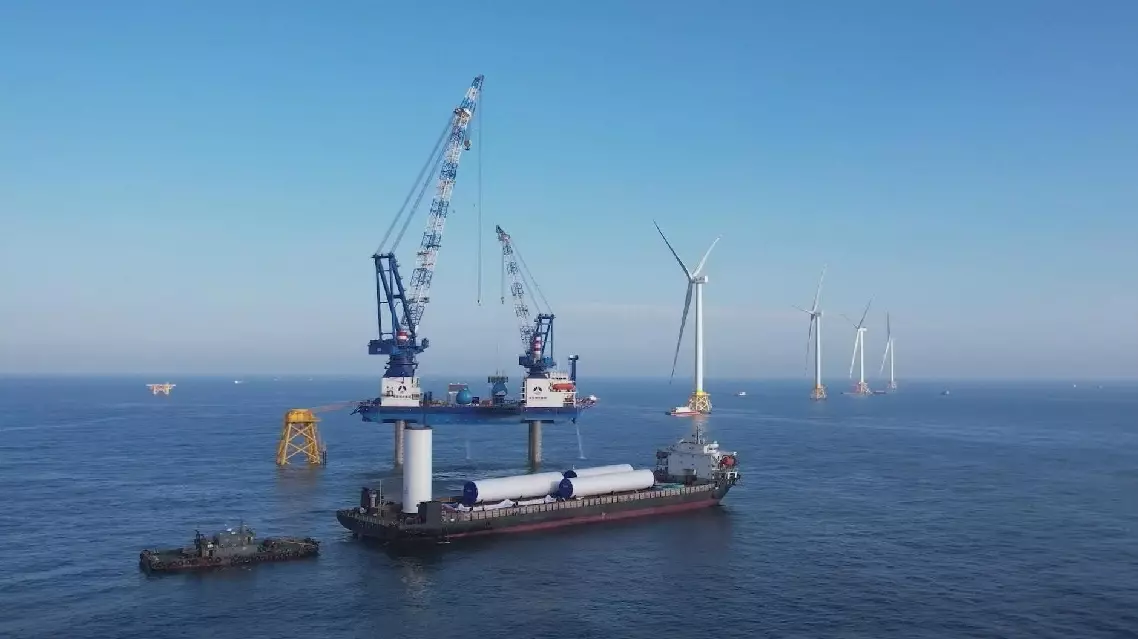
China has ranked first worldwide in installed wind power capacity for a 16th consecutive year, as the country continues rapid expansion of its wind energy generation.
The country's wind power capacity increased by 53.26 gigawatts to 692.72 gigawatts in the first eight months of the year, up 19.64 percent year on year, according to data from the China Wind Energy Association, part of the Chinese Renewable Energy Society.
As installed capacity and power generation expand steadily, China's wind turbine exports are also on the rise, with generators sold to 60 countries across six continents.
"In the first half of the year, our overseas sales grew by more than 300 percent year on year. In the first three quarters, the volume of overseas orders for our wind power equipment increased by nearly 50 percent year on year," said Lin Zhigang, director of overseas businesses at Sany Renewable Energy.
Seven Chinese wind turbine equipment manufacturers have already established overseas factories or are advancing plans to do so.
In 2025, China exported 1,175 wind turbines with a combined capacity of 7.75 gigawatts, an increase of nearly 50 percent year on year. This brought the country's cumulative total of export units to 6,974, with an aggregate capacity of 28.52 gigawatts.
"Last year in 2025, the world installed around 155 gigawatts of wind energy. That's the highest amount ever in history. In 2025, more than 70 percent of the manufacturing for wind energy equipment was from China. But China was also around 65 or 70 percent of the total global market. And we expect China to continue to be a real motor for the wind industry globally. We are also seeing many more Chinese companies going international and taking part in the international industry,” said Ben Backwell, CEO of the Global Wind Energy Council.
China tops world in wind power capacity for 16th consecutive year
Approaching Typhoon Champi, coupled with a cold front, has prompted local authorities in east China's coastal regions to take a series of precautionary measures, including personnel evacuation and ferry service suspension.
Affected by the typhoon's outer circulation and a cold front, Shanghai is bracing for strong winds and heavy rain from Friday afternoon through Sunday, with torrential downpours expected citywide and the heaviest rainfall hitting eastern and southern areas.
Conditions are expected to ease gradually by Sunday night. Meteorological authorities said Champi will turn near waters adjacent to Shanghai, noting the impact period coincides with an astronomical spring tide, compounding wind, rain, and tides to heighten the risk of localized waterlogging.
Relevant departments have relocated residents in advance, completing all transfers by 18:00 on Friday, with 62,400 people evacuated.
Meteorological authorities forecast sustained strong winds in Zhoushan's waters through the weekend, compounded by the astronomical spring tide, as the typhoon brings prolonged rainfall and large cumulative totals.
The Zhejiang Zhoushan Maritime Safety Administration raised its waterborne typhoon emergency response to Level II at 8:00 on Saturday. All 72 passenger routes in its jurisdiction have been suspended, and passengers have been evacuated from key island ferry terminals, including Putuoshan.
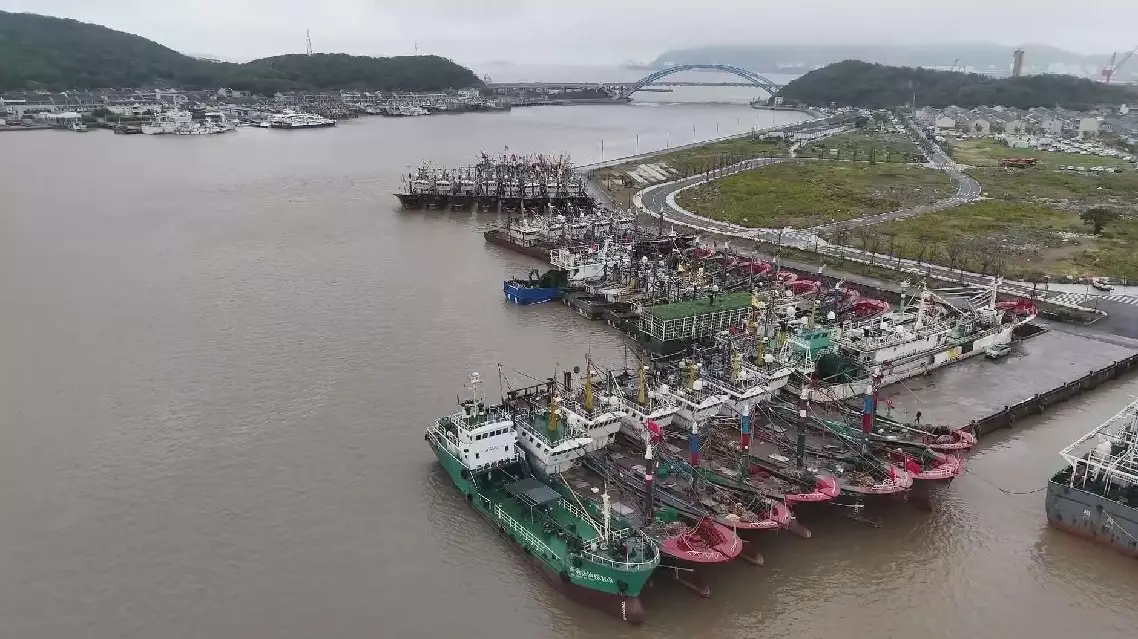
All 75 marine engineering projects have been halted, 4,263 fishing vessels have returned to port in batches to shelter or moved to safe waters, and all 167 leisure fishing boats have suspended operations.
Coastal winds in Ningbo, Zhejiang, have gradually strengthened due to the cold front and typhoon, prompting the successive suspension of passenger routes. As of 17:00 on Friday, 13 passenger routes in Ningbo's jurisdiction had been suspended.
In addition, temporary speed restrictions were enforced on sections of the Hangzhou-Shenzhen, Jinhua-Wenzhou, and Hangzhou-Taizhou high-speed railways from 17:00 on Friday to 24:00 Saturday, with some trains passing through these sections temporarily suspended.
Typhoon Champi brings heavy rain to east China as 62,400 evacuated in Shanghai