AUSTIN, Texas--(BUSINESS WIRE)--Oct 15, 2026--
Homa, the AI platform reinventing how Americans buy homes while returning up to 2% of the purchase price to buyers at closing, has raised $5 million in seed funding led by Quiet Capital, with participation from Restive Ventures and Cambrian Ventures. The round funds expansion across California and the launch of mortgage lending inside the platform.
This press release features multimedia. View the full release here: https://www.businesswire.com/news/home/20261013895291/en/
Homa is now available statewide in California (alongside Florida and Texas), covering roughly 95 million Americans. Buyers can search, tour, negotiate, close, and secure a mortgage in one place. The company, which went viral earlier this year with the first AI closings in the U.S., recorded its strongest month in September.
Quiet Capital, an early investor in OpenAI and Reddit, led the round alongside fintech-focused Restive Ventures and Cambrian Ventures.
Co-founder and CEO Arman Javaherian, a former senior director at Zillow, said the traditional process has barely changed in 40 years. “You tour on someone else’s schedule, you take advice from someone paid more when you spend more, and you hand over tens of thousands of dollars at the closing table for work you largely did yourself,” he said. “We built Homa so buyers get better information, better representation, and serious money back that can dramatically reduce the lifetime cost of a mortgage and boost their purchasing power.”
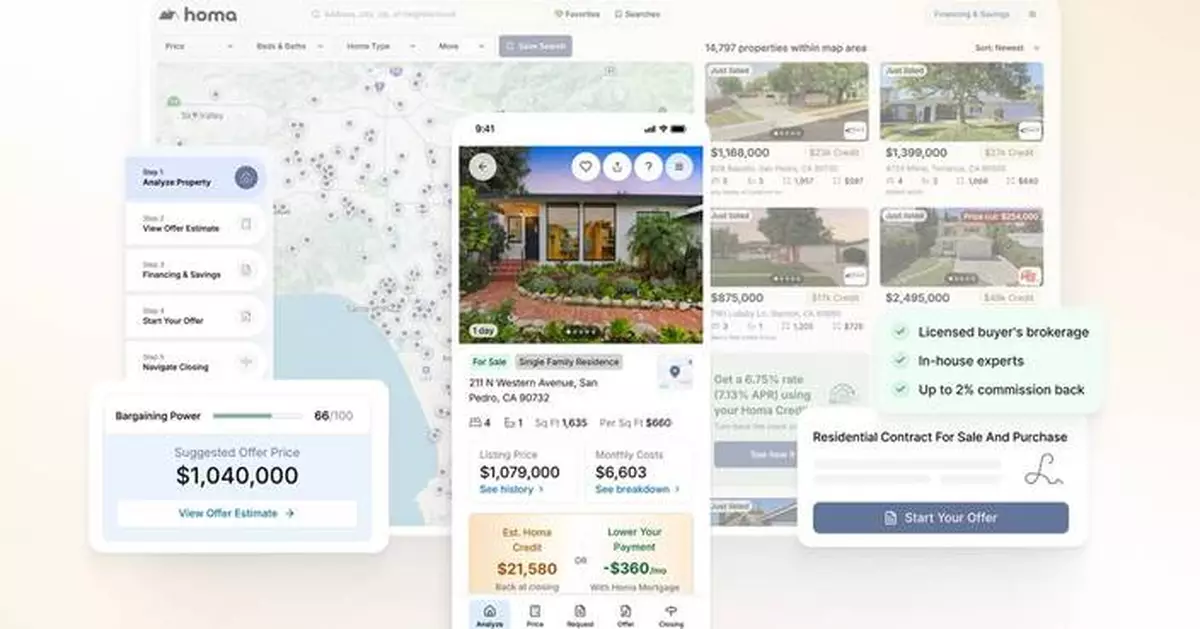
Homa is a licensed brokerage whose AI is trained on state-specific law, property data, and real-estate coursework. It provides pricing insight, disclosures, comps, risk analysis, and bargaining-power scoring before an offer. Local specialists handle tours on the buyer’s schedule for a flat fee. Offers are written and negotiated by in-house brokers—one per state—each with more than a decade of experience and hundreds of closed transactions.
On deals where the seller offers a buyer-broker commission of up to 3%, Homa keeps 1% and credits the remainder (typically about 2%) back to the buyer. Credits have averaged more than $10,000 and exceed $40,000 on higher-priced homes. Buyers can apply the credit to a rate buydown, closing costs, or the purchase price.
The new mortgage feature lets buyers shop for a loan inside Homa instead of being handed off to an outside lender. When the credit and loan sit in the same file, the credit can fund a rate buydown that lowers the mortgage rate by as much as 0.75%, compounding savings over the life of the loan. Integrating brokerage and lending also reduces delays from financing issues and poor coordination.
“Buying a home is the biggest financial decision most people will ever make, and the two parties who decide whether it goes smoothly—the brokerage and the lender—are almost always separate businesses with no incentive to coordinate well,” said Michael Bloch, Partner at Quiet Capital. “Homa is the only consumer company we have seen that runs both sides and hands the customer real money back. The expansion to California coupled with the new mortgage feature is an inflection point on Homa’s path to changing the economics of homebuying in America.”
Homa timed the California launch for surging demand in the state’s largest metros. It has been live in Florida since 2025, expanded to Texas in June 2026, and soft-launched California on September 1. Capital will also support a mobile app later this year.
“California buyers do their own research, and they are not looking for someone to unlock a door and mark it up by 3%,” Javaherian added. “What they actually need is real MLS access, a licensed broker who negotiates for a living, financing that is part of the offer strategy rather than an afterthought, and a credit large enough to increase their purchasing power.”
Homa was co-founded by Javaherian and Federico Campeotto, a computer scientist with a Ph.D. specializing in artificial intelligence. It is the only end-to-end platform of its kind and has already returned millions of dollars to buyers in Texas and Florida.
About Homa
Homa is the first AI-powered homebuying platform and licensed brokerage to take buyers through search, analysis, touring, offer, financing, and closing in one place, then credit most of the buyer-side commission back to them. Available in California, Florida, and Texas. Learn more at www.tryhoma.com.
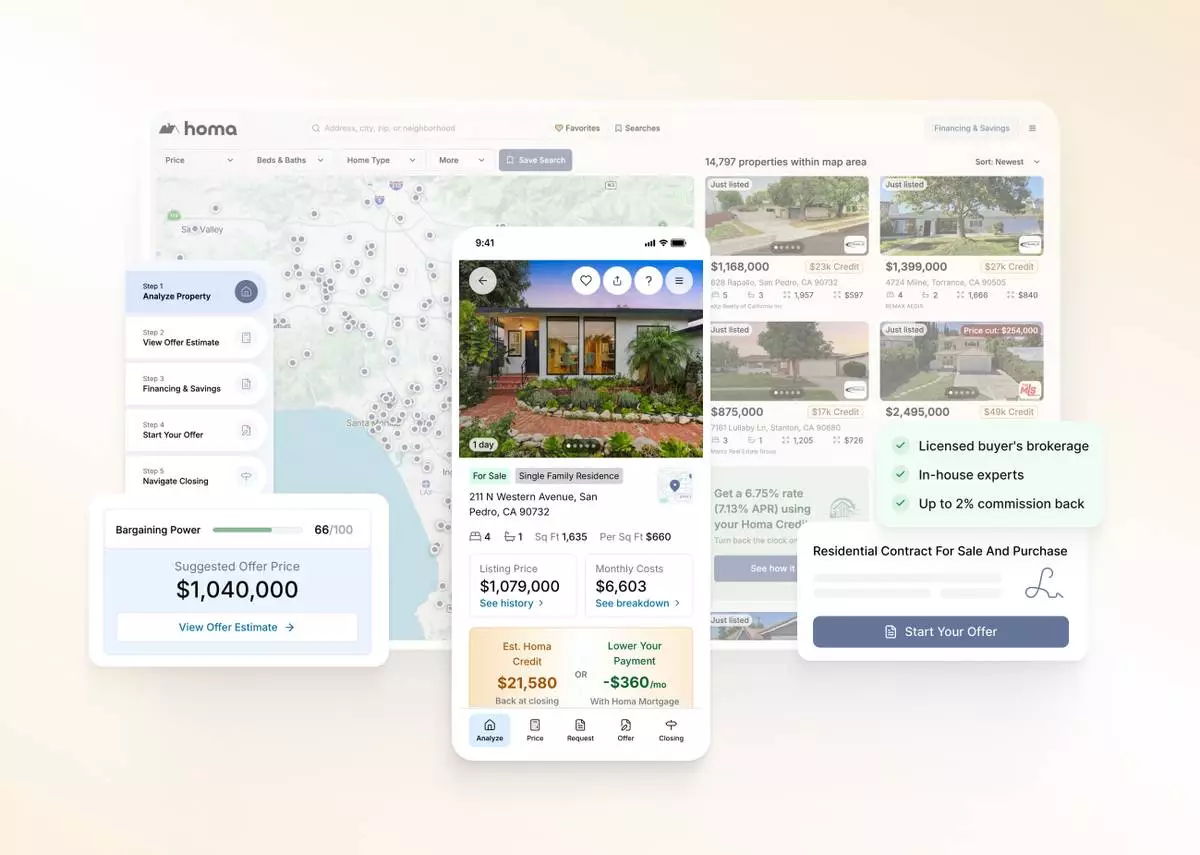
Homa Raises $5 Million to Redefine Homebuying with AI
WASHINGTON (AP) — A strong majority of voters believe that President Donald Trump is falling short at home and abroad, and they want major change in the upcoming midterm elections, according to a new AP-NORC poll that raises serious warning signs for the Republican Party at a critical moment.
The survey from The Associated Press-NORC Center for Public Affairs Research, conducted less than four weeks before Election Day, finds that registered voters who identify as Democrats are more enthusiastic than Republican voters about casting a ballot. More voters want Democrats to win control of Congress and have a more negative view of Republicans.
The Democratic advantage is small in some cases, but, taken together, the findings paint a challenging picture for Republicans, who are clinging to control of Congress under the weight of an unpopular war with Iran and surging prices at home.
About 8 in 10 voters overall say the economy or the cost of living is among their top issues for the upcoming election, while about two-thirds say this about healthcare and the war in Iran. Other issues that are stronger for Trump — like immigration or crime — are lower priorities.
“The world is going backwards. We can barely afford anything,” said Diana Walker, a 65-year-old Democrat from Decatur, Georgia. “Everybody’s down. I don’t care if you’re a Democrat or Republican, we’re all catching hell.”
Less than a month before the final midterm votes are cast, the poll finds that Democratic voters are more motivated to vote.
Overall, about two-thirds of registered voters say it’s “extremely" important to vote in the upcoming election, while about 2 in 10 say it’s “very" important.
But about three-quarters of Democratic voters say that voting in this November’s midterm elections is “extremely” important, compared with roughly 6 in 10 Republicans.
Ryan Longbrake, a 52-year-old Democrat from Columbus, Ohio who works in technology marketing, said he's especially excited about casting his ballot, and he's already taken steps to ensure that his wife and two college-age daughters will vote as well.
“I believe that there is change on the horizon and there is an excitement within our party,” he said, pointing to Democrats' momentum in Ohio's elections for governor and U.S. Senate. The party is also investing resources in Republican-leaning states, like Iowa and Kansas, where the political environment has put Democratic candidates on friendlier footing.
Republicans have controlled Congress for the past two years, but about half of registered voters now say they’d prefer to see the Democratic Party control the House or the Senate. A smaller percentage, roughly 4 in 10, say they want the Republican Party to control each chamber, while 15% are undecided.
One thing is crystal clear on the eve of the 2026 midterms: Voters want change.
About half of voters say they want “substantial change,” and roughly 3 in 10 want “complete and total upheaval” in the way the country is run.
Democrats and independents are much likelier than Republicans to want a full overhaul of the country’s direction. But even Republican voters are still looking for something different. Slightly fewer than half, 45%, want substantial change, while 13% want upheaval.
“I’m kind of tired of sending people there and nothing gets done,” said Krista Kohles, a 70-year-old Republican from near Davey, Nebraska. “Nothing’s changing.”
Voters are deeply frustrated with Trump and his leadership on the issues they say matter most.
Only about one-third of registered voters overall have a “very” or “somewhat” favorable view of the Republican president, and a similar share approve of his performance as president.
Voters continue to be frustrated by the high cost of living, an issue that Trump vowed to address before winning a second term in the White House.
Nearly two years after his successful election, about 8 in 10 registered voters disapprove of how Trump is handling the cost of living, in line with a September AP-NORC poll. About three-quarters disapprove of his performance on the economy.
Even among Republican voters, only 44% approve of Trump's performance on the cost of living, while 54% approve of his leadership on the economy. That's a sharp contrast with other issues, like crime, on which Republican approval is much higher.
There are cracks in Trump's Republican base on other issues, too. Just 69% of Republican voters support Trump on foreign policy as the war in Iran stretches into its eighth month, despite his promises that it would only last four or five weeks.
DonnaJean Weber, a 72-year-old Republican from Manistee, Michigan, says she will continue to support Republican candidates this fall, but she's not happy with the state of the economy under Trump's leadership.
“Everything’s going up,” she said, pointing to the impact of the war with Iran, among other Trump decisions. “I don’t agree with him fully on all of these tariffs, either. It’s making this country look bad.”
The economy and the cost of living are high priorities for voters on both sides of the aisle. The survey found that the vast majority of Republican and Democratic voters say both issues are among the most important for the upcoming election.
Voters aren't any higher on one of Trump's potential successors in the next presidential election, Vice President JD Vance: About half have a “somewhat” or “very” negative view of Vance, compared with about one-third who have a positive opinion.
Trump's struggles do not mean that voters are particularly excited about the direction of the Democratic Party.
Overall, about 4 in 10 voters have a “very” or “somewhat” favorable view of the Democrats, while about half view the party unfavorably. That's roughly similar to views of the GOP, although about 6 in 10 voters view the Republicans unfavorably.
Democratic and Republican voters are equally enthusiastic about their own side, with about 8 in 10 saying they have a favorable view of their own party.
But the critical bloc of voters who identify as independents is much more likely to have a negative view of the Republicans than of the Democrats. About two-thirds of independent voters view the GOP negatively, compared with about 4 in 10 who view Democrats negatively.
Michael Russo, a 51-year-old Texas voter who is not registered with either party, described the state of the country under Republican control as “a nightmare.”
Does he want Republicans to maintain control of Congress? “No, I want them in prison — several of them,” he said. But he's not thrilled with the Democratic Party, either.
"I’m not confident they’re going to do anything if they get into power," Russo said.
Peoples reported from New York.
The AP-NORC poll of 1,119 adults, including 925 registered voters, was conducted Oct. 8-12 using a sample drawn from NORC’s probability-based AmeriSpeak Panel, which is designed to be representative of the U.S. population. The margin of sampling error for adults overall is plus or minus 3.9 percentage points, and the margin of error for registered voters is plus or minus 4.2 percentage points.
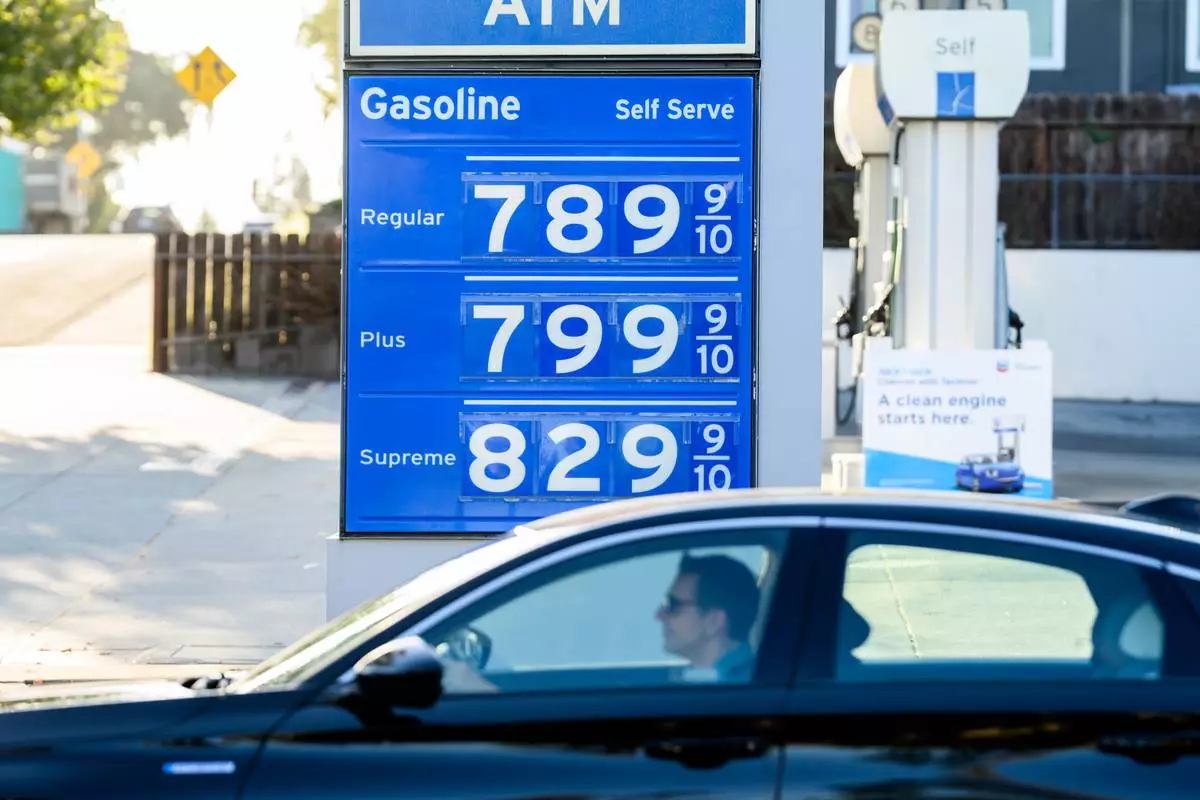
A driver passes a marquee displaying gas prices at a Menlo Park, Calif., Chevron station on Monday, Oct. 5, 2026. (AP Photo/Noah Berger)

Demonstrators gather at Memorial Circle to protest the proposed Triumphal Arch, Thursday, Oct. 1, 2026, in Arlington, Va. (AP Photo/Allison Robbert)

President Donald Trump departs a campaign rally at the Laughlin Bullhead International Airport, Wednesday, Oct. 14, 2026, in Bullhead City, Ariz. (AP Photo/John Locher)