PROVO, Utah (AP) — Both Notre Dame and BYU were denied at-large berths to the College Football Playoff a season ago. Now the two teams face one another in a top-10 matchup with a huge opportunity to build a case for a CFP bid this season.
The No. 2 Fighting Irish (6-0) and the No. 8 Cougars (5-0) meet in Provo on Saturday in the first game of a two-year home-and-home series. Oddsmakers have made BYU a 10.5-point home underdog.
Both teams have emerged as regular contenders for CFP bids since the playoff field expanded to 12 teams. With each team facing criticism for weak early schedules, this game represents a chance for both to make a statement that they’re not paper tigers.
This is the first time in series history where both teams are ranked and it will be the first top-10 matchup ever played at LaVell Edwards Stadium.
“You want to play against the best and you know this is going to be, on paper, the best opponent we’re going to see, to date,” Notre Dame coach Marcus Freeman said. “I love it. They love it because they’re competitors. So let’s go do it.”
Notre Dame and BYU last played one another in 2022 in Las Vegas. The Irish held off a second-half rally in a 28-20 victory to take a 7-2 lead in the all-time series.
“We ended up losing that game, but I thought it was a really good experience for our players,” BYU coach Kalani Sitake said. “I’d like to think that we’re different as a program and a team now than we were in that game, but so is Notre Dame.”
For BYU, Notre Dame is the highest-ranked opponent the Cougars have faced at home since hosting No. 1 USC in 2004. Ironically, that’s also the last time the Irish traveled to Provo, falling 20-17 to BYU in the season opener for both teams.
Having a chance to play a team of Notre Dame’s caliber is a meaningful milestone to the BYU players and coaches.
“I feel like everybody growing up just knows Notre Dame to be a powerhouse,” BYU defensive tackle Viliami Po’uha said. “They’re a name that has been in every household for every kid that wants to play football.”
A series between Notre Dame and BYU was born out of necessity after both teams needed to fill sudden holes in their respective schedules.
The Cougars replaced USC on the Irish’s schedule after Notre Dame could not reach an agreement with the Trojans on a date for a game this season. It led to a temporary pause in the longtime rivalry, which will resume in 2030.
BYU had to replace California when the Bears pulled out of a home-and-home series after the ACC moved to a nine-game conference schedule.
“Notre Dame – they’re the ones that reached out and wanted this game, and so it’d be crazy for us to turn it down,” Sitake said. “When they reached out and wanted this series and wanted this game, I thought that was a huge opportunity for us to play them.”
The two teams had a chance to meet last season when the Pop Tarts Bowl invited both Notre Dame and BYU to play in its bowl game. The Irish ultimately declined the invitation after their CFB snub.
Notre Dame leads the nation in total defense, allowing 214.2 yards per game. BYU tops the Big 12 in the same category, yielding 254.4 yards per contest. Opponents are scoring 11.0 points per game against the Irish and 13.4 against the Cougars.
Notre Dame linebacker Drayk Bowen expects the run game to decide which defense prevails.
“They’re a run-heavy team,” Bowen said. “We’re a stop-the-run team. It’s going to be who can establish the line of scrimmage first, and who can set the other one back behind the sticks. If we can do that, you know we’re going to have a pretty good night.”
Sophomore quarterback Bear Bachmeier will likely shoulder much of the load for BYU in the run game. The Cougars’ top rusher, LJ Martin, is out until November with a lower-body injury. Martin led the Big 12 with 1,305 rushing yards last season.
Notre Dame has been preparing for the altitude of LaVell Edwards Stadium since the summer. At 4,649 feet above sea level, it is one of the highest elevations in college football. South Bend, Indiana, is less than 1,000.
Freeman said he consulted his assistant coaches who have coached in high-altitude venues as well as D.J. McKinney, a defensive back who played at Colorado before transferring to Notre Dame.
“The biggest thing is reemphasizing the things we’ve already educated them on, and how you hydrate and how you fuel your body is even more crucial earlier, right?” Freeman said. “They have to make sure that they really focus on recovery after each play, and how you take these deep breaths, and how you settle down and calm down your breathing.”
AP Sports Writer Mike Marot contributed to this story.
Sign up for Top 25 poll alerts here. Visit the Top 25 here and see AP’s full college football coverage here.

Notre Dame quarterback CJ Carr, right, looks to pass against North Carolina behind the block of offensive lineman Sullivan Absher (75) during the first half of an NCAA college football game Saturday, Oct. 3, 2026, in Chapel Hill, N.C. (AP Photo/Chris Seward)
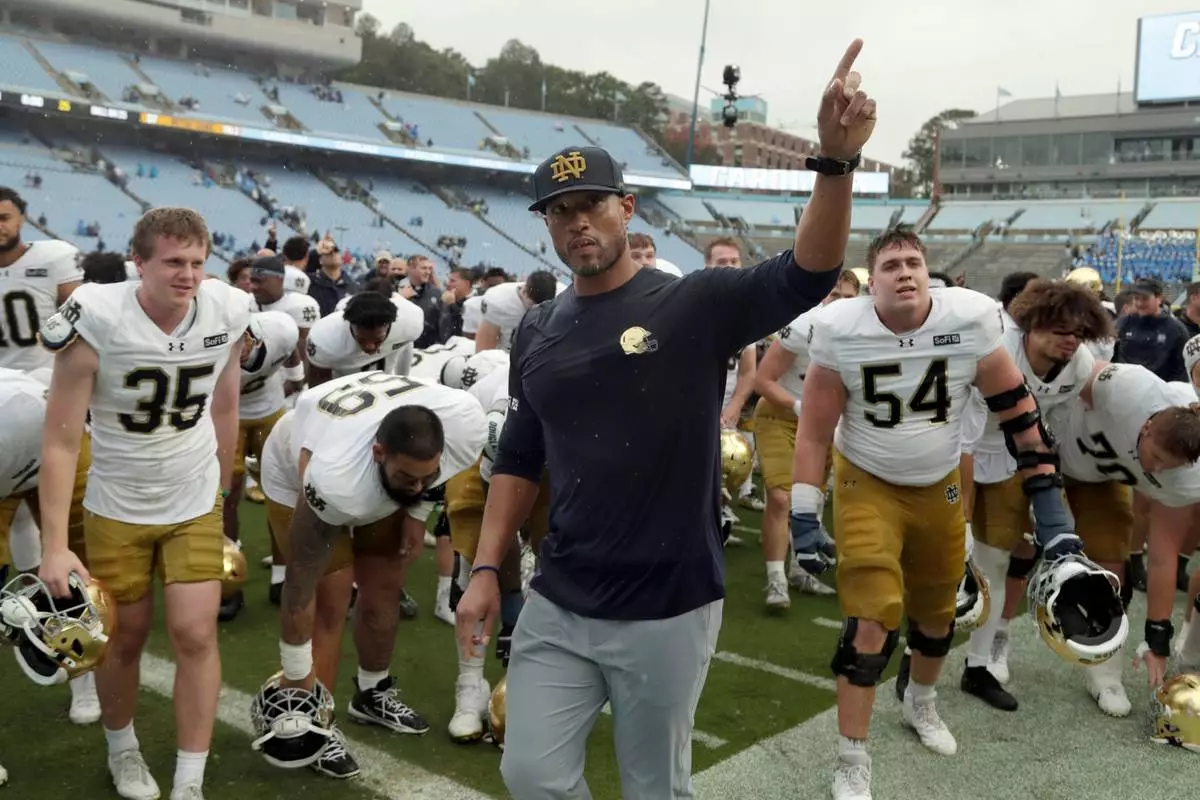
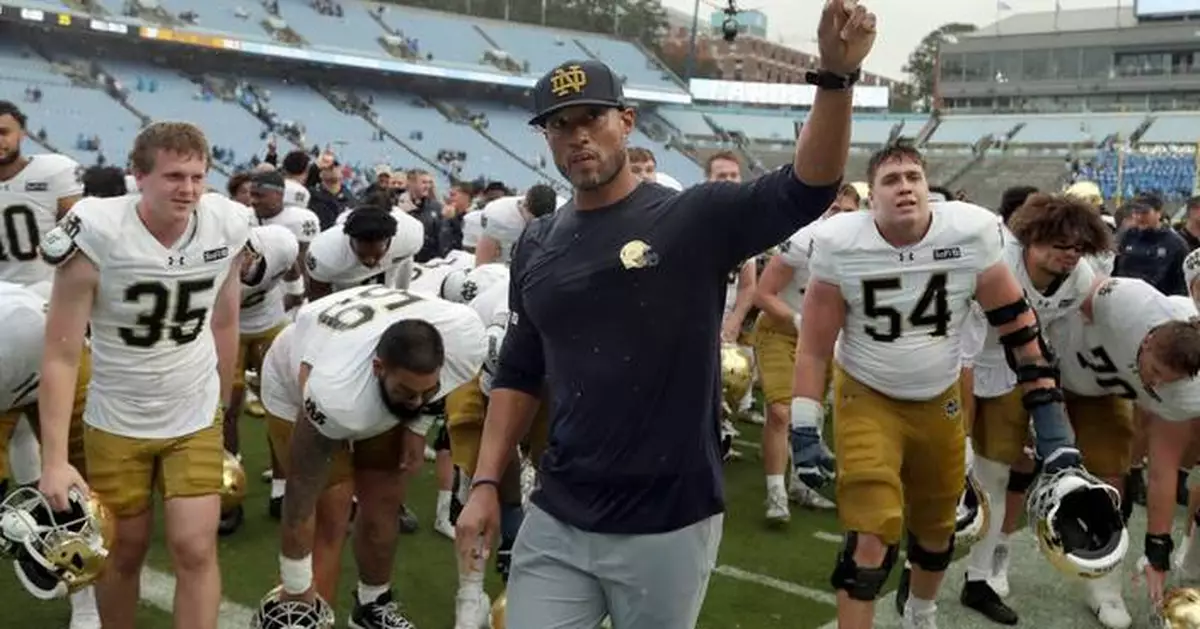
Notre Dame head coach Marcus Freeman and the team recognize their fans at the end of an NCAA college football game against North Carolina, Saturday, Oct. 3, 2026, in Chapel Hill, N.C. (AP Photo/Chris Seward)
Six propellers whir to life, lifting a drone above a field somewhere in Ukraine. A weighted stretcher secured to its frame simulates a wounded soldier in body armor.
Far from the front line, the demonstration offers a glimpse of a far more dangerous mission: flying into a battlefield where enemy drones and artillery can leave wounded troops stranded for weeks or months, then carrying them to safety without an evacuation crew.
The Associated Press was granted exclusive access to a field demonstration of the drone. This week, StarGate was handed over to a combat brigade for evaluation under front-line conditions.
The aerial medical evacuation drone was developed over the past year by Ukrainian defense technology company SkyFall. If it proves reliable in combat, it could transform battlefield evacuations, reaching soldiers in places that ground vehicles cannot access and potentially saving those so severely wounded that hours of waiting could cost them their lives.
“The idea came directly from the front line, from the trenches,” said SkyFall's spokesperson, who asked not to be named because of the security risks facing Ukrainian military technology personnel. He spoke to AP wearing a balaclava. The AP was not permitted to disclose the testing location.
In some sectors, the so-called kill zone — the area under constant threat from drones and artillery — stretches 10 to 15 kilometers (6 to 9 miles) or farther. StarGate has a one-way range of 15 kilometers, potentially allowing it to reach critically wounded soldiers trapped deep inside the kill zone.
The idea grew out of a military request, the spokesperson said. Last year, Flint, commander of the 475th Separate Assault Regiment, known as Code 9.2, approached SkyFall’s founder about developing a safer way to evacuate wounded soldiers from hard-to-reach positions.
For troops in Code 9.2, reaching a front-line position to retrieve the wounded can mean traveling on foot through areas where vehicles are vulnerable to drones. Unmanned ground vehicles have taken on a growing role in evacuating casualties and delivering supplies, but they struggle through mud, craters and shattered roads. Rivers, mines and drones can stop them altogether.
Ground robots typically take two to three hours to reach a position, depending on distance, road conditions and the threat from above, said KVN, a commander with Code 9.2.
“Covering 10 kilometers in minutes would be a drastic change on the front line,” he said.
Evacuations continue regularly in his unit’s area, he said, but it is not always possible to retrieve a wounded soldier on the same day. For someone with severe injuries, the wait can be critical.
Both Flint and KVN were identified only by their call signs in line with Ukrainian military protocol.
SkyFall emerged after Russia’s full-scale invasion in 2022, and has grown into a Ukrainian drone manufacturer. Its Vampire heavy-lift drone, known to Russian forces as “Baba Yaga,” is used by Ukrainian troops for battlefield missions. The company also makes Shrike first-person-view drones and has developed the P1-SUN aerial interceptor.
Named after the science-fiction franchise in which portals connect distant worlds, StarGate can carry a payload of up to 150 kilograms (330 pounds), according to the company - enough for a wounded soldier wearing body armor and carrying combat equipment. Its medical evacuation cabin is built around a stretcher.
The drone cruises at 65 kph (40 mph) and can reach speeds of up to 105 kph (65 mph). SkyFall says it can be prepared for flight in about 10 minutes.
At the test field, StarGate lifts off as first-person-view drones buzz toward it, simulating the aerial threats that dominate Ukraine’s front line. Electronic jamming is activated. As one attacking drone closes in, a net shoots out, ensnaring it and sending it off course.
The encounter resembles a futuristic duel fought by machines. But carrying a wounded soldier raises the stakes.
One of SkyFall’s biggest challenges was ensuring the drone could navigate when electronic warfare disrupts communications or interferes with GPS signals. StarGate uses two communication channels — Starlink and the company’s proprietary L-Link system — alongside an artificial intelligence-based system to help it maintain control when satellite navigation is unavailable.
The drone is operated manually, but has several AI functions that allow it to operate in GPS-denied environments or when signals are spoofed or frequencies are jammed, the spokesperson said.
If communication is lost entirely, SkyFall says, the drone can plot a route back to a safe area. It is designed to operate in rain and snow, with thermal-imaging cameras for nighttime missions.
SkyFall also says it has demonstrated the drone's ability to continue flying after losing one of its arms. The company has not provided data showing how reliably it can withstand damage under combat conditions. The drone began front-line tests this week.
StarGate has undergone multiple design changes, including detachable arms for easier transport, a medical-grade stretcher and improved software and defenses.
The company estimates each system will cost at least $50,000, depending on configuration, and aims to produce up to 1,000 a month by the end of 2026.
For KVN, however, it is too early to judge. His unit needs at least a month of experience with the drone before it can provide meaningful statistics on its success rate.
“It’s a completely new method of evacuation,” he said. “It’s difficult to talk in depth about the pros and cons right now. We need to work with it more.”
SkyFall confirmed the unit is evaluating StarGate but declined to disclose the results.
Follow the AP’s coverage of the war in Ukraine at https://apnews.com/hub/russia-ukraine
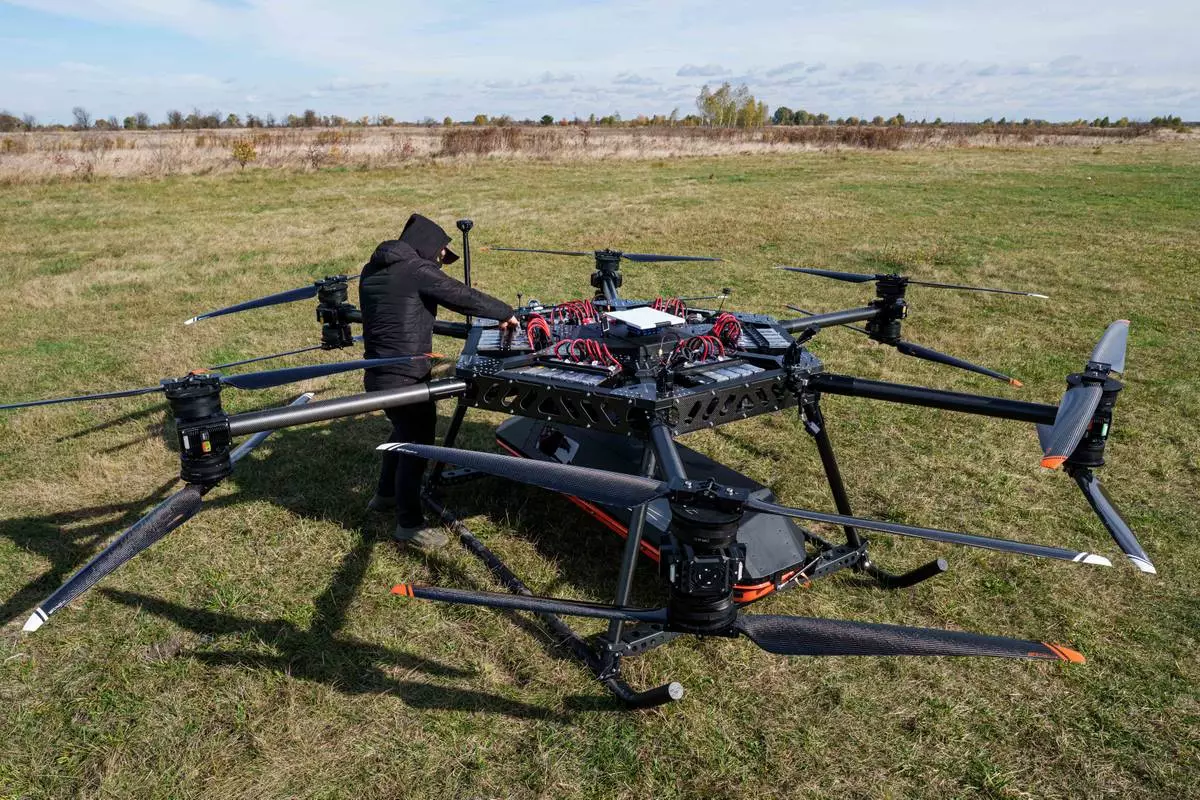
A representative of the SkyFall drone company checks the SkyGate drone before a demonstration flight at an undisclosed location in Ukraine, Wednesday, Oct. 14, 2026. (AP Photo/Evgeniy Maloletka)
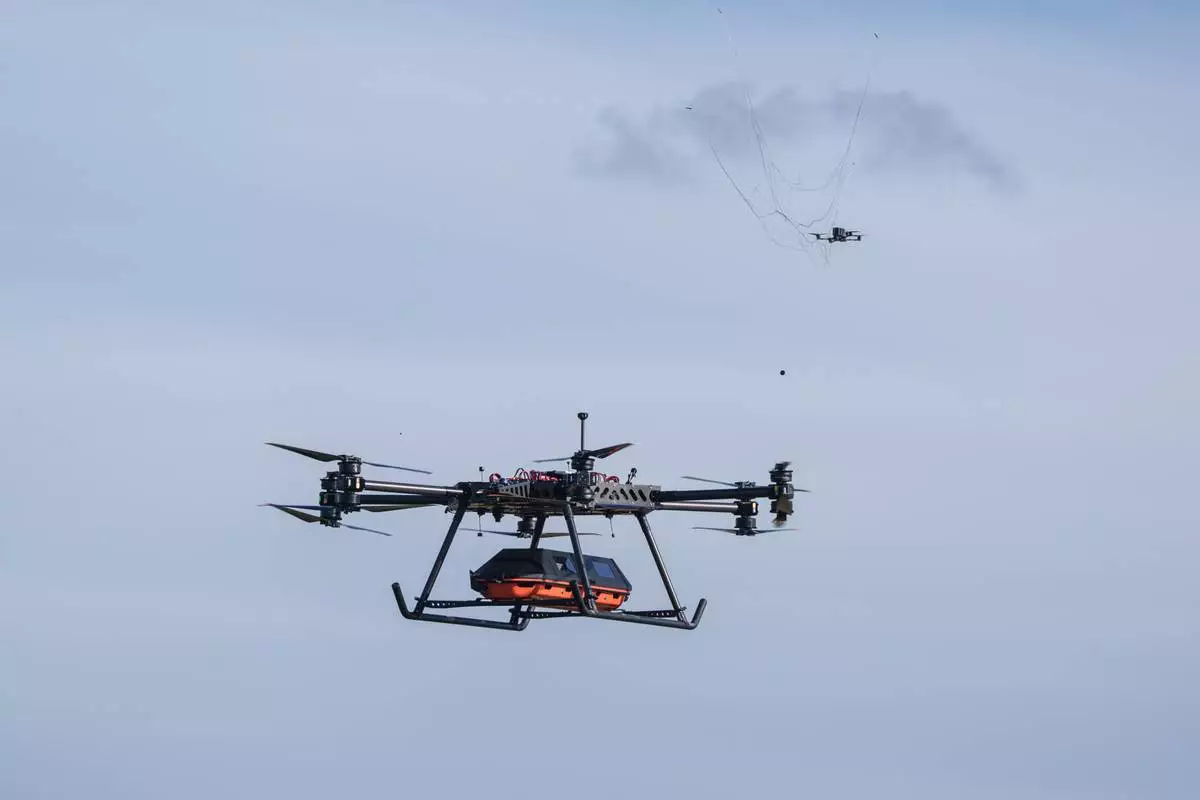
The SkyGate drone, made by the SkyFall drone company and equipped with a medical module, deploys a net designed to intercept aerial threats commonly encountered along Ukraine's front line at an undisclosed location in Ukraine, Wednesday, Oct. 14, 2026. (AP Photo/Evgeniy Maloletka)
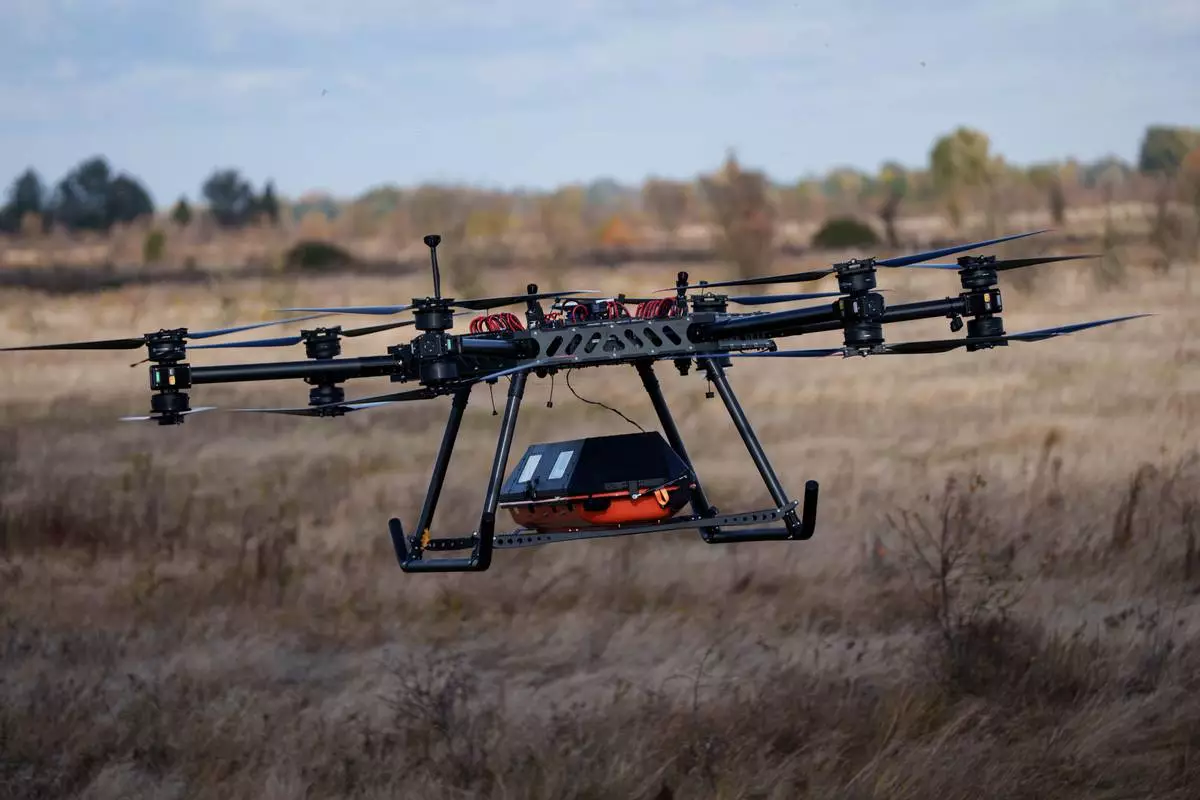
The SkyGate drone, made by the SkyFall drone company and equipped with a medical module, flies during a demonstration at an undisclosed location in Ukraine, Wednesday, Oct. 14, 2026. (AP Photo/Evgeniy Maloletka)
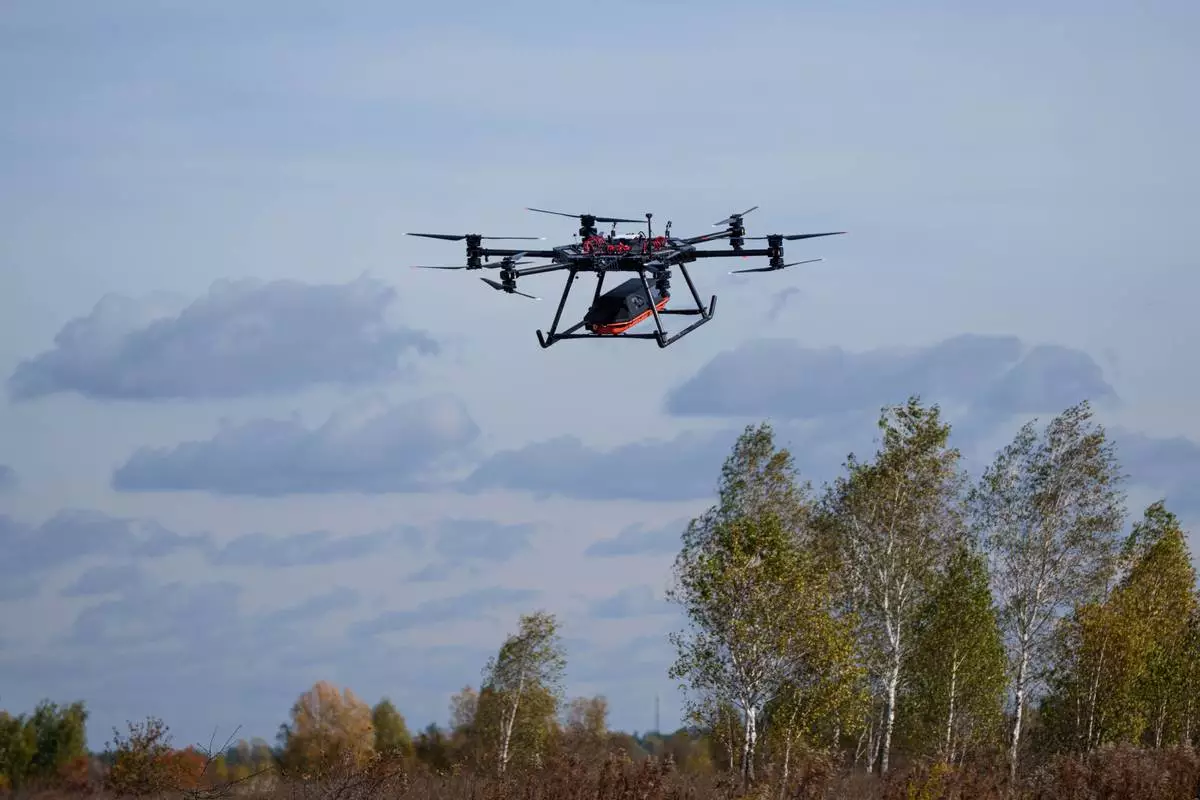
The SkyGate drone, made by the SkyFall drone company and equipped with a medical module, flies during a demonstration at an undisclosed location in Ukraine, Wednesday, Oct. 14, 2026. (AP Photo/Evgeniy Maloletka)
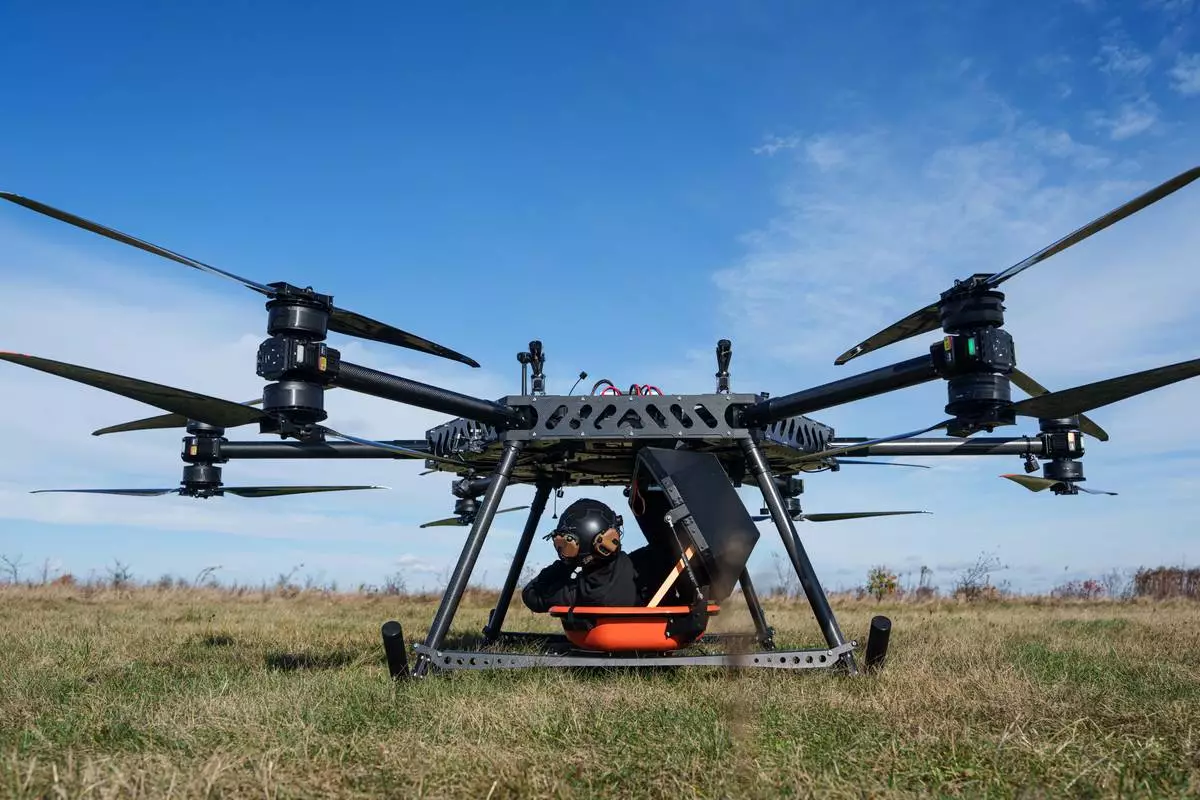
A representative of the SkyFall drone company climbs into a medical module of the SkyGate drone before a demonstration flight at an undisclosed location in Ukraine, Wednesday, Oct. 14, 2026. (AP Photo/Evgeniy Maloletka)