COLUMBUS, Ohio (AP) — Another court declared Ohio’s private school voucher program unconstitutional on Thursday, finding it provides a choice to the private schools that must honor the taxpayer-funded vouchers rather than to Ohio families.
The ruling by a three-judge panel of the 10th District Court of Appeals affirmed a lower court’s June 2025 ruling that found the EdChoice program violates an Ohio constitutional requirement for “a thorough and efficient system of common schools.” The ruling will not immediately affect the EdChoice program, which was allowed to remain operational in anticipation of an appeal.
“EdChoice, as presently structured and funded, secures with taxpayer funds a competing system of uncommon schools that is not subject to the same obligations imposed on Ohio’s system of common schools,” Judge David Leland wrote in a unanimous opinion.
Judges took particular issue with the fact that a private school that participates in EdChoice has “broad discretion” over which students it admits, including denying or discontinuing any student “based on its perception that its stated admissions criteria are not met, whatever those criteria may be.”
“Thus, under the program, it is the participating school, not the student or their family, that chooses whether to admit the student and, consequently, whether the student may utilize taxpayer vouchers at that school," the court said.
The court further found that EdChoice harms public schools in three ways: by allowing private schools to cherry-pick students, concentrating participating schools in urban areas and giving voters less reason to approve local school levies.
“Each one of these effects reinforce one another,” according to the court, “creating a downward spiral of reduced enrollment, reduced revenue, and increased fiscal pressure on schools.”
The decision comes in a 2022 lawsuit joined by hundreds of public school districts, known collectively as Vouchers Hurt Ohio, as well as some parents, students and the Ohio Coalition for Equity & Adequacy of School Funding.
The plaintiffs argued that Ohio’s nearly 30-year-old school voucher plan, known as EdChoice, has over time created an unconstitutional system of separately funded private schools and led to resegregation of some districts because mostly nonminority students take advantage of the program. In her lower court ruling, Franklin County Common Pleas Judge Jaiza Page rejected plaintiffs' argument that EdChoice violates the equal protection clause.
Ohio expanded to a universal voucher program in 2023 that is one of the largest and most expansive in the U.S.
Republican Ohio House Speaker Matt Huffman, who championed that effort, said Thursday that the appellate court's ruling is out of step with legal precedent.
“The constitutionality of various school choice programs has been affirmed by the United States Supreme Court, the Ohio Supreme Court, and a variety of other tribunals over the past several decades," Huffman said in a statement. "The decision of one of 12 courts of appeal in Ohio will not affect that.”
In Thursday's opinion, Leland wrote that the appeals court was not suggesting “that school vouchers in all forms violate the Ohio Constitution” — only that EdChoice does “as presently structured, funded, and challenged in this case.”
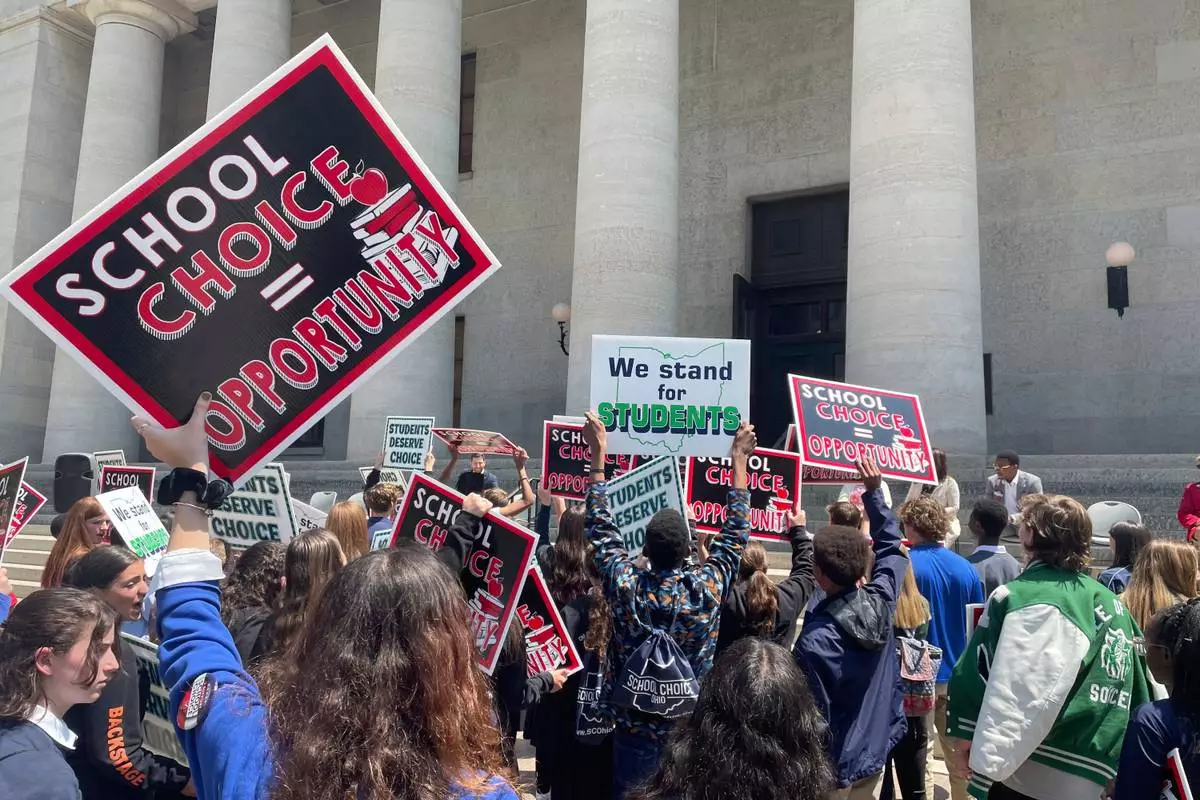
FILE - Students and parents rally at the Ohio Statehouse in support of possible changes that would increase eligibility for taxpayer-funded school vouchers to K-12 students statewide, May 17, 2023, in Columbus, Ohio. (AP Photo/Samantha Hendrickson, File)
ATLANTA (AP) — A growing number of amusement parks have shut down roller coasters as police and state regulators investigate what caused a man to fall out of his seat and plummet to his death at a Georgia park.
Sea World Orlando in Florida and La Ronde theme park in Montreal, Canada, confirmed on Thursday they had temporarily closed rides, bringing the total number of roller coasters halted to 12.
Police and a state regulatory agency are investigating what caused Hassan Jihad Ibn Kariem, a 42-year-old school employee from Atlanta, to fall from the Goliath coaster at Six Flags Over Georgia on Monday. Witnesses described seeing him ejected from the coaster; some people who rode the Goliath before him raised concerns about its restraints.
Ten of the roller coasters taken out of service have the same manufacturer and a similar restraint system as the Goliath at Six Flags.
Erica Billups said her son and daughter rode Goliath about an hour before Kariem’s death and encountered a problem with the restraint on one seat. Her son initially sat in that seat and tried to lock it, but then moved when it repeatedly became unlocked. The roller coaster embarked with the seat empty and the harness up, she said in a post on X.
She confirmed the post in a text message to The Associated Press on Thursday.
She said staff did not tell her kids there was a problem.
Summer Bates, who was at the Georgia park with her husband and three children and saw Kariem fall, told the AP previously that her older two children kept trying to push their restraints down tighter while on the ride. She understood why they were doing that later when she was on the coaster, she said, because the restraints didn’t feel secure.
Six Flags did not immediately respond to an email for comment on any issues with restraints.
La Ronde in Montreal said one of its coasters — also named Goliath — is offline “while we conduct a thorough safety review in collaboration with the ride’s manufacturer.”
Neither La Ronde nor Sea World Orlando said why those specific rides were closed. Both were manufactured by the Swiss company Bolliger & Mabillard, which also built the Goliath ride in Georgia and eight of the other coasters that Six Flags closed. Bolliger & Mabillard declined Thursday to answer questions about the shutdowns.
Online photos and videos of 10 of the closed coasters show each equipped with so-called “clamshell” restraints, mounted in front of each seat on a vertical bar that sits between the rider’s knees. The bar locks the padded restraint into place over the rider’s lap and upper legs.
It’s unclear from the images whether any of those coasters also have seat belts or other secondary restraints. Goliath in Georgia has no such backup restraints.
Dennis Speigel, a theme park consultant and past president of the International Association of Amusement Parks and Attractions, a trade group, said the similar restraint systems are almost certainly why most of the coasters were closed.
Speigel said they’re likely to remain shut down until investigators have determined what went wrong on the Georgia coaster, but he said that “obviously it was something with the restraint.”
Roller coaster manufacturers decide what type of restraints to use after considering speed, force and the track’s transitions, said Brian D. Avery, a University of Florida professor and amusement ride safety expert.
He advocates the use of a backup restraint for riders, but there is a long-running debate in the industry over whether that would increase wait times, Avery said.
The company said in an email it would have no further comment until it had a “better understanding of what transpired” on Monday.
Kariem was thrown from his seat and struck other patrons before landing below the ride. Goliath, one of Six Flags Over Georgia's headline attractions, towers above the park's entrance. It opened in 2006 and features a series of hills and turns. It doesn’t take riders upside down, but its first hill rises to 200 feet (61 meters) and it has a top speed of 70 miles per hour (112 kilometers).
Nick Mendenhall, who had just ridden Goliath with his son and was watching the coaster cars passing overhead, said it looked like Kariem was hovering because the car was moving underneath him. He fell headfirst back into the coaster, Mendenhall said, and then was ejected from the ride on its final turn.
A class-action lawsuit filed by investors in 2025 alleges that Six Flags concealed the poor state of its amusement parks — including long-neglected maintenance — ahead of its merger with major amusement park operator Cedar Fair.
“Prior to the Merger, Legacy Six Flags had for years deferred or foregone basic park maintenance, operational improvements, infrastructure repairs, and ride design and development updates,” the complaint said. The company also cut staffing to reduce costs, it alleges.
Timothy Loranger, a California attorney who sued Six Flags in a fatal case, said it’s a positive step that the theme park chain closed down rides at other parks as a precaution. Loranger represented the family of 22-year-old Christopher Hawley, who died after riding the X2 roller coaster in 2022 at Six Flags Magic Mountain.
“In all instances, X2 had many reports of injury in the past, and instead of doing a deep dive investigation into the ride, they did things like blame the passengers, the injured person for not sitting properly or holding their head against the headrest or they blamed an imaginary pre-existing condition,” Loranger said.
Six Flags permanently closed the X2 ride last month.
Six Flags Over Georgia is set to reopen on Friday. The Goliath, however, is not expected to be running.
The park, which has about a dozen roller coasters, is in Austell, about 15 miles (24 kilometers) northwest of Atlanta.
Bynum reported from Savannah, Georgia. Associated Press writers Dylan Lovan in Louisville, Kentucky, and Jaimie Ding in Los Angeles contributed to this report.
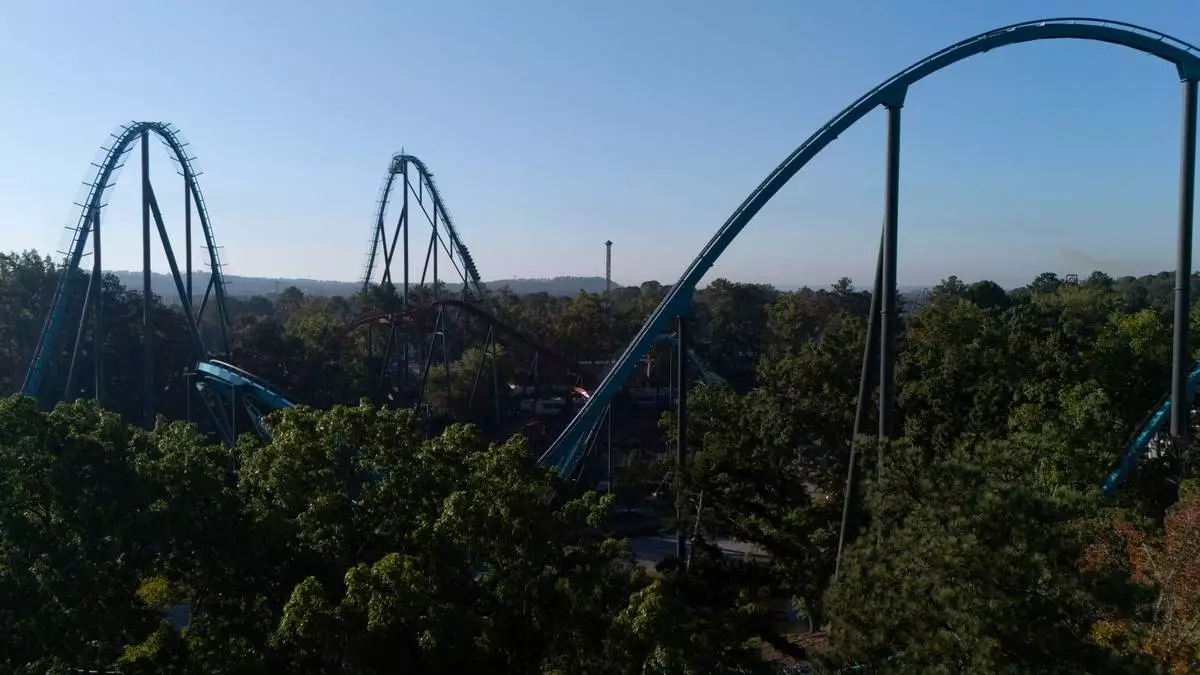
Attractions are seen at Six Flags Over Georgia, about 15 miles (24 kilometers) northwest of Atlanta, Tuesday, Oct. 13, 2026. (AP Photo/Mike Stewart)
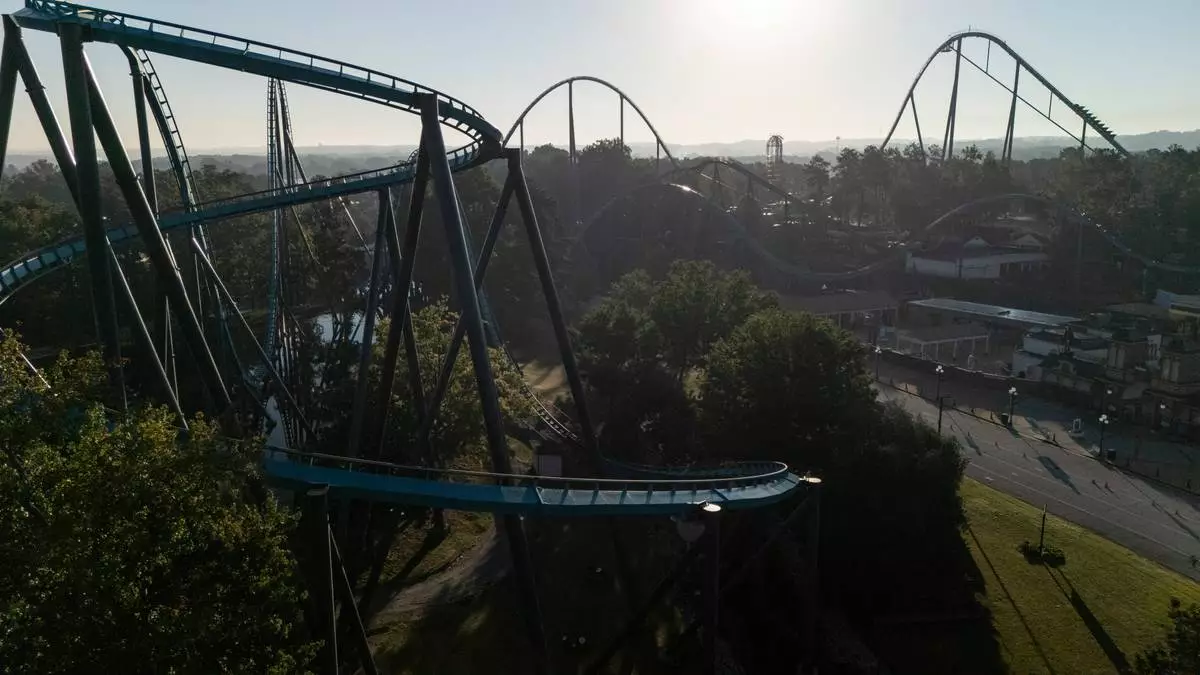
Attractions are seen at Six Flags Over Georgia, about 15 miles (24 kilometers) northwest of Atlanta, Tuesday, Oct. 13, 2026. (AP Photo/Mike Stewart)
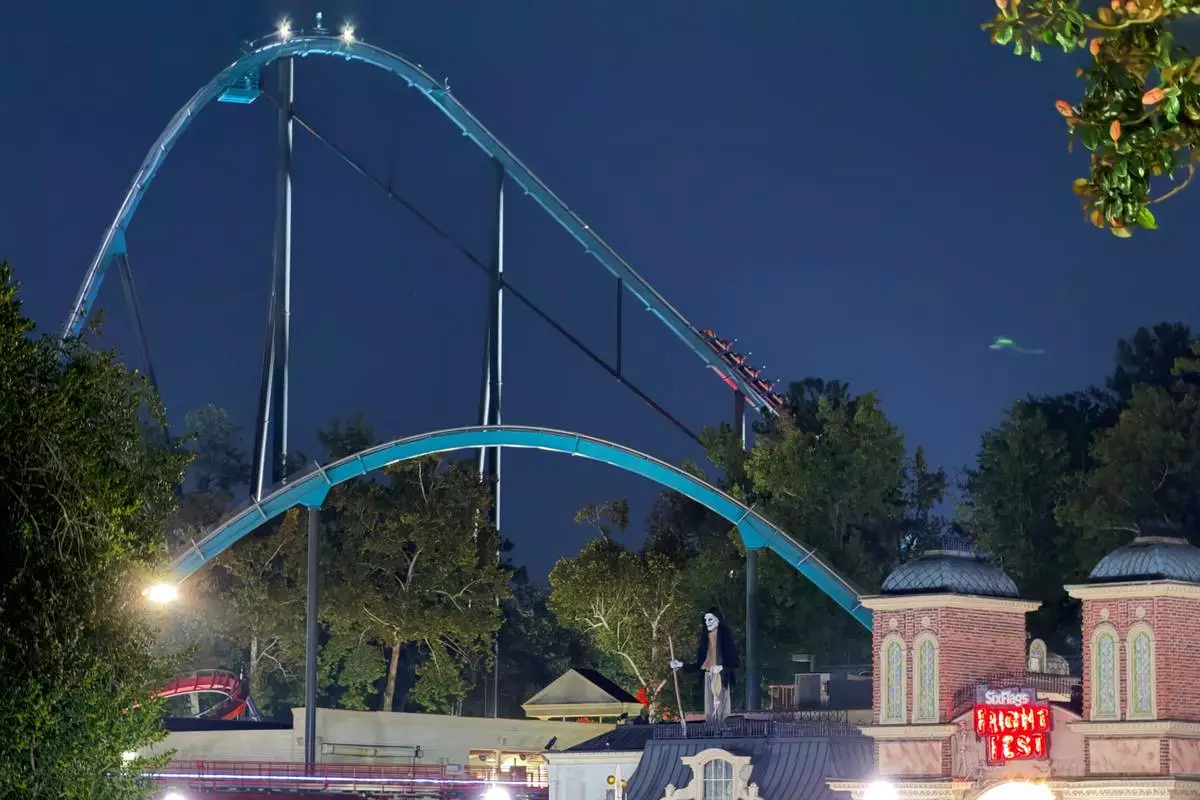
A roller coaster is shown at Six Flags over Georgia on Monday, Oct. 12, 2026 in Austell, Ga. (AP Photo/Emilie Megnien)
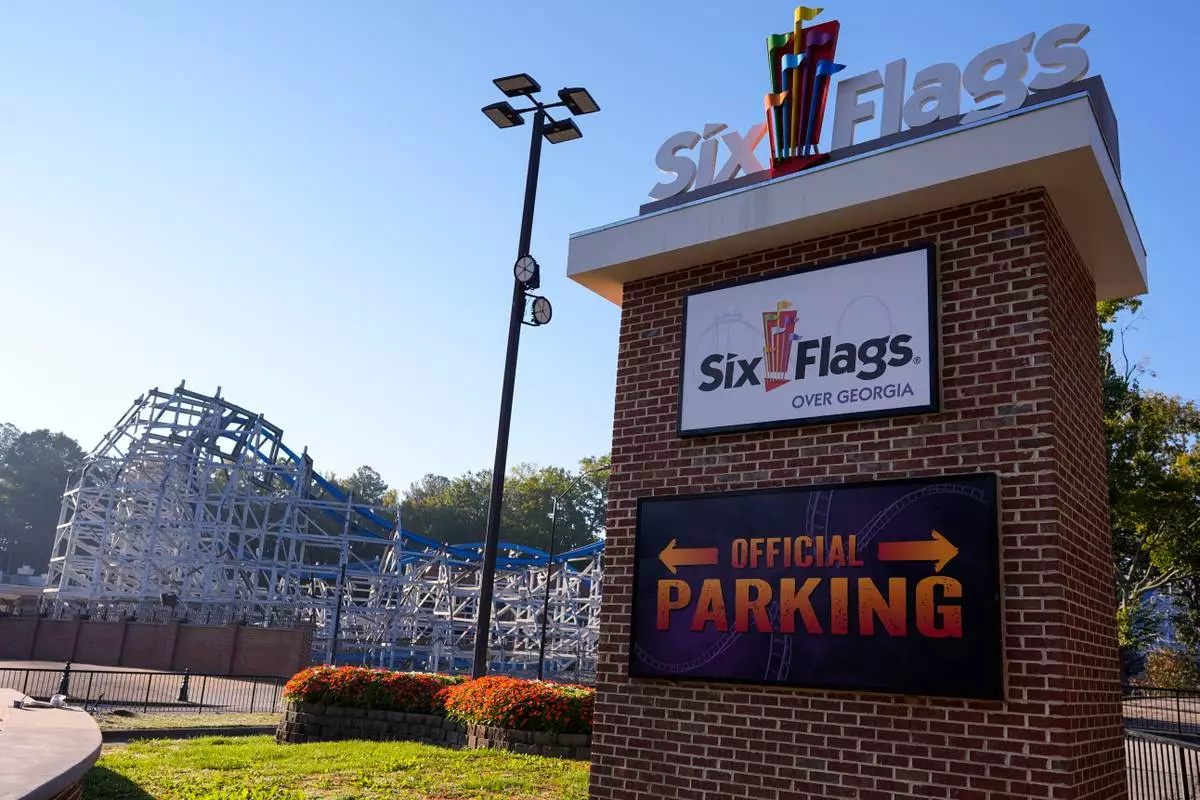
Attractions are seen at Six Flags Over Georgia, about 15 miles (24 kilometers) northwest of Atlanta, Tuesday, Oct. 13, 2026. (AP Photo/Mike Stewart)