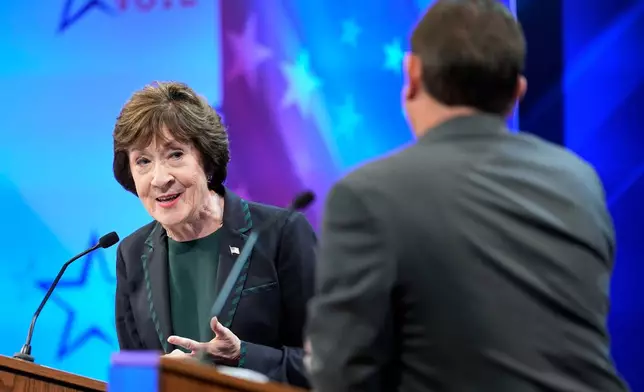
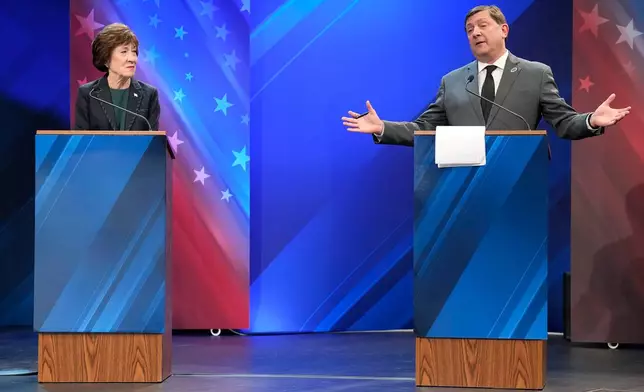
PORTLAND, Maine (AP) — Democratic Senate candidate Troy Jackson told Republican Sen. Susan Collins to “shut up” during a heated final Maine U.S. Senate debate that also included an interruption from a data center protester.
Thursday night's debate in a Bangor theater was the last of four meetings between Collins and Jackson, who are running for a seat that's considered crucial in the fight for a Senate majority. The debate, like those that preceded it, included several testy exchanges over issues including the national debt, Collins' relationship with President Donald Trump's administration, and the candidates' respective roles in worsening partisan divisions.
Click to Gallery
This combination of photos shows Sen. Susan Collins, R-Maine, on Sept. 24, 2026, in Washington, left, and her challenger for the Maine's U.S. Senate seat, Democratic candidate Troy Jackson on July 16, 2026, in Portland, Maine. (AP Photo/Mariam Zuhaib, Robert F. Bukaty)
Sen. Susan Collins (R) and Troy Jackson (D) shake hands at the end of the final Maine U.S. Senate debate in Bangor, Maine, Thursday, Oct. 15, 2026. (Gregory A. Rec/Portland Press Herald via AP, Pool)
Sen. Susan Collins (R) looks to Troy Jackson (D) as he answers a question during the final Maine U.S. Senate debate in Bangor, Maine, on Thursday, Oct. 15, 2026. (Gregory A. Rec/Portland Press Herald via AP, Pool)
Sen. Susan Collins (R) looks to Troy Jackson (D) as he answers a question during the final Maine U.S. Senate debate in Bangor, Maine, Thursday, Oct. 15, 2026. (Gregory A. Rec/Portland Press Herald via AP, Pool)
This combination of photos shows Sen. Susan Collins, R-Maine, on Sept. 24, 2026, in Washington, left, and her challenger for the Maine's U.S. Senate seat, Democratic candidate Troy Jackson on July 16, 2026, in Portland, Maine. (AP Photo/Mariam Zuhaib, Robert F. Bukaty)
The scene became briefly chaotic when a protester opposing data centers began yelling as Collins spoke. As moderators asked for the protester to be removed, Collins said the shouting demonstrator was “obviously one of Troy's supporters.”
Jackson responded: “Oh, shut up. I don't even know that kid.”
Maine GOP said in a social media post after the debate that Jackson's “shut up” comment was “unacceptable behavior.” Jackson's campaign declined to comment on the exchange.
The issue of party loyalty came up during the debate, with one question posed to Collins asking her to cite a time she has defied the Republican Party. She referenced her push to oppose Pete Hegseth's nomination as defense secretary, saying she organized Republicans to vote no. But Collins acknowledged he was confirmed despite her effort.
Collins accused Jackson of being a guaranteed vote for the Democratic Party while she has a track record of independence. Jackson disputed that characterization and said Collins is loyal to Trump when he needs key votes.
“What I know is that 100% of the time when Donald Trump goes to Susan Collins for a vote, he gets it,” Jackson said.
Collins, who is seeking her sixth term, has sought to distance herself from Trump during the debates, including using the phrase “Gulf of Mexico” instead of Trump's preferred “Gulf of America.” Jackson described Collins' votes against Trump as “managed votes” when she already knows the outcome is decided.
Jackson's campaign also said Thursday that it raised $20.4 million in the third quarter as it seeks to close a funding gap with Collins. Jackson was a late entry into the race and the third quarter was his first quarter of fundraising.
Collins’ campaign said she raised $5.2 million in the same time period. Collins began the race with a considerable fundraising advantage over Jackson, as she had raised more than $18 million by the end of June and Jackson did not become the Democrats’ nominee until late July.

Sen. Susan Collins (R) and Troy Jackson (D) shake hands at the end of the final Maine U.S. Senate debate in Bangor, Maine, Thursday, Oct. 15, 2026. (Gregory A. Rec/Portland Press Herald via AP, Pool)
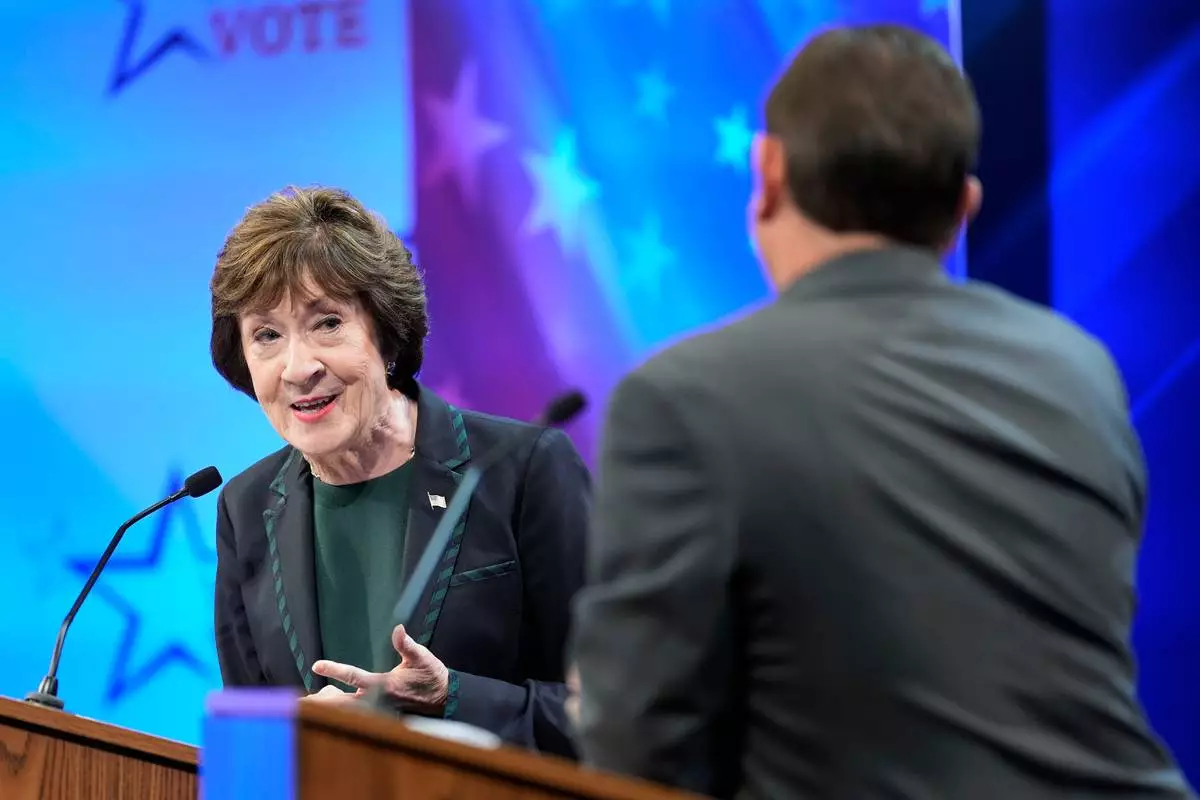
Sen. Susan Collins (R) looks to Troy Jackson (D) as he answers a question during the final Maine U.S. Senate debate in Bangor, Maine, on Thursday, Oct. 15, 2026. (Gregory A. Rec/Portland Press Herald via AP, Pool)
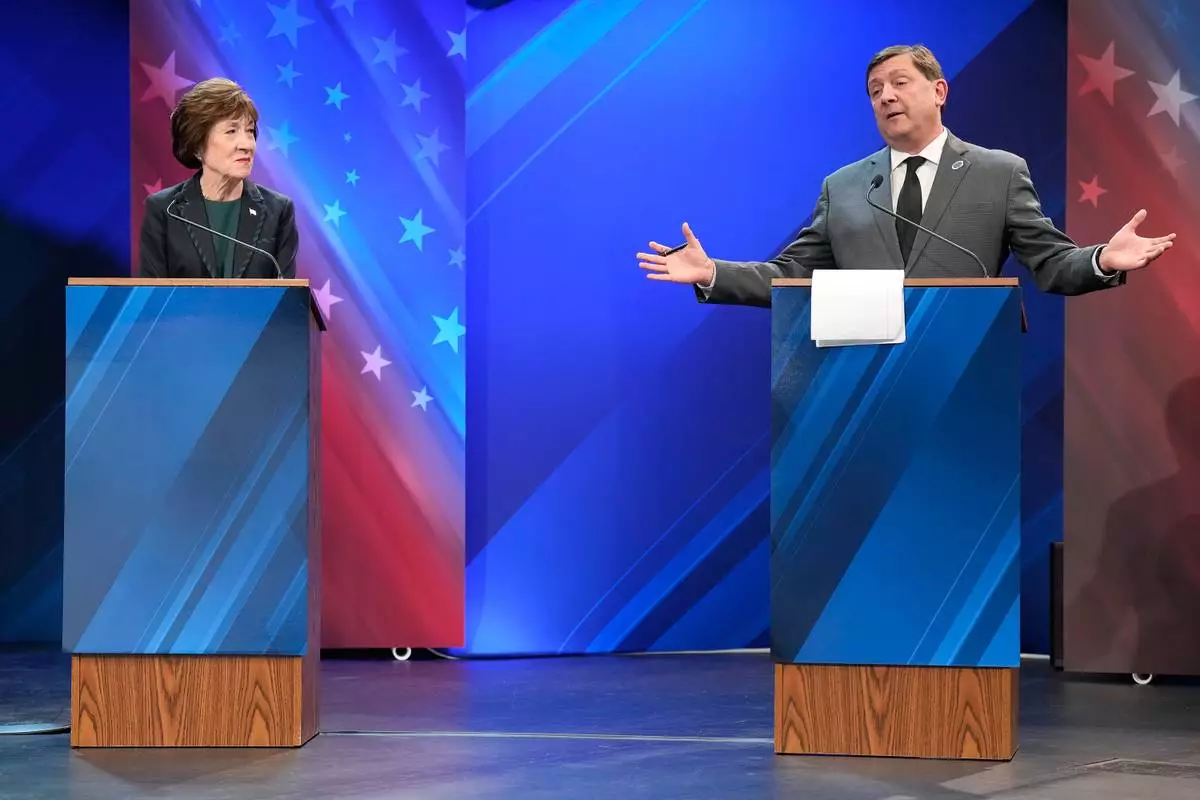
Sen. Susan Collins (R) looks to Troy Jackson (D) as he answers a question during the final Maine U.S. Senate debate in Bangor, Maine, Thursday, Oct. 15, 2026. (Gregory A. Rec/Portland Press Herald via AP, Pool)
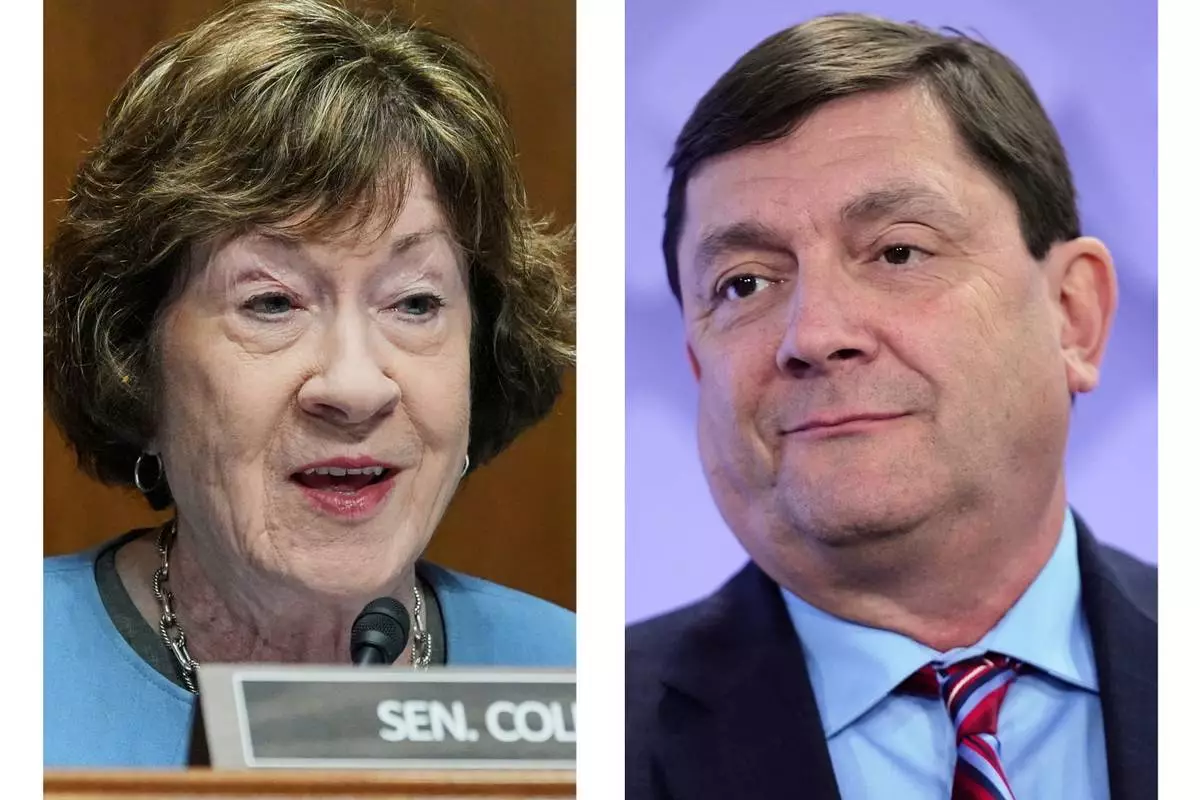
This combination of photos shows Sen. Susan Collins, R-Maine, on Sept. 24, 2026, in Washington, left, and her challenger for the Maine's U.S. Senate seat, Democratic candidate Troy Jackson on July 16, 2026, in Portland, Maine. (AP Photo/Mariam Zuhaib, Robert F. Bukaty)
At a packed rally in Texas Thursday, James Talarico compared his U.S. Senate campaign to David — who fought Goliath — as the Democrat faces more than $158 million in outside spending by Republican leadership and the world's richest man, Elon Musk.
Talarico told rallygoers under bright lights that David may not have had Goliath's strength, but he had a slingshot.
“You are my slingshot," he continued, without mentioning Musk or the other the spending against him. "We are going up against our own Goliaths.”
The description falls in line with Talarico's past rhetoric painting politics not as right versus left, but the ultrawealthy versus everyone else, as he tries to become the first Democrat to win statewide in over 30 years. Talarico's own campaign has raised record amounts of money in one of the nation's more expensive and competitive Senate races.
The national conversation around Talarico’s campaign has evolved over the past months. Initially, the state lawmaker was considered just the latest of several Democratic candidates over the past years who gave the party a hope of flipping Texas, only for that hope to deflate come Election Day.
Now, Talarico is seen as a real contender to win the seat against Republican candidate Ken Paxton. Talarico’s success so far can partly be chalked up to voters’ apprehensions toward Paxton, who faced questions in his past over corruption, including being impeached by his own party in the Texas legislature. He was later acquitted.
While outside spending in support of Paxton has flooded the Texas airwaves with ads, Talarico's campaign itself has outpaced Paxton's in fundraising from donors eager for Texas to forgo its solidly Republican title.
The prospect of a flagship GOP state turning blue doesn't just fill Democrats with glee and Republicans with alarm. Whoever wins will help determine which party controls the Senate in President Donald Trump's final two years in office, making it either smooth sailing for Trump or a bog of investigations and opposition.
Talarico, a seminarian and state representative, has also tread a very careful path — as nonpartisan as he can — from the major metros that already tilt Democratic, along the border towns that flipped from blue to red last election, and to the rural Republican high plains and desert.
The candidate has distanced himself from former President Joe Biden's administration and his own party, and while progressive Sen. Bernie Sanders is coming to Texas this month, he won't be sharing a stage with Talarico.
Talarico's strategy is to take direct aim at what voters say they are most concerned about: the costs that have inexorably grown for years. That unaffordability, Talarico argued at the nighttime rally in Texas that was packed with younger voters, is because billionaires and corrupt politicians have rigged the system. It resonated.
“They think that they can buy us, and that they can essentially be the kings of the country,” said Kaitlyn Johnson, a 29-year-old bartender who attended the rally.
Johnson felt that Talarico put words to that feeling she'd held for awhile, and the high costs keep nagging at her, too.
“I make decent money,” she said, “but there's no way in hell that I'm going to be able to buy a house anytime soon.”
Trump and Republicans are well aware of Talarico's ability to connect with voters, and of Paxton's struggles to find purchase in what would otherwise be a relatively easy race for a Republican. The president has made several trips to Texas to rally for Paxton.
Paxton has received significant financial support from Musk, who last year headed Trump’s Department of Government Efficiency. Musk contributed $158 million to the Senate Leadership Fund, federal campaign spending filings showed Thursday. The Senate Leadership Fund gave $158 million to Texas PAC, the largest contributor to Paxton’s campaign.
Musk also provided $10 million to Lone Star Liberty PAC, a group that supports Paxton.
The rally Thursday in the small city of San Marcos south of Austin follows nine days earlier this month when Talarico was out of the public eye due to the flu. His absence sparked a swirl of conspiracies online, including the false claim that he was at a mental health treatment center in Ohio. Shared by conservative social media influencers, the claim quickly fell apart at closer inspection.

President Donald Trump listens as Republican U.S. Senate candidate Texas Attorney General Ken Paxton speaks at a campaign rally at the Freeman Coliseum in San Antonio, Wednesday, Oct. 7, 2026. (AP Photo/Alex Brandon)

Supporters listen to Democratic U.S. Senate candidate Texas state Rep. James Talarico speaks during a campaign event in San Marcos, Texas, Thursday, Oct. 15, 2026. (AP Photo/Eric Gay)

Democratic U.S. Senate candidate Texas state Rep. James Talarico waves as he leaves a campaign event in San Marcos, Texas, Thursday, Oct. 15, 2026. (AP Photo/Eric Gay)

Democratic U.S. Senate candidate Texas state Rep. James Talarico speaks during a campaign event in San Marcos, Texas, Thursday, Oct. 15, 2026. (AP Photo/Eric Gay)

FILE - Democratic U.S. Senate candidate Texas state Rep. James Talarico speaks during a television interview at a food drive at the Frederick Douglass Human Services and Justice Center, Sept. 9, 2026, in Dallas. (AP Photo/Julia Demaree Nikhinson, File)