Croatian President Zoran Milanovic met with visiting Chinese Foreign Minister Wang Yi in the Croatian capital of Zagreb on Friday, expressing Croatia's willingness to strengthen exchanges at all levels and advance mutually beneficial cooperation with China.
During their meeting, Milanovic asked Wang, also a member of the Political Bureau of the Communist Party of China Central Committee, to convey his sincere greetings to Chinese President Xi Jinping. China has undergone tremendous changes over the past few decades and made remarkable achievements in economic and social development, Milanovic said.
China's peaceful development poses no threat to any country and should be viewed objectively and rationally by all parties. Each country has its own system and principles, and all countries should respect each other's development paths and ways of life and strengthen mutual understanding and trust through dialogue and communication, Milanovic said.
Stressing that Croatia and China enjoy longstanding friendly relations and have achieved significant outcomes in cooperation across various fields, Milanovic said that Croatia attaches great importance to its relations with China, and is willing to strengthen exchanges at all levels and advance mutually beneficial cooperation.
Milanovic said that he has long paid attention to China's foreign policy and fully understands its positions and views. He reaffirmed Croatia's firm commitment to the one-China policy, stressing that Taiwan is an inalienable part of China.
Wang conveyed President Xi's cordial greetings to President Milanovic and commended him for his rational, pragmatic and friendly perspective on China's development and rejuvenation. Wang also highlighted Milanovic's efforts to promote mutual understanding and his longstanding commitment to friendly exchanges with China.
With a civilization spanning 5,000 years, China's deep-rooted commitment to peace means that it does not seek to use its strength to dominate others, but instead pursues cooperation and mutual benefits with all countries, Wang added.
President Xi has put forward the goal of building a community with a shared future for mankind, emphasizing that all countries should stand together, embrace their shared destiny and jointly protect and develop the only planet that humanity calls home, Wang said.
China advocates an equal and orderly multipolar world in which all countries, large and small, are equal and uphold the basic norms of international relations based on the United Nations Charter, Wang said.
Emphasizing that China has found a development path suited to its own conditions, supported by its people and aligned with the trend of the times, Wang said that the great rejuvenation of the Chinese nation has entered an irreversible historical process.
China will strive to make the world more peaceful, stable and prosperous, Wang said, adding that China's success is not only its own, but also a success for all countries of the Global South.
China is willing to view its relations with Croatia from a strategic and long-term perspective and explore ways to further elevate bilateral ties on the basis of their comprehensive cooperative partnership, Wang said.
The two sides also exchanged views on China-Europe relations. Wang noted that there is no fundamental conflict of interests between China and the European Union (EU), and that the two sides can help each other succeed and achieve common prosperity.
Regarding the EU's concerns over China's trade surplus, Wang said that the surplus is a result of market demand and the international division of labor. China and the EU are partners, not adversaries, and should pursue cooperation rather than confrontation, he added.
Recent progress under the China-EU trade and investment consultation mechanism shows that the two sides can find mutually beneficial solutions as long as they remain committed to dialogue and consultation, Wang said.
Milanovic said that Croatia, as an EU member, adheres to the bloc's common foreign and security policy while striving to maintain its own independence. On current economic and trade disputes between China and the EU, he said that he shares China's position and believes that China's strong competitiveness stems mainly from an efficient, comprehensive system for organizing production.
He expressed belief that the two sides will resolve development-related issues through communication and dialogue and find solutions satisfactory to all parties.
During his visit to Croatia, Wang also held talks with Croatian Minister of Foreign and European Affairs Gordan Grlic Radman.
Croatia is one of the stops on Wang's tour of Azerbaijan, Croatia, Montenegro and Bulgaria from Oct 14 to 20.
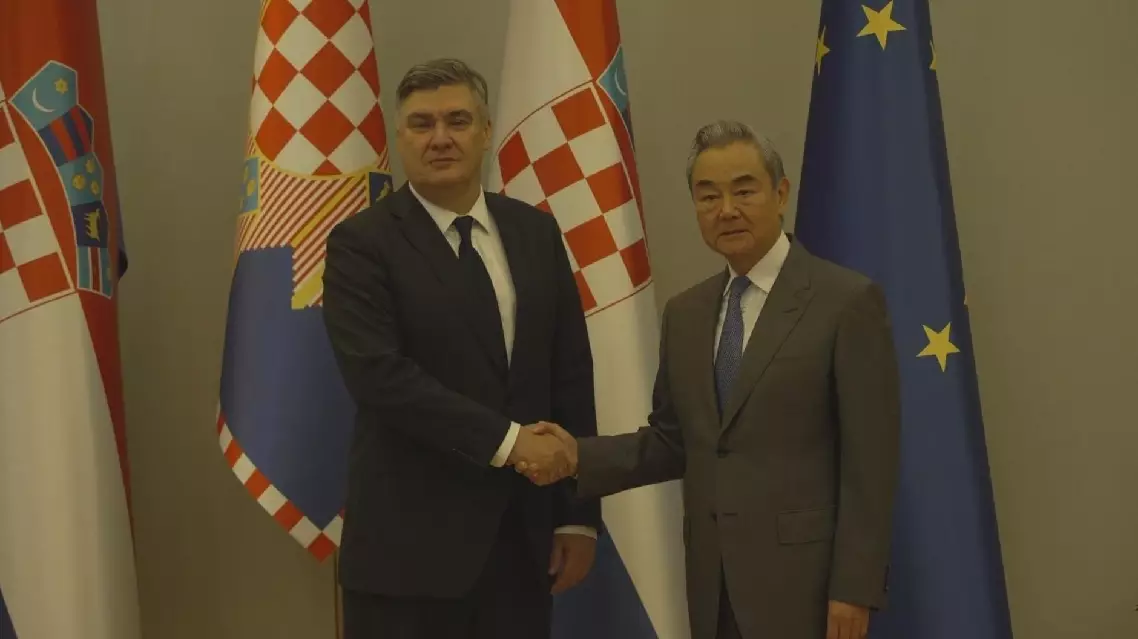
Croatian president meets Chinese FM, pledges to strengthen bilateral cooperation