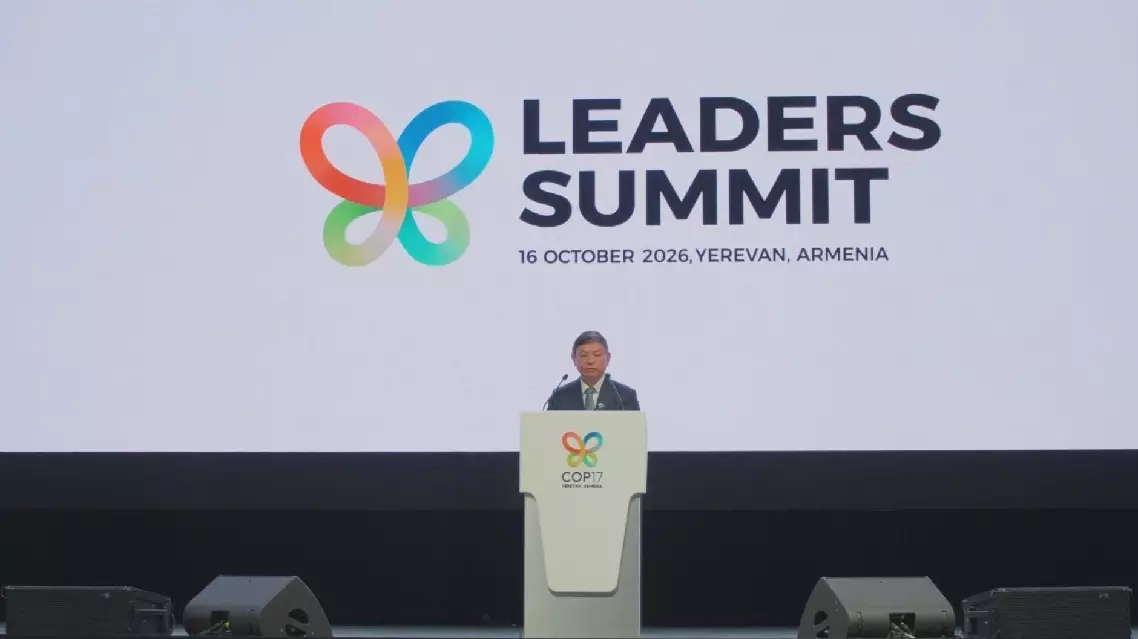
Chinese Minister of Ecology and Environment Huang Runqiu urged the international community to build consensus, strengthen cooperation and take holistic measures to meet global biodiversity targets on Friday at a summit in Armenia's capital Yerevan.
The summit was held ahead of the 17th Conference of the Parties (COP17) to the Convention on Biological Diversity scheduled for Oct 19 to 30.
In his speech at the summit in the capacity of China's representative, Huang outlined the country's progress and achievements in biodiversity protection in recent years.
Under the theme "taking action for nature," the summit aims to raise the ambition of the Kunming-Montreal Global Biodiversity Framework, adopted in 2022, and advance coordinated global action to protect biodiversity.
Huang said that China has consistently taken part in global biodiversity governance with the highest political will and the strongest practical action, and helped secure the landmark Kunming-Montreal framework, which maps out a blueprint for global biodiversity protection through 2030 and beyond.
With the framework guiding the way, countries have stepped up efforts, updating their strategies, action plans and national targets, and global ecological restoration and conservation have made progress.
China urges stronger global action at biodiversity summit ahead of COP17
China urges stronger global action at biodiversity summit ahead of COP17
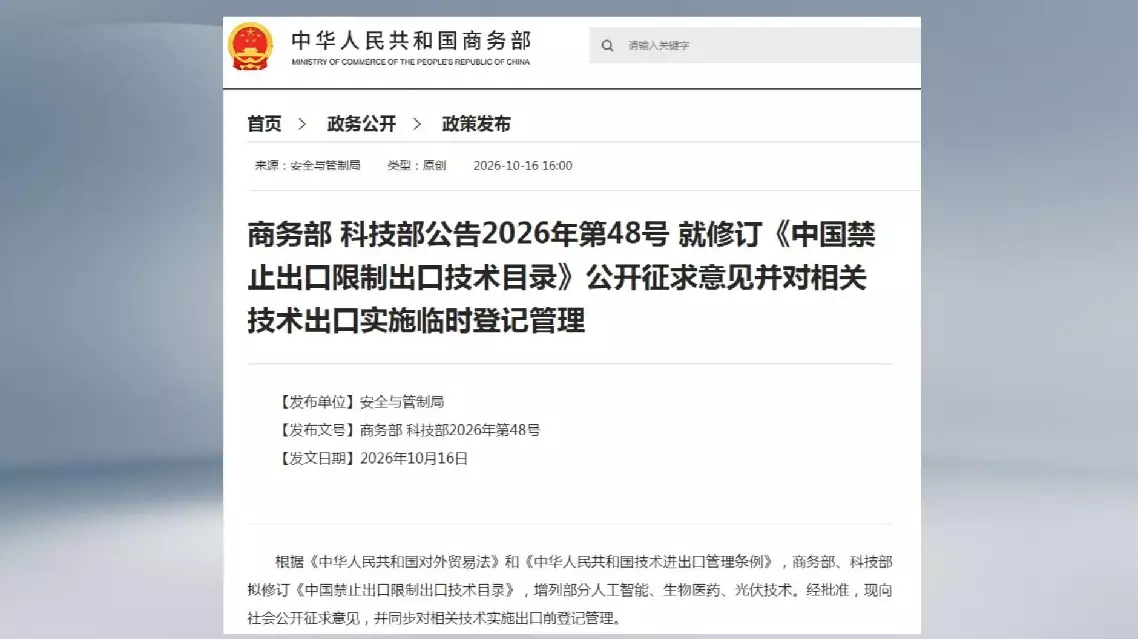
Chinese authorities on Friday began soliciting public opinion on a revision to the catalog of technologies that are subject to export bans or restrictions, with plans to add some technologies in artificial intelligence (AI), biomedicine and photovoltaics to the list.
The adjustment, initiated by the Ministry of Commerce and the Ministry of Science and Technology, covers 40 technologies across the three sectors, according to a notice released by the commerce ministry.
Pre-export registration management will be implemented for these technologies in parallel, the commerce ministry said.
The proposed adjustment includes 23 technologies related to large models, intelligent agents, computing power clusters, and information processing in the AI sector, five technologies related to cell and gene therapy, small nucleic acid drugs, and pathogenic microorganisms in the biomedical sector, and 12 technologies related to polysilicon, wafer and cell manufacturing in the photovoltaic sector.
In a separate statement, the commerce ministry said adjustments to the catalog have been routine since 2001, and the latest proposed revision does not target any specific country, region or entity.
The ministry noted that major economies have implemented varied export controls amid the expanding application of AI, biomedicine and photovoltaic-related technologies in sensitive fields in recent years.
China exercises necessary management in accordance with the law to prevent the risk of losing control over technologies and their improper proliferation, while safeguarding normal international technological exchanges and cooperation, it said.
Regarding the AI sector, the ministry said the move aims to ensure AI technologies are safe and controllable, noting the risk of misuse, including the employment of AI-driven malicious code generation and mutation technologies to attack sensitive systems such as information infrastructure and bypass national security defense systems.
However, the authorities have also specified multiple export scenarios to which facilitation measures can apply, reflecting a tiered and categorized management approach that enhances policy transparency and predictability.
For instance, AI technologies that have already entered the public domain through open source and published academic papers will be exempt from the export control measures. In the biomedical sector, automatic licensing will apply to outbound licensing models that do not involve a transfer of ownership.
The soliciting of public opinion lasts from Oct. 16 to Nov. 15, 2026, and the specific content of the adjustment can be found on the commerce ministry's official website.
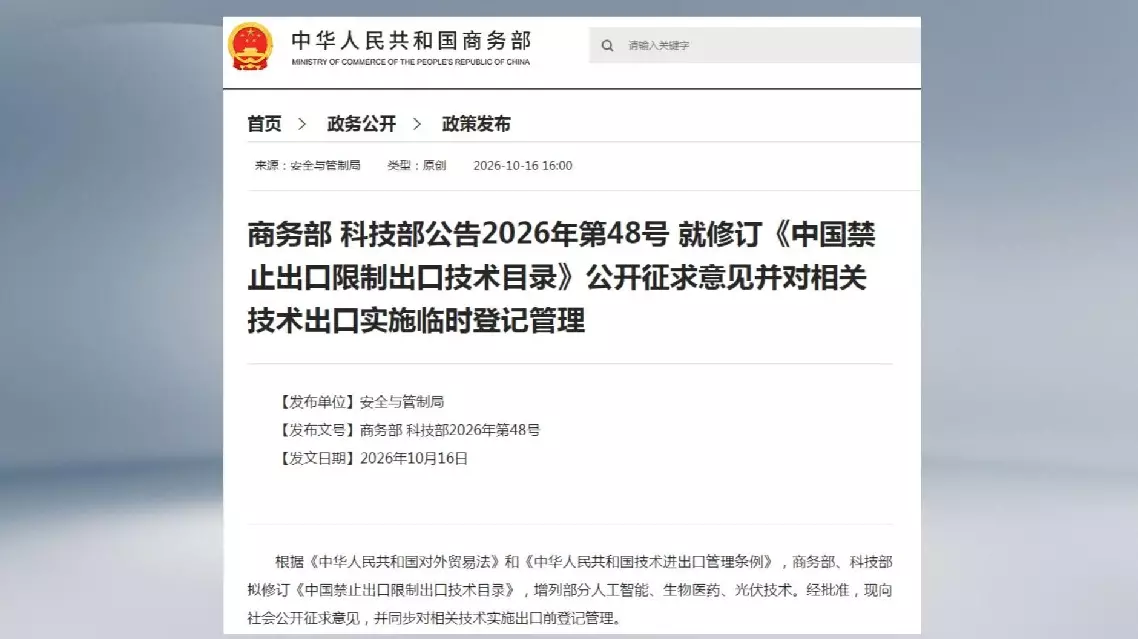
China to adjust export control list, proposes adding AI, biomedicine, photovoltaics
China to adjust export control list, proposes adding AI, biomedicine, photovoltaics