In northwest China's Ningxia Hui Autonomous Region, a potato noodle-making craft passed down from Red Army soldiers 90 years ago has grown into a flourishing industry. Today, Red Army noodles not only help lift villagers out of poverty but also reach dining tables across China.
As this year marks the 90th anniversary of the Long March, a historic trek by the Red Army from 1934 to 1936, memories surface not only of grueling battles, but also of peaceful moments shared between soldiers and locals. In Xiji County, Red Army noodles are more than a local delicacy; they are a living link to this remarkable history.
In August 1935, the 25th Red Army Corps passed through Xiji on the Long March. Wounded soldiers stayed behind longer to recover, and one Red Army soldier saw locals roasting, baking, or frying potatoes. He showed them a new method: hand-made potato noodles. Gu Haiyin's grandfather was one of the locals who learned the craft. Today, Gu is a third-generation inheritor of Red Army noodles.
"Back then, lacking proper tools, they carved this strainer from a tree root on-site to make vermicelli [potato noodles] and teach locals the craft. My grandfather learned the skill. When the Red Army departed, they left the strainer to him. He kept using it to make vermicelli, then passed it to my father, and now it is in my hands," Gu said.
To expand the market for Red Army noodles, Gu founded his own noodle factory in 2016. Drawing on his traditional know-how, he standardized production and scaled up, raising output to four tonnes a day.
"After my poverty-alleviation workshop opened in 2020, output multiplied several times compared with 2016, reaching around 1,000 tonnes annually," Gu said.
The skills taught by the Red Army have been upgraded over time, and potato noodle making has become one of Xiji's prime industries. Gu's business earns nearly 10 million yuan (around 1.5 million U.S. dollars) in annual revenue, employs more than 30 villagers, and pays out over one million yuan (around 150,000 U.S. dollars) in salaries each year.
"After taking up this local job, villagers are able to care for their children and manage their own farmland at home. The flexible schedule lets them earn additional income," Gu said.
But his business is only one piece of a larger potato-noodle industry that now thrives across the county's villages.
"We have 643 registered households with a population of 2,742 in our village. Thirteen such enterprises operate in our village. They provide jobs for 287 people, including 178 formerly poverty-alleviated households. Our annual output exceeds 9,000 tonnes, with an output value of over 120 million yuan (around 17.9 million U.S. dollars)," said Min Shifu, Party branch secretary of Wanghe Village.
Today, Red Army noodles can be found not just in Xiji but on dining tables across China. Ninety years on, the humble potato stands as a tasty reminder of this region's unique place in history.
The Long March, a roughly 12,500-kilometer military odyssey that began in 1934, not only preserved the revolutionary forces but also gave the Communist Party of China a new foothold to strengthen the revolution and a new starting point to carry it to victory.
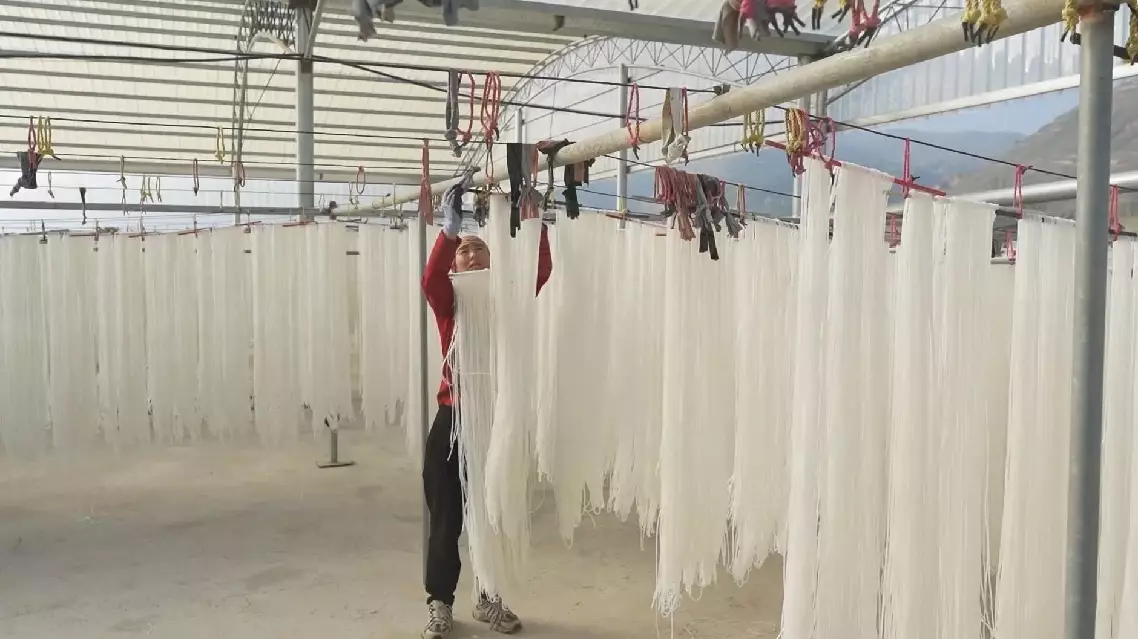
Red Army-inherited potato noodle lifts Ningxia's remote county out of poverty