TOPEKA, Kan. (AP) — Fifth-generation Kansas farmer Glenn Brunkow describes this time of year as “go time,” when farmers are combining fields, hauling crops to town and moving livestock from summer pastures to their winter homes.
But this harvest season, they’re doing it with diesel prices more than $2.50 per gallon higher than a year ago, adding to financial pressures from rising costs, unpredictable markets and shrinking profits.
“It seems like it’s coming at us from all directions,” said Brunkow, president of the Kansas Farm Bureau.
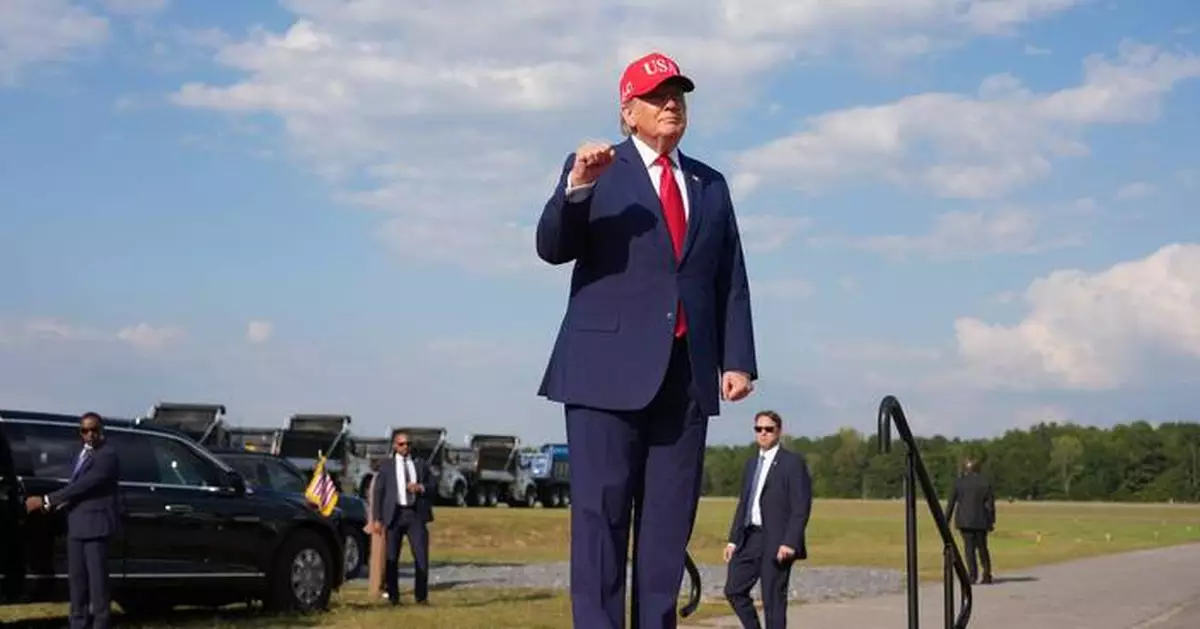
The economic strain is becoming a growing political concern for Republicans in states they have long dominated. President Donald Trump is heading to Kansas on Monday and Iowa later in the week, the latest in a series of stops where he's trying to energize his base in the final weeks before the midterm elections.
The visits come as Republicans pour money into Senate races in Kansas, Nebraska and Iowa amid concerns about voter enthusiasm. The anxiety may be especially notable in Kansas — a state Trump won by 16 percentage points against Democrat Kamala Harris in 2024 — as Republican Sen. Roger Marshall faces a tough challenge from Democrat Adam Hamilton. Democrats have not won a Senate election in Kansas in 94 years.
Brunkow, whose organization endorsed Marshall, said he’s been asked many times whether the economic frustrations could drive Republican farmers to vote for Democrats.
“I don’t think it necessarily does that,” Brunkow said. “But I think it dampens the enthusiasm for agriculture producers to get to the polls.”
Don Hineman, a western Kansas rancher and former Republican state House majority leader, said he’s seeing growing frustration among GOP voters beyond just farmers, including some who have supported Trump in multiple elections.
He said farmers understand that Trump’s tariffs have hurt their businesses and are upset over the ongoing war with Iran. Immigration has also become a source of concern, particularly after recent immigration raids in western Kansas that resulted in the detention of more than 100 people.
“We need a secure border — we can all agree on that,” Hineman said. “But we also need workable immigration policy that provides the workforce that the United States has always depended on and will always continue to need.”
Hineman said the traditional Republican argument in Kansas — that electing Democrats would empower the party’s liberal wing — is losing its effectiveness with some voters, including himself.
“I am tired of being persuaded by charges that the boogeyman is going to get us,” he said. “I am so fed up with the Republican Party and their willingness to play sycophant to our current commander in chief that I’m willing to consider alternatives.”
Debbie Geneva, 61, of Nortonville, Kansas, said she was impressed by Hamilton after he visited a local market to meet people, something she hasn't seen Marshall do. She's never voted for a Democrat, she said, but remains undecided about the Senate race.
“I’ve never voted for a Democrat in my entire life, so that’s a little scary for me to be undecided,” said Geneva. "I told one of my friends that, and they can’t believe it, but that’s just the way I feel right now.”
Geneva said rising costs for healthcare and everyday expenses have added to her frustrations.
“And then of course the trade agreements," she added. “The Republicans haven’t done the Midwest any favors with that.”
Farmers have spent months feeling the squeeze as costs for inputs like diesel, fertilizer and seed have soared due to refinery constraints and supply disruptions tied to the Iran war.
Diesel averaged $6.30 per gallon nationwide on Friday, more than 70% higher than a year ago, according to motor club AAA. The surge has been especially painful during harvest season, when farmers depend heavily on fuel to operate machinery and transport crops.
“This is a time of year when we use a lot of fuel, and there just isn’t much we can do,” Brunkow said. “The margins are tight, and anything that cuts into that margin really hurts.”
The U.S. Department of Agriculture projects that net farm income will decline by 2.6% this year as production expenses rise by 4.5%. Fuel and oil expenses alone are expected to jump nearly 30%, according to the agency’s September forecast.
The Trump administration has attempted to ease some of those burdens. Earlier this month, Trump signed an executive order to ease limits on the tax-free use of red-dyed diesel, a decision he said would save “millions” for farmers. That came after a $12 billion aid package for farmers announced by the Trump administration in December.
But those efforts have not erased frustrations among some farmers who expected their financial outlook to improve under Trump.
Brunkow said many farmers “thought it would be better” under Trump, although he thinks most would still consider him the better choice in the 2024 election.
“He’s made some unforced errors," said Brunkow. “Miscalculations, bad advice, that had unintended consequences.”
Trump will travel on Thursday to Iowa, where Republicans are defending competitive races for governor and Senate. The state, which Trump has carried in three consecutive presidential elections, is another agricultural stronghold where economic frustrations have become part of the political debate.
In Nebraska, Senate Republicans have poured nearly $15 million into a race between GOP Sen. Pete Ricketts and independent candidate Dan Osborn, an unprecedented amount for a state Trump won by 20 percentage points in 2024.
David McIntosh, president of the influential Club for Growth, said his group has kept a close eye on the heavy agriculture states since summer and acknowledged concerns about a drop-off in enthusiasm. His group is spending millions of dollars for GOP candidates in Kansas, Nebraska and elsewhere.
“Farmers are squeezed between higher input prices and less of an international market because of retaliatory tariffs,” McIntosh said. “The economic environment has not been good.”
Democrats, meanwhile, see an opportunity in the economic frustrations, even in states where they have struggled to win statewide elections.
Former Sen. Jon Tester, a Montana Democrat who lost reelection in 2024, said there is “no doubt” that Democrats will perform better than expected in agricultural states.
“These guys got to pay bills at the end of the month, and for a number of months now it’s been hard to do,” said Tester. “This is way beyond politics.”
A third-generation farmer, Tester said he first began farming in 1978 and witnessed the farm crisis of the 1980s, when “a fair number of my neighbors left town.”
“We’re setting up for the same kind of situation,” said Tester. “The economics in family farm production agriculture right now are probably worse right now than they were in the 1980s.”
Cappelletti reported from Washington. Associated Press journalist Nick Ingram contributed to this report.
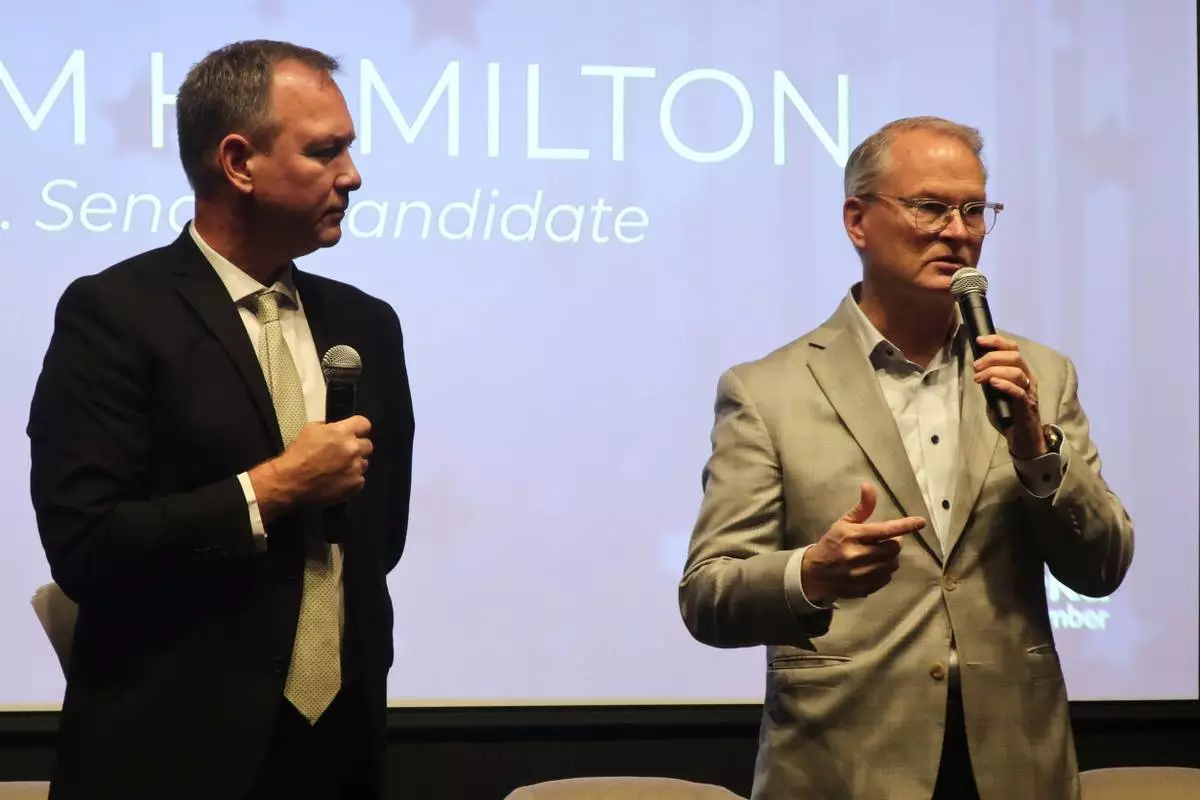
Adam Hamilton, right, the Democratic Senate nominee in Kansas, answers questions posed by Bob Ross, left, the president of the Greater Topeka Chamber of Commerce, during a Meet the Candidate event sponsored by the chamber, Friday, Oct. 16, 2026, in Topeka, Kan. (AP Photo/John Hanna)
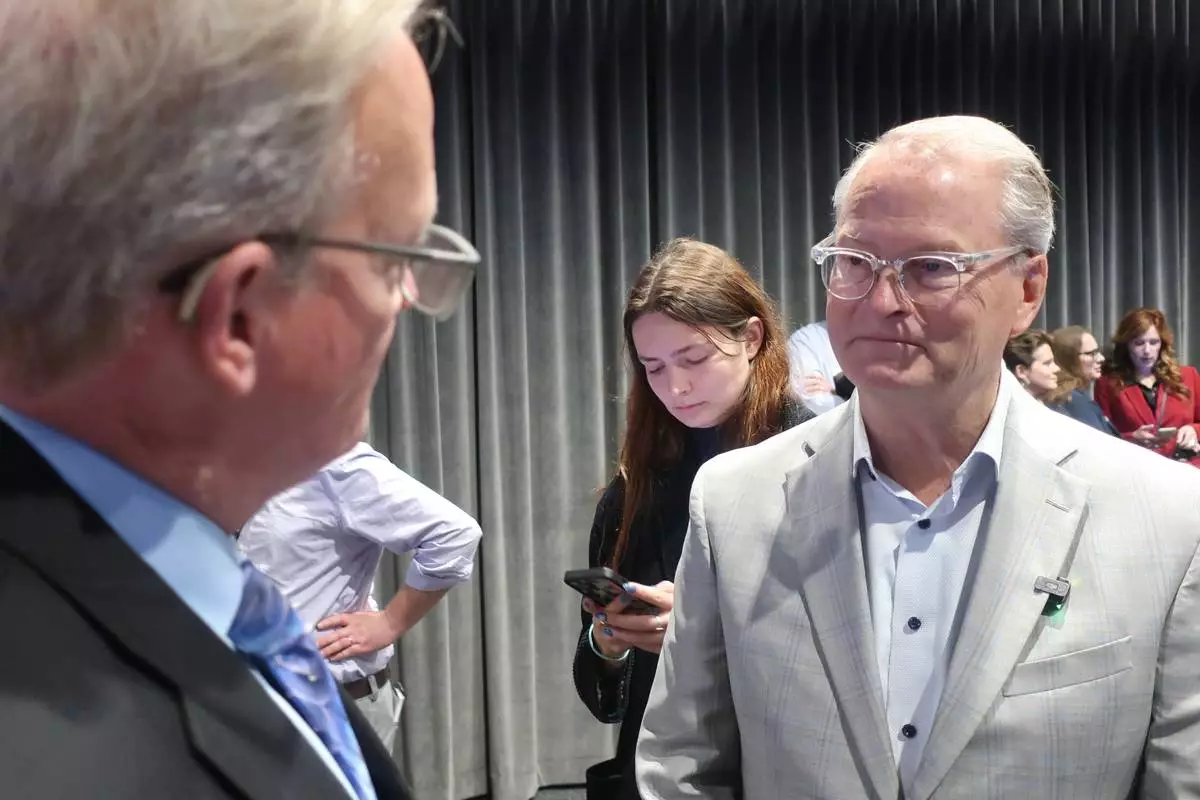
Adam Hamilton, right, Democratic Senate nominee in Kansas, speaks with Curtis Sneden, president and CEO of the Metropolitan Topeka Airport Authority, at a Meet the Candidate event sponsored by the Greater Topeka Chamber of Commerce, Friday, Oct. 16, 2026, in Topeka, Kan. (AP Photo/John Hanna)
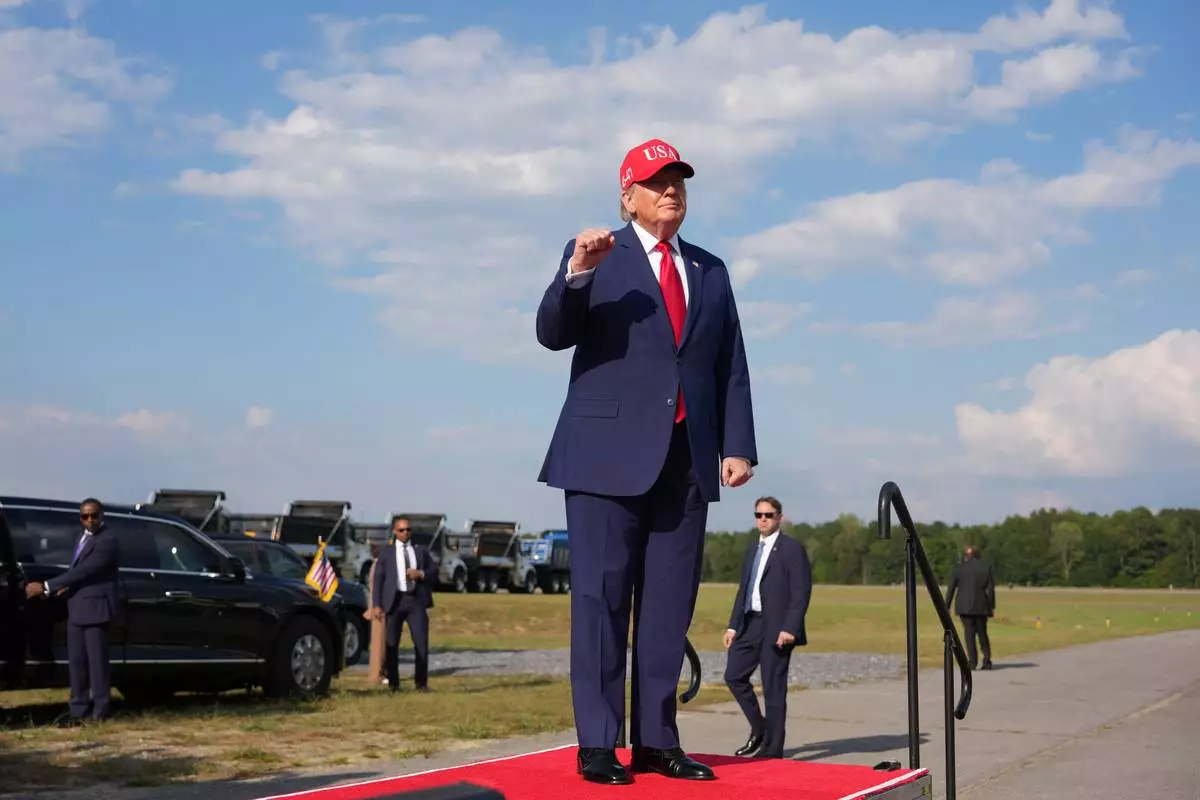
President Donald Trump arrives at a campaign rally at Dalton Municipal Airport, Friday, Oct. 16, 2026, in Dalton Ga. (AP Photo/Mark Schiefelbein)