Skip to Content Facebook Feature Image

Calix Launches Subscriber Agent in CommandIQ To Simplify the Connected Home, Reduce Support Costs, and Build Subscriber Loyalty

Business

Calix Launches Subscriber Agent in CommandIQ To Simplify the Connected Home, Reduce Support Costs, and Build Subscriber Loyalty
Business

Business

Calix Launches Subscriber Agent in CommandIQ To Simplify the Connected Home, Reduce Support Costs, and Build Subscriber Loyalty

2026-10-19 23:36 Last Updated At:23:40

SAN JOSE, Calif.--(BUSINESS WIRE)--Oct 19, 2026--

Today, at its annual innovation and customer success conference, Calix, Inc. (NYSE: CALX) launched Subscriber Agent, bringing a conversational AI assistant to the refreshed Command IQ ® mobile app. Built for Calix Agent Workforce ™ and the AI-native Calix One ™ platform, the new app experience lets residential subscribers use natural voice and text conversations to manage their connected homes, get personalized assistance, and accomplish everyday tasks with greater ease. For service providers, this creates new opportunities to reduce routine support calls and strengthen subscriber loyalty.

This press release features multimedia. View the full release here: https://www.businesswire.com/news/home/20261019305426/en/

Already used by millions of subscribers and customizable to each service provider’s brand, Command IQ gives providers a direct digital channel to deliver differentiated connected-home experiences. The refreshed app simplifies navigation for subscribers, while Subscriber Agent draws on decades of network intelligence and subscriber context to understand individual connected-home environments and help subscribers take action without navigating complex menus or settings.

Subscriber Agent goes far beyond the capabilities of generic AI assistants. It builds on proven SmartHome ™ experiences that have helped service providers achieve Net Promoter Scores℠ (NPS®) in the 80s and 90s and year-over-year revenue growth. Extending intelligent workflows introduced last month, Subscriber Agent makes capabilities like Experience IQ ® for managing family internet experiences, Protect IQ ® for securing home networks, and ScamWatch IQ ™ for navigating online threats easier to access through natural conversations. Together with contextual alerts and billing integration , these capabilities in Command IQ improve the connected-home experience for subscribers while keeping the service provider's brand front and center.

With Subscriber Agent in Command IQ, subscribers can:

To help service providers drive adoption of Subscriber Agent-powered AI assistance in Command IQ and advance residential market success, Calix Success ™ is releasing launch resources, customizable campaigns, and expert guidance. Through Calix University, Success events, and the Calix Community, service providers can access proven playbooks, ready-to-use campaign assets, and personalized support.

Katie Luckett, director of marketing, communications and education atChoptank Electric Cooperative, said: “I grew up as a Choptank member, so I know how important it is that the technology we offer feels useful, convenient, and worthy of the trust our community places in us. Subscriber Agent gives members a secure and more natural way to get help and manage their connected homes 24/7 simply by asking in their own words. For Choptank Fiber, that means empowering members to resolve everyday issues on their own—reducing routine support calls while keeping our team focused on those who need more assistance. Leveraging the Calix One platform gives us a trusted foundation to bring AI into our business in a way that feels practical, secure, and true to how we serve our members.”

Juergen Lindner, chief marketing officer at Calix, said: “In the past, digital experiences required people to figure out what to do next. Subscriber Agent changes that. A new conversational AI experience in Command IQ makes it easy for subscribers to address their everyday issues around their connected homes, simply by asking for help. We are infusing decades of network experience into our AI-native Calix One platform, so we can move beyond smart answers into taking relevant action. For service providers, every subscriber interaction is an opportunity to deliver exceptional value, strengthen loyalty and brand differentiation with experiences subscribers actually crave.”

Learn more about Subscriber Agent in the refreshed Command IQ mobile app—powered by Calix One.

About Calix

Calix, Inc. (NYSE: CALX) is an AI platform company that enables service providers to transform their operations and accelerate delivery of differentiated experiences—so they can compete and win in the markets and communities they serve.

Through the AI-native Calix One platform, service providers can securely and privately activate agentic AI alongside their human teams to acquire new subscribers, grow existing subscriber revenue, and build loyalty across residential, business, municipal, and MDU markets. More than 1,200 customers of all sizes leverage the Calix One platform, which has evolved over 15 years at an investment of more than $2 billion.

Calix innovation cycles are underpinned by a strong financial balance sheet and a people‑first culture that routinely earns broad industry recognition—winning 81 culture and innovation awards since 2025 alone, as well as Fortune’s 100 Best Companies to Work For® in 2026.

This press release contains forward-looking statements that are based upon management’s current expectations and are inherently uncertain. Forward-looking statements are based upon information available to us as of the date of this release, and we assume no obligation to revise or update any such forward-looking statement to reflect any event or circumstance after the date of this release, except as required by law. Actual results and the timing of events could differ materially from current expectations based on risks and uncertainties affecting Calix’s business. The reader is cautioned not to rely on the forward-looking statements contained in this press release. Additional information on potential factors that could affect Calix’s results and other risks and uncertainties are detailed in its quarterly reports on Form 10-Q and Annual Report on Form 10-K filed with the SEC and available at www.sec.gov.

Calix and the Calix logo are trademarks or registered trademarks of Calix and/or its affiliates in the U.S. and other countries. A listing of Calix’s trademarks can be found at https://www.calix.com/legal/trademarks.html. Third-party trademarks mentioned are the property of their respective owners.

Net Promoter®, NPS®, NPS Prism®, and the NPS-related emoticons are registered trademarks of Bain & Company, Inc., Satmetrix Systems, Inc., and Fred Reichheld. Net Promoter Score℠ and Net Promoter System℠ are service marks of Bain & Company, Inc., Satmetrix Systems, Inc., and Fred Reichheld.

AI assistant in the refreshed CommandIQ mobile app.


AI assistant in the refreshed CommandIQ mobile app.

A Japanese spacecraft rocketed toward Mars on Tuesday on an unprecedented quest to explore its mysterious moons and bring back samples.

Five of the world’s space agencies joined forces for the five-year mission that will attempt to land a robotic prospector plus a rover on Phobos, the larger and closer of Mars’ two pint-sized moons.

The Japan Aerospace Exploration Agency, which is leading the bold sampling effort, launched the spacecraft before dawn from the country's main spaceport on Tanegashima Island. Officials declared success an hour later when the spacecraft separated as planned from the rocket's upper stage. Flight controllers burst into applause and jumped to their feet, shaking hands and embracing.

While NASA has successfully landed nine spacecraft on Mars over the past 50 years and China scored a 2021 touchdown, no one has ever ventured onto Phobos or its sidekick Deimos. And no one has managed to fetch samples from Mars, let alone its moons.

If successful, bits of dust, soil and rocks from Phobos will arrive on Earth in 2031.

“There’s a lot of adrenaline and a lot of excitement and a lot of wow,” said NASA astrophysicist Tom Statler, who’s involved with the project.

Japan has an edge going in, with two asteroid sample returns already under its cosmic belt.

Phobos is a lumpy, potato-shaped rock just 14 miles (22 kilometers) or so across. Examining pieces of it can explain how Mars’ moons — and possibly moons elsewhere — came to be.

Dubbed MMX for Martian Moons Exploration, the $578 million mission features a hefty 5-ton spacecraft that should reach Mars by late next summer. It will sync up with Phobos’ tight orbit around the red planet, before ejecting the French-German rover that’s named Idefix after the white terrier in the Asterix comics.

No bigger than a microwave oven, Idefix will plop onto Phobos by itself, bouncing for several minutes before coming to a halt in the moon's extraordinarily low gravity.

The four-wheeled rover is designed to right itself if it lands upside down. All bets are off, though, if it sinks into soft soil or gets wedged between rocks, said the French Space Agency’s Julien Baroukh. Once the rover’s solar panels are deployed, the vehicle can no longer right itself, he added, which is why it will move at a glacial 1 millimeter per second (0.04 inches per second).

Idefix will serve as a “scout for safety,” according to Baroukh, as it prowls around Phobos for 100 days. Japanese flight controllers want to avoid powdery soil and rough terrain when the mothership — a four-legged stationary lander — descends to the surface to gather samples in late 2028 or 2029.

The lander will spend just two hours on Phobos, drilling and vacuuming up at least one-third of an ounce (10 grams) of material, before launching back into space. It will study Deimos during a series of flybys before leaving the Martian neighborhood in 2030 and hustling back to Earth for a 2031 sample delivery in the Australian desert.

It’s a treacherous undertaking, with wreckage littering the path.

The moons’ names aren’t exactly comforting: Phobos is Greek for fear and Deimos means dread. They’re the twin sons of the god of war Ares — Mars in Roman mythology.

Russia stumbled in all three of its Phobos attempts as well as many other Mars endeavors. In its only other Mars mission, Japan failed to get a spacecraft into orbit around the red planet. Even NASA has had its share of flops in a bid to answer the burning question: Did life ever exist on Mars?

By studying Mars’ moons, scientists hope to learn whether Phobos and Deimos formed in the aftermath of an ancient collision between Mars and a battering space rock. It’s also possible that the moons might be stray asteroids that became ensnared in Mars’ gravity.

Either way, scientists anticipate finding traces of Mars on Phobos, making the samples an irresistible two-for-one that should help demystify planetary and moon formation, and perhaps even the recipe for life. The findings will help shape future Mars missions, including those by astronauts, said NASA’s acting planetary science director Lindsay Hays.

“It is a once-in-a-lifetime chance. We are part of the first sample return mission from the Martian system,” said the Germany Space Agency's rover chief Markus Grebenstein.

Japan isn’t the only one looking to claim the scientific riches packed into the Martian system’s rocks and dirt. China plans to launch a sample return mission to Mars in 2028, while NASA is still debating how to retrieve the more than 30 sample tubes collected by the Perseverance Mars rover, the new champion for off-Earth driving.

Japan and China could be neck-and-neck in getting samples back from the Martian system. Both are targeting 2031.

Japan is investing $350 million in this mission. NASA is contributing $87 million, the French Space Agency about $68 million, the German Space Agency about $56 million and the European Space Agency some $17 million.

The Associated Press’ health and science coverage receives financial support from the AP Fund for Journalism and private foundations. AP is solely responsible for all content. Find AP’s standards for working with philanthropies, a list of supporters and funded coverage areas at AP.org

An H3 rocket lifts off from the Tanegashima Space Center in Kagoshima prefecture, southern Japan, Tuesday Oct. 20, 2026. (Naoki Hiraoka/Kyodo News via AP)

An H3 rocket lifts off from the Tanegashima Space Center in Kagoshima prefecture, southern Japan, Tuesday Oct. 20, 2026. (Naoki Hiraoka/Kyodo News via AP)

An H3 rocket lifts off from the Tanegashima Space Center in Kagoshima prefecture, southern Japan, Tuesday Oct. 20, 2026. (Naoki Hiraoka/Kyodo News via AP)

An H3 rocket lifts off from the Tanegashima Space Center in Kagoshima prefecture, southern Japan, Tuesday Oct. 20, 2026. (Naoki Hiraoka/Kyodo News via AP)

An H3 rocket lifts off from the Tanegashima Space Center in Kagoshima prefecture, southern Japan, Tuesday Oct. 20, 2026. (Naoki Hiraoka/Kyodo News via AP)

An H3 rocket lifts off from the Tanegashima Space Center in Kagoshima prefecture, southern Japan, Tuesday Oct. 20, 2026. (Naoki Hiraoka/Kyodo News via AP)

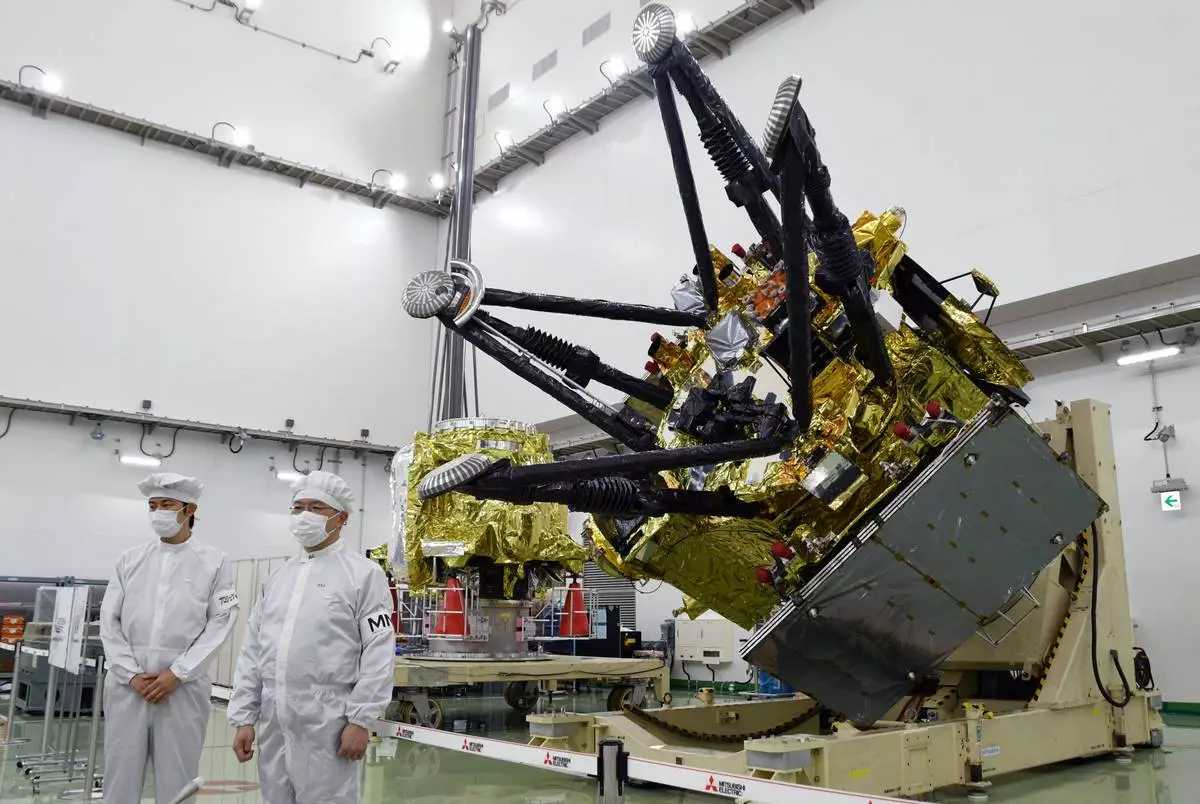
The Japan Aerospace Exploration Agency unveils a spacecraft for its Martian Moons eXploration mission at the Tanegashima Space Center in Minamitane, southwestern Japan, Aug. 13, 2026. (Yuika Kawazoe/Kyodo News via AP)

The Japan Aerospace Exploration Agency unveils a spacecraft for its Martian Moons eXploration mission at the Tanegashima Space Center in Minamitane, southwestern Japan, Aug. 13, 2026. (Yuika Kawazoe/Kyodo News via AP)

This photo provided by NASA/JPL-Caltech/University of Arizona, taken with NASA's Mars Reconnaissance Orbiter, shows Phobos, one of Mars' moons, on March 23, 2008. (NASA/JPL-Caltech/University of Arizona via AP)

This photo provided by NASA/JPL-Caltech/University of Arizona, taken with NASA's Mars Reconnaissance Orbiter, shows Phobos, one of Mars' moons, on March 23, 2008. (NASA/JPL-Caltech/University of Arizona via AP)

Recommended Articles