China is accelerating the construction of three national highways that will be linked end-to-end during the 15th Five-Year Plan period (2026-2030) to form the "golden outer ring," an ultra-long loop skirting the country's borders and coastline.
Stretching from Dandong City in northeast China's Liaoning Province to Dongxing City in south China's Guangxi Zhuang Autonomous Region, National Highway 228, spanning approximately 7,400 kilometers, is rapidly nearing full connectivity.
The route links 10 coastal provinces, autonomous regions, and municipalities, creating a seamless corridor between major coastal hubs.
The Donggang grand bridge, a key project along a section of National Highway 228 in east China's Fuijan Province, is currently being paved with asphalt on its deck, marking the final sprint toward completion. "The Donggang grand bridge will close the critical bay gap along the Fujian section of the G228 National Highway. Vehicles will no longer need to make a 10-kilometer detour. This development will help establish a half-hour travel circle integrating Fuqing City, Fuzhou Binhai New City, downtown Fuzhou, and Pingtan County, thereby accelerating the efficient flow of people and goods," said Zhong Yongfeng, deputy director of the chief engineer's office at Fujian Highway Development Center.
Another part of the loop, National Highway 219, stretched approximately 10,000 kilometers westward from Dongxing to Kanas in northwest China's Xinjiang Uygur Autonomous Region, and traverses the four provincial-level regions of Xinjiang, Tibet, Yunnan, and Guangxi, making it one of the highest-altitude highways in the world.
In the northern part of the country, National Highway 331, which is about 9,200 kilometers long, crosses the six provincial-level regions -- Inner Mongolia, Gansu, Xinjiang and the three northeastern provinces of Heilongjiang, Jilin, and Liaoning.
"'Connecting frontiers and reaching the seas' serves as a concise summary of the transport function of the 'golden outer ring.' It breaks away from the previous road network pattern, characterized by isolated, often dead-end routes along the borders and coasts, and achieves an upgrade from unidirectional, terminal-end paths to a circular network, establishing a major transport artery that fosters the coordinated development of border and coastal regions," said Liu Dong, deputy director general of the Department of Comprehensive Planning at the Ministry of Transport.
During the 15th Five-Year Plan period, the construction and renovation of the "golden outer ring" is expected to cover 7,400 kilometers of roadways, with an investment of about 370 billion yuan (about 55.30 billion U.S. dollars).
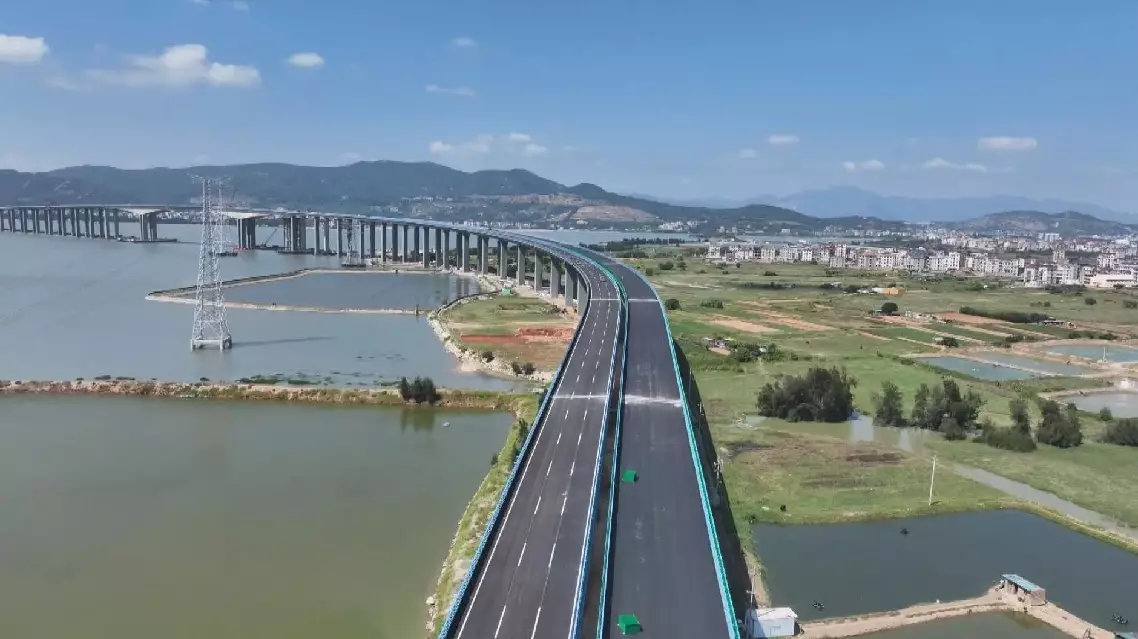
China speeds up construction of national loop highway